The Reader Enters the Machine
Games, Simulations and Procedural Storytelling
1. The Village That Remembered What You Did
The village was burning when Mara arrived.
Smoke drifted across the narrow streets. Someone was shouting from the bell tower, and the sound of breaking glass came from the market square.
At the northern gate, a soldier had abandoned his post.
Beyond the gate stood a small stone bridge crossing a river swollen by rain.
Mara had three immediate possibilities.
She could help the villagers extinguish the fire.
She could cross the bridge and pursue the attackers.
Or she could climb the bell tower and signal for assistance.
A conventional author might select one of these actions and describe its consequences.
An interactive-fiction author might write three passages, allowing the reader to choose which one appeared next.
But imagine a different system.
The fire is simulated.
It spreads according to rules.
The villagers have individual needs and relationships.
The river rises as the storm continues.
The attackers move through the surrounding countryside.
The signal tower can summon assistance, but only if someone reaches it before the flames spread.
Whatever Mara chooses, the other processes continue.
If she pursues the attackers, the fire may destroy the market.
If she fights the fire, the attackers may escape.
If she signals for help, the bridge may collapse before reinforcements arrive.
None of these outcomes needs to be written as a complete scene in advance.
Instead, the author can create rules describing how the fictional world behaves.
The computer applies those rules.
Events emerge from their interaction.
When Mara returns to the village, she may discover that the blacksmith has died, the market has been abandoned and a family she once helped has taken refuge in the church.
The village remembers her decisions.
But it also remembers things she did not personally witness.
This example is invented for the chapter. Mara's village is not a description of a particular published game.
It demonstrates a significant development in computational literature.
The reader is no longer simply moving between passages.
The reader is participating in a simulated world.
The world possesses state, processes and relationships that may continue changing independently of the reader's immediate attention.
The story becomes something that emerges from the interaction between rules, characters, events and player decisions.
This is the world of procedural storytelling.
And it raises a question that would have seemed strange to many earlier novelists.
Can an author create a story without deciding everything that happens in it?
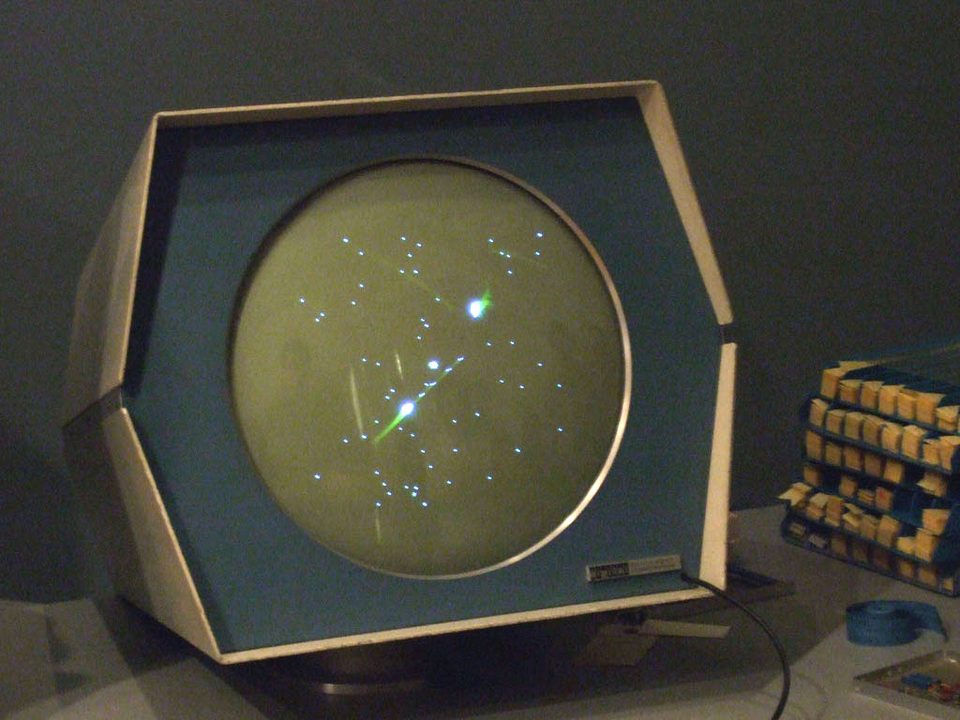
Spacewar! displayed on a PDP-1, photographed in 2007. Credit: Kenneth Lu. Source. CC BY 2.0. Resized; no crop.

2. From a Network of Pages to a World of Rules
In Chapter Eleven, we explored hypertext fiction.
A hypertext story can be represented as a network of passages connected by links.
The reader selects a link.
The system presents another passage.
The order of reading may vary, but the passages themselves are generally written in advance.
A simulation takes a different approach.
Instead of storing only passages and connections, the computer maintains a model of some fictional environment.
The model may contain rooms, objects, characters, locations, resources, relationships and events.
It also contains rules that determine how these things can change.
Consider a simple room containing a door, a key and a prisoner.
We might record:
world = {
    "has_key": False,
    "door_locked": True,
    "prisoner_free": False
}
The program can then define actions that modify this information.
Taking the key changes has_key.
Unlocking the door changes door_locked.
Freeing the prisoner changes prisoner_free.
The important feature is that the program describes the current condition of the world, not simply the next passage in a sequence.
The state-transition model
We can describe the process mathematically:
S(t + 1)=F(S(t),A(t),E(t))
Here:
- S(t) is the world's current state.
- A(t) represents an action taken by the player.
- E(t) represents other events or environmental changes.
- F is the collection of rules governing the world.
- S(t + 1) is the resulting state.
In an ordinary branching story, the reader might choose passage B instead of passage C.
In a simulation, the reader's action can change several aspects of the world simultaneously.
Opening a gate might release a prisoner.
It might also allow an enemy to enter.
It might change the attitude of a guard.
And it might make a previously inaccessible location available.
These consequences are connected through the rules of the simulation.
A model is not reality
We should be precise about what a simulated world actually contains.
It does not contain a complete miniature reality.
It contains selected representations of things the designer considers important.
A game may model food supplies without modelling individual digestive processes.
It may represent a character's friendship using a number.
It may describe a storm through a timer rather than calculating atmospheric physics.
Every simulation simplifies.
The designer decides which properties matter and which can be ignored.
Those decisions influence which stories can emerge.
A world that models warfare in great detail but barely represents friendship will tend to produce certain kinds of stories more readily than others.
The simulation's apparent freedom exists inside the author's chosen model.
3. The Difference Between a Script and a Procedure
Suppose a novelist wants a bridge to collapse.
They can write:
As Mara crossed the river, the bridge shuddered beneath her. The central arch broke, and the stones disappeared into the water.
The event is fixed.
It happens because the author has placed it in the story.
A game designer could produce a similar effect through a scripted sequence.
When the player reaches a particular location, the program triggers a predetermined collapse.
But a procedural system might work differently.
Perhaps the bridge has a structural integrity value.
Heavy traffic reduces that value.
Floodwater causes additional damage.
Repairing the bridge restores some integrity.
When integrity reaches zero, the bridge collapses.
Now the collapse does not depend upon one predetermined dramatic moment.
It depends on the state of the simulation.
Different kinds of causation
The distinction is between scripted causation and procedural causation.
In a scripted sequence, the designer explicitly specifies the event and its trigger.
In a procedural simulation, an event can arise from interactions among more general rules.
A bridge might collapse because of flooding.
Or because a heavily loaded wagon crosses it.
Or because the player neglected maintenance.
Or because several individually harmless events happened together.
The author may have anticipated the possibility of collapse without writing every particular sequence leading to it.
This is one meaning of emergent narrative.
A story-like event emerges from the interaction of systems rather than from a fully predetermined plot.
A useful limitation
Not every event produced by a simulation is a story.
A calculation that reduces a bridge's integrity from 70 to 65 is a state change.
It may have no particular dramatic significance.
But if Mara is crossing the bridge while carrying medicine needed by a sick child, that same calculation may become part of a suspenseful narrative.
The difference depends upon context, stakes and interpretation.
Computer rules can create circumstances.
Literary meaning depends upon how those circumstances are represented and understood.
4. Dwarf Fortress and the History Nobody Wrote
One of the most extraordinary examples of procedural world-building is Dwarf Fortress.
Developed by brothers Tarn and Zach Adams, the game first became publicly available in 2006.
It creates elaborate fantasy worlds containing geography, civilisations, creatures, settlements, histories and interacting systems.
Players may establish and manage a dwarven settlement, attempting to provide food, shelter, security and resources while confronting threats and unexpected disasters.
The game's historical significance has been recognised by the Electronic Literature Organization, which included it in the third volume of the Electronic Literature Collection.
A world with a history
Unlike a conventional game in which every significant historical event is written in advance, Dwarf Fortress can generate histories through computational procedures.
The resulting world contains relationships and conflicts that provide context for the player's experience.
A settlement may encounter dangers associated with its environment.
A character may develop a history through interactions with others.
Events can accumulate into circumstances that feel like the consequences of a living world.
The simulation's complexity makes it particularly capable of producing unexpected combinations.
A relatively ordinary problem with food supplies can become serious when combined with another emergency.
A defensive construction intended to protect a settlement may cause an unforeseen difficulty.
An individual character's actions may influence a wider chain of events.
Not every outcome is dramatic.
Some are mundane.
Some are absurd.
Others become memorable because several systems interact in an unexpected way.
The stories players tell
An important feature of Dwarf Fortress is the relationship between simulated events and the stories players construct about them.
A game may record that a worker became trapped in a flooded chamber.
The player remembers that the worker had recently completed an important construction project.
Perhaps another character attempted a rescue.
Perhaps the flooding was caused by a poorly designed channel.
The player connects these events into a narrative.
The simulation provides the circumstances.
The player supplies interpretation, emphasis and often retrospective explanation.
This is one reason accounts of Dwarf Fortress can resemble chronicles of fictional civilisations.
The underlying software produces states and events.
Human observers turn selected events into stories.
The limits of emergence
It would be misleading to say that every narrative arising from Dwarf Fortress is entirely independent of its creators.
The Adams brothers designed the systems, rules, categories and many of the textual descriptions.
The possible events are shaped by that design.
The player also makes decisions that influence the outcome.
And the eventual account often involves human storytelling choices.
The resulting narrative is therefore a product of several layers of authorship and interpretation.
The computer is not simply writing a conventional novel without human involvement.
It is simulating an environment rich enough to support many possible stories.
5. The Characters Who Behave Like People
A simulated world becomes more compelling when its inhabitants appear to possess motives.
Imagine a village containing three characters.
Anika wants to protect her family.
Bren wants to become mayor.
Celia distrusts Bren because of an earlier dispute.
Suppose the player asks Bren for assistance.
The result may depend on several factors.
Does Bren like the player?
Would helping improve his reputation?
Would the action anger Anika?
Could it damage his political ambitions?
A system could represent these relationships through variables and rules.
For example, Bren might possess:
bren = {
    "trust_player": 3,
    "ambition": 8,
    "fears_anika": False
}
The exact numbers are fictional teaching values, not a scientifically validated model of personality.
A designer might use such information to influence which actions Bren chooses.
Behaviour is not consciousness
This is an important distinction.
A simulated character can behave consistently without possessing subjective experience.
It may appear loyal because its programmed loyalty value is high.
It may appear frightened because a threat condition has been triggered.
It may appear compassionate because its rules favour helping vulnerable characters.
These behaviours can support convincing fiction.
But they do not prove that the character actually feels loyalty, fear or compassion.
We encountered this distinction in Chapter Three, when examining artificial personality and consciousness.
For narrative purposes, the central question is often not whether the character is conscious.
It is whether its behaviour is understandable, consistent and dramatically interesting.
The problem of believable behaviour
A character who always follows one simple rule may quickly become predictable.
Suppose Bren always accepts any request when his trust value is greater than five.
A player may discover the rule and exploit it.
The character ceases to feel like a person and begins to resemble a switch.
More sophisticated simulations may consider multiple goals, memories, relationships and environmental conditions.
But greater complexity is not automatically better.
A character whose decisions cannot be understood may appear random rather than believable.
The designer must balance complexity with intelligibility.
A fictional character should surprise us occasionally.
But if every action is inexplicable, readers may struggle to recognise a coherent personality.
The challenge is to create behaviour that feels both responsive and meaningful.
6. Façade: A Marriage Under Computer Control
In 2005, Michael Mateas and Andrew Stern released Façade.
The work was developed as an experiment in interactive drama, combining artificial intelligence techniques, character behaviour, natural-language input and dramatic structure.
The player visits the apartment of Grace and Trip, a married couple whose relationship is deteriorating.
What begins as a social visit develops into an emotionally uncomfortable confrontation.
The player can move through the apartment, interact with objects and type conversational responses.
Grace and Trip respond through a combination of authored dialogue and computational systems.
The creators described the project as an attempt to move beyond traditional branching narratives towards a more responsive dramatic experience.
Their 2005 research paper explains how the system combined character behaviour with larger dramatic structures.
Characters and drama managers
One of the central difficulties in interactive drama is maintaining a coherent dramatic structure while allowing the player to act.
If every character simply follows local rules, the result may be realistic in small details but dramatically shapeless.
Characters might argue indefinitely.
Important revelations might never occur.
The player might accidentally disrupt a scene before its essential information becomes clear.
Façade addressed this problem partly through a drama manager.
A drama manager coordinates higher-level narrative structure while individual characters respond to the player.
It can influence which dramatic situations become active and how the experience progresses.
This creates a compromise between authored drama and procedural responsiveness.
The player has meaningful opportunities to intervene.
The characters possess programmed behavioural patterns.
But the system also attempts to maintain an overall dramatic trajectory.
The illusion of natural conversation
A player can type ordinary language, but that does not mean the system understands human conversation in the full sense.
Its language-processing capabilities are limited by its implementation.
It may recognise some intentions and fail to recognise others.
Its responses can be strikingly appropriate or awkwardly misplaced.
This is not evidence that the characters possess human-level understanding.
It is evidence that carefully designed computational techniques can support a particular kind of interactive dramatic experience.
The distinction matters because the apparent naturalness of fictional characters can conceal the substantial authoring and engineering work beneath them.
The significance of Façade
Façade demonstrates that interactive narrative need not be built primarily around spatial exploration, combat or puzzle-solving.
Its central activity is a social encounter.
The player influences a relationship.
The drama emerges through dialogue, timing and emotional conflict.
This expands the idea of what a simulated literary world can contain.
A world need not be geographically enormous to be narratively complex.
A single apartment can support substantial interaction if its characters and relationships are sufficiently developed.
7. Prom Week and the Rules of Social Life
Another important experiment is Prom Week.
Developed by researchers associated with the University of California, Santa Cruz, Prom Week explores a world of students whose relationships, friendships, rivalries and social ambitions change through interaction.
The project uses a social artificial intelligence system called Comme il Faut, often abbreviated to CiF.
Rather than treating every social interaction as a separate scripted scene, the system represents relationships and social conditions through rules.
Players influence the social world by selecting interactions that affect characters' relationships and circumstances.
The creators’ 2013 paper explains how CiF makes social relationships playable through encoded social rules.
A story made from relationships
Consider two fictional characters.
Alice wants to invite Ben to a dance.
Ben is friends with Claire.
Claire dislikes Alice.
A conventional story might describe a carefully planned sequence of conversations leading to an invitation or rejection.
A social simulation could instead model relationships.
Alice and Ben might have a friendship score.
Claire might influence Ben's opinions.
A previous argument could create a negative social condition.
The program could then determine which interactions are available and how likely they are to succeed.
The resulting story emerges through changes in the social network.
Social rules are not human psychology
Such systems should not be mistaken for complete models of human relationships.
A friendship value of seven does not capture everything involved in friendship.
Jealousy cannot be reduced to one universal numerical formula.
Human social behaviour depends upon culture, personal history, uncertainty and context.
But simplified models can still support meaningful interactive experiences.
They provide enough structure for actions to have consequences.
The reader or player can recognise patterns of friendship, betrayal, embarrassment and reconciliation.
The program models relationships.
The player interprets them as social drama.
This illustrates an important principle of procedural storytelling.
A system need not reproduce every detail of reality to create situations that readers understand as meaningful.
8. When the Player Becomes a Storyteller
Imagine playing a simulation in which a settlement is threatened by flooding.
You decide to reinforce the northern embankment.
The work consumes resources intended for repairing a bridge.
Several days later, a merchant cannot deliver medicine because the bridge is unsafe.
The settlement suffers a shortage.
You remember that your decision to reinforce the embankment contributed indirectly to the problem.
The game may never explicitly state that you have created a tragedy.
Nevertheless, you recognise a causal chain.
Your decisions have produced consequences.
You can tell a story about what happened.
Emergent narrative and retrospective interpretation
This is sometimes called retrospective storytelling.
A sequence of simulated events becomes a coherent narrative when an observer selects and interprets them.
The process resembles the way people recount real experiences.
Ordinary life does not arrive organised into chapters.
Events happen.
Later, we decide which events matter, how they are connected and what they reveal.
A simulation can support a similar process.
The player experiences events and constructs an account of them.
But the simulation does not necessarily contain an explicit narrative interpretation.
It may simply record that a bridge remained unrepaired and a delivery failed.
The tragic significance arises when the player connects those facts with the settlement's needs.
Authorship becomes distributed
Several participants contribute to the resulting account.
The designer creates the rules.
The player makes decisions.
The computer applies the rules and records state changes.
The observer selects which events to remember and describe.
These roles are not identical, but they interact.
A player can produce an unusual sequence without having designed the system.
A designer can create a system that produces surprising outcomes without choosing each one.
A reader may find literary significance in an event that neither designer nor player anticipated.
This complicates traditional ideas of authorship.
The experience is not simply written by the computer.
Nor is it wholly authored by the player.
It emerges from a designed environment and the actions performed within it.
9. The Difference Between a Game and a Story
Games and stories overlap, but they are not identical.
A story generally organises events into a meaningful experience.
A game establishes rules within which participants pursue goals, make decisions or explore possibilities.
Some games contain extensive narratives.
Others possess little or no narrative content.
Chess, for example, has rules, conflict and outcomes.
A particular match can be described dramatically.
But the rules of chess do not automatically supply characters, motives or a fictional world.
Conversely, a novel can depict conflict without giving the reader any ability to influence the outcome.
The relationship between games and narrative has therefore been a major subject of game studies.
Chris Crawford's The Art of Computer Game Design, originally written in 1982, is an important early discussion of games as interactive systems.
Rules and representation
Consider a rule:
If the bridge's integrity falls to zero, the bridge becomes unusable.
The rule is computational.
But its representation can vary.
In one game, the collapse is shown through animation.
In another, the computer prints a sentence.
In a third, a map changes colour.
The same underlying state transition can support different experiences.
Literary representation supplies context and significance.
A bridge collapsing in an empty landscape may be unremarkable.
The same collapse while refugees are attempting to escape becomes dramatic.
The rule establishes what happens.
The narrative context helps establish why it matters.
The problem of optimisation
Players often approach games by seeking effective strategies.
They learn the rules.
They discover which actions produce desirable results.
They may begin treating characters as resources and relationships as numerical systems.
This creates a tension.
A designer may intend a situation to evoke sympathy.
A player may instead calculate the most efficient outcome.
For example, a game might represent rescuing villagers as costly but morally admirable.
If the reward system consistently favours abandoning them, some players may learn to ignore the intended moral theme.
The game's mechanics and its narrative message can conflict.
A successful procedural story should consider that relationship.
Its rules should support, complicate or deliberately challenge the experience it asks readers to have.
10. The Author Who Cannot Predict Everything
A traditional novelist generally knows the major events of the finished novel.
Even if characters appear to develop unexpectedly during composition, the published text establishes a particular sequence.
A simulation designer faces a different problem.
The rules may produce combinations that were never individually anticipated.
This is especially true when several systems interact.
Suppose a fictional settlement contains rules for weather, farming, trade, health and transportation.
A storm damages crops.
Food prices rise.
A merchant redirects supplies.
A hospital experiences shortages.
A sick character cannot obtain treatment.
None of these events needs to have been written as one predetermined tragic plot.
The outcome emerges from the interaction of several systems.
Complexity grows through interaction
If a simulation contains n independent properties, each with k possible values, its theoretical state space can contain as many as:
kⁿ
combinations.
For example, five independent properties with three possible values each allow:
3⁵ = 243
combinations.
This simple calculation assumes that every combination is permitted and that the properties are independent.
Real simulations may contain constraints that make some states impossible.
Nevertheless, the principle illustrates how quickly complexity can grow.
A small number of variables can produce many distinct situations.
When rules connect those variables, the designer may find it difficult to anticipate every consequence.
Emergence is not magic
Unexpected behaviour does not imply that a system has escaped its computational rules.
A deterministic simulation can produce surprising results because its state space is large and its interactions are complicated.
The rules remain in effect.
The designer's knowledge of all possible outcomes is incomplete.
This distinction is important.
A program can generate unexpected events without possessing consciousness or independent artistic intentions.
The surprise may arise from the complexity of interactions.
But those events can still become meaningful to players.
The fictional world may produce something that feels like an unscripted story.
11. A Small Procedural World
We can demonstrate these ideas with a finite Python simulation.
Our fictional setting is a watchtower beside a damaged bridge.
A traveller is trapped on the far side.
A storm is approaching.
The player has three actions available:
REPAIR repairs the bridge.
SIGNAL activates a warning beacon.
CROSS attempts to bring the traveller to safety.
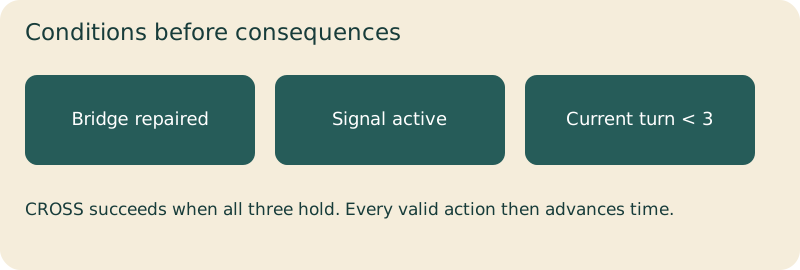
The traveller can be rescued only if the bridge has been repaired, the signal has been activated and the crossing begins before the storm reaches its dangerous stage.
The storm becomes dangerous at turn three.
Every action takes one turn.
This is an invented teaching example, not a reconstruction of any historical game.
Enable JavaScript to use this experiment. The chapter text remains readable.
The program
world = {
    "bridge_repaired": False,
    "signal_active": False,
    "traveller_safe": False,
    "turn": 0
}

def act(command):
    if command == "REPAIR":
        world["bridge_repaired"] = True
    elif command == "SIGNAL":
        world["signal_active"] = True
    elif command == "CROSS":
        if (world["bridge_repaired"] and world["signal_active"]
                and world["turn"] < 3):
            world["traveller_safe"] = True
    else:
        return "INVALID ACTION"
    world["turn"] += 1
    return "ACTION COMPLETE"

actions = ["REPAIR", "SIGNAL", "CROSS"]
for command in actions:
    act(command)
print("Bridge repaired:", world["bridge_repaired"])
print("Signal active:", world["signal_active"])
print("Traveller safe:", world["traveller_safe"])
print("Turn:", world["turn"])
Exact output
Bridge repaired: True
Signal active: True
Traveller safe: True
Turn: 3
The rescue succeeds because the crossing is attempted when the turn counter is 2.
After the crossing, time advances to turn 3.
Trace of the simulated world
| Stage | Bridge repaired | Signal active | Traveller safe | Turn |
| Initial | False | False | False | 0 |
After REPAIR | True | False | False | 1 |
After SIGNAL | True | True | False | 2 |
After CROSS | True | True | True | 3 |
The program does not contain a prewritten rescue story.
It contains a world state and rules.
A successful rescue emerges when the appropriate conditions are satisfied.
What happens in a different order?
Suppose we change the action sequence to:
actions = ["CROSS", "REPAIR", "SIGNAL"]With the world reset to its original state, the first crossing fails.
The bridge has not been repaired.
The signal is inactive.
The later actions repair the bridge and activate the signal, but there is no second crossing attempt.
The final state becomes:
Bridge repaired: True
Signal active: True
Traveller safe: False
Turn: 3
The same actions occur.
Their order changes.
The resulting story is different.
This is procedural causation.
The outcome depends on the interaction between action, state and timing.
12. The Story Is What Happens
Let us return to Mara's burning village.
She could have crossed the bridge.
She could have fought the fire.
She could have climbed the tower and summoned help.
A conventional novelist would choose which sequence to tell.
A branching author might write several alternative sequences.
A simulation designer might instead create interacting rules for fire, weather, movement, resources and characters.
The computer would apply those rules.
The player would act within them.
And the resulting events could form a story that nobody had individually scripted.
But there is an important qualification.
The system does not automatically understand the meaning of those events.
It knows which values changed.
It may know that the bridge collapsed, the market burned and a traveller escaped.
It does not necessarily understand grief, responsibility or courage.
A player or reader may recognise those qualities in what happened.
A writer may provide descriptions that make them emotionally compelling.
The literary effect emerges through representation and interpretation as well as computation.
This is the fundamental achievement of procedural storytelling.
It allows an author to create not merely a sequence of events, but a system capable of producing events.
What the executable book has become
Across Part III, we have witnessed three important changes.
Raymond Queneau constructed a physical book containing an enormous space of possible poems.
Early computer writers such as Christopher Strachey and Theo Lutz transferred combinatorial selection into electronic computation.
Hypertext and interactive-fiction authors created networks of passages through which readers could navigate.
Now, procedural simulations extend the process further.
The reader can enter a world whose rules generate consequences.
The literary work may consist partly of the system rather than solely of any particular text it produces.
The author designs possibilities.
The player performs actions.
The computer maintains the fictional world.
The resulting experience can be interpreted as narrative.
This does not mean that traditional storytelling has been superseded.
A carefully composed novel can achieve effects that a procedural system may struggle to reproduce.
The precise placement of a sentence, the timing of a revelation and the rhythm of a chapter remain powerful artistic techniques.
Procedural storytelling offers something different.
It allows events to acquire significance through participation.
The reader may feel responsible for an outcome because their decisions helped produce it.
They may encounter an unforeseen tragedy.
They may discover an unexpected relationship.
They may construct a story through exploration rather than simply receiving one through narration.
The machine no longer merely displays the story. It maintains a world in which stories can happen.
That is the final transformation of the executable book.
And it prepares us for the most controversial development yet.
What happens when the machine is no longer restricted to choosing from a small vocabulary, navigating fixed passages or applying explicitly written world rules?
What happens when it can generate new language in response to almost any request?
The reader has entered the machine.
In the next part of our study, the machine begins writing back.
Questions to Take Away
- What distinguishes a simulated fictional world from a branching network of passages?
- Why can a sequence of computational state changes become meaningful as a story, even when the program does not explicitly interpret them?
- How does Dwarf Fortress demonstrate the possibility of emergent narrative?
- Why is the distinction between simulated behaviour and subjective consciousness important when discussing artificial characters?
- How does Façade attempt to balance responsive character behaviour with coherent dramatic structure?
- What does Prom Week demonstrate about using social relationships as the basis of interactive storytelling?
- Can a player become an author through their actions within a simulation? How does their contribution differ from that of the system's designer?
- Why might a simulation with many interacting rules produce unexpected outcomes without possessing independent creative intentions?
- What happens when a game's reward system encourages behaviour that conflicts with its apparent moral message?
- Is the story contained in the simulation's rules, the sequence of events produced during play or the player's interpretation of those events?
A Small Reader Experiment: Rewrite the Rescue
Return to the watchtower simulation in Section 11.
The original action sequence was:
actions = ["REPAIR", "SIGNAL", "CROSS"]It produced a successful rescue.
Your task is to explore how different decisions change the outcome.
Step 1: Predict the outcome
Reset the world and use:
actions = ["SIGNAL", "CROSS", "REPAIR"]Will the traveller be rescued?
Before examining the result, consider the conditions required for a successful crossing.
Step 2: Trace the result
| Stage | Bridge repaired | Signal active | Traveller safe | Turn |
| Initial | False | False | False | 0 |
After SIGNAL | False | True | False | 1 |
After CROSS | False | True | False | 2 |
After REPAIR | True | True | False | 3 |
The crossing fails because the bridge has not been repaired.
The later repair does not reverse the failed attempt.
The traveller remains in danger.
Step 3: Change the rules
Suppose the traveller can cross safely without the signal, provided the bridge has been repaired.
Remove the requirement that signal_active must be true.
Now test:
actions = ["REPAIR", "CROSS", "SIGNAL"]The crossing begins at turn 1.
The bridge is repaired.
The traveller is rescued.
The final state is:
Bridge repaired: True
Signal active: True
Traveller safe: True
Turn: 3
Step 4: Write the story
Describe the two outcomes in prose.
In the first, Mara signals for help before attempting the crossing, but the damaged bridge prevents the rescue.
In the second, she repairs the bridge and brings the traveller to safety.
Both accounts arise from the same fictional environment.
The difference lies in the actions and rules.
Step 5: Add a moral complication
Imagine that repairing the bridge consumes materials needed to protect the nearby village from flooding.
The program would now need another state variable representing village safety.
Rescuing the traveller could create a risk for others.
The situation becomes more interesting because the best action is no longer obvious.
A simple rescue problem has become a conflict between competing responsibilities.
What this experiment demonstrates: Procedural storytelling creates narrative possibilities through interacting rules. Changing an action, its timing or the rules themselves can produce a different sequence of events without requiring the author to script every outcome.
Further Reading
Procedural Worlds
Tarn Adams and Zach Adams — Dwarf Fortress (2006 onward)
A pioneering fantasy simulation whose generated worlds, character histories and interacting systems support emergent narratives.
Electronic Literature Organization — Dwarf Fortress
Bay 12 Games — Official developer website
Interactive Drama
Michael Mateas and Andrew Stern — Façade (2005)
An interactive drama exploring artificial characters, natural-language interaction and the coordination of procedural behaviour with authored dramatic structure.
Original research paper — Structuring Content in the Façade Interactive Drama Architecture
Electronic Literature Organization — Façade
Michael Mateas and Andrew Stern — Build It to Understand It (2005)
An original research paper examining the relationship between game design and narrative theory through the development of Façade.
DiGRA Digital Library — Original paper
Social Simulation
Josh McCoy and collaborators — Prom Week
A research project exploring social simulation, relationships and emergent dramatic situations.
Prom Week — Official project website
Prom Week — Creators’ 2013 research paper
Foundations of Game Design
Chris Crawford — The Art of Computer Game Design (1982)
An influential early examination of computer games as systems of rules, interaction and meaningful player decisions.
Read the original book — Authorised electronic edition
Emily Short — Galatea (2000)
An interactive-fiction work in which conversational interaction with a single character becomes central to the narrative experience.
Electronic Literature Collection — Galatea
Together, these sources demonstrate several different approaches to procedural storytelling: simulated worlds, interactive drama, social systems and conversational characters.
They also show that procedural narrative is not one technique. It is a family of approaches connecting authored rules, computational behaviour and human interpretation.
Up Next — The Machine That Writes Back
Part IV — The Future of the Word
Artificial Intelligence, Creativity and the New Literary Conversation
We have reached a turning point.
The literary machines encountered so far have followed procedures defined by their authors.
They selected words from prepared collections.
They assembled sentences according to grammatical templates.
They connected passages through hyperlinks.
They simulated worlds through programmed rules.
But modern artificial intelligence introduces a different possibility.
A system can respond to language by generating new language.
It can continue a story, imitate a genre, propose a character, explain a metaphor or revise a paragraph.
Its output is not restricted to a small, explicitly authored list of possible sentences.
Instead, the system uses statistical patterns learned from extensive training data to generate sequences of tokens.
The result can resemble a conversation with another writer.
But this resemblance raises difficult questions.
Does generating convincing prose amount to understanding literature?
Can a machine possess a creative intention?
What happens when a human author collaborates with an artificial intelligence?
Who is responsible for the resulting work?
And does a story change when its sentences are produced by a system that may not understand them as a human writer does?
Chapter Thirteen will investigate the development of AI-generated language, the capabilities and limitations of modern language models and the emerging relationship between human authors and computational systems.
The central question is no longer merely whether a computer can produce a story.
What happens when the machine becomes a participant in the conversation through which the story is written?
Bay 12 Games — Implemented world features
Editorial note: These games have not been replayed for this edition. The developer descriptions and research records support the design discussion; the fictional examples are original teaching models.