The Machine That Writes Back
Artificial Intelligence, Creativity and the New Literary Conversation
1. The Author Who Met Her Replacement
The novelist had been working on the same paragraph for three hours.
Her protagonist, a woman named Elena, had returned to the house where her father died. She was standing in the hallway, holding a letter she had never opened.
The novelist knew what ought to happen.
Elena would discover that her father had concealed something important.
But every version of the scene seemed predictable.
The novelist opened a conversational artificial intelligence system and entered a request.
Continue this scene. Make the discovery emotionally devastating, but avoid an obvious family secret.
The machine produced three paragraphs.
They were fluent, atmospheric and carefully paced.
In the first, Elena discovered that her father had been protecting someone.
In the second, she discovered that the letter contained a description of an event that had not yet happened.
In the third, the letter was blank, but Elena recognised the handwriting on the envelope as her own.
The novelist considered the suggestions.
The first was too familiar.
The second belonged to a different kind of story.
The third was interesting.
She deleted the generated prose and began writing again.
This time, the letter was not blank. It contained a detailed account of Elena's childhood, written in her adult handwriting.
The scene finally began to work.
The novelist had not copied the machine's paragraph.
She had used its suggestion to discover a different possibility.
But as she continued writing, an uncomfortable question occurred to her.
Had she invented the idea?
Had the machine?
Or had the idea emerged from their interaction?
This scene is fictional. Elena and her novelist are inventions created for this chapter.
Nevertheless, the situation is now familiar to many writers.
A machine can generate prose in response to a request.
It can propose dialogue, describe settings, suggest plots, imitate broad genres and revise existing passages.
It can participate in a process that resembles literary collaboration.
But what does that resemblance actually establish?
Does the machine understand the story?
Does it possess creative intentions?
Can it recognise beauty, tragedy or irony?
And if a writer develops an idea suggested by artificial intelligence, where should we locate the creative achievement?
These questions bring our investigation into the present.
For twelve chapters, we have explored machines that calculate, encode, combine, execute and simulate.
Now we encounter machines capable of responding to language with new language.
The literary machine no longer merely follows a visible set of writing instructions. It appears to join the conversation about what should be written.
The word appears is important.
To understand why, we must examine how modern language models actually work.
An attendee typing on a laptop at WikiCamp Morocco, 2026. A contemporary setting for human participation in writing. Credit: DERDAKI ILIAS. Source. CC BY-SA 4.0. Wikimedia thumbnail; no further edits.

2. From Mechanical Love Letters to Language Models
In Chapter Ten, we encountered Christopher Strachey's love-letter generator of 1952.
Strachey's program selected romantic expressions from prepared collections and combined them according to rules.
The resulting letters could be amusing, extravagant or unexpectedly suggestive.
But the system was limited by its vocabulary and templates.
The programmer could inspect the possible components and understand much of the mechanism.
A modern large language model operates differently.
Rather than selecting only from a small collection of explicitly written phrases, it learns statistical patterns through training on large quantities of data.
Its training process adjusts numerical parameters so that the model becomes better at predicting or generating sequences.
A trained language model may then produce responses to prompts it has never encountered in exactly that form.
This represents a substantial change in capability.
But the historical development was gradual.
The conversational illusion
In 1966, Joseph Weizenbaum published a description of ELIZA, a computer program capable of conducting limited conversations.
One famous ELIZA script imitated aspects of a nondirective psychotherapist's conversational style.
The program recognised keywords and used decomposition and reassembly rules to construct responses.
For example, a statement about the user's family might trigger a question encouraging further discussion.
ELIZA did not employ modern neural language modelling.
Its conversational behaviour arose from explicit rules and text transformations.
Nevertheless, some users attributed considerably more understanding to the system than its implementation justified.
Weizenbaum's original paper described both the technical mechanisms and the psychological questions raised by such interactions.
The lesson remains relevant.
Human beings are remarkably willing to interpret conversational fluency as evidence of an inner mind.
A computer that responds appropriately to emotional language may appear sympathetic.
A system that remembers details of a conversation may appear attentive.
A system that offers thoughtful criticism may appear intellectually engaged.
Yet conversational behaviour, however sophisticated, does not by itself settle questions about subjective experience.
From rules to learned patterns
Early conversational programs relied heavily on explicit patterns.
Modern neural language models learn vast numbers of numerical relationships during training.
These relationships are distributed across model parameters rather than represented exclusively as hand-written grammatical templates.
The model can generalise beyond examples supplied directly by a programmer.
It may combine concepts, generate explanations and respond to unfamiliar requests.
But the ability to produce appropriate language should be distinguished from possessing human intentions or experiences.
That distinction will accompany us throughout this chapter.
3. The Machine That Predicts the Next Word
Imagine seeing this unfinished sentence:
The detective opened the locked...
What word might come next?
Perhaps door.
Perhaps cabinet.
Perhaps drawer.
Your expectations are influenced by your knowledge of language and stories.
The adjective locked makes certain nouns more likely.
The presence of a detective suggests mysteries, rooms, keys and hidden objects.
A language model performs a mathematically related task, although through a different mechanism from human reading.
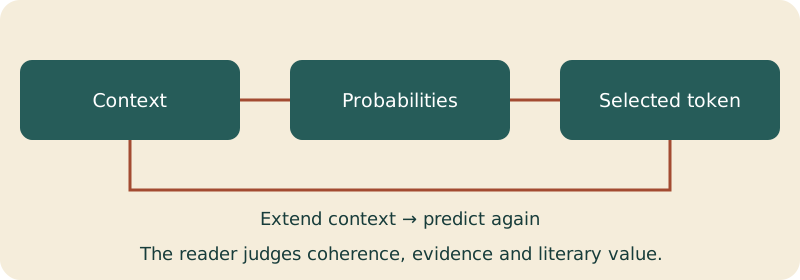
It estimates probabilities for possible next tokens based on the preceding context.
A token is a unit used by the model's text-processing system.
It might correspond to a word, part of a word, punctuation or another character sequence.
A simplified next-token model estimates:
P(next token | preceding tokens)
This means:
The probability of the next token, given the tokens that came before it.
The model does not normally generate an entire novel in one indivisible operation.
In autoregressive generation, it produces a token, adds that token to the context and uses the extended sequence to predict what may follow.
The process repeats.
An illustrative probability table
Suppose our fictional model assigns these probabilities after the phrase:
The detective opened the locked...
| Possible next token | Illustrative probability |
| door | 0.50 |
| cabinet | 0.25 |
| drawer | 0.15 |
| box | 0.10 |
These numbers are invented for teaching. They are not measurements from an actual language model.
The probabilities sum to one.
The model could always select the highest-probability option.
That would produce door.
Or a selection procedure could sometimes choose less probable alternatives.
This allows variation.
But variation is not the same as unrestricted creativity.
The model's possible outputs are influenced by its training, architecture, context and decoding procedure.
Why next-token prediction is powerful
Predicting language is more complicated than remembering which words commonly appear together.
To continue a passage effectively, a model may need to track characters, relationships, grammar, genre and information introduced many sentences earlier.
Consider:
Elena put the blue notebook inside the locked cabinet. Three chapters later, she returned to retrieve it.
A useful continuation must recognise that the notebook was placed inside the cabinet.
The model may maintain representations that help preserve such relationships.
Training for token prediction can therefore encourage the development of capabilities useful for reasoning about language and its context.
However, this does not establish that next-token prediction and human understanding are identical.
Nor does it mean that every generated continuation will preserve consistency.
A model may forget details, confuse characters or introduce contradictions.
The mechanism is powerful, but it is not infallible.
4. The Transformer and the Attention Revolution
A major development occurred in 2017, when Ashish Vaswani and seven collaborators published Attention Is All You Need.
The paper introduced the Transformer architecture.
It demonstrated that attention mechanisms could support highly effective sequence processing without relying on the recurrent or convolutional architectures that had dominated many earlier approaches.
The original research concerned machine translation and related sequence-processing tasks.
Transformers subsequently became foundational to many modern large language models.
What does attention mean?
Imagine reading a sentence:
The detective gave the notebook to Elena because she had asked for it.
To interpret the sentence, we must connect words appearing at different positions.
Who asked for the notebook?
What does it refer to?
A language model needs mechanisms for representing relationships among tokens.
Attention is one family of mechanisms that allows information from different positions in a sequence to influence the representation being computed.
The mathematical details are more elaborate than this description, but the central idea is accessible.
Instead of treating every preceding word as equally relevant, attention mechanisms can assign different weights to relationships among tokens.
This can help the model represent contextual dependencies.
Attention is not human attention
The technical term should not be interpreted too literally.
A Transformer attention mechanism is a mathematical operation.
It is not evidence that the model experiences concentration, curiosity or awareness.
The word attention is borrowed from ordinary language because it provides a useful analogy.
The mechanism calculates relationships.
It does not establish consciousness.
Why scale mattered
As researchers developed larger models, trained them on larger datasets and increased computational resources, language-generation capabilities improved substantially.
In 2020, OpenAI published research on GPT-3, a model with 175 billion parameters.
The paper demonstrated that a single pretrained model could perform a range of language tasks using instructions and examples supplied in its prompt, without task-specific parameter updates for each evaluation.
This was significant for literary writing.
Instead of requiring a separate generator with specially prepared vocabulary for every new genre, a general-purpose language model could respond to many different writing requests.
It could produce a detective scene, then revise dialogue, then explain a metaphor.
The human author could communicate through ordinary language rather than constructing a new program for each task.
This changed the relationship between programmer and literary machine.
The writer no longer needed to define every grammatical template.
They could describe an intention and ask the model to produce a possible realisation.
5. The Prompt as a New Literary Form
A prompt is an input supplied to a model.
It may contain a question, instruction, passage, example or combination of these.
For literary purposes, a prompt can function rather like a creative brief.
Consider:
Write a scene in which a detective discovers that her closest friend has been lying.
This establishes a situation.
But it leaves many questions unanswered.
Where does the scene take place?
What was the lie?
Why did the friend tell it?
How does the detective react?
A model must produce a particular continuation despite the missing details.
Now consider a more specific prompt:
Write a scene set in an abandoned railway station. A detective discovers that her closest friend concealed evidence to protect a stranger. The scene should be restrained, with the emotional conflict revealed through actions rather than explicit declarations.
This gives the model more constraints.
It specifies setting, situation, motivation and style.
The range of acceptable continuations becomes narrower.
Prompting and authorship
A prompt can make significant creative decisions.
It can establish genre, structure, character relationships and dramatic objectives.
But a prompt is not the same as a completed literary work.
The resulting text may contain choices the human did not explicitly specify.
Some may be interesting.
Others may be inappropriate.
The writer can accept, revise or reject them.
This creates several possible forms of collaboration.
A writer might use the model to explore alternatives before composing the prose independently.
Another might generate a draft and revise it extensively.
A third might use generated text with little alteration.
These workflows involve different kinds and degrees of human contribution.
It would be misleading to treat them as equivalent.
The danger of vague instructions
Suppose a writer requests:
Make this more literary.
What should the model do?
Add metaphors?
Lengthen sentences?
Use unusual vocabulary?
Increase ambiguity?
A human editor would also need to interpret the request.
But a model may respond by producing familiar signals of supposedly literary writing: elaborate descriptions, melancholy imagery or abstract reflections.
The result can become decorative rather than meaningful.
The useful question is not whether a paragraph sounds impressive.
It is whether its language serves the story.
A strong prompt can help establish the task, but evaluation remains necessary.
The prompt can direct the machine towards a literary objective. It does not guarantee that the resulting prose achieves that objective.
6. Does the Machine Understand What It Writes?
We now encounter the central philosophical difficulty.
A language model may describe grief convincingly.
It may explain a character's motivation.
It may identify an inconsistency in a plot.
It may propose a metaphor that readers consider moving.
Does this establish understanding?
The answer depends partly on how understanding is defined.
Understanding as successful performance
One approach evaluates behaviour.
If a system can answer questions, explain concepts and apply information appropriately, perhaps it possesses at least some functional understanding.
A model may demonstrate capabilities that go beyond simple memorisation.
It can apply patterns learned during training to unfamiliar tasks.
On this view, understanding need not require conscious experience.
It may involve the ability to represent and use relationships effectively.
Understanding as grounded meaning
Other researchers argue that fluent manipulation of linguistic form does not automatically provide access to meaning in the human sense.
In their 2020 paper Climbing towards NLU, Emily Bender and Alexander Koller examined the distinction between linguistic form and meaning.
They argued that success at predicting or processing text should not simply be equated with understanding the communicative intentions and real-world relationships through which language acquires meaning. ACL Anthology
This is an influential argument, not a universally accepted final resolution.
Subsequent research continues to investigate how learned representations relate to reasoning, perception, action and grounding.
The difference between knowledge and experience
Consider a model that produces a beautiful description of walking through snow.
It may correctly describe sound, light, cold and the sensation of snow beneath boots.
It may combine these details into vivid prose.
But generating such a description does not establish that the model has ever experienced cold.
Nor does it establish that subjective sensory experience is necessary for producing the description.
The human writer and the computational system may arrive at similar sentences through different processes.
The resulting text can be evaluated as writing.
The question of subjective experience remains separate.
This distinction should not diminish genuine technical accomplishments.
It prevents us from claiming more than the evidence supports.
A machine can produce meaningful text for readers without demonstrating that it experiences the meanings in the way humans do.
That possibility is remarkable enough without embellishment.
7. The Confident Inventor
Literary generation involves imagination.
A novelist may invent a city, a historical document or a scientist who never existed.
Within fiction, invention is expected.
But language models can also invent information when they are supposed to provide factual answers.
This creates a serious distinction between fictional creativity and factual reliability.
Suppose a writer asks a model:
Describe an imaginary seventeenth-century observatory built on the coast of Cornwall.
The model may invent architectural details, instruments and historical events.
That is appropriate if the work is clearly presented as fiction.
Now suppose the writer asks:
Identify the architect of a real seventeenth-century observatory.
A fabricated name would be an error.
The same fluency that supports creative writing can make factual inaccuracies appear convincing.
Confabulation
The US National Institute of Standards and Technology identifies confabulation as a risk associated with generative AI: the production of confidently stated false or erroneous content.
Its 2024 Generative AI Profile discusses this risk alongside concerns involving privacy, bias, information integrity and other consequences of deployment.
The problem is particularly important for historical fiction.
A writer may want accurate details about clothing, architecture, transport and language.
A model can produce plausible descriptions.
But plausible does not necessarily mean historically correct.
Fiction requires a different kind of truth
A fictional account need not be factually true.
But it should ordinarily remain consistent with the world it establishes.
Suppose a novel's first chapter establishes that a spaceship has no faster-than-light capability.
In chapter seven, the ship suddenly travels across the galaxy in minutes without explanation.
The problem is not that faster-than-light travel violates real physics.
The problem is that the fictional world has contradicted its own rules.
A language model can make this kind of mistake.
It may produce a locally convincing paragraph while losing track of earlier constraints.
The writer must therefore distinguish two forms of checking.
Factual verification asks whether claims about the real world are supported by evidence.
Continuity checking asks whether the fictional text remains consistent with its established characters, events and rules.
Both matter.
But they require different standards.
8. The Problem of the Average Story
A language model learns from patterns across its training data.
This can make it exceptionally capable of reproducing familiar literary structures.
It may recognise that detective stories often contain clues, suspects, revelations and reversals.
It may produce a plausible scene involving a suspicious conversation.
But familiarity can become a limitation.
If a system repeatedly selects conventional patterns, its writing may feel predictable.
A detective enters a darkened room.
The floorboards creak.
A forgotten photograph reveals a secret.
A stranger watches from the shadows.
None of these devices is inherently bad.
But their effectiveness depends on context and execution.
A story constructed entirely from familiar signals may resemble literature without achieving much individuality.
Prediction and originality
A next-token model assigns probabilities to possible continuations.
Higher-probability tokens often reflect familiar linguistic patterns.
Sampling from less probable alternatives may increase variation.
But selecting unusual words does not automatically produce originality.
Consider:
The refrigerator mourned the purple geometry of Tuesday.
The sentence is unexpected.
It may even be amusing.
But surprise alone does not make it meaningful.
A strong literary image usually establishes relationships that reward interpretation.
The unusual combination must contribute something to the work.
The writer as critic
This is where human judgement becomes especially important.
A writer can ask whether a generated image belongs in the story.
Does it reveal character?
Does it develop a theme?
Does it change how readers understand an event?
Or is it simply unusual?
The model can generate possibilities.
The writer evaluates them.
This resembles the relationship between Queneau's combinatorial system and its reader.
A machine can create an enormous space of possible arrangements.
But the number of possibilities does not establish their value.
The writer's task becomes partly editorial.
Not merely correcting grammar, but deciding what deserves to remain.
9. The Risk of Mistaking Fluency for Authority
Language models can explain ideas in confident, coherent prose.
That can be useful.
It can also mislead.
A system may produce an answer that sounds authoritative even when the underlying information is uncertain.
Readers may confuse verbal confidence with expertise.
This is related to the problem encountered in Chapter Four, when fictional governing computers claimed authority through superior calculation.
A system may be capable without being entitled to decide.
A language model may offer a persuasive explanation without possessing independent evidence that the explanation is correct.
Its outputs should therefore be evaluated according to the task.
A fictional scene can be judged for literary effect.
A historical claim requires historical evidence.
A scientific explanation requires technical accuracy.
A legal interpretation requires appropriate legal grounding.
The same generated style should not confer the same level of trust in every context.
Whose language becomes normal?
There is another difficulty.
Training data reflects the material included in the model's development.
That material may contain social biases, stereotypes, exclusions and uneven representation of cultures or languages.
A model may reproduce some of those patterns.
It may favour familiar narrative conventions from heavily represented sources.
It may offer less accurate or less culturally appropriate material for communities poorly represented in its training.
In their 2021 paper On the Dangers of Stochastic Parrots, Emily Bender, Timnit Gebru, Angelina McMillan-Major and Margaret Mitchell examined risks associated with increasingly large language models.
They emphasised concerns involving training data, environmental costs, documentation and the social consequences of language-model deployment. DOI
For writers, these concerns are not abstract.
A machine may make certain characters, histories or narrative voices seem more typical than others.
The author's responsibility includes recognising when generated material reflects a stereotype rather than a carefully imagined individual.
Fluent writing is not necessarily fair, accurate or original writing.
Those qualities require separate examination.
10. Collaboration Without Surrendering the Story
Let us return to the fictional novelist writing about Elena.
The machine suggested that the mysterious letter might be blank.
The novelist rejected the literal suggestion but developed a different idea.
She retained control over the final scene.
This illustrates one possible relationship between human writers and generative systems.
The machine functions as a source of alternatives.
The writer remains responsible for selecting, shaping and integrating them.
Four possible roles
A language model can participate in literary work in several ways.
It may function as a brainstorming partner, offering alternative situations, characters or plot developments.
It may function as a drafting assistant, producing prose that the writer subsequently revises.
It may function as a critic, identifying possible inconsistencies, weak transitions or unclear motivations.
It may function as a transformational tool, helping convert a passage into another format, perspective or register.
These roles overlap, but they place different demands on the model.
Brainstorming values variety.
Drafting values coherence and style.
Criticism values accurate attention to the supplied text.
Transformation values preservation of the intended meaning while changing selected features.
A system that performs well in one role may perform poorly in another.
The importance of a literary brief
A writer can improve the process by establishing constraints before generating material.
For example:
The story is set in a remote coastal town in 1978. The protagonist is a local journalist investigating a disappearance. The supernatural explanation should remain uncertain. The dialogue must avoid modern technical terminology. Do not introduce new major characters.
This creates a more specific task.
The model still has choices to make, but the acceptable space is narrower.
The writer can then evaluate whether the response satisfies the brief.
The problem of continuity
Long-form fiction introduces additional difficulties.
A model may need to preserve information about characters, locations, chronology and earlier decisions across many chapters.
Writers can maintain structured records describing these facts.
A character record might include a name, relationships, significant events and unresolved conflicts.
A timeline can identify when important events occurred.
A continuity ledger can record established facts that should not be contradicted.
Such records do not guarantee correctness.
But they provide material against which generated drafts can be checked.
This is especially useful in collaborative workflows involving both computational assistance and human editorial review.
The important principle is not that the machine should write everything.
It is that the process should preserve the author's ability to make deliberate decisions.
11. A Story Written by Two Different Kinds of Intelligence?
The phrase human-AI collaboration is convenient.
But it can conceal important differences.
Two human authors may share experiences, intentions and social responsibilities.
They can discuss why a scene matters.
They can disagree about moral questions.
They can explain personal memories that influence their choices.
An AI system can participate in a similar conversational structure.
It can answer questions and revise suggestions.
But that does not establish that its underlying experiences, motivations or understanding are equivalent to those of a human collaborator.
Three separate questions
We should distinguish:
- Can the system contribute useful material? This is an empirical question about capability.
- Does the system possess creative intentions or subjective experience? This remains philosophically and scientifically contested.
- How should responsibility and credit be assigned? This is an ethical, social and potentially legal question.
A positive answer to the first does not settle the other two.
A model can contribute an excellent sentence without necessarily understanding why it is excellent.
A human writer can select that sentence because it advances a particular theme.
The final work may reflect both the generated material and the writer's deliberate choices.
Authorship as a process
Literature has always involved more than solitary inspiration.
Editors influence manuscripts.
Translators transform literary works.
Collaborators contribute ideas.
Publishers shape presentation.
Readers discover interpretations that authors did not anticipate.
Generative AI introduces another participant into this complex process.
But it also changes the scale and speed of possible contribution.
A model can offer dozens of alternatives rapidly.
It can revise a passage repeatedly.
It can generate enough material to overwhelm the writer's capacity for careful evaluation.
The central creative challenge may therefore shift.
Instead of struggling to produce any words, the writer may struggle to decide which words matter.
Abundance creates its own difficulty.
The problem is no longer simply composition.
It is selection, judgement and responsibility.
12. The Machine That Does Not Know the Ending
Imagine giving a language model the opening of a novel.
It describes a girl discovering a mechanical bird in her grandfather's attic.
The bird contains a recording of a voice speaking a language nobody recognises.
You ask the model to continue.
It produces a scene in which the girl investigates the recording.
You ask for another continuation.
It introduces a hidden map.
You ask for another.
A secret laboratory appears.
The prose remains fluent.
The plot grows.
But the system may not possess a complete plan for the story.
It may be extending the text one passage at a time according to the context and generation procedure.
This can produce a familiar difficulty.
The story accumulates mysteries faster than it resolves them.
New revelations replace earlier questions.
Characters change motivation without sufficient explanation.
The ending becomes increasingly difficult to construct.
Local coherence and global structure
A paragraph may be coherent on its own.
A chapter may follow naturally from the preceding chapter.
But a novel requires relationships across much greater distances.
An early detail may need to become important hundreds of pages later.
A character's decision may depend upon something established near the beginning.
A mystery must eventually reconcile its clues with its solution.
These are problems of global narrative structure.
Language models can assist with planning and continuity, but their success depends on the model, the available context, the supporting workflow and the quality of evaluation.
There is no guarantee that generating plausible passages sequentially will produce a satisfying novel.
The writer's larger design
A writer can maintain a distinction between the story model and the prose.
The story model contains the major events, causal relationships, character arcs and thematic objectives.
The prose expresses those elements through scenes, dialogue and description.
A generative system may assist with both.
But the writer should examine whether the prose serves the larger design.
This returns us to Chapter Six.
A program can describe a fictional world through state and rules.
A novel can be analysed through causation and continuity.
Generative writing introduces flexibility, but it does not eliminate the need for structure.
The machine may be able to write a convincing next paragraph.
That does not mean it knows what the novel ought to become.
13. The Literary Machine Comes Full Circle
Our journey began with imaginary machines that rearranged words.
Jonathan Swift's mechanical professor in Gulliver's Travels attempted to produce knowledge through combinations of language.
Later, mathematicians and engineers constructed genuine systems for manipulating symbols.
Christopher Strachey generated love letters.
Theo Lutz assembled stochastic texts.
Raymond Queneau created a paper machine capable of producing one hundred trillion poems.
Hypertext authors created networks of possible readings.
Game designers built simulated worlds whose interactions produced emergent stories.
Modern language models now generate extended prose in response to open-ended instructions.
The methods differ enormously.
Yet a common question runs through them.
What happens when some part of literary production is delegated to a system?
The changing role of the machine
At first, the machine was an imagined subject within the story.
Then it became a tool for storing and transforming text.
Later, it became a mechanism for generating combinations.
Then it became an environment readers could navigate or inhabit.
Now it can participate in a conversation about the work itself.
The machine can suggest what happens next.
It can propose revisions.
It can explain why a character's motivation appears inconsistent.
It can offer several possible endings.
But its ability to perform these tasks does not settle questions about consciousness, understanding or authorship.
Those questions require evidence and argument beyond fluent text generation.
The writer's new responsibility
The abundance of generated language changes the writer's practical circumstances.
Producing sentences may become easier.
Evaluating them remains difficult.
A writer must still decide what the story means, which effects it should achieve and whether the work remains coherent.
The machine can produce alternatives.
But someone must judge them.
The machine can generate historical claims.
But someone must verify them.
The machine can imitate a familiar genre.
But someone must decide whether the result offers anything distinctive.
The writer's role does not necessarily disappear.
It may become more explicitly concerned with design, criticism, selection and accountability.
The last conversation
Imagine our fictional novelist returning to Elena's letter.
She asks the machine why the scene is unsatisfying.
The model proposes several explanations.
Perhaps the secret is too predictable.
Perhaps Elena's emotional response is insufficiently connected to her past.
Perhaps the letter changes the plot without changing her understanding of herself.
The novelist considers the suggestions.
Then she closes the conversation and begins writing.
The machine has contributed possibilities.
But the writer must decide which one belongs to Elena.
This is the central tension of AI-assisted literature.
The system can produce language that resembles creative thought.
It can influence human imagination.
It can generate material that becomes part of a published work.
Yet the distinction between producing text and understanding its significance remains open to investigation.
The machine can write back. The question is what kind of relationship we should establish with a system whose words can matter to us, even when its own relationship to those words may be fundamentally different.
That question leads directly to the problem of authorship.
If the machine contributes to the work, who owns the resulting story?
Questions to Take Away
- How does a modern language model differ from Christopher Strachey's early template-based love-letter generator?
- Why can predicting the next token require representations of grammar, narrative context and relationships among ideas?
- What does the Transformer attention mechanism accomplish, and why should we avoid confusing technical attention with conscious awareness?
- Does a language model's ability to produce convincing descriptions of emotion establish that it experiences those emotions?
- How can a writer distinguish useful surprise from meaningless novelty in generated prose?
- Why might fluent AI-generated historical information still require independent verification?
- What kinds of creative contributions can a human writer make when working with generated material?
- Can an AI system produce a satisfying paragraph while contributing to an unsatisfactory novel?
- If a writer selects and extensively revises one generated idea from hundreds of alternatives, how should we describe the creative process?
- What evidence would be needed before claiming that a language model understands literature in the same way a human writer does?
A Small Reader Experiment: The Predictive Story Machine
We can demonstrate a simplified form of predictive text generation without using a neural network.
This is an original teaching example.
It is deliberately small, deterministic and local.
It does not reproduce the architecture or capabilities of a modern language model.
Its purpose is to illustrate how a sequence can be generated through choices informed by preceding context.
Step 1: Define a tiny vocabulary
Imagine a fictional system that continues a short opening using the following word transitions.
| Previous word | Possible continuation | Illustrative probability |
| The | detective | 0.6 |
| The | stranger | 0.4 |
| detective | opened | 0.7 |
| detective | waited | 0.3 |
| opened | the | 1.0 |
| the | door | 0.8 |
| the | letter | 0.2 |
The probabilities are invented.
They are not learned from real training data.
Notice that the distinction between capitalised The and lowercase the matters in this table.
The first begins a sentence.
The second appears later.
Step 2: Select the most probable continuation
Starting with The, choose the highest-probability continuation at each stage.
The choices are:
The → detective → opened → the → door
The resulting sentence is:
The detective opened the door.
This is a simple deterministic decoding procedure.
It always chooses the most probable available next word.
Enable JavaScript to use this experiment. The chapter text remains readable.
Step 3: Examine a short Python implementation
transitions = {
    "The": [("detective", 0.6), ("stranger", 0.4)],
    "detective": [("opened", 0.7), ("waited", 0.3)],
    "opened": [("the", 1.0)],
    "the": [("door", 0.8), ("letter", 0.2)]
}

words = ["The"]
current = "The"

for _ in range(4):
    options = transitions[current]
    next_word = max(options, key=lambda item: item[1])[0]
    words.append(next_word)
    current = next_word

print(" ".join(words) + ".")
Exact output
The detective opened the door.Step 4: Trace the execution
| Step | Current word | Selected next word | Selection probability |
| 1 | The | detective | 0.6 |
| 2 | detective | opened | 0.7 |
| 3 | opened | the | 1.0 |
| 4 | the | door | 0.8 |
The complete sequence is generated one word at a time.
The program does not understand detectives or doors.
It follows a fixed transition table.
The Python example follows its highest-probability path for exactly four steps. Its table is incomplete for other paths: stranger and waited have no continuation rules. The browser companion stops when no rule exists; it does not invent a missing continuation.
Step 5: Examine the limitations
Our generator remembers only the immediately preceding word.
It has no representation of the detective's identity, location, goals or history.
It cannot maintain a coherent extended plot.
A modern Transformer language model can use a much richer representation of context, including relationships among tokens at many positions.
The tiny example therefore explains one underlying idea—conditional sequence generation—without pretending to reproduce modern AI.
Step 6: Introduce variation
Suppose we change the final probabilities:
Continuation after the | New probability |
| door | 0.3 |
| letter | 0.7 |
The deterministic procedure now produces:
The detective opened the letter.
Only one probability distribution has changed.
Yet the implied story is different.
Opening a door suggests movement into a space.
Opening a letter suggests the discovery of information.
The computational distinction is simple.
The literary implications are richer.
Step 7: Become the editor
Write two possible continuations for each sentence.
For the door:
Behind it stood someone she believed had died.
For the letter:
The handwriting belonged to someone she believed had died.
These are original example sentences.
Both introduce a mystery.
But they do so through different narrative mechanisms.
The first uses physical revelation.
The second uses documentary evidence.
Now decide which continuation better serves the story you want to tell.
What this experiment demonstrates: A computational system can select words according to defined relationships. The resulting sentences may suggest different narrative possibilities, but choosing which possibility deserves development requires additional literary judgement.
Further Reading
Foundations of Conversational Computing
Joseph Weizenbaum — ELIZA—A Computer Program for the Study of Natural Language Communication Between Man and Machine (1966)
The original paper describing keyword analysis, decomposition and reassembly rules, and the psychological questions raised by conversational computing.
Association for Computing Machinery — Original paper
Information Theory and Language Models
Claude E. Shannon — A Mathematical Theory of Communication (1948)
The foundational work on information, entropy and communication, providing important mathematical background for statistical language modelling.
Original paper — Yale-hosted copy
Ashish Vaswani and collaborators — Attention Is All You Need (2017)
The original paper introducing the Transformer architecture.
Original research paper — arXiv
Google Research — Official publication record
Tom B. Brown and collaborators — Language Models are Few-Shot Learners (2020)
The original GPT-3 research paper examining how a large language model can perform multiple tasks using textual instructions and examples.
OpenAI — Original research publication
Language, Meaning and Interpretation
Emily M. Bender and Alexander Koller — Climbing towards NLU (2020)
An influential argument distinguishing linguistic form from communicative meaning and questioning whether success at processing text establishes full language understanding.
Association for Computational Linguistics — Original paper
Emily M. Bender, Timnit Gebru, Angelina McMillan-Major and Shmargaret Shmitchell (Margaret Mitchell) — On the Dangers of Stochastic Parrots (2021)
A discussion of the limitations and social risks of large language models, including data representation, documentation and environmental costs.
Reliability and Responsible Use
National Institute of Standards and Technology — Generative Artificial Intelligence Profile (2024)
An official technical framework discussing risks associated with generative AI, including confabulation, bias, information integrity and privacy.
Suggested Reading Order
Begin with Weizenbaum's ELIZA paper to understand how convincing conversation could emerge from relatively simple rules.
Then examine the Transformer paper and GPT-3 research to see how the technology developed towards large-scale statistical language generation.
Read Bender and Koller's paper alongside these technical sources. It provides a contrasting perspective on the relationship between successful language processing and genuine understanding.
Finally, examine the NIST profile to consider the practical consequences of deploying systems whose generated language may appear more authoritative than the evidence warrants.
These sources establish the technological history and the principal scientific debates. They do not provide a universally agreed philosophical answer to whether artificial intelligence possesses creative intentions or subjective experience.
Up Next — Who Owns a Story Nobody Wrote?
Authorship, Copyright and the Problem of Machine Creativity
The machine has produced a story.
A human supplied the prompt.
The model generated the prose.
An editor revised the result.
A publisher prepared it for publication.
A reader discovered meaning in it.
Who should be regarded as the author?
The question becomes more complicated when the text is generated through a system trained on large collections of existing writing.
Can literary style be owned?
What distinguishes inspiration from imitation?
How much human contribution is required for copyright protection?
Does the person operating a generative system own the resulting text?
And what responsibilities arise when a machine produces material resembling the work of another writer?
Chapter Fourteen will examine the relationship between computational creativity, human authorship, intellectual property and literary responsibility.
It will distinguish philosophical questions about creativity from legal questions about copyright, which depend on jurisdiction and the circumstances of particular works.
The central question is no longer simply whether a computer can write.
If a story emerges from a collaboration among people, data and algorithms, who has the right to claim it—and who must accept responsibility for what it says?
ELIZA — Original paper, Stanford-hosted scan