There is a temptation, when a writer dies comparatively young, to imagine a locked drawer.
Inside it lies the unwritten masterpiece: the novel that would have completed the system, transformed the reputation, corrected the weaknesses of the earlier work and shown where everything had been going. Franz Kafka has his destroyed and rescued manuscripts; Charles Dickens has The Mystery of Edwin Drood; Mervyn Peake has the increasingly fragmentary later Gormenghast material. The incomplete work acquires a strange authority because it simultaneously exists and does not exist.
H. P. Lovecraft presents a different and perhaps more interesting case.
He died in Providence on 15 March 1937, aged forty-six. There was no half-completed final Cthulhu novel waiting beside his bed. His last major original fiction had largely been written earlier. Yet around the finished corpus lies a penumbra of abandoned narratives, lost juvenilia, story fragments, discarded drafts, notebooks, unrealised plans, dream accounts and ideas distributed through an enormous correspondence.
Brown University’s Lovecraft collection now contains thousands of letters and manuscripts; many of his papers were deposited there only months after his death. (Brown University Library) The surviving record is therefore unusually rich.
And still there are gaps.
The official chronology includes works identified simply as nonextant or lost: The Noble Eavesdropper, The Haunted House, John, the Detective, The Secret of the Grave, The Picture, The Mystery of Murdon Grange and Life and Death, alongside surviving but incomplete pieces such as Azathoth, The Descendant and The Book. (H.P. Lovecraft Archive)
These losses matter less because they conceal missing episodes of the Cthulhu Mythos than because they expose alternative Lovecrafts.
The Lovecraft we inherited was not inevitable.
Behind him stand several authors who almost existed: Lovecraft the fantasy novelist, Lovecraft the writer of nonhuman protagonists, Lovecraft the historical novelist of buried Britain, Lovecraft the psychological explorer of fractured identity, Lovecraft the writer increasingly moving from supernatural horror toward speculative science fiction, and perhaps Lovecraft the architect of a much more ambiguous and less systematised cosmic literature than the later “Mythos” encouraged readers to imagine.
The unfinished Lovecraft therefore deserves study not as a collection of curiosities but as a literary archaeology of possible futures.
The fragments are ruins.
And ruins are valuable precisely because they allow us to imagine the buildings that might have stood there.
I. The Danger of the Missing Masterpiece
The first caution is necessary.
An unfinished text is not necessarily an interrupted masterpiece.
Writers abandon things because they do not work.
They experiment with voices, structures and ideas and then recognise that the material is inert. An incomplete manuscript can represent exhaustion rather than possibility. It can be a false start, an exercise or an idea absorbed more successfully into another work.
Lovecraft himself was an unusually self-critical writer. Several substantial works that later became central to his reputation were not commercially published in his lifetime. The Dream-Quest of Unknown Kadath and The Case of Charles Dexter Ward, for example, remained unpublished until after his death.
There is consequently no reason to assume that every fragment represented something he intended eventually to finish.
But fragments possess another value.
They reveal movement.
Finished works show decisions that have already been made. Unfinished works preserve the moment before alternatives were eliminated.
They allow us to see an author standing at a junction.
Lovecraft explicitly described his method as beginning with an image, mood or idea and then constructing circumstances capable of expressing it. He emphasised atmosphere over action and treated weird fiction as an attempt to produce the illusion of violations of time, space and natural law. (H.P. Lovecraft Archive)
This means that an abandoned Lovecraft fragment may contain the most important part of the experiment even where almost no plot survives.
A landscape.
A narrator.
A metaphysical proposition.
A particular kind of fear.
The story might have failed while the conceptual direction remained viable.
Those directions are what constitute the true “lost Lovecraft.”
II. Before Cthulhu: The Lost Juvenile Lovecraft
Several of Lovecraft’s earliest stories no longer survive.
The chronology records The Noble Eavesdropper from approximately 1897, The Haunted House, John, the Detective and The Secret of the Grave from around 1898–1902, The Picture from 1907, and The Mystery of Murdon Grange from 1918 as nonextant. A work called Life and Death, probably dating from around 1920, is simply listed as lost. (H.P. Lovecraft Archive)
We should resist inventing contents for titles alone.
Yet the titles themselves reveal something about the genres from which Lovecraft emerged.
Before cosmicism there was mystery.
Before R’lyeh there was the graveyard.
Before alien civilisations there were haunted houses, detectives, pictures and secrets.
The surviving juvenilia confirms that young Lovecraft experimented with conventional adventure and mystery structures. The Mystery of the Grave-Yard survives; so do The Secret Cave and The Mysterious Ship. These are not cosmic horror in embryo so much as a child learning the machinery of narrative.
This missing juvenile corpus matters because the mature Lovecraft is sometimes retrospectively treated as though he had been born thinking about cosmic indifference.
He was not.
He learned his way toward it.
Had more of the early material survived, we might see more clearly the extent to which his mature fiction resulted from the progressive dismantling of conventional narrative mechanisms.
The detective seeks an explanation.
Lovecraft retains the investigation but destroys the reassuring explanation.
The haunted-house tale establishes a local supernatural cause.
Lovecraft enlarges that cause until the house becomes merely one visible intersection with something cosmically distributed.
The graveyard story concerns the dead.
Lovecraft gradually transforms death into something almost provincial: one biological event inside processes extending across geological and astronomical time.
In this sense the lost juvenilia may represent the roads out of which cosmic horror emerged.
Lovecraft did not abandon the detective story.
He mutated it.
His mature narrators continue to behave like detectives while discovering that detection itself may be fatal.
III. Azathoth: The Great Unwritten Novel
The most tantalising surviving fragment is Azathoth.
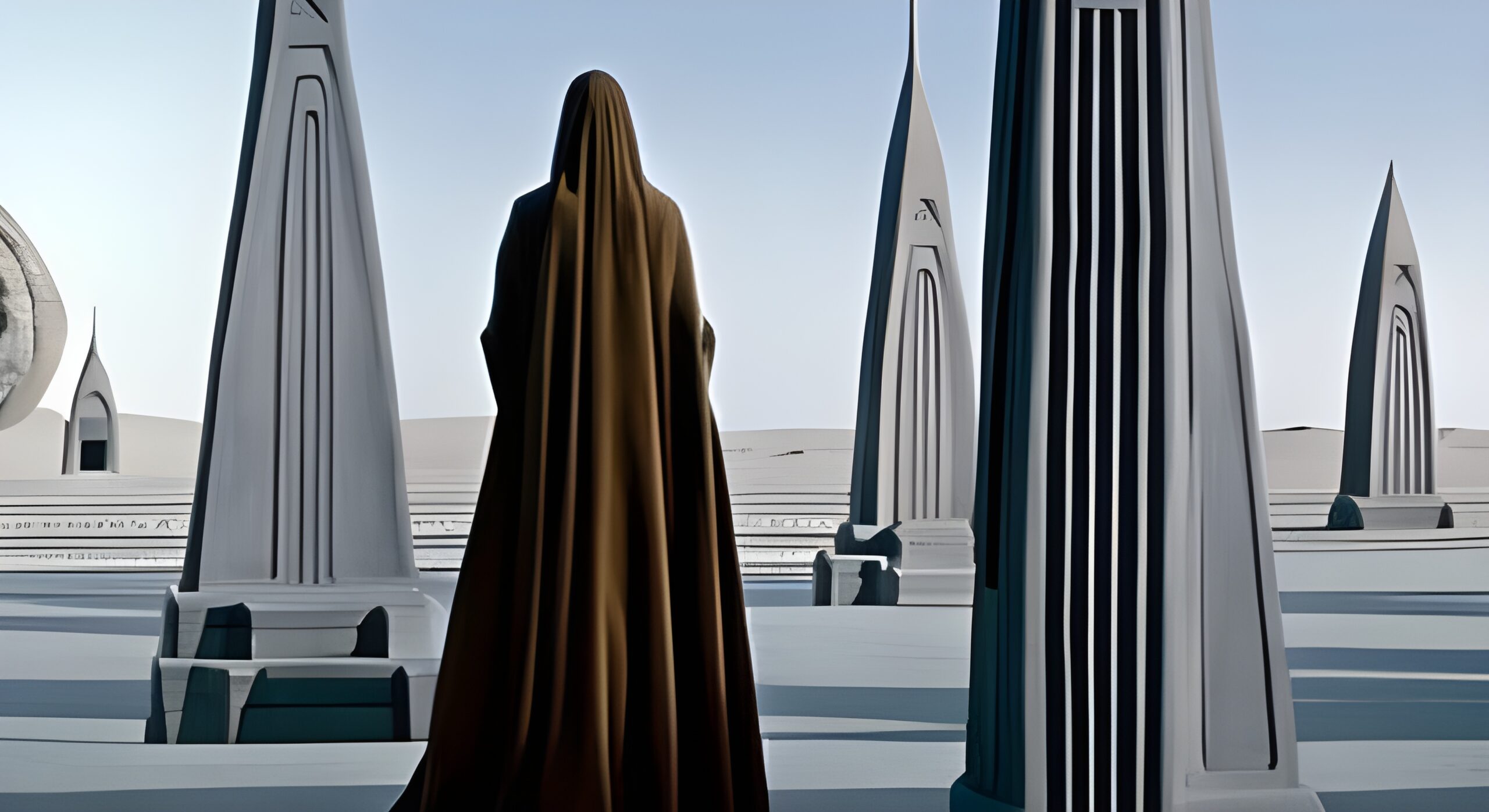
Only a few hundred words survive, written in June 1922. The fragment begins in a world from which wonder has disappeared. Modern civilisation has become grey, urban and spiritually exhausted. An unnamed man living among walls and windows looks upward at the stars until ordinary reality seems to open and the cosmos reaches down toward him. (H.P. Lovecraft Archive)
Then it stops.
This is not simply an unfinished short story.
Lovecraft explicitly regarded Azathoth as a projected novel.
In a 1924 letter discussing his fiction, he described the project as a long fantasy influenced by William Beckford’s Vathek, containing exotic scenes and prose-poetic landscapes. Even more strikingly, he suggested that its setting might be on another planet and that it might contain “no human characters in the accepted sense.” (Wikisource)
This is extraordinary.
The name Azathoth now carries immense Mythos baggage. Later readers encounter it as the name of Lovecraft’s blind cosmic chaos, surrounded by an accumulated mythology created partly by later writers.
But the surviving fragment is not fundamentally about a monster.
It is about escape from modernity.
The city has killed wonder.
The protagonist looks through a window.
The stars become a gateway.
The body remains while consciousness departs.
The unfinished Azathoth therefore suggests an alternative Lovecraftian tradition: not principally horror but cosmic fantasy of radical estrangement.
Had Lovecraft completed the novel, the centre of his later reputation might have shifted.
Instead of being remembered primarily as the creator of a pantheon of cosmic horrors, he might have been equally associated with a tradition extending from Dunsany and Beckford toward surreal planetary fantasy.
The potential absence of conventional human characters is especially important.
Lovecraft’s mature cosmicism repeatedly argues that human beings occupy no privileged position in the universe. Yet most of his stories remain structurally anthropocentric because humans narrate them.
We look at the Old Ones.
We investigate the Mi-Go.
We discover the Great Race.
Human consciousness remains the camera.
A fully realised Azathoth with genuinely nonhuman protagonists could have gone further.
It might have removed humanity from the narrative centre altogether.
Imagine Lovecraft writing not about a human discovering alien civilisation but from within a civilisation to which humanity was irrelevant.
That would have been a considerable formal advance.
The surviving stories approach this possibility but rarely inhabit it.
At the Mountains of Madness reconstructs the history of the Elder Things sympathetically enough that they cease to be simple monsters.
The Shadow Out of Time gives the Great Race a civilisation more durable and intellectually sophisticated than humanity.
But we still encounter them through human consciousness.
The unwritten Azathoth raises the possibility that Lovecraft was, at least temporarily, imagining something more radical:
cosmic fiction without the human spectator.
If realised successfully, it might have anticipated later speculative traditions concerned with nonhuman intelligence, xenofiction and posthuman perspective.
The unfinished novel is therefore important not because we have lost “the secret story of Azathoth.”
We may have lost a different Lovecraftian genre.
IV. The Dreamlands That Might Have Expanded
The Azathoth fragment also reveals a tension inside Lovecraft’s career.
There are effectively two great movements in his imagination.
One moves toward dream.
The other moves toward science.
The dream tradition gives us Celephaïs, Ulthar, Sarnath, Kadath, strange cities, forgotten gods, impossible journeys and landscapes whose reality is fundamentally aesthetic.
The scientific tradition gives us Antarctic expeditions, spectral analysis, archaeology, mathematics, evolutionary history, extraterrestrial biology and attempts to place cosmic strangeness within material reality.
Eventually the scientific mode became dominant.
The Colour out of Space, The Whisperer in Darkness, At the Mountains of Madness and The Shadow Out of Time increasingly approach science fiction while preserving the emotional structure of supernatural horror.
But Azathoth suggests that this outcome was not predetermined.
Lovecraft might instead have expanded the Dreamlands.
Had he completed a substantial fantasy novel in the early 1920s, particularly one conceived as an extended prose-poetic quest, it might have provided a second major branch to his career.
The Dream-Quest of Unknown Kadath later partly occupies this space, but even that work was left unpublished during his life.
The lost possibility is therefore a Lovecraft who develops long-form secondary-world fantasy simultaneously with cosmic horror.
Such a career might have altered twentieth-century fantasy.
Lovecraft would have sat less exclusively between Poe and modern horror and more visibly alongside Dunsany, E. R. Eddison and the developing traditions that eventually produced Tolkien.
But Lovecraftian fantasy would have been very different from Tolkienian fantasy.
There would probably have been no stable moral cosmology.
No reassuring metaphysical hierarchy.
No fundamentally recoverable golden order.
Lovecraft’s fantasy landscapes tend toward melancholy, estrangement and impermanence.
His great dream cities are already ruins while they are being admired.
Beauty and extinction coexist.
A developed Lovecraftian fantasy tradition might therefore have normalised a form of secondary-world fiction in which worldbuilding served not historical solidity but ontological uncertainty.
The fantasy world would be real enough to enter and unstable enough never to trust.
That road was available.
Lovecraft only partially travelled it.
V. The Descendant: The British Lovecraft That Never Fully Appeared
Another fragment, The Descendant, offers a different possibility.
It begins in London with a man who screams when church bells ring.
He is Lord Northam, an aristocratic scholar who has deliberately surrounded himself with trivial books because serious thought has become unbearable. A younger neighbour acquires the Necronomicon, forcing Northam to reveal something of his history. His ancestry reaches back toward Roman Britain; beneath the family’s ancient Yorkshire fortress lies a prehistorical stratum connected with vanished peoples, strange rites and possibly a civilisation predating recognised history. (H.P. Lovecraft Archive)
The story stops precisely where its deeper revelation should begin.
What remains is astonishingly suggestive.
Here Lovecraft begins constructing deep British time.
Roman Britain is not the beginning.
Behind Rome lies something else.
Behind recognised archaeology lies another civilisation.
Inheritance crosses not merely generations but historical epochs.
The landscape becomes stratified.
Church bells, medieval texts, Roman masonry, prehistoric rites and cosmic memory coexist.
Had Lovecraft developed this material extensively, he might have produced a British equivalent to his fictional New England.
His mature geography—Arkham, Innsmouth, Dunwich and Kingsport—became essential to his influence. It demonstrated that cosmic horror worked particularly well when mapped onto a coherent regional environment.
But The Descendant hints at another regional system.
Yorkshire cliffs.
Roman remains.
Stone circles.
Medieval aristocratic lineages.
London antiquarian culture.
Prehistoric Britain.
The North Sea.
Buried caverns.
Such a cycle could have moved Lovecraft closer to Arthur Machen while remaining distinctly his own.
More importantly, The Descendant combines cosmicism with historical continuity.
Lord Northam experiences impressions that seem not to belong to his individual biography. His mind may contain access to “elder and future lives” and unknown dimensions. (H.P. Lovecraft Archive)
That phrase suggests one of Lovecraft’s most fertile undeveloped themes:
memory larger than personality.
This idea appears elsewhere.
It reaches magnificent form in The Shadow Out of Time.
But The Descendant places it specifically inside ancestry.
The self may not merely inherit physical characteristics.
It may be a temporary surface over something enormously older.
Had Lovecraft followed that direction, his fiction might have moved beyond relatively simple hereditary horror into something more conceptually ambitious: personal identity as an archaeological layer.
A person would become a ruin inhabited by previous selves.
That is a remarkably modern idea.
VI. A Lost Theory of Identity
Much of Lovecraft’s fiction is already concerned with unstable identity.
But because his work is often reduced to cosmic monsters, this aspect can be underestimated.
Arthur Jermyn discovers that genealogy changes the meaning of his humanity.
Charles Dexter Ward is displaced by Joseph Curwen.
Asenath Waite and Edward Derby destabilise the relationship between body and personality.
The narrator of The Shadow Out of Time experiences memory that cannot be contained within his own lifetime.
Randolph Carter passes through metaphysical transformations in Through the Gates of the Silver Key.
The unfinished works imply that Lovecraft might have pushed further in this direction.
This is particularly clear in The Book.
Written probably in late 1933, the surviving fragment opens with a narrator whose memory has become profoundly uncertain. He cannot establish where his experiences begin, is unsure of the mechanism by which he is communicating, and describes his own identity as clouded. (H.P. Lovecraft Archive)
Then comes the occult book.
But the important development occurs before the object is explained.
The narrator himself has become ontologically unstable.
This feels different from the comparatively external documentary structure of At the Mountains of Madness.
There the world is strange but the narrator remains recognisably himself.
In The Book, selfhood itself appears damaged by encounter.
Had Lovecraft developed this tendency, his late fiction might have become increasingly concerned with subjective fragmentation.
Not:
“There is an alien thing.”
But:
“There may no longer be a coherent observer capable of deciding what is alien.”
That trajectory would place him unexpectedly close to later writers such as Borges, Philip K. Dick, Thomas Ligotti and the more metaphysical forms of postwar speculative fiction.
The horror would migrate from cosmology into consciousness.
And this might have changed the history of the “Lovecraftian.”
Instead of becoming shorthand for tentacles, ancient gods and forbidden books, it might have become equally associated with unstable narrators, temporal discontinuity and dissolution of personal identity.
In contemporary terminology, the lost mature Lovecraft might have become increasingly posthuman.
VII. The Book: Lovecraft Turning Inward
The Book deserves special attention because it belongs to Lovecraft’s mature period.
The question is no longer what an inexperienced writer might have become.
By 1933 Lovecraft had already written much of the work upon which his reputation rests.
That makes an abandoned experiment from this period more significant.
Its opening is not concerned with conventional exposition. There is no immediate place-name, scholarly dossier or chronological framework.
Instead the narrator’s ability to narrate is itself in question.
Who is speaking?
From when?
Through what medium?
How continuous is this personality with the person who originally encountered the book?
These are extraordinarily productive questions.
One scholarly interpretation associates the fragment with an attempt to transform material from Lovecraft’s Fungi from Yuggoth sonnet sequence into prose, although the relationship remains a matter of textual reconstruction rather than a completed authorial statement. (H.P. Lovecraft Archive)
What matters for the lost future is the form.
Lovecraft may have been experimenting with prose that behaved less like a conventional pulp narrative and more like a sequence of visionary states.
Had he continued in this direction, the mature fiction could have become increasingly compressed, poetic and uncertain.
It would have been a significant departure from the encyclopaedic explanations sometimes associated with his later cosmic tales.
Perhaps the alien would have become less explained.
Perhaps narrative itself would have begun to fracture under the pressure of the experience being represented.
This is one of the great counterfactual possibilities of late Lovecraft.
His increasing engagement with science encouraged greater explanatory sophistication.
But The Book points in the opposite direction:
toward epistemological collapse.
A future Lovecraft might have combined both.
Scientific precision at the surface.
Radical uncertainty beneath.
That combination could have been formidable.
VIII. The Unwritten Scientific Lovecraft
There is, however, another plausible trajectory.
If Lovecraft had lived into the 1940s and 1950s, the scientific world available to him would have transformed dramatically.
This speculation must be handled carefully.
One cannot simply give a dead writer knowledge of later history and assume a predictable response.
But Lovecraft was intensely interested in astronomy, physics, geology, archaeology and contemporary scientific speculation. His fiction increasingly incorporated scientific concepts rather than merely supernatural conventions.
The direction is visible.
The Colour out of Space refuses to classify its central phenomenon within normal terrestrial categories.
The Whisperer in Darkness combines folklore with extraterrestrial biology and technology.
At the Mountains of Madness reconstructs an alien evolutionary history through geology and archaeology.
The Shadow Out of Time treats consciousness, deep time and extraterrestrial civilisation through a quasi-scientific documentary structure.
The possible next stage is intriguing.
Had Lovecraft lived another twenty years he would have encountered, at least culturally:
nuclear fission,
radar,
rocketry,
early electronic computers,
cybernetics,
the expanding universe,
new developments in genetics,
the beginnings of information theory,
atomic weaponry,
and the first serious postwar discussion of artificial satellites and space travel.
One can easily imagine these developments feeding his cosmicism.
But the most interesting possibility is not “Lovecraft writes about the atomic bomb.”
It is that twentieth-century science increasingly began producing phenomena structurally compatible with his metaphysics.
Matter became less intuitive.
Information became increasingly abstract.
Machines began performing operations beyond unaided human capacity.
The relationship between observer and system became more complicated.
Human beings acquired technological powers vastly exceeding individual comprehension.
Lovecraft might have found in cybernetics and computation an entirely new language for cosmic horror.
The forbidden book could become an information system.
Possession could become informational substitution.
The Great Race’s archive could become computational.
Memory could become transferable pattern.
The distinction between body and identity, already unstable in his fiction, could become technological rather than occult.
There is no evidence that he “would have invented cyberpunk.”
That would be absurd.
But there is considerable reason to suspect that the increasingly scientific direction of his late work would not have stopped with Antarctic archaeology.
The unknown would have changed as science changed.
IX. Lovecraft and the Atomic Age
The atomic age might have produced a particularly severe transformation.
Lovecraft’s mature cosmicism depends upon the realisation that human civilisation is small compared with forces operating at scales it barely understands.
The atomic bomb added a terrible inversion:
human beings themselves had acquired access to forces operating at scales emotionally disproportionate to ordinary human life.
A city could be destroyed through interactions occurring within matter.
The cosmic entered politics.
What might Lovecraft have made of this?
Perhaps his great postwar horror would not have concerned a monster waking beneath the sea.
Perhaps it would have concerned humanity discovering that it had become capable of behaving like one of its own cosmic entities.
Indifferent destruction.
Planetary consequences.
Knowledge without proportional wisdom.
Scientific revelation producing existential danger.
The theme already existed in embryonic form in Lovecraft’s attitude toward knowledge.
His protagonists repeatedly succeed intellectually and suffer existentially.
Atomic physics gave civilisation itself that structure.
The species opened the forbidden book.
It understood.
And the understanding could not be reversed.
This would have allowed Lovecraftian horror to become explicitly technological without abandoning cosmicism.
The Great Old Ones might have become unnecessary.
Humanity could produce cosmic terror on its own.
X. The Novel Lovecraft Never Became
Another significant lost future concerns form.
Lovecraft wrote long works, but he never established himself as a novelist in the conventional commercial sense.
The Case of Charles Dexter Ward, The Dream-Quest of Unknown Kadath and At the Mountains of Madness demonstrate that he could sustain substantial narratives, yet his reputation was fundamentally built upon short fiction and novellas.
This may have been partly circumstantial.
The pulp market shaped length.
His finances constrained his writing life.
His perfectionism and lack of confidence complicated publication.
But his letters show that he did imagine longer projects, most explicitly Azathoth. Scholarship on his abandoned work includes discussion not merely of destroyed fiction but of “planned novels.” (H.P. Lovecraft Archive)
Had Lovecraft lived longer and achieved greater recognition, the economics of his writing might have changed enough to make the novel more practical.
What would a genuine mature Lovecraft novel have looked like?
Probably not a conventional character-driven narrative.
His strengths lay elsewhere.
Architecture.
Documents.
Historical depth.
Accumulating evidence.
Geography.
Atmosphere.
Conceptual revelation.
A mature Lovecraft novel might therefore have resembled an archive.
Letters.
Maps.
Scientific papers.
Testimony.
Archaeological reports.
Genealogies.
Fragments of earlier manuscripts.
Conflicting interpretations.
Multiple narrators approaching the same impossible object.
In other words, the documentary structure already present in The Call of Cthulhu could have expanded dramatically.
Such a novel might appear strikingly modern.
The protagonist would not necessarily be a person.
The protagonist could be the investigation itself.
Or the archive.
Or the gradual emergence of a pattern from multiple incomplete perspectives.
This would have anticipated later forms of documentary and ergodic horror, from found manuscripts to internet collaborative fiction.
The Lovecraftian novel that never existed might have been less like a traditional novel than a dossier concerning something no single narrator could comprehend.
XI. The Mythos Might Have Remained Less Systematic
There is another major counterfactual.
Lovecraft’s death froze his relationship to his own creations.
Other writers inherited them.
August Derleth was enormously important in preserving and publishing Lovecraft’s work, but Derleth also helped systematise the Mythos in ways that do not always correspond neatly with Lovecraft’s own cosmic materialism.
The temptation was understandable.
Readers wanted order.
Pantheons acquire genealogies.
Gods acquire categories.
Entities acquire relationships.
The mysterious becomes codified.
But Lovecraft’s own practice was often looser.
Names recur without a completely stable theology.
One story’s cosmic entity does not necessarily fit into a coherent metaphysical hierarchy with another.
The Necronomicon functions partly because its contents remain fragmentary.
The reader sees references.
Not doctrine.
Had Lovecraft lived another twenty years, he might have resisted—or contributed to—the systematisation of his fictional universe.
We cannot know which.
But his continued presence would almost certainly have changed what became the Cthulhu Mythos.
Perhaps he would have contradicted earlier stories.
Perhaps he would have introduced new terminology that rendered previous classifications obsolete.
Perhaps Azathoth, Nyarlathotep and Yog-Sothoth would have become increasingly metaphorical.
Perhaps he would have abandoned some of them.
A living author creates instability.
A dead author creates canon.
The Mythos we inherited is partly a consequence of Lovecraft’s absence.
That is itself a form of lost fiction.
We possess the universe that his successors organised after he could no longer interfere with it.
We do not possess the universe he might have continued to destabilise.
XII. The Problem of Derleth’s “Posthumous Collaborations”
This distinction becomes critical when discussing works published after Lovecraft’s death as collaborations with August Derleth.
They are often mistaken for completed Lovecraft fragments.
They generally are not.
The H. P. Lovecraft Archive notes that the sixteen so-called posthumous collaborations were overwhelmingly Derleth’s work, often based upon brief ideas in Lovecraft’s Commonplace Book. The Lurker at the Threshold, for example, contains only a comparatively small quantity of actual Lovecraft prose, while works such as The Survivor developed plot sketches or notes into stories whose execution was Derleth’s. (H.P. Lovecraft Archive)
This matters enormously to the idea of lost Lovecraft.
A completion closes possibility.
The fragment says:
It might have become this.
The posthumous completion says:
Here is what it became.
But unless Lovecraft wrote that development, the closure is artificial.
Derleth’s stories are historically important pieces of Lovecraftian literature.
They are not reliable windows onto the stories Lovecraft would have written.
Indeed, their very existence demonstrates the problem of reconstructing unfinished authors.
To finish a Lovecraft fragment, another writer must decide what the thing is.
Is the presence a monster?
A god?
An extraterrestrial?
A supernatural force?
A psychological projection?
The original fragment may derive much of its power from refusing to settle the question.
Completion can therefore destroy precisely the uncertainty that made the fragment Lovecraftian.
The academically responsible approach is not to finish Lost Lovecraft.
It is to preserve the branching possibilities.
XIII. The Commonplace Book: A Cemetery of Possible Worlds
Perhaps the most extraordinary document in this context is Lovecraft’s Commonplace Book, compiled over many years and containing brief ideas, images and possible premises.
It has been described as something close to a real-world counterpart of his fictional grimoires: an accumulation of unrealised narrative seeds. (H.P. Lovecraft Archive)
Some ideas became stories.
Others did not.
This makes the notebook a peculiar object.
It is not a collection of unfinished tales.
It is a collection of potential realities.
A sentence may contain an entire unwritten cosmology.
A fisherman catches something impossible.
A house possesses some unexplained historical anomaly.
A person experiences an impossible relation with time.
A fragment of folklore becomes physically consequential.
The minimalism is important.
Before plot, there is anomaly.
Lovecraft’s creative process often began with the impossibility itself.
This resembles his theoretical description of weird fiction: first determine the underlying abnormality, then its effects, mode of manifestation and the human reaction to it. (H.P. Lovecraft Archive)
The Commonplace Book therefore preserves Lovecraft at the moment immediately before causality.
It is pure speculative potential.
And because many entries were never developed, the notebook contains a shadow bibliography:
books that exist only as one sentence.
This is perhaps the truest Lost Lovecraft.
Not destroyed manuscripts.
Uncollapsed possibilities.
XIV. The Lovecraft Who Might Have Changed Politically
Any counterfactual examination of Lovecraft must confront a difficult question.
Would his social and racial attitudes have changed significantly had he lived longer?
There is evidence that some of his political and economic thinking changed during the 1930s. He became more responsive to the social consequences of the Depression and more interested in forms of technocratic economic planning than the extreme antiquarian conservatism of his youth might suggest.
But it would be irresponsible to turn this movement into a convenient redemption narrative.
Lovecraft’s racism was substantial, explicit and deeply entangled with parts of his imaginative vocabulary.
We cannot simply assume that another decade would have removed it.
Yet an extended career would have forced new encounters.
The Holocaust.
The Second World War.
The collapse of European fascism.
Decolonisation.
Atomic warfare.
The beginnings of the civil-rights era.
The changing demographics of American cities.
A Lovecraft who reached seventy would have lived until 1960.
His cultural world would have become almost unrecognisable.
The resulting fiction might have hardened.
Or changed.
Or contradicted itself.
That uncertainty itself matters.
The Lovecraft canon is often treated as a fixed ideological object because death arrested its development in 1937.
The lost later Lovecraft would have been obliged to respond to events that dramatically transformed the very subjects—race, civilisation, decadence, history, science and modernity—that obsessed him.
We therefore lost not merely stories.
We lost the possibility of watching a difficult writer collide with the historical consequences of his own century.
XV. The War Lovecraft Never Saw
The Second World War is particularly significant.
Lovecraft died before the conflict transformed technological civilisation.
Consider how compatible the war’s imagery would have been with his existing concerns:
cities destroyed from the air,
populations displaced,
ancient European architecture obliterated,
industrialised death,
secret scientific laboratories,
radar detecting invisible presences,
rockets crossing the edge of space,
cryptographic machines processing information beyond ordinary human capacity,
submarines moving invisibly beneath oceans,
and finally atomic fire.
The Gothic castle was no longer secure.
History itself became vulnerable to technology.
For an antiquarian such as Lovecraft, the destruction of old European urban landscapes might have carried enormous emotional force.
One can imagine a postwar Lovecraft in which the haunted ruin is no longer medieval.
It is modern.
Concrete bunkers.
Abandoned radar stations.
Bombed libraries.
Weapons laboratories.
Contaminated islands.
Underground command complexes.
The architectural vocabulary of cosmic horror might have changed completely.
Lovecraftian ruins could have become technological.
That would have brought his fiction surprisingly close to the environmental and technological horror of the later twentieth century.
XVI. The Computer as Forbidden Book
Of all the speculative directions, computation may be the most fascinating.
Lovecraft repeatedly imagines information that human beings should not possess.
Traditionally that information exists in books.
The Necronomicon is dangerous because it contains relationships among things that ordinary culture has forgotten or suppressed.
But books are passive.
Computers are not.
Had Lovecraft encountered the emergence of computation and cybernetics, the concept of forbidden knowledge could have undergone a profound transformation.
Imagine a Lovecraftian information machine.
It does not merely contain forbidden knowledge.
It derives it.
It correlates observations no individual has connected.
It reconstructs patterns from fragmentary evidence.
It discovers that apparently unrelated archaeological, astronomical and biological datasets describe the same phenomenon.
The human operators initially assume malfunction.
Then coincidence.
Then enemy activity.
Eventually they realise the machine is correct.
Such a story would preserve the classic Lovecraftian investigative structure while transforming the occult manuscript into automated inference.
The horror becomes:
We built something capable of discovering what evolution had protected us from noticing.
That would be an almost perfect continuation of Lovecraft’s mature epistemology.
And it would connect directly with the concerns of contemporary technological culture.
This suggests the most radical possible late Lovecraft.
Perhaps his central concept would eventually have ceased to be the cosmic monster.
Perhaps it would have become information.
The pattern is already present.
The protagonist is safe before learning.
Evidence accumulates.
The correct interpretation emerges.
Identity or reality collapses.
The knowledge cannot be forgotten.
This structure works regardless of whether the information is found in:
a manuscript,
a telescope,
a geological formation,
a photograph,
a computer,
a genetic sequence,
or an artificial intelligence.
Lovecraft’s mature achievement may therefore have been moving toward something larger than horror.
A theory of epistemological danger.
There are truths whose discovery alters the discoverer.
There are scales of explanation at which familiar categories cease to function.
There are accurate models of reality that human beings may find psychologically intolerable.
The unfinished fragments suggest that this insight could have expanded considerably.
The Descendant asks whether identity contains memories outside individual life.
The Book begins after identity and temporal continuity have already become confused.
Azathoth imagines escape from human reality toward a cosmos where human beings may not even be narratively necessary.
Together they outline an unwritten trilogy of dissolution:
dissolution of civilisation,
dissolution of personal identity,
dissolution of the human viewpoint.
That may be the deepest Lost Lovecraft.
XVIII. What We Probably Did Not Lose
There is also value in stating what probably would not have happened.
Lovecraft was unlikely to have written a conventional heroic Cthulhu saga.
His fiction does not naturally move toward armies fighting monsters.
He was unlikely to have provided a definitive family tree of the Great Old Ones.
Systematisation was not his principal imaginative strength.
He probably would not have explained the Necronomicon comprehensively.
Explanation would have diminished it.
Nor is there strong reason to assume that he would suddenly have become a psychologically naturalistic novelist centred on interpersonal relationships.
His interests were consistently architectural, historical, atmospheric and conceptual.
A future Lovecraft would still have been Lovecraft.
But mature writers often deepen precisely by becoming more themselves.
The speculative later Lovecraft is therefore most convincing when extrapolated from existing tendencies:
greater scientific sophistication,
deeper temporal scale,
more complex treatment of consciousness,
increasing fusion of horror and speculative fiction,
further erosion of supernatural explanations,
and perhaps greater formal experimentation with documents and fragmented narration.
Not a different writer.
A more extreme version of the writer already emerging.
XIX. The Irony of Survival
There is a final paradox.
Lovecraft himself spent much of his life marginal to professional literary culture.
Yet his papers survived with unusual abundance.
Brown University today preserves extensive collections of manuscripts, correspondence and associated material, including more than two thousand original letters and manuscripts according to its collection description. (Brown University Library)
Even apparently lost material has occasionally returned.
The autograph manuscript of The Shadow Out of Time was considered lost for decades before being rediscovered among papers connected with June Evelyn Ripley and donated to Brown; the manuscript demonstrated that published versions had not fully preserved Lovecraft’s original text. (Brown University Library)
This creates an appropriately Lovecraftian archival situation.
A text is thought lost.
It survives unknowingly inside another archive.
The custodian dies.
The papers move.
Decades pass.
The manuscript resurfaces.
The dead author modifies the living canon.
Lovecraft’s own literary afterlife therefore resembles one of his stories.
The archive is incomplete.
What survives may not be where scholars expect it.
Documents migrate through private collections.
One recovered page can alter an established text.
The past is not dead.
It is merely uncatalogued.
XX. The Hauntology of the Unwritten Story
The unfinished Lovecraft ultimately belongs to hauntology.
A completed story belongs to literary history.
An unfinished story belongs partly to the future.
It points toward something that was expected to exist but never did.
Azathoth is therefore not simply a fragment from 1922.
It is the ruin of a novel from an alternate twentieth century.
The Descendant is the opening of a British Lovecraftian cycle that never developed.
The Book is evidence of a mature psychological and metaphysical experiment that never acquired final form.
The Commonplace Book contains dozens of narrative futures that remained permanently embryonic.
These texts create an unusual temporality.
We read them after the completed Lovecraft canon.
We therefore know what Lovecraft eventually wrote.
But the fragments themselves do not.
They still contain the paths he did not take.
Reading them requires temporarily forgetting the inevitability of Cthulhu.
That is their greatest value.
They restore contingency.
XXI. What Could Have Been
If we assemble the evidence cautiously, a plausible alternative career appears.
Not a prophecy.
A possibility.
Lovecraft survives his illness and continues writing into the 1940s.
His cosmic horror becomes increasingly technological and scientific.
The experience of world war darkens his conception of civilisation while exposing him to forms of mechanised destruction more terrible than anything in the pulp imagination.
The atomic bomb transforms forbidden knowledge into historical fact.
Radar, rocketry and computation provide new forms of invisible perception.
His earlier interest in consciousness detached from body develops into stories about information and identity.
His documentary technique expands.
He writes longer works composed from conflicting archives.
The supernatural terminology gradually becomes less important than the epistemological problem behind it.
The Mythos remains inconsistent because Lovecraft continually alters it.
Younger writers correspond with him and borrow from him while he borrows from them.
Science fiction increasingly recognises him as one of its own.
He perhaps completes a major novel—not necessarily Azathoth, but something fulfilling its abandoned ambition to move beyond conventional human perspective.
By the 1950s his central horror may no longer be that humanity is insignificant.
It may be that humanity has created instruments capable of perceiving the systems within which its insignificance becomes measurable.
The telescope did it spatially.
Geology did it temporally.
Evolution did it biologically.
The computer might do it informationally.
The final Lovecraftian revelation becomes:
the universe was always full of patterns, but human consciousness was too narrow to detect them.
Then we built machines that could.
That is one possible Lost Lovecraft.
Perhaps he would never have written it.
But the path is visible.
Conclusion: The Author Who Remains Unfinished
The most important unfinished Lovecraft work is ultimately Lovecraft himself.
He died at forty-six at precisely the moment when several elements of his fiction had begun converging.
Dream fantasy.
Science fiction.
Cosmic pessimism.
Deep history.
Alien civilisation.
Unstable consciousness.
Documentary narrative.
The horror of knowledge.
The surviving fragments show these forces pulling in different directions.
Azathoth points outward toward a dream cosmos potentially free of conventional human protagonists.
The Descendant points backward into historical and hereditary depths where personal memory merges with prehistory.
The Book points inward toward fractured identity and unreliable temporal consciousness.
The scientific tales point forward toward increasingly material explanations for experiences once labelled supernatural.
None of these roads had reached an endpoint.
That is why the unfinished works matter.
Not because somewhere among them lies a hidden canonical sequel to The Call of Cthulhu.
There is something more valuable.
They reveal that “Lovecraftian” itself might have meant something different.
Perhaps the dominant image would not have been the tentacle.
Perhaps it would have been the window.
The window in Azathoth through which a human being looks beyond the grey city until ordinary reality opens.
The window separates one order from another.
Inside is the known.
Outside is possibility.
Lovecraft spent his career standing at such thresholds: between dream and waking, human and alien, science and supernaturalism, self and other, history and prehistory, knowledge and terror.
His finished stories tell us what he saw through some of those windows.
The fragments leave others open.
And because they remain unfinished, we cannot finally know what lay beyond them.
That uncertainty is not a defect in the Lost Lovecraft.
It is precisely what makes it Lovecraftian.