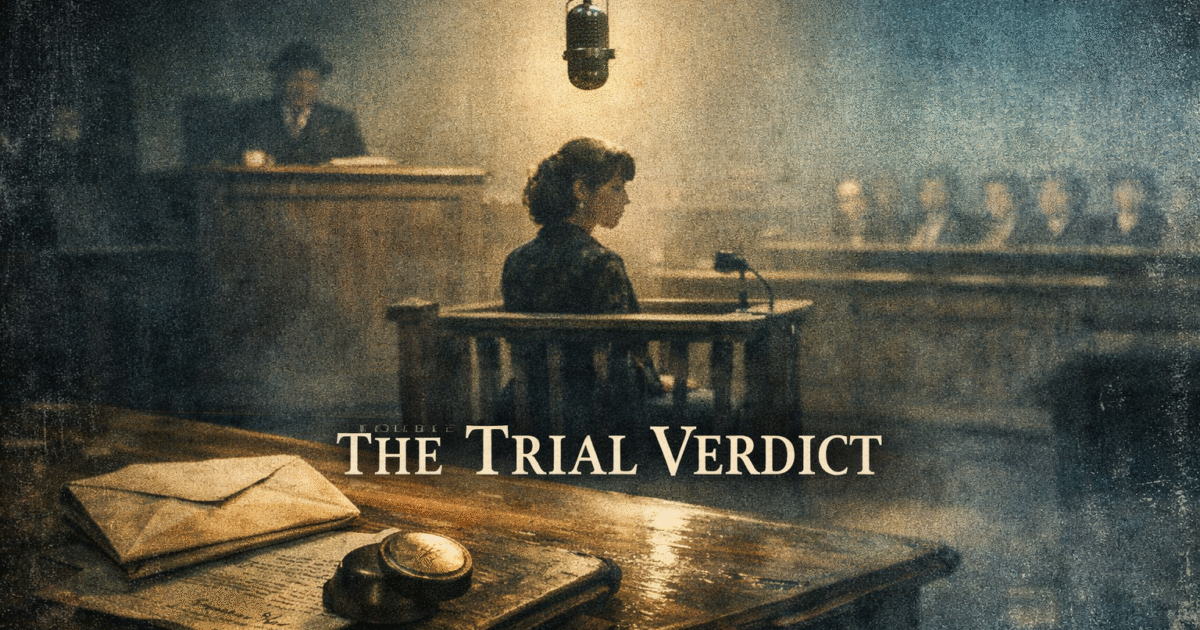
Dr. Elspeth Vale met the prospective patron at a restaurant in Marylebone where the chairs were too low, the plates too large, and the waiters had been trained to move as if overhearing were a hereditary sin.
His name was Mr. Lionel Frax, though he gave it as if correcting an older record.
He was seventy-six, perhaps seventy-eight, narrow through the shoulders, with a good suit gone shiny at the cuffs and a folded envelope placed beside his knife before the menus arrived. He had the quality Elspeth associated with men who had preserved one idea beyond its useful life. Not obsession exactly. Obsession is vulgar and energetic. This was more refined. A custody of memory.
“I am told you locate things,” he said.
“I locate records of things,” Elspeth replied. “The distinction matters.”
“In this case the thing may no longer exist.”
“Then the distinction matters more.”
He smiled, grateful rather than amused.
The envelope contained a typed page, no letterhead, no fee schedule, no ornamental secrecy. Only a title and a few particulars.
THE TRIAL VERDICT
BBC Television?
Live broadcast, probably 1956 or 1957.
Three acts. Courtroom drama. Anonymous author.
One performance only.
No known recording.
Remembered from childhood.
Elspeth read it twice.
“You are aware,” she said, “that most live television from that period was not recorded.”
“Yes.”
“And that titles are often misremembered.”
“Yes.”
“And that anonymous authors of single-broadcast plays are difficult to distinguish from no author at all.”
“Yes.”
“And still?”
Mr. Frax placed both hands flat on the table.
“I saw it.”
There was no theatrical emphasis. That interested her.
“What do you remember?”
“A courtroom. Not a grand one. No wigs, I think. Or perhaps there were wigs and I have removed them because the room was so bare. A judge. Counsel. A woman accused of murder. A jury never seen directly. The play proceeded normally at first. Evidence. Cross-examination. Character testimony. Then, in the third act, something went wrong.”
“In the plot?”
“In the room.”
The waiter arrived. Mr. Frax ordered sole and tap water. Elspeth ordered coffee she did not want.
“When you say wrong,” she said, after the waiter withdrew.
“The verdict came too early.”
“That can happen in drama.”
“No. Before the summing up. Before the jury had retired. A voice off-screen said, ‘Guilty.’ Everyone on screen heard it.”
Elspeth watched his hands. They had not moved.
“The actors?”
“The characters. That was what frightened me. They did not look at the camera. They looked toward the ceiling, as if judgment had entered from above the set.”
“How old were you?”
“Eight. Perhaps nine.”
“Children misremember television. Especially frightening television.”
“I know. I have been told so by librarians, archivists, television historians, and my second wife.”
“Was she usually correct?”
“Frequently. Not about this.”
He described more. A woman at the dock with dark hair. A barrister who began to cry silently while still speaking. A clerk who repeated the word verdict until it no longer sounded like English. The judge removing his spectacles and saying, “This court has not yet been given permission to conclude.” Then static. Then the announcer apologizing for technical difficulties. Then no repeat, no mention, no listing.
The cheque he offered was absurdly generous.
Elspeth did not take it.
“I’ll look,” she said. “I will not promise discovery.”
“I do not require discovery.”
“Most patrons do.”
“I require contradiction, if contradiction is all that survives.”
That was a better answer than he knew.
She began with the ordinary ghosts: BBC listings, Radio Times, production files, newspaper schedules, memoirs, lost television databases, union notices, rehearsal logs, dramatic rights records, viewer complaints, estate papers of plausible writers, and private collector indexes of off-air audio. Nothing.
There was no The Trial Verdict.
There was The Verdict, radio, 1952. No relation.
There was Trial by Candlelight, television, 1958. Surviving fragment. Not his.
There was The Last Witness, courtroom, 1957. Listed, reviewed, dull.
There were dozens of live plays with interchangeable titles, grey moralities, exhausted barristers, and murdered wives. None had the structure he described. None contained an anomalous verdict. None vanished unusually.
She checked regional variations. Nothing.
She checked whether his memory might have fused a stage play, a radio drama, and a news interruption. Possible. Likely, even. But likelihood is not truth. It is only probability with manners.
After eleven days she visited Mr. Frax at his flat in Maida Vale.
He had prepared tea and laid out three objects on a small table: a child’s exercise book, a Bakelite television knob, and a folded square of yellowing newspaper.
The exercise book contained a boy’s handwriting.
The Trial Verdict was on tonight. Mother said I must not watch but Father said it was only a play. The lady was guilty before they said why. I did not like the voice.
The date at the top was 3 November 1956.
The newspaper square was from the next day’s television listings.
No such play was listed.
The Bakelite knob, he explained, came from the family television set, saved for no rational reason when it was replaced in 1964.
“My father said there must have been interference,” he said. “My mother said I dreamed it. But I wrote that before breakfast. I remember the ink still wet.”
Elspeth held the knob in her palm.
Objects do not prove memory. But they give memory somewhere to stand.
“Did anyone else see it?” she asked.
“My parents denied it.”
“Denied watching, or denied the broadcast?”
He looked away.
“That is a good question.”
“And?”
“They denied being in the room.”
“But were they?”
“Yes.”
“How do you know?”
“Because when the voice said guilty, my mother said, ‘Not again.’”
The flat seemed to alter slightly around the sentence. Not supernaturally. Semantically. A fact had entered late and reorganized the furniture.
Elspeth set the knob down.
“Mr. Frax, the title may not have been the title.”
He nodded.
“The broadcast may not have been BBC.”
He nodded.
“The drama may not have been transmitted publicly.”
He nodded again, but less certainly.
“And the thing you remember may not have been preserved because it was never recorded as a programme.”
“What else could it be?”
“A domestic event using television as its surface.”
He sat very still.
Outside, traffic moved along the wet road. Ordinary, indifferent, continuous.
“My mother was on a jury,” he said after a while.
“When?”
“I don’t know. Before I was born, I think. Or after. She never spoke of it. My father once said she had done her civic duty and that should be enough for any woman.”
“What was the case?”
“I don’t know.”
“But she said, ‘Not again.’”
“Yes.”
Elspeth looked at the child’s exercise book. The boy had written what he believed he saw: a play, a title, a verdict arriving before process, judgment without permission. Perhaps that was all memory could offer him. A child’s mind had turned a mother’s buried sentence into broadcast drama because television was the household altar through which impossible things became visible.
“There may be no lost play,” she said.
Mr. Frax closed his eyes.
“I thought you might say that.”
“There may be no anonymous author.”
“No.”
“There may be only your memory of adults refusing to explain what had entered the room.”
He nodded once.
Then opened his eyes.
“But I heard it.”
“Yes,” Elspeth said. “I believe you heard it.”
“Then what do I do with that?”
“Stop looking for the programme.”
He looked at the three objects on the table.
“And look for the trial?”
“Yes.”
The old man smiled sadly.
“That is a crueler commission.”
“Most accurate ones are.”
He pushed the cheque toward her again.
This time she took it.
Not for locating lost media. That case had failed.
Or rather, it had corrected itself.
Two weeks later, Elspeth found a small paragraph in a provincial paper from 1949: a murder trial, a disputed verdict, a juror taken ill, proceedings delayed, conviction later quashed, records partly sealed under an order no one now seemed able to justify. One juror was named only as Mrs. L. Frax.
She sent Lionel Frax a photocopy and a note:
The play does not appear to have existed. The verdict did.
He replied on a postcard, in a hand less steady than before:
Then my memory was not wrong. Only misfiled.
Elspeth placed the postcard in a folder marked BROADCASTS, FALSE.
Later, after midnight, she found herself thinking of the title.
The Trial Verdict.
Ungrammatical. Redundant. Childish.
And perhaps exact.
A trial is meant to produce a verdict. But in certain houses, the verdict arrives first and everything that follows is only theatre arranged to justify it.
No recording was ever found.
None was needed.