A Hundred Trillion Poems
Combinatorial Literature Before Electronic Computers
1. The Book That Could Never Be Finished
Imagine entering a library and discovering a remarkably thin book.
It contains only ten pages of poetry.
At first glance, it seems ordinary enough. Each page carries a sonnet: fourteen lines arranged into a familiar poetic form.
But the pages have been cut into narrow horizontal strips.
Each strip contains a single line.
The strips can be turned independently.
You lift the first strip and reveal a different opening line. The second line remains unchanged. You select another third line, another fourth, and continue until you have assembled an entirely new sonnet.
You read the result.
It is strange, but recognisably poetic.
You turn another strip.
One line changes, altering the atmosphere of the entire poem.
A melancholy description becomes comic. An apparently romantic scene becomes threatening. Two lines that were written separately now seem to answer each other.
You try another combination.
And another.
Eventually, you wonder how many poems the little book contains.
Ten?
A hundred?
A thousand?
The answer is considerably larger.
The book contains enough alternative lines to produce one hundred trillion different combinations.
That is:
100,000,000,000,000
The book really exists.
It was created by the French writer Raymond Queneau and published in 1961 under the title Cent mille milliards de poèmes.
Its construction is documented by Oulipo, the literary group with which Queneau was closely associated. The original work contains ten sonnets, each consisting of fourteen lines, arranged so that corresponding lines can be exchanged. 
Oulipo
The reader does not merely select which poem to read.
The reader constructs a poem by choosing its component lines.
And the extraordinary thing is that this happens without an electronic computer.
There is no processor.
No programming language.
No screen.
No random-number generator.
The machine consists of paper, printing, carefully designed poetic structure and the hands of the reader.
Yet its underlying principle is computational.
A finite collection of components is combined according to rules to produce a much larger collection of possible results.
The author has not written every resulting poem individually.
Instead, he has created a system capable of producing them.
This marks a decisive moment in our study.
In Part II, we examined books that contain or discuss computer code.
Now we move towards literary works whose behaviour is governed by rules.
The book is no longer merely something to read. It becomes something to operate.
2. Raymond Queneau and the Workshop of Possibilities
Raymond Queneau was a novelist, poet and experimenter with a longstanding interest in mathematics, language and literary form.
His writing often combines intellectual playfulness with rigorous construction.
He was interested in the possibilities created when a writer deliberately accepts unusual restrictions.
This might seem contradictory.
We often imagine creativity as freedom from rules.
An artist is supposedly most creative when allowed to follow inspiration wherever it leads.
But Queneau and his collaborators explored a different proposition.
What if deliberately limiting the available choices could produce new kinds of freedom?
In 1960, Queneau and the mathematician and writer François Le Lionnais helped establish a group that became known as Oulipo.
The name abbreviates Ouvroir de littérature potentielle, usually translated as Workshop of Potential Literature.
According to Oulipo's own historical account, the group emerged in autumn 1960 from a gathering of writers and thinkers interested in experimental literary forms. Its programme centred on discovering structures and constraints that writers might use creatively. 
Oulipo
The word potential is important.
Ordinary literary criticism often examines works that have already been written.
Oulipo became interested in possible works: texts that could be produced by applying certain rules.
A constraint might determine which letters are permitted.
It might require a particular arrangement of sentences.
It might establish a mathematical relationship between parts of a poem.
Or it might allow existing textual components to be rearranged into new combinations.
The group did not invent every form of constrained writing.
Poetry had employed metre, rhyme and formal patterns for centuries.
Nor was it the first literary movement to experiment with combinatorial techniques.
Its significance lay partly in treating the investigation of literary constraints as a systematic creative project.
The workshop metaphor is revealing.
A workshop contains tools.
A carpenter might use a saw, plane or measuring instrument.
A literary workshop can develop methods for constructing texts.
The methods do not replace creativity.
They provide structures within which creativity can operate.
Queneau's extraordinary book is one of the clearest demonstrations of this approach.
He did not simply write ten sonnets and leave readers to rearrange them however they pleased.
He designed the sonnets so that corresponding lines would remain compatible.
That required considerable attention to form.
The apparent freedom of combination depended upon disciplined preparation.
3. The Mathematics of a Hundred Trillion Poems
We can calculate the number of possible poems without knowing any French or reading a single line of Queneau's work.
The book supplies ten alternatives for the first line.
For each choice of first line, there are ten alternatives for the second line.
There are ten alternatives for the third.
And so on through fourteen positions.
The total is:
10 × 10 × … × 10
with fourteen factors.
Therefore:
N=10¹⁴
Or:
N=100,000,000,000,000
One hundred trillion.
The calculation uses the multiplication principle of counting.
If one decision has a possibilities and a second independent decision has b possibilities, the two decisions together provide a × b combinations.
For example, imagine choosing an outfit from three shirts and two pairs of trousers.
There are:
3 × 2=6
possible outfits.
Now suppose we add four possible jackets.
The total becomes:
3 × 2 × 4=24
Each new independent choice multiplies the number of possibilities.
Queneau applies the same principle to poetry.
But unlike clothing, the alternatives are carefully constructed lines of language.
Why this is not an ordinary combination problem
There is a useful mathematical distinction here.
In some counting problems, order does not matter.
Selecting three students from a class might produce the same group regardless of the order in which their names are chosen.
Queneau's system is different.
The fourteen positions are fixed.
A first line cannot simply be moved into the seventh position.
Instead, each position has its own collection of alternatives.
We are choosing one item from each of fourteen distinct sets.
The mathematical structure is a Cartesian product.
If Lᵢ represents the set of permitted lines at position i, the space of possible poems can be represented as:
P=L₁ × L₂ × … × L₁₄
Each Lᵢ contains ten alternatives.
Thus:
|P|=10¹⁴
This is not the same as selecting fourteen lines from a common pool without replacement.
The position of each line is part of the design.
That positional structure is what allows the author to preserve the sonnet's overall form.
A number beyond ordinary reading
One hundred trillion is difficult to imagine.
Suppose you could read one complete sonnet every minute, continuously, without sleeping.
There are 525,600 minutes in an ordinary 365-day year.
Reading every combination would require approximately:
(10¹⁴ / 525,600) ≈ 190,258,752
years.
That is about 190 million years.
If you read only during an ordinary working day, the period would be considerably longer.
The exact number depends on the reading schedule, of course.
The important point is the difference in scale.
The original book is small.
The space of possible readings is enormous.
A relatively compact arrangement of material describes more possibilities than any individual could reasonably examine.
This is combinatorial explosion, a concept we encountered in the first chapter when considering libraries of possible texts.
But Queneau introduces something new.
His vast collection is not produced by assembling arbitrary characters.
It is produced by combining carefully authored literary units.
The difference between those approaches is central to understanding his achievement.
4. Why the Lines Have to Fit
Imagine writing fourteen lines of poetry independently and placing them in fourteen containers.
Each container offers ten alternatives.
Mathematically, the result is straightforward.
But would every combination make sense?
Probably not.
One line might refer to a character who has never been introduced.
Another might use a pronoun without an identifiable subject.
A third might disrupt the rhyme scheme.
A fourth might depend upon a grammatical construction established by a particular preceding line.
The resulting combinations could be awkward, incoherent or simply uninteresting.
Queneau's design addresses this difficulty by making corresponding lines compatible in important formal respects.
Oulipo's official explanation specifically identifies rhyme and syntactic compatibility as features of the construction. 
Oulipo
This does not mean that all combinations possess identical meanings or equal artistic quality.
Nor does it mean every combination will appear equally natural to every reader.
It means that the author has designed the alternatives to work within a common structural framework.
Compatible line slots
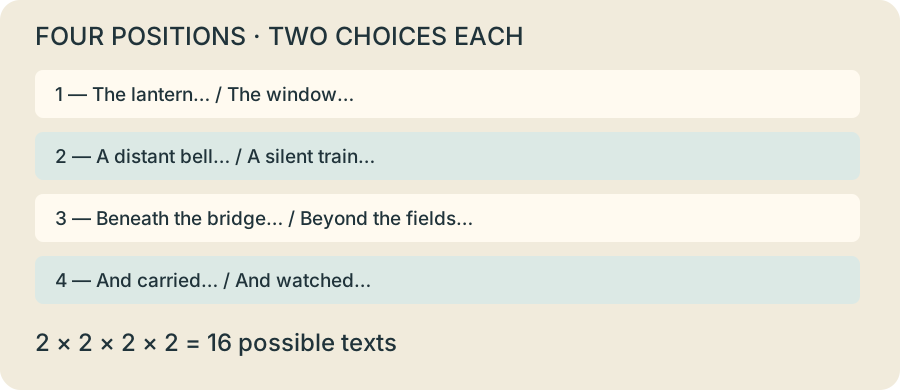
We can demonstrate the principle with an original example.
Suppose we are writing a short four-line poem.
Each line occupies a particular position.
For every position, we provide two alternatives.
| Position | Alternative A | Alternative B |
| 1 | The lantern trembled in the rain | The window shivered in the rain |
| 2 | A distant bell announced the night | A silent train withdrew from sight |
| 3 | Beneath the bridge the river sighed | Beyond the fields the shadows sighed |
| 4 | And carried every dream away | And watched the stars dissolve to grey |
These lines have been written specifically for this teaching example. They are not translations or adaptations of Queneau's poems.
The first position establishes a scene.
The second introduces an event or distant presence.
The third extends the atmosphere.
The fourth provides a closing movement.
The alternatives share related grammatical structures and compatible emotional tones.
We can combine them in different ways.
For example:
The lantern trembled in the rain
A silent train withdrew from sight
Beyond the fields the shadows sighed
And carried every dream away
Or:
The window shivered in the rain
A distant bell announced the night
Beneath the bridge the river sighed
And watched the stars dissolve to grey
Both resemble short atmospheric poems.
Neither combination was written out as a complete poem before the line selections were made.
The author created the component lines and the rules determining their positions.
The reader selected one possible arrangement.
Structure makes combination possible
Our example has two alternatives for each of four positions.
The total number of combinations is:
2⁴=16
This is a modest number.
We could examine all sixteen possibilities without much difficulty.
But imagine expanding the system.
Ten positions, each with ten alternatives, produce ten billion combinations.
Fourteen positions, each with ten alternatives, produce Queneau's one hundred trillion.
The mathematical principle remains unchanged.
The literary problem becomes harder.
The author must produce enough compatible material to preserve meaningful possibilities.
The more tightly the lines depend upon one another, the harder it becomes to interchange them successfully.
A line such as She finally opened the letter requires some context.
Who is she?
Which letter?
Why was it previously unopened?
By contrast, a line describing rain on an empty street may be easier to combine with several alternatives.
This reveals a trade-off.
Highly specific narrative lines can produce strong causal relationships.
More flexible lines may permit a greater range of combinations.
Combinatorial literature must negotiate between these demands.
Its success depends not merely on the number of possibilities, but on the literary quality of the space those possibilities occupy.
5. The Constraint That Creates Freedom
The term constraint often sounds negative.
It suggests a limitation imposed upon someone who would otherwise be free.
Yet many familiar artistic forms depend upon constraints.
A sonnet typically has fourteen lines and follows established traditions of metre and rhyme.
A haiku is associated with compact poetic structures, though its Japanese history and forms are more complex than the familiar English-language syllable rule.
A musical composition may follow a particular rhythmic or harmonic pattern.
A novelist may choose to tell an entire story through letters.
These restrictions do not automatically make a work less creative.
They change the problems the artist must solve.
A sonnet writer must discover how to express an idea within a demanding form.
A writer using only dialogue must communicate setting and action without conventional narration.
A novelist excluding a particular letter must find alternative ways to express ordinary ideas.
Oulipo deliberately investigates such restrictions.
Its members have explored techniques including lipograms, substitutions, numerical patterns and many other formal procedures.
The official Oulipo site maintains a catalogue of constraints, including the method associated with Queneau's combinatorial sonnets. 
Oulipo
A constraint is not a recipe for quality
Suppose we create a rule requiring every line of a poem to begin with the same letter.
We might produce:
Silver shadows silently shine.
This satisfies a simple alliterative constraint.
But satisfying the rule does not make the line an excellent poem.
The result could be memorable, monotonous or ridiculous.
The constraint defines a formal condition.
Artistic judgement determines whether the result achieves something worthwhile.
This distinction is crucial.
A computer can verify many formal constraints.
It can check whether a word contains a forbidden letter.
It can count syllables approximately, although accurate poetic scansion can be more demanding.
It can select lines from predefined sets.
It can produce combinations according to a mathematical rule.
But the fact that a result satisfies the rule does not establish its literary value.
The constraint creates a space of possibilities.
Creative judgement operates within that space.
Why restrictions can encourage invention
Constraints can force writers away from familiar habits.
Suppose a writer repeatedly describes sadness through tears.
A rule forbidding references to crying may encourage different imagery.
Sadness might be expressed through an empty chair, an unanswered letter or the sound of a train leaving a station.
The restriction makes certain obvious choices unavailable.
The writer must search for alternatives.
Queneau's system imposes an especially demanding constraint.
Every corresponding line must work within a shared formal structure.
That forces the poet to think not only about individual lines, but about their relationships with possible neighbours.
The author is writing for many potential contexts simultaneously.
This is a different skill from composing one fixed poem.
It resembles the design of reusable software components: each part must function within a larger structure even when other parts vary.
The resemblance is useful, although Queneau's work is a literary construction rather than a piece of electronic software.
6. The Poem as a Space of Possibilities
When we speak about Queneau's one hundred trillion poems, we should distinguish three things.
The first is the physical book.
The second is the mathematical space of combinations.
The third is the particular poem selected by a reader.
These are related but not identical objects.
The physical book contains a finite collection of printed lines and a mechanism allowing them to be rearranged.
The mathematical space describes every permitted selection of those lines.
A particular reading is one path through that space.
Potential versus actual
Imagine that no one has ever selected a particular combination.
Does that poem exist?
Mathematically, the combination belongs to the set of possibilities.
The author has supplied all the lines required to construct it.
But the poem has not necessarily been assembled, read aloud or experienced as a complete literary object.
We can call it a potential text.
When a reader selects its fourteen lines, the potential arrangement becomes an actual reading.
This distinction is central to Oulipo's interests.
The workshop investigates not only texts already realised, but structures capable of producing further texts.
It is tempting to compare the process with a computer program.
A program can define possibilities without executing every one of them.
For example, a game might allow a player to travel through several routes while any particular playthrough follows only one.
Similarly, Queneau's book defines an enormous number of possible selections while a reader experiences one combination at a time.
But a crucial historical distinction remains.
Queneau's original book is a physical combinatorial object, not an electronic program.
It can be modelled computationally because its selection rules are precise.
That does not make an electronic computer necessary to its original operation.
Is every possible poem already written?
There are competing ways to answer.
One approach regards the entire combinatorial structure as the authored work. Every permitted poem belongs to that work, whether or not anyone has selected it.
Another emphasises the individual reading. The poem becomes a distinct literary experience only when a particular combination is assembled and interpreted.
A third treats both levels as important.
Queneau authored the lines and designed the structure.
The reader chooses an arrangement.
The resulting poem emerges from their interaction.
This does not make the reader a co-author in precisely the same sense as Queneau. The reader has not necessarily written any new lines.
Nevertheless, selection can become a meaningful creative activity.
Choosing which possibilities to realise is itself a form of participation.
7. Why One Hundred Trillion Is Not the Same as One Hundred Trillion Masterpieces
The mathematical size of Queneau's system is extraordinary.
But quantity is not quality.
Suppose an author creates a generator capable of producing a million sentences.
Most are grammatically correct.
Some are amusing.
A few are memorable.
Others are dull.
The generator's ability to produce a million outputs tells us nothing directly about how many deserve attention.
This distinction is easy to overlook because large numbers are impressive.
A computer that produces ten thousand poems per second sounds remarkably creative.
But if the results consist of predictable clichés, the abundance may become tiresome.
Three different measures
We can distinguish between formal validity, literary coherence and artistic value.
Formal validity asks whether an output satisfies the rules of construction.
Literary coherence asks whether its elements form an intelligible or suggestive whole.
Artistic value asks whether the result achieves something significant for a reader.
These are not interchangeable measures.
A poem may satisfy its metre and rhyme scheme while expressing almost nothing memorable.
A poem may contain deliberate grammatical disruption yet possess considerable emotional force.
A surprising combination may appear incoherent at first but reward closer reading.
Literary quality is not reducible to a simple test.
An illustrative model
Suppose, purely for discussion, that only one combination in every million produced by a system is judged excellent by some particular reader.
If the system contains one hundred trillion combinations, that would correspond to:
(10¹⁴ / 10⁶)=10⁸
Or one hundred million excellent combinations under that assumed rate.
But the rate is invented.
There is no established measurement showing that one in a million of Queneau's combinations is excellent.
The example simply demonstrates how even a very small proportion can produce a large absolute number when the space of possibilities is enormous.
More importantly, judgements of excellence are not uniform.
One reader may appreciate absurd humour.
Another may prefer emotional intensity.
A third may value formal elegance.
The same combination may seem brilliant to one person and unremarkable to another.
A machine can enumerate possibilities.
It does not thereby settle which possibilities deserve to be valued.
The search problem
This creates a new difficulty.
If a system contains an immense number of possible texts, how can readers discover the most interesting ones?
Random selection is one option.
Careful manual selection is another.
A computer might be programmed to favour combinations satisfying additional constraints.
Readers might preserve favourite arrangements and share them.
But every method changes how the work is encountered.
A system that produces possibilities has one function.
A system that ranks or selects possibilities has another.
The second introduces judgements about what counts as desirable.
This connects combinatorial literature with a central problem in artificial intelligence: generation is not the same as evaluation.
8. The Reader as an Operator
The physical design of Queneau's book changes the experience of reading.
Ordinarily, a printed poem remains fixed.
The reader can skip lines, reread passages or interpret them differently, but the sequence of words does not change.
Queneau's book invites physical intervention.
The reader manipulates the strips.
A line is concealed or revealed.
Another is selected.
A new arrangement appears.
Reading becomes partly an act of construction.
The importance of the physical object
The strips are not merely an attractive presentation.
They embody the poem-generating procedure.
Each strip acts as a selectable element.
The page position determines which line slot it occupies.
The binding keeps the alternatives organised.
The reader's hand performs the selection.
The book is therefore both a literary publication and a physical interface.
Its design allows an abstract mathematical system to be experienced directly.
A reader does not need to calculate 10¹⁴ to understand that enormous variation is possible.
They can see it.
They can turn the strips and watch the poem change.
A human-powered algorithm
We can describe the process as a procedure:
- Choose one of the ten alternatives for line one.
- Choose one of the ten alternatives for line two.
- Continue through the remaining positions.
- Read the resulting fourteen-line poem.
The procedure is finite and precisely defined.
It is therefore algorithmic in the broad sense of following an explicit method.
Yet it does not require automation.
The human reader performs the selections.
This illustrates an important historical point.
Algorithms are older than electronic computers.
People have followed mathematical and procedural rules for centuries.
Computers made the execution of many procedures dramatically faster and more scalable.
They did not invent the underlying idea of a rule-governed process.
Queneau's book demonstrates that literature can be algorithmic without being electronic.
It also shows why the history of computational literature should not begin with the first digital poem generator.
Earlier experiments with combinatorial language provide part of its intellectual ancestry.
9. From Paper Strips to Python
We can reproduce the central selection principle using a tiny Python program.
For clarity, we will use the four-line example introduced earlier.
There are two alternatives at each of four positions.
The resulting program is intentionally finite, local and deterministic.
It does not use random selection, read files, contact networks or execute user-supplied code.
It simply selects a particular combination.
The program
lines = [['The lantern trembled in the rain', 'The window shivered in the rain'], ['A distant bell announced the night', 'A silent train withdrew from sight'], ['Beneath the bridge the river sighed', 'Beyond the fields the shadows sighed'], ['And carried every dream away', 'And watched the stars dissolve to grey']]
choices = [0, 1, 1, 0]
for position, choice in enumerate(choices):
    print(lines[position][choice])
total = 1
for slot in lines:
    total *= len(slot)
print("Possible poems:", total)
Exact output
The lantern trembled in the rain
A silent train withdrew from sight
Beyond the fields the shadows sighed
And carried every dream away
Possible poems: 16
The selection list is:
choices = [0, 1, 1, 0]Python uses zero-based indexing.
Therefore, zero selects the first alternative in a list, while one selects the second.
The program chooses:
| Position | Selection | Result |
| 1 | 0 | The lantern trembled in the rain |
| 2 | 1 | A silent train withdrew from sight |
| 3 | 1 | Beyond the fields the shadows sighed |
| 4 | 0 | And carried every dream away |
The count is:
2 × 2 × 2 × 2=16
The program does not generate all sixteen poems.
It generates one specified selection and calculates how many distinct selection patterns are available.
Our alternatives are distinct within each position, so the sixteen selection patterns also produce sixteen distinct four-line texts.
This qualification matters.
If two alternatives were identical, the number of selection patterns could exceed the number of distinct texts.
Queneau's published construction is conventionally counted by its independent choices of lines.
Enable JavaScript to use this experiment. The chapter text remains readable.
What has changed?
The paper version requires the reader to move strips.
The Python version uses numerical indices.
Both implement the same general principle.
The author supplies alternatives.
A selection procedure chooses one alternative for each position.
The chosen lines are assembled into a complete text.
The computational version offers additional possibilities.
It could enumerate every combination.
It could select combinations randomly.
It could apply extra rules.
It could remember previously selected poems.
But none of those features is necessary to demonstrate the basic idea.
The literary machine is the structured set of possibilities.
The computer is one way to operate it.
10. The Difference Between Chance and Design
Queneau's book often prompts the question: who wrote the resulting poem?
The answer becomes more interesting when we distinguish chance from design.
Suppose a reader closes their eyes and selects one strip from each position.
The particular combination may be accidental.
But the alternatives themselves were not created accidentally.
Queneau wrote them.
He organised them into compatible positions.
He constructed a system in which independent selections could produce recognisable sonnets.
Chance operates within a designed space.
Randomness does not replace authorship
Imagine shaking a box containing fourteen thousand pieces of paper, each bearing a fragment of language.
If we draw fourteen fragments at random, the resulting text will probably lack coherent structure.
Some combinations might be unexpectedly beautiful.
Most may not be.
Now imagine a box containing carefully designed sets of lines.
Every first line establishes a setting.
Every second line introduces movement.
Every third line develops a relationship.
Every final line provides a possible conclusion.
Random selection from this system is much more likely to produce something with an intentional literary shape.
The difference is not the randomness.
It is the design of the possible outcomes.
This distinction matters for generative writing.
A generator can combine words without making meaningful artistic choices itself.
The author may have made those choices earlier, when selecting vocabulary, defining structures and establishing constraints.
The generated output can contain surprising relationships that the author did not individually anticipate.
But surprise is not the same as creation without human influence.
A constrained universe
Consider a board game.
Its designer establishes the board, pieces and rules.
Players produce individual games through their decisions.
The designer cannot know every game that will ever be played.
Yet the rules shape every legitimate move.
Queneau's book possesses a similar relationship between designer and participant.
The author defines a structured universe.
The reader explores it.
The difference is that the outcome is a literary text rather than a game position.
The analogy also has limits.
A game often includes competition, objectives and strategic decisions.
Queneau's combinatorial book does not require the reader to win anything.
There is no single best solution established by its rules.
The purpose is exploration.
The reader discovers unexpected relationships among authored lines.
This makes the system a particularly elegant example of potential literature.
Its mathematical design is exact.
Its literary interpretation remains open.
11. The Infinite Library Revisited
In Chapter One, we encountered Jorge Luis Borges's The Library of Babel.
Borges imagined a universe containing books assembled from possible combinations of symbols.
The library's extraordinary size creates a problem.
Some books contain meaningful statements.
Many contain nonsense.
Countless books may contain convincing falsehoods.
The difficulty is not simply generating text.
It is discovering which texts deserve attention.
Queneau's book addresses a related problem from the opposite direction.
Instead of generating every possible arrangement of characters, he begins with carefully chosen poetic material.
He then allows combinations within a restricted structure.
Borges imagines a vast possibility space in which meaningful language is difficult to locate.
Queneau constructs a much smaller, though still enormous, possibility space designed to preserve formal literary properties.
The contrast is revealing.
Two kinds of abundance
A library of arbitrary character combinations can contain almost unimaginable quantities of text.
But most of that text may be useless to a human reader.
A constrained literary generator can produce fewer possibilities while increasing the likelihood that its outputs have recognisable structure.
The difference concerns the relationship between freedom and restrictions.
Unlimited formal possibilities do not automatically produce rich literary experiences.
Carefully chosen restrictions may create a more productive space.
This suggests a general principle:
The quality of a generative system depends not only on how many possibilities it contains, but on how its possibilities are organised.
The same principle appears in other creative activities.
A musician can improvise within a scale or harmonic structure.
An architect works within physical and functional constraints.
A game designer defines rules that make interesting play possible.
A programmer creates interfaces that permit some operations while excluding others.
In each case, limits can help give activity a meaningful shape.
What Queneau could not guarantee
Even a carefully constrained system cannot guarantee that every reader will value every output.
A formally correct sonnet may seem dull.
An unusual juxtaposition may strike one reader as profound and another as meaningless.
Some combinations may create accidental humour.
Others may suggest narratives that Queneau never explicitly intended.
This openness is not necessarily a defect.
It is part of the work's artistic character.
The author supplies a structured collection of possibilities.
The reader supplies attention, interpretation and judgement.
The resulting literary experience emerges from their interaction.
12. The Book That Became a Machine
We began with a thin book whose pages had been cut into strips.
We have now discovered that its construction embodies several important ideas.
It uses a finite set of authored components.
It divides those components into compatible positions.
It defines a rule for selecting and assembling them.
It produces an enormous number of possible textual arrangements.
And it requires a reader to realise particular possibilities.
The system is mathematical.
The results are literary.
The interface is physical.
The process is algorithmic.
No electronic computer is required.
Yet the conceptual relationship with computational literature is unmistakable.
A new role for the author
A conventional poet may write a particular line because it follows another line with a particular emotional or rhythmic effect.
Queneau had to think more generally.
He needed lines capable of following several alternatives.
Each line belonged not only to one poem, but to a network of possible poems.
The author was therefore designing relationships among possibilities.
This resembles programming, but it should not be reduced to programming.
Queneau's choices involved the qualities of French language, poetic form, rhythm, rhyme and imagination.
A mathematical formula can count the combinations.
It cannot explain why particular images are effective or why an unexpected juxtaposition feels poetic.
The mathematics reveals the architecture.
Literary interpretation reveals the experience.
The reader becomes an operator
The reader's role also changes.
Reading is no longer simply following a fixed sequence.
The reader selects a path through a structured space.
They can return to earlier choices.
They can compare alternatives.
They can discover favourite arrangements.
They may even begin to recognise which kinds of combinations produce effects they enjoy.
The reading process becomes partly exploratory.
This anticipates several forms of electronic literature.
Hypertext fiction allows readers to select paths among linked passages.
Interactive fiction allows choices to influence simulated events.
Generative poetry uses programmed procedures to assemble language.
Each technology introduces its own possibilities and limitations.
But the idea that a literary work can consist of a structured field of potential texts is already powerfully demonstrated by Queneau's paper book.
The threshold of computational authorship
The next historical development is almost inevitable.
If a human reader can select lines according to rules, a computer can also perform the selection.
If a computer can select lines, it can repeat the procedure rapidly.
If it can repeat the procedure, it can generate thousands of outputs.
And if the rules become more sophisticated, the machine may begin producing combinations with structures that were not individually written by its programmer.
At that point, a new question arises.
Where should we locate the creative act?
In the original vocabulary?
In the rules?
In the selection procedure?
In the generated output?
Or in the reader's interpretation?
Queneau does not settle these questions.
He makes them impossible to ignore.
His book demonstrates that a writer can create more literary possibilities than any reader could ever exhaust.
But it also reveals why literary value cannot simply be counted.
One hundred trillion possible poems are not automatically one hundred trillion equally rewarding experiences.
The significance of the work lies partly in the tension between those two facts.
The number is astonishing.
The structure makes it possible.
But individual poems still have to be read.
And reading remains an act of interpretation.
A literary machine can multiply the number of possible texts. It cannot, by multiplication alone, determine what those texts will mean.
That is the achievement—and the limitation—of the book that could never be finished.
Questions to Take Away
- What distinguishes Queneau's Cent mille milliards de poèmes from a conventional collection of ten sonnets?
- Why is the number of possible poems calculated as 10¹⁴, rather than as a simple addition of the available lines?
- How do compatible grammatical structures and rhyme patterns make the system more effective?
- Does a poem exist as a literary work before anyone has selected and read its particular combination?
- If the reader selects the lines but the author wrote every alternative, who should receive credit for the resulting poem?
- Can a formally correct combination still be a poor poem? What additional qualities might give it artistic value?
- Is selecting a combination randomly less creative than choosing one deliberately?
- Why might imposing restrictions increase a writer's creative possibilities?
- Does translating Queneau's method into computer software change the nature of the literary work?
- What distinguishes a system capable of generating many texts from a system capable of identifying valuable texts?
A Small Reader Experiment: Build Your Own Poetry Machine
The following exercise uses original lines written for this chapter. It is a simplified demonstration of Queneau's combinatorial principle, not a reproduction of his sonnets.
Step 1: Prepare four line slots
Each slot has three alternatives.
| Position | Alternative 0 | Alternative 1 | Alternative 2 |
| 1 | The morning folded into rain | The evening gathered on the hill | The darkness settled on the town |
| 2 | A quiet bell disturbed the air | A distant engine crossed the fields | A lonely window held the light |
| 3 | The river carried dreams away | The orchard whispered to the wind | The station waited for the dawn |
| 4 | And nothing stayed as it had been | And all the roads returned to home | And every shadow learned to sing |
All twelve lines are original teaching material.
They share a generally compatible atmospheric style and can function as four-line poems, although they are not designed to preserve a strict metrical or rhyme scheme.
Step 2: Calculate the possibilities
Each position has three choices.
There are four positions.
Therefore:
N=3⁴=81
There are 81 possible selection patterns.
Because every alternative within a position is distinct, the 81 selections produce 81 distinct four-line texts.
Step 3: Select a poem
Choose the sequence:
0, 2, 1, 0
This produces:
The morning folded into rain
A lonely window held the light
The orchard whispered to the wind
And nothing stayed as it had been
Now choose:
2, 0, 2, 1
The result is:
The darkness settled on the town
A quiet bell disturbed the air
The station waited for the dawn
And all the roads returned to home
Notice that different combinations create different implied settings and emotional associations.
Neither poem required writing four entirely new lines after the selection was made.
Step 4: Predict a program's output
Use this short Python program:
lines = [['The morning folded into rain', 'The evening gathered on the hill', 'The darkness settled on the town'], ['A quiet bell disturbed the air', 'A distant engine crossed the fields', 'A lonely window held the light'], ['The river carried dreams away', 'The orchard whispered to the wind', 'The station waited for the dawn'], ['And nothing stayed as it had been', 'And all the roads returned to home', 'And every shadow learned to sing']]
choices = [2, 0, 2, 1]
for position, choice in enumerate(choices):
    print(lines[position][choice])
total = 1
for slot in lines:
    total *= len(slot)
print("Possible poems:", total)
The exact output is:
The darkness settled on the town
A quiet bell disturbed the air
The station waited for the dawn
And all the roads returned to home
Possible poems: 81
Step 5: Improve the system
Try replacing one line in each position.
Your objective is not merely to increase the number of combinations.
Instead, make the lines more compatible while preserving variety.
Ask whether the alternatives share appropriate grammatical structures.
Consider whether particular combinations introduce awkward references.
Try to maintain an atmosphere without making every poem feel identical.
Step 6: Evaluate the results
Choose five combinations.
Read each one aloud.
Rank them according to whichever literary qualities you consider important: rhythm, imagery, coherence, surprise or emotional effect.
Then ask someone else to rank the same poems.
Do your judgements agree?
The experiment illustrates a central distinction.
The program determines which texts are possible. Readers decide which possibilities they value.
Further Reading
Original Oulipo Sources
Oulipo — Cent mille milliards de poèmes constraint
The group's official explanation of Queneau's combinatorial method, including its fourteen line positions, ten alternatives per position and formal compatibility requirements.
Oulipo — CMMP, official description
This is the most useful primary reference for the mathematical construction. 
Oulipo
Oulipo — History of the Workshop
An account by Oulipo member Marcel Bénabou describing the group's formation in 1960 and its programme of investigating literary structures and constraints.
Oulipo — Historique de l'Oulipo
Oulipo — Catalogue of Constraints
The group's collection of formal literary techniques, providing context for Queneau's work alongside other methods of constrained writing.
Original Work and Publishing History
Raymond Queneau — Cent mille milliards de poèmes (1961)
The original work was published by Éditions Gallimard. Its physical design allows corresponding lines from ten sonnets to be combined.
BnF — Original work and editions
Gallimard's catalogue also documents the 2026 Oulipo recreation, Cent (mille milliards de) poèmes: Une recréation raisonnée, which revisits Queneau's combinatorial project using further literary constraints. 
Cercle Gallimard
Suggested Reading Order
Begin with Oulipo's official explanation of the CMMP constraint.
Then examine the group's historical account to understand why formal literary experimentation became a shared research programme.
Finally, investigate Queneau's original physical book, paying attention to the relationship between its paper strips and the mathematical space they represent.
The key is to experience the method rather than merely admire its enormous number of combinations.
Up Next — The Author Becomes an Algorithm
From Early Computer Poetry to Generative Writing
Queneau constructed a machine for producing poetry, but his machine was made of paper.
The reader operated it by moving strips.
What happens when the selection procedure moves inside an electronic computer?
In the 1950s, researchers began experimenting with computers that could generate written language.
Theo Lutz used a machine to produce stochastic texts from literary vocabulary.
Christopher Strachey developed a program that generated curious mechanical love letters.
Later experimenters created poetry generators, narrative systems and programs that combined formal linguistic rules with unpredictable selections.
The computer could now carry out the procedures that earlier authors had described or built into physical objects.
But this development created new questions.
If a machine selects the words, who is the writer?
If the author designs the algorithm but never sees every result, what exactly has the author created?
And if a generated poem surprises its programmer, does that surprise count as creativity?
Chapter Ten will trace the early history of computer-generated literature and examine how the roles of author, program and reader began to change.
The next literary machine will not require the reader to turn the strips. It will begin producing poems by itself.