A true account, as near as memory and the surviving women allow.*
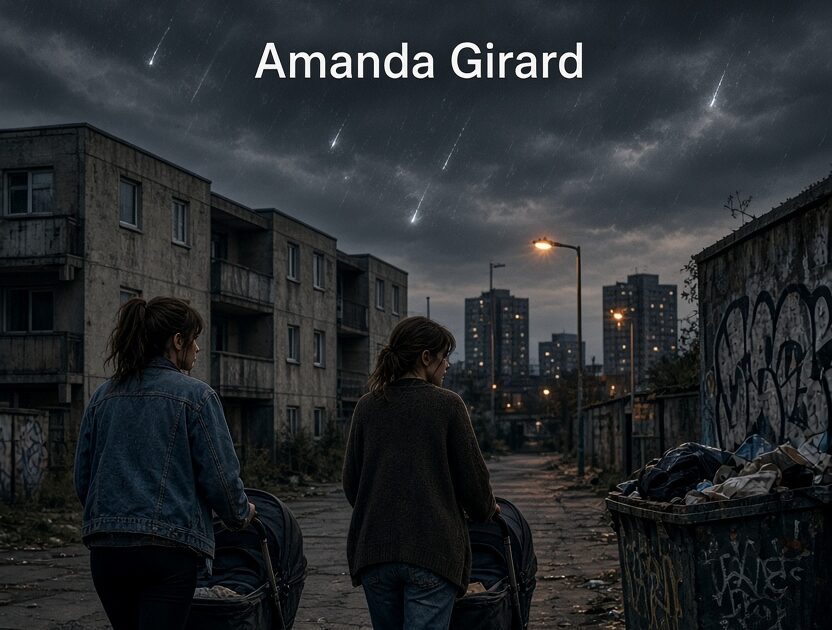
They still call it that in the pubs and the corner shops of the estate, even though the papers long ago stopped using the phrase. Comet Babies. 12 March 1994. A clear, cold sky over northern England, the kind that makes the sodium lights look sickly. Something bright and dirty streaked across the dark, broke up, and fell in pieces that nobody officially recorded. Most people slept through it. Some woke to a soft rain that left a faint metallic smell on the washing lines and the pavements. By morning the smell was gone. By the end of the week the first women were late.
What follows is pieced together from the women who lived it, from the few medical notes that weren’t shredded, and from the quiet, stubborn records kept on the estate itself. Names have not been changed. The women asked that they not be.
Karen
Karen Ward was thirty-two, two kids already, living in a three-bed on the top walk of the Houghton estate. The kind of place where the lifts broke every other month and the bins overflowed because the council only came when they felt like it. Her husband, Dave, drove wagons and was away more than he was home. She worked mornings at the Co-op checkout and evenings cleaning offices. She was tired in the ordinary way.
The first sign was the hunger.
It came on the third day after the comet, sudden and total. She woke at four in the morning with her stomach clenched so hard she thought she was going to be sick, but there was nothing to bring up. She ate the last of the bread, then the biscuits, then the cold leftovers of the kids’ fish fingers. Still not enough. By the time the shops opened she was light-headed. She bought two loaves, a block of cheese, a packet of digestives, and ate half of it walking home. The other half she finished sitting on the sofa while the kids got themselves ready for school.
She told herself it was stress. Or the flu. Or the fact that Dave had been gone ten days and the heating was playing up again.
That night the cramps started. Low, deep, like period pain but wrong—too early, too sharp. She took paracetamol and went to bed early. In the dark she felt something move inside her, a slow roll that made her press both hands flat to her belly. She had two children. She knew what a baby felt like when it turned. This was smaller. And colder.
By the end of the week she had missed her period. The home test was positive. She sat on the closed toilet lid staring at the two blue lines and felt nothing at first except a dull, practical dread. Another mouth. Another set of shoes. Dave would go mental.
She booked in at the surgery.
Dr Patel was kind in the way overworked GPs are kind—efficient, slightly distant. He confirmed the pregnancy, estimated six weeks, and wrote her a referral for the twelve-week scan. Karen left with a leaflet about folic acid and a sense that something was already wrong. The hunger had not eased. She was eating constantly now: toast, crisps, whole packets of biscuits, the children’s leftover chips. Her belly stayed flat. No swelling. Just the constant, grinding need for food and the occasional flutter deep inside that felt nothing like a human child.
Two other women on the estate were late as well. Kaylie from number 47, nineteen and already a mum to a toddler. Latoyah from the flats near the shops, twenty-four, no kids yet, lived with her mum. They started comparing notes in the corner shop while buying more bread than any one household needed.
“I’m starving all the time,” Kaylie said, voice low so the cashier wouldn’t hear. “Like, proper starving. And I’m never late. Never.”
Latoyah nodded. “Same. And I keep feeling it move. Tiny. Like a fish or summat.”
Karen said nothing at first. Then: “I took a test. It’s positive.”
The three of them stood there among the tinned beans and the lottery tickets and felt the first real cold of it settle in.
The news broke slowly. First a few more positive tests on the estate. Then a cluster reported at the local hospital. Then the regional papers picked it up: unexplained surge in early pregnancies across three northern towns, all dating to the same narrow window after the comet. The national press arrived a week later with their cameras and their headlines about “Comet Babies” and “Alien Conception Scare.” Scientists muttered about radiation or chemical fallout or mass hysteria. The Ministry of Defence said nothing useful. The NHS began calling women in for mandatory scans and bloods.
Karen went. She had no choice if she wanted the child benefit forms sorted.
The ultrasound room was colder than it should have been. The gel was cold. The probe pressed hard. The sonographer’s face changed.
“There’s… multiple sacs,” she said carefully. “But only one seems viable at the moment. The others are… irregular.”
Karen stared at the screen. A dark shape, small, coiled. Not a bean. Not a human outline. Something with too many thin, shifting lines.
“What is that?”
The sonographer didn’t answer. She called for a consultant. The consultant looked, then looked again, then asked Karen to wait outside while they made phone calls.
That afternoon an official in a grey suit and a woman from public health sat her down and told her the pregnancy was non-viable. Abnormal. A risk to her health. Termination was strongly advised—recommended—required, if she wanted continued care. They used soft words. Clinical words. They handed her a consent form already half-filled.
Karen signed because she was frightened and because they made it sound like the only sane thing to do. She went in the next morning. D&C. Local anaesthetic. They told her it would be over quickly.
It wasn’t.
Something in her resisted. The procedure took longer than it should have. She felt pulling, scraping, a deep wrongness. When they finished, the nurse looked pale. The specimen jar was taken away under a cloth.
Karen went home empty and sore and still hungry.
Three days later the hunger returned harder than before. The cramps came back. Another positive test. Another scan. Another “non-viable” diagnosis. Another termination.
By the fourth time the doctors stopped pretending it was ordinary. They admitted her. Put her on a drip. Started talking about “recurrent anomalous implantation” and “possible parasitic gestation.” They used the word “changeling” only once, in a corridor when they thought she couldn’t hear.
On the estate the other women were watching. Some went quietly to the hospital and never came back the same. Some disappeared into the system of wards and locked doors and repeated procedures. A few, like Karen, kept coming home between the terminations, thinner, greyer, still eating everything in the house.
Kaylie stopped answering her door.
Latoyah’s mum started telling people her daughter had gone to stay with relatives down south.
Chris—Christopher Hale, twenty-eight, father of Kaylie’s toddler—started asking questions at the pub that nobody wanted to answer.
Ivy, who ran the community centre and knew every family on the estate by name, began keeping a quiet list of who was late, who had been called in, who had come back empty-eyed.
Susanna, the health visitor who still made her rounds despite the official advice to report every anomalous case, started leaving extra food parcels on certain doorsteps and saying nothing about it in her notes.
The hunger did not stop.
The things inside the women did not stop growing back.
And on the Houghton estate, in the damp flats and the cracked walkways under the orange lights, the women began to choose sides without ever saying the words out loud.
Kaylie
Kaylie Brennan was nineteen and already tired of being looked at like she was thick. She lived in number 47 with her two-year-old, Jamie, and the occasional presence of Chris, who was the dad and sometimes slept on the sofa and sometimes disappeared for days when the money ran out or the arguments got too sharp. The flat smelled of damp and washing powder and the cheap air freshener she sprayed to cover both. She kept it clean because that was one of the few things she could control.
The hunger hit her harder than it hit most.
It started the morning after the comet. She woke with her mouth dry and her stomach already growling, even though she’d eaten a proper tea the night before—chips, beans, a bit of sausage for Jamie. She made toast. Ate four slices. Still empty. By midday she was going through the cupboards like someone had robbed her. Jamie watched from his highchair, solemn, while she finished the last of the cereal dry because the milk had gone.
“Mam’s just a bit poorly, love,” she told him, though she didn’t feel poorly. She felt hollowed out and ravenous at the same time.
Her period was due that week. It didn’t come. She’d never been regular exactly, but she’d never been this late either, not since Jamie. She waited another week, then bought a test from the chemist on the high street, the expensive one because she didn’t trust the cheap ones. Two lines. Clear as anything.
She sat on the edge of the bath with the stick in her hand and cried without making a sound so Jamie wouldn’t hear. Another baby. Chris would do his nut. The council would want to know about the bedroom tax and the benefits. She was already skint.
The movement started a few days later. Not kicks. Something smaller, wetter, sliding under the skin low down. She pressed her fingers there and felt it shift away, like it didn’t want to be touched. That night she dreamed of cold water and something coiled in the dark.
She told Chris when he next turned up, two days later, smelling of the pub and looking sheepish.
“I’m pregnant.”
He stared at her. “You what?”
“Test said so. And I can feel it. Something’s not right, Chris. It’s moving already and it’s only been a couple of weeks.”
He rubbed his face. “Fuck’s sake, Kaylie. We can’t afford another one. Have you been down the doctor’s?”
“Not yet.”
“Well go. Get it sorted. I’m not having another kid on this estate with nowt coming in.”
She went. Same surgery as Karen. Same Dr Patel, who looked more tired than last time and didn’t meet her eyes properly when the test confirmed it. He booked the scan and gave her the same leaflets. She didn’t tell him about the hunger or the cold sliding feeling. She didn’t know how to put it into words that wouldn’t make her sound mad.
The scan was worse than she expected.
The room was full of machines and the woman doing it kept glancing at the door like she wanted someone else to come in. On the screen there was a dark shape, not the little bean Kaylie remembered from Jamie. This one was longer, thinner, with pale threads that twitched when the probe moved. The sonographer went very quiet. Then she said, carefully, “I’m going to need to get a second opinion.”
They left Kaylie on the couch with the gel drying sticky on her belly. She heard low voices in the corridor. When they came back it was a different doctor, older, and a woman in a suit who wasn’t wearing a white coat.
They told her the pregnancy was abnormal. Non-viable. A danger. Termination was the only safe option. They used the word “urgent.” They had a slot the next morning.
Kaylie signed because Chris had said get it sorted, and because the way they looked at her made her feel like a child again, thick and in the way. She went home and cried into Jamie’s hair while he watched cartoons. Chris didn’t come back that night.
The procedure was supposed to be straightforward. It wasn’t. She felt them scraping and the thing inside her twisting away, and for a moment she thought she heard a thin wet sound that wasn’t the machines. When they finished she was shaking. They sent her home with painkillers and a leaflet about counselling.
Three days later the hunger came back like a punch. The test was positive again. The movement returned, lower this time, more insistent.
She didn’t go back to the surgery straight away. She stayed in the flat with the curtains drawn and ate everything she could get her hands on—bread, biscuits, the emergency tins at the back of the cupboard, even the dry pasta when there was nothing left. Jamie started crying because there was no food left for him. She walked to the shop with him in the pushchair and spent the last of the child benefit on more bread and milk and a big bag of potatoes. The woman behind the counter looked at the pile and then at Kaylie’s face and didn’t say anything.
On the way home she saw Karen coming out of the lifts, thinner than she’d been a fortnight ago, eyes shadowed.
“You as well?” Karen asked quietly.
Kaylie nodded. “They took it out. It’s back.”
Karen’s mouth tightened. “Same. Third time for me. They’re talking about keeping me in next time.”
They stood there in the wind that always funneled down the walkway, two women with empty bellies that wouldn’t stay empty, while Jamie kicked his feet against the pushchair and asked for a biscuit.
That was the day Kaylie stopped answering the phone when the surgery called. She stopped opening the door when the health visitor knocked. She started keeping a bag of clothes and nappies by the door in case she needed to leave quick. She didn’t know where she would go. She only knew she wasn’t going back under those lights and those scraping instruments if she could help it.
Chris turned up again a few nights later. She told him the truth this time—the whole of it, the repeated terminations, the thing growing back, the way the doctors looked at her like she was already a problem to be managed.
He went pale. Then he got angry, the way he did when he was frightened.
“You’re talking shite. They’re doctors. If they say it’s wrong, it’s wrong. You need to go back and get it done proper.”
“I can’t,” she said. “It doesn’t stay gone. And I’m not letting them cut me open again while I’m awake. I felt it, Chris. It didn’t want to come out.”
He left. Slammed the door hard enough to make Jamie cry. She didn’t see him for a week after that.
In the quiet that followed, Kaylie began to notice the other women. Latoyah from the flats, who had stopped coming to the community centre. Ivy, who left a bag of shopping outside number 47 one morning with a note that just said Eat what you need. Tell no one. Susanna, the health visitor, who still knocked but when Kaylie finally opened the door a crack only said, “I’m not here officially. How many weeks do you think you are this time?” and then left without writing anything down.
The hunger grew. The thing inside her grew with it. She could feel the shape of it now when she lay still—long, coiled, the faint brush of something like thin limbs or tentacles against the wall of her womb. It didn’t kick like Jamie had. It pulsed. And every time it pulsed she felt a wash of something that wasn’t quite love and wasn’t quite fear, a biological tug that made her press her hands over it protectively even while her mind screamed that it was wrong.
She started talking to it in the dark, the way she had with Jamie when she was pregnant the first time.
“You’re not supposed to be here,” she whispered. “But you’re here now. So we have to figure something out.”
It didn’t answer. It only shifted, cold and patient, and the hunger deepened.
By the end of the month the papers were full of it. Clusters of anomalous pregnancies. Mandatory reporting. Hospitals opening special wards. Women being sectioned under mental health acts when they refused treatment. On the Houghton estate the women who were still free began to move differently—quieter, more watchful, sharing food and information in the corners of the community centre when Ivy looked the other way.
Kaylie kept her curtains closed. She fed Jamie first, then herself, then the thing that was growing back for the third time. She waited. She did not know for what. Only that she would not go back to the hospital if she could help it, and that the cold sliding presence inside her was starting to feel less like an invader and more like something that belonged to her, whether she wanted it or not.
Latoyah
Latoyah Okonkwo was twenty-four and still lived with her mum in the low-rise flats near the shops because the waiting list for a place of her own was years long and the private rents were a joke. She worked nights at the care home on the edge of town, wiping arses and making tea for old people who sometimes remembered her name and sometimes called her by the names of daughters long gone. She was good at the job. Quiet, steady, didn’t flinch. Her mum, Grace, cleaned offices in the city centre and came home smelling of polish and exhaustion. They got on. They kept out of each other’s way when they needed to.
The hunger arrived like a betrayal.
Latoyah had always been careful with food. Not fussy—just measured. She knew what it cost. After the comet she woke one morning with her stomach clenched so tight she had to sit on the edge of the bed until the dizziness passed. She ate the leftover rice from the night before, then the bread, then the last of the groundnuts her auntie had sent from London. Still not enough. By the end of the shift at the care home she was light-headed and snapping at the residents, which wasn’t like her.
She missed her period the following week. She had never been late. Not once. She bought a test on the way home, did it in the staff toilet at the care home because she didn’t want her mum to see the packet, and stared at the two lines until the timer ran out and the result stayed the same.
She told no one at first.
The movement started early. Too early. A slow, cold coiling low in her belly that made her press her palm there during the night feeds at work, pretending she was just tired. It didn’t feel like a baby. She had helped deliver enough of them in the care home when the old women still talked about their own labours. This was different. Slippery. Insistent. Like something trying to find the right place to settle.
She went to the surgery because the hunger was making her drop things at work and the manager had started asking questions. Dr Patel—same one who had seen Karen and Kaylie—confirmed the pregnancy and booked the scan with the same careful, distant voice. Latoyah noticed the dark circles under his eyes. She noticed the way the receptionist looked at her when she gave her name, like another tick on a list that was getting too long.
The scan showed what the others had shown. Multiple irregular sacs. One larger shape that moved when the probe pressed, thin pale structures shifting inside the dark. The sonographer went quiet. The consultant came in. Then the woman from public health who wasn’t wearing a badge that Latoyah recognised.
They used the same words. Non-viable. Abnormal. Risk to maternal health. Termination recommended—required if she wanted to remain under NHS care. They had a slot the next day. They spoke gently. They watched her face the way people watch someone who might make a scene.
Latoyah signed. She was practical. She had seen what happened to women who argued with systems. She went home, told her mum she had a stomach bug, and went in the next morning.
The procedure took longer than they said it would. She felt the scrape and the pull and a sudden deep resistance that made the doctor swear under his breath. Something came out that they covered quickly. She was sent home with painkillers and instructions to rest. Her mum made soup. Latoyah ate it and then the rest of the loaf and still felt hollow.
Four days later the hunger returned. The test was positive again. The cold coiling feeling was back, lower and stronger.
She did not go back to the surgery.
Instead she started moving differently. She swapped her night shifts for days so she could be home when the health visitor might call. She stopped answering the landline. She began buying food in cash from the corner shop and the market stalls, more than two women needed, hiding the excess under her bed in the way she had once hidden exam revision from her mum when she was a teenager. She ate in the dark after Grace had gone to sleep—bread, tins of beans, packets of biscuits, cold rice, anything that filled the space for an hour or two.
The thing inside her grew. She could map its shape now when she lay still. Long. Segmented. The faint brush of what felt like thin, flexible limbs against the inner wall. Sometimes it pulsed and a wave of heat went through her that wasn’t fever. Sometimes it went completely still and the hunger sharpened until she had to get up and eat or risk being sick from the emptiness.
She started talking to Karen in the stairwell when they crossed paths, voices low.
“How many times for you?” Latoyah asked.
“Four. They’re keeping me in next time. Said the regeneration is stressing the uterus. Whatever that means.”
“I’m not going back.”
Karen looked at her for a long moment. “Neither is Kaylie. She’s stopped answering the door. Ivy’s been leaving food.”
Latoyah nodded. She had seen the bags outside certain flats. She had seen Susanna the health visitor walking the estate with her usual bag but not writing in her notebook the way she used to.
The papers had caught up by then. “Comet Pregnancy Crisis.” “NHS Overwhelmed by Anomalous Gestations.” “Experts Warn of Unknown Pathogen.” Television crews tried to film on the estate and were told to clear off by groups of lads who didn’t like cameras pointed at their mams and sisters. The official line was that the pregnancies were the result of an unidentified environmental contaminant linked to the meteor event. Termination and supportive care were the only recommended pathways. Women who refused were to be reported. Some were already being held on the special wards at the general hospital—drips, monitors, repeated procedures as the things grew back one after another. Word filtered back through cousins and friends who worked there: the women on the wards were weakening. The repeated growth and removal was taking too much. Some had started haemorrhaging. Some had simply stopped fighting the next implantation.
On the Houghton estate the ones who were still outside began to organise without ever calling it that.
Ivy opened the community centre earlier and locked the doors when the wrong people came asking questions. She kept a quiet tally of who was pregnant, who had been taken in, who was still free. She made sure there was always tea and biscuits and a back room where women could sit without being overheard.
Susanna stopped filing the full reports. She still visited. She still checked blood pressures and asked about bleeding. But she left extra iron tablets and bags of rice and never wrote down the true dates or the true symptoms.
Chris, Kaylie’s on-and-off, started turning up at the pub with questions that made the older men look at their pints. He had seen the scan pictures Kaylie had stolen from her notes before the second termination. He had seen the shape. He didn’t know what to do with the knowledge, so he drank and asked the same questions of anyone who would listen.
Latoyah kept her head down and her curtains closed and the thing inside her fed. She could feel it more clearly every day—the slow stretch of it, the way it seemed to settle deeper when she ate, the strange protective heat that rose in her chest when she thought about the hospital and the scraping instruments. Biological imperative, the doctors had called it in one of the leaflets she had been given and then thrown away. She didn’t have a better word. She only knew that the thought of letting them take it again made her hands shake and her vision narrow.
One night her mum came into her room without knocking. Grace stood in the doorway in her dressing gown and looked at the empty plates stacked by the bed and at Latoyah’s hands resting over her still-flat belly.
“How far along are you this time?” Grace asked quietly.
Latoyah didn’t lie. “Maybe seven weeks. Maybe more. It doesn’t grow like a normal one.”
Grace was silent for a long time. Then she said, “Your auntie in London says they’re taking women off the streets down there if they refuse the procedure. Putting them on wards and not letting family in. I’m not having that. Not with you.”
She sat on the edge of the bed. “We hide it. We say nothing. When the time comes we do it here. Ivy knows people who can help with the birth if it comes to that. Home birth. Quiet. No hospitals.”
Latoyah felt the thing inside her shift, as if it had heard. The hunger surged. She reached for the packet of biscuits on the side and ate three before she could answer.
“They’re not human, Mum.”
“I know.” Grace’s voice was steady. “But they’re in you. And you’re mine. So we deal with what’s in front of us.”
That was the night Latoyah stopped thinking of escape as a solitary act. She was one of several now. Karen on the top walk, still going in and out of the hospital but talking more to the others between admissions. Kaylie locked in with Jamie and the growing cold presence she had started calling “it” out loud. Ivy keeping the lists and the back room and the extra food. Susanna walking the estate with her mouth shut and her bag heavier than it should have been. Chris asking questions that no one in authority wanted to answer.
And somewhere in the general hospital the women who had not been able to refuse were hooked to drips and monitors while the seeds grew back one after another, each removal taking a little more of them, each new implantation arriving faster than the last.
Latoyah lay awake after her mum had gone and felt the slow pulse of the thing that would not stay gone. She did not love it. Not yet. But the thought of the hospital lights and the instruments made her curl around her belly protectively, and the thing inside her seemed to settle, as if it understood the bargain that was forming in the dark.
Chris
Chris Hale was twenty-eight and had never been good at staying. He worked cash-in-hand on building sites when there was work, signed on when there wasn’t, and spent too many nights in the Crown & Anchor because the flat with Kaylie and Jamie felt too small and too full of things he didn’t know how to fix. He loved them in the way that made him angry when he thought about it too long. He had a temper that flared when he was frightened, and he was frightened a lot that spring.
He first heard about the comet the way most people did—someone in the pub saying there’d been a bright streak and a funny smell in the rain. He didn’t think anything of it. Then Kaylie told him she was pregnant and he did what he always did: shut down, got loud, told her to get it sorted. He hadn’t looked at her face properly when he said it. He had only thought about the money and the space and the fact that he already felt like he was failing at the one kid they had.
When she told him the second time—after the termination, after the thing grew back—he had called her mad and left. He stayed away a week. Slept on mates’ sofas. Drank. Tried not to think about the way her hands had rested over her belly while she spoke, protective even while her voice shook.
He went back because Jamie had started asking for him at the community centre, and Ivy had given him a look that said she knew exactly where he’d been hiding.
Kaylie opened the door with the chain on. She looked thinner in the face and heavier around the middle, though the pregnancy still didn’t show the way a normal one would. The flat smelled of toast and the cheap cleaner she used on everything.
“You coming in or what?” she said.
He came in. Jamie launched himself at his legs. Chris picked him up and felt the familiar mix of love and panic. Kaylie watched them without smiling.
“It’s still there,” she said once Jamie was occupied with a cartoon. “Growing. I can feel it proper now. Long. Like it’s got arms or tentacles or summat. And I’m hungry all the time. Proper starving. I eat and it’s like it takes it straight off me.”
Chris sat at the small kitchen table and stared at the laminate. “The doctors said it’s not right. They said get rid.”
“They did get rid. Twice. It comes back. Karen’s on her fifth. They’re keeping her in the hospital now. Latoyah’s not going back. Neither am I.”
He looked up. “You can’t just hide a pregnancy, Kaylie. They’ll find out. Benefits. Health visitor. School when Jamie starts. They’ll take him off you if they think you’re not coping.”
“They’re already taking women,” she said. “Putting them on wards and scraping them out over and over till there’s nowt left of them. I’m not going in there. Ivy’s helping. Susanna’s not reporting us. We’re doing it quiet.”
Chris didn’t know what to do with the information. He went to the pub that night and asked questions he shouldn’t have. Old Tommy behind the bar had a niece on one of the special wards. He said the women there were hooked up to drips because the repeated growths were draining them. Said some of them had started bleeding and not stopping. Said the doctors looked scared and the security had been doubled.
“They’re calling them changelings in the papers,” Tommy said, wiping a glass. “Load of shite. But whatever’s in them lasses isn’t coming out easy, and it’s not staying gone.”
Chris drank until the fear softened into something he could carry. The next day he went looking for answers in the only places he knew—mates who worked at the hospital, a cousin who drove ambulances, the quiet conversations at the bookies where men talked about their partners and sisters and the way the hunger made them eat everything in the house and still look empty.
He saw one of the scan pictures Kaylie had kept. She had stolen it from the file before the second procedure. The shape on the black-and-white print was wrong. Too elongated. Faint radiating lines that looked like thin limbs or feelers. A darker central mass that the radiographer had circled and then crossed out.
He felt sick. Then he felt angry. Then he felt the same protective heat he sometimes felt when Jamie was poorly—an animal thing that didn’t care about sense.
He started carrying shopping to number 47. Bread, milk, tins, the big bags of porridge oats that filled a stomach for longer. He fixed the broken catch on the kitchen window so Kaylie could leave it open at night without worrying about who might climb in. He sat with Jamie so she could sleep in the afternoons when the hunger and the movement made rest impossible.
He still didn’t know how to talk about the thing inside her. He called it “it” the way she did. He watched her hands rest over her belly and felt something twist in his own chest that wasn’t jealousy and wasn’t acceptance. It was closer to grief.
One evening he found her standing in the bathroom looking at herself sideways in the mirror. The bump was still small, lower than a normal pregnancy, and when she lifted her top he saw the faint movement under the skin—slow, coiling, like something turning over in cold water.
“Does it hurt?” he asked.
“No. It just… wants. All the time. Food. And me not to go near the hospital. I can feel it when I think about the wards. It goes still and cold and I start shaking.”
He stepped closer. She didn’t pull away. He put his hand over hers on her belly and felt the shift of it under the skin, a deliberate press against his palm as if it already knew the difference between threat and not-threat.
“I’m not going anywhere,” he said, and for once he thought he might mean it.
Outside the flat the estate was changing. More women with closed curtains. More quiet deliveries of food after dark. Ivy’s community centre stayed open later and the back room was always occupied. Susanna walked her rounds with a heavier bag and a closed mouth. Karen was still in the hospital; word came through a cleaner who lived on the next walk that she was on her sixth regeneration and the doctors were talking about hysterectomy if the next removal didn’t hold. Latoyah and her mum had stopped answering the door to anyone in a suit or a uniform.
The authorities had started knocking harder. Official letters. Visits from social services framed as welfare checks. Two women from the lower flats had been taken in the previous week after refusing scans; their kids had gone to temporary foster care and the mothers had not come back. The message was clear. Compliance or consequences.
Chris began walking Kaylie to the corner shop and back. He stood outside when the health visitor came and made sure it was Susanna and not one of the new ones who asked too many questions. He learned the names of the other women who were hiding—Karen’s neighbour who had gone to ground, a quiet girl from the tower block, two sisters on the far side of the estate who only came out at night. He didn’t know what he was becoming. He only knew that the alternative was watching Kaylie get taken the way the others had, and something in him refused that picture.
Late one night, after Jamie was asleep and Kaylie had finally dozed off with her hands still curved around the low swell of her belly, Chris sat in the kitchen with a mug of tea gone cold and tried to name what he was feeling. It wasn’t love for the thing inside her. He didn’t think he would ever manage that. It was something simpler and harder. She was his, in the messy, unfinished way of people who had made a child together and never quite sorted the rest. The thing inside her was part of her now, whether it should have been or not. And the people with the clipboards and the wards and the repeated procedures were coming for both of them.
He finished the tea. Rinsed the mug. Checked the locks. Then he lay down on the sofa the way he used to when they were first arguing about everything, and listened to the quiet of the flat, and the quieter sound of Kaylie breathing in the next room, and the knowledge that none of them were getting out of this clean.
Ivy
Ivy Morrison was forty-seven and had run the Houghton Community Centre for eleven years. She knew every family on the estate by the sound of their kids’ feet on the stairs and the particular way they argued when the benefits were late. She had buried two husbands, raised three children who had all left for better places, and kept the centre open through funding cuts, broken boilers, and the slow grinding knowledge that the council would rather the whole place quietly failed. She was wide, strong, grey at the roots, and had a voice that could stop a fight at twenty paces. People trusted her because she never pretended things were better than they were.
She first noticed the pattern in the second week after the comet.
Women who usually came in for the parent-and-toddler group or the cheap toastie lunch started missing sessions. When they did appear they were pale, distracted, always eating. The biscuit tin emptied faster than usual. The kitchen staff reported missing loaves. Ivy started watching more carefully. She saw Karen Ward leaving the centre one afternoon with two full carrier bags and a look that said she was already calculating how long the food would last. She saw Kaylie Brennan sitting in the corner of the main hall with Jamie on her knee, one hand pressed low on her belly while the other fed the boy bits of apple she wasn’t eating herself. She saw Latoyah Okonkwo collect a food parcel and then ask, very quietly, whether the back room could be used for a private conversation.
Ivy unlocked the back room and listened.
By the end of the month she had a list. Not written down—she wasn’t stupid—but held in her head the way she held the names of every child who used the after-school club. Twelve women on the estate with confirmed or suspected anomalous pregnancies. Four already taken into the general hospital’s new isolation wing. Three more receiving official letters that used words like “mandatory assessment” and “public health requirement.” The rest were still outside, hungry, frightened, and starting to look to her for something she wasn’t sure she could give.
She began leaving bags of shopping outside certain doors before the centre opened. Bread, oats, tinned fruit, UHT milk, the high-calorie stuff that would keep a body going when it was feeding something that didn’t belong there. She did it without notes and without being seen. When Susanna the health visitor came in for her usual cup of tea, Ivy looked at her over the rim of her mug and said, “You’re not writing everything down anymore.”
Susanna held her gaze. “Neither are you, from what I hear.”
They didn’t say anything else. They didn’t need to. The agreement settled between them like a third person in the room.
The centre became the quiet heart of it. Ivy opened earlier and closed later. She kept the back room free. Women started using it the way they had once used the old laundry rooms—places to talk without being overheard. They compared symptoms in low voices: the hunger that never eased, the cold coiling movement, the way the things inside them seemed to react to the mention of hospital, going still and heavy as if bracing. They shared what little they knew about the wards. Karen managed to get a message out through a cleaner she knew: the women inside were on constant drips. The regenerations were coming faster. Some of the mothers were developing fevers that didn’t respond to antibiotics. One woman from the tower block had haemorrhaged during a removal and been taken to intensive care. She hadn’t come back to the ward.
Ivy listened to all of it and kept her face steady. She had seen enough over the years to know that panic helped no one. What helped was food, locked doors, and a plan for when the births started.
Because they would start. The things were growing. Not at the rate of human babies—faster in some ways, slower in others—but they were growing. Kaylie was beginning to show properly now, a low, tight swell that moved under her clothes when she thought no one was looking. Latoyah had the same. Others were further along, hiding under baggy jumpers and the general tiredness of the estate that made people look away.
Ivy started talking to the older women who still remembered home births from before everything became hospital-default. She found two who were willing to help if it came to it—quiet, practical women who had caught babies in front rooms when the ambulances were too slow or the mothers too stubborn. She stocked the back room with clean towels, plastic sheeting, sanitary pads, a couple of birth pools that had been donated years ago for a water-birth group that never quite took off. She didn’t advertise what she was doing. She simply made sure the things were there.
Chris Hale started appearing more often. He carried shopping without being asked. He fixed the broken lock on the centre’s side door. He stood outside when official-looking cars pulled up and made sure the women inside had time to move to the back if needed. Ivy watched him and saw the same shift she was seeing in some of the mothers—the slow, reluctant acceptance that this was no longer a problem that could be handed over to someone in a white coat.
One afternoon Karen’s sister came in. She had been to the hospital. She sat in the back room with her hands wrapped around a mug of tea that Ivy had made extra strong and said, “They’re dying in there. Not quick. The things keep growing back and every time they take one the women get weaker. They’re talking about experimental treatments and consent forms that don’t mean anything anymore. Karen told me to tell you she’s trying to hold on but she doesn’t know how many more she can take.”
Ivy felt the familiar cold settle in her chest—the one that came when a child on the estate was being failed by every system that was supposed to protect them. She nodded once.
“Tell her we’re here. Tell her if she can get out, we have a place.”
She knew it was almost certainly too late for the ones already inside. The security on the isolation wing had been increased. Visitors were restricted. The official line was still contamination and non-viable gestation and the necessity of repeated intervention. The papers had moved on to other scandals, the way they always did, leaving the women on the wards as a quiet, ongoing failure that no one in power wanted to look at too closely.
On the estate the opposite was happening. The women who remained free were becoming more organised, more careful, more tightly bound to each other. They shared food. They watched each other’s kids. They developed signals—curtains left half-drawn, a particular plant pot moved to the left of a door—to show who was safe and who was under pressure. Latoyah’s mum, Grace, started coming to the centre with extra portions of food from her own kitchen. Kaylie brought Jamie and let him play with the toys while she sat with her hands over the moving shape inside her and listened to the others talk about what the births might look like.
No one pretended it would be ordinary.
Ivy had seen the scan images some of the women had managed to keep. She had heard the descriptions: tentacle-ringed mouths, dark eyes, bodies that were not human and not animal but something that had used the womb as a doorway. She had also seen the way the mothers already curled around the pregnancies when they felt threatened. Biological imperative. Pheromones. Whatever name the doctors wanted to give it. The bond was forming whether the women wanted it or not.
She didn’t know what would happen when the things were born. She only knew that the alternative—letting the hospital take every last one of them and scrape them out until the mothers were empty shells—was not a thing she could stand by and watch.
So she kept the centre open. She kept the back room ready. She kept the list in her head and the food moving and the doors locked against the wrong kind of visitors. And when the first of the free women went into early labour on a wet Tuesday night in late May, it was Ivy who got the call, and Ivy who unlocked the side door, and Ivy who said, calm as anything, “Right. We’re doing this here. No hospitals. No arguments. Let’s get her comfortable and see what we’re dealing with.”
Susanna
Susanna Reed was thirty-nine and had been a health visitor on the Houghton estate for six years. She knew the smell of the stairwells, the particular damp that never left the low-rise flats, the way mothers watched her bag when she opened it as if it might contain bad news. She was good at her job in the ordinary sense—patient, thorough, not easily shocked. She had seen neglect, violence, addiction, the slow grind of poverty that made every small crisis worse. She had never seen anything like the spring of 1994.
The first anomalous pregnancy she logged was Karen Ward’s. She had written the notes the way she always did: clear, dated, careful with the language. Positive test. Early scan anomalies. Referral to secondary care. When the termination was recorded and then the second positive test arrived within days, she wrote that down too. By the third regeneration she had started leaving things out of the official file.
It wasn’t a sudden decision. It was a series of small ones. The look on Kaylie Brennan’s face when Susanna asked about bleeding and the girl simply shook her head and pressed both hands over the low swell of her belly. The way Latoyah Okonkwo’s blood pressure stayed normal while everything else about the pregnancy was wrong. The quiet message that came back from the hospital through a nurse Susanna had trained with: the women on the isolation wing were not recovering between procedures. The seeds—someone had started using that word in the clinical notes—regrew too quickly. Nutritional demand was extreme. Several mothers were now on continuous feeding tubes because they could no longer eat enough by mouth to keep up. Two had developed sepsis after incomplete removals. One had died on the table during the fifth termination; the official cause was listed as haemorrhage secondary to abnormal placentation.
Susanna stopped writing the full truth the week that death was quietly confirmed.
She still made her visits. She still checked blood pressures and urine and the height of the fundus, though the measurements never matched any chart she had been trained on. She still asked the required questions. But she stopped recording the true dates. She stopped flagging the refusals. She began carrying extra high-calorie supplements in her bag and leaving them on kitchen tables without writing a prescription. When the new public-health directives came down—mandatory reporting of any suspected anomalous gestation, escalation of non-compliant cases to social services and, if necessary, mental-health assessment for capacity—she read them, signed the acknowledgement form, and then did the opposite.
She worked with Ivy without ever discussing the arrangement out loud. A look across the community-centre kitchen. A quieter-than-usual handover when a woman was close to crisis. The understanding that certain names were no longer being entered into the system the way the guidelines demanded.
The hospital team noticed. Of course they did. A consultant called her in for a “supportive discussion” about protocol and the importance of consistent data in an evolving public-health event. Susanna sat in the overheated office and listened to the careful, bureaucratic language and thought about Karen Ward, who was by then on her seventh regeneration and too weak to sit up unsupported. She thought about the scan images she had seen—the elongated shapes, the radiating filaments, the dark central masses that pulsed with their own rhythm. She thought about the mothers on the estate who were still free, still hungry, still curling around their secret pregnancies with a ferocity that looked like love even while their faces showed pure fear.
“I’ll take it under advisement,” she told the consultant, and left with her bag heavier than when she arrived.
On the estate the births were getting closer. Kaylie was the furthest along of the ones still outside. The bump was low and tight and moved constantly now, long slow rolls that made her breath catch. She had started leaking a thin, cloudy fluid that wasn’t milk and wasn’t normal show. Latoyah was not far behind. Two other women on the far side of the estate had gone into early labour already; Ivy had managed both in the back room of the centre with the help of the older women who still remembered how to catch a baby without a hospital around them. The first birth had taken six hours. The second, shorter. Both mothers had survived. Both infants—if that was the right word—had been alive.
Susanna had not been present for either. She had only seen the aftermath: the mothers pale and shaking and already protective, the small wrapped shapes that did not cry like human newborns. She had been told enough. Tentacle-ringed mouths. Dark, milky eyes. Skin that was mottled and slightly translucent in places. They had latched onto the breast with a strength that surprised everyone in the room. They took human milk. They settled when held. The mothers, despite everything, did not reject them.
Biological imperative. The phrase kept appearing in the restricted clinical bulletins Susanna still received. Whatever the organisms were, they exerted a powerful bonding effect on the host. Resistance was possible but costly. Most of the women on the wards who had undergone repeated terminations showed signs of profound psychological and physiological stress; the few who had been allowed to progress further (under heavy monitoring, in the name of research) showed the opposite—calm, focused, fiercely attached.
Susanna did not know which outcome was worse.
She kept walking her rounds. She kept leaving the extra food. She kept her mouth shut when the social-services teams came asking for lists of non-compliant mothers. When they pressed, she gave them the names of women who had already been taken or who had moved away. She protected the ones who were still hiding.
One evening she sat in her car outside the community centre after locking the drug cupboard and updating the incomplete files she still had to maintain. Rain streaked the windscreen. The orange sodium lights made the wet tarmac look like polished blood. She thought about the career she was quietly destroying, the professional standards she was choosing to breach every day, the possibility that she would be struck off if the full extent of her omissions ever came to light. Then she thought about Kaylie Brennan’s face when she had last visited—exhausted, hungry, one hand on the moving shape inside her, the other resting on Jamie’s hair as he leaned against her knee. She thought about the alternative: that girl on the isolation wing, dripped and monitored and emptied again and again until there was nothing left.
Susanna started the engine. She drove home. She slept poorly, the way she had for weeks. The next morning she went back to the estate with her bag full of supplements and her official notebook deliberately vague, and she continued doing the only thing that still felt like not failing the women in front of her.
In the hospital the death toll was rising. On the estate the first true cluster of births was only days away. And somewhere in the middle Susanna Reed kept walking the same cracked pavements she had walked for six years, carrying two sets of truth and no longer pretending they could be reconciled.
The Births
The first of the free births happened on a Thursday night in early June, in the back room of the community centre, with the rain hammering the flat roof and the orange streetlights pressing against the blacked-out windows.
Kaylie went into labour at home. The pains were wrong from the start—deep, rolling, more like something trying to rearrange her from the inside than the sharp, purposeful contractions she remembered with Jamie. She sent Chris for Ivy with a single look. He ran. Ivy came with the two older women who had already caught the earlier ones, and a quiet, grim efficiency that left no room for panic. They moved Kaylie to the centre under cover of the weather. Susanna arrived twenty minutes later with her bag and a face that said she had already chosen which side of the line she was standing on.
The birth took nine hours.
Kaylie pushed when her body told her to push. She swore in the flat, hard Northern way that made Chris flinch and then steady her shoulders from behind. The thing inside her moved with purpose now, no longer coiling aimlessly but pressing downward in long, deliberate surges. Fluid came—cloudy, slightly iridescent under the electric light. The smell was metallic and sweet at the same time. When the head (if it could be called a head) crowned, Ivy’s hands did not hesitate.
What came out was not a baby.
It was the size of a large newborn, but longer in the torso, the limbs thinner and more numerous than they should have been. The mouth was a circular ring of small, flexible tentacles around a central opening that flexed and closed. The eyes were dark, milky, without clear pupils. The skin was mottled grey-pink and slightly translucent in places, so that darker shapes moved underneath it. It did not cry. It made a low, wet sound and turned its face toward Kaylie’s body as if it already knew the source of heat and milk.
Kaylie reached for it before anyone could speak. The biological pull that had been building for weeks closed over her like a wave. She pulled the creature to her chest. It latched onto the breast with the ring of tentacles, sealing and sucking with a strength that made her gasp. Milk came. The thing fed. Kaylie’s face, which had been twisted with pain and fear, loosened into something that was not quite peace and not quite horror—recognition, perhaps. Ownership.
Chris stood against the wall and watched his hands shake. He did not touch it. He did not leave.
Jamie slept through the whole thing on a camp bed in the corner, one of Ivy’s old cardigans over him.
They cleaned Kaylie up. They wrapped the creature in a soft towel because the baby grows they had prepared looked wrong on it. They watched it feed and then sleep against its mother’s skin, the tentacles relaxing but not fully releasing. Kaylie would not let anyone take it more than a few inches from her body. When Susanna checked her bleeding—normal, astonishingly normal—Kaylie only nodded and kept her eyes on the thing in her arms.
“It’s mine,” she said, voice hoarse. “I don’t care what it is. It’s mine.”
Word moved through the estate the way it always did—quietly, quickly, without telephones. Latoyah went into labour two nights later. Same room. Same women. Shorter labour. Same result: a creature of the same general form, slightly smaller, the same ringed mouth, the same dark milky eyes, the same immediate, powerful latch. Latoyah wept while it fed, tears running into her hair, one hand cupped around the mottled back as if she could shield it from the entire world.
Three more births followed in the next ten days. All in the centre or in carefully prepared front rooms. All attended by Ivy’s small, closed circle. All producing the same kind of infant. Twenty-two women on the estate had carried the seeds to term or near it
The Remaining
By the middle of June the back room of the community centre smelled permanently of blood, milk, and the faint metallic sweetness that came with each birth. Ivy kept the windows cracked despite the rain and burned cheap incense when the scent got too heavy. They had stopped counting the hours and started counting the survivors.
Twenty-two women on the estate had carried the seeds far enough. Of those, nineteen delivered live young in the centre or in front rooms prepared with plastic sheeting and boiled water and the quiet competence of women who had decided the hospitals were no longer safe. Three more laboured too quickly or too far from help; their creatures were stillborn or lived only minutes. The mothers were not consoled by the distinction. The bond had already formed.
The live ones were all variations on the same form: elongated torsos, too many thin limbs, the circular mouth ringed with small prehensile tentacles, the dark milky eyes that tracked light and faces. They did not cry like human infants. They made soft, wet clicking sounds when separated from skin and fell silent when held against a heartbeat. They latched with startling strength. They took breast milk, then formula when the mothers’ supply could not keep up with the constant demand. They grew faster than human babies in the first weeks—lengthening, the tentacles becoming more coordinated, the eyes clearing slightly but never becoming ordinary.
Kaylie named hers Rowan, after no one in particular. She carried it in a sling under a baggy coat when she had to go to the shop. The tentacles stayed tucked against her until it wanted to feed, then uncurled and sealed over the nipple with a soft, insistent pull. Jamie was fascinated and only slightly jealous. Chris learned to change the cloth nappies and to hold the creature so that its mouth faced away from him. He still could not look at it for long without feeling the world tilt, but he stayed.
Latoyah named hers nothing at first. She simply called it “mine.” Grace made up a second cot in the small bedroom and learned the particular way the infant needed to be supported so the extra limbs did not fold wrong. Neighbours who had once stopped to chat now crossed the walkway when they saw the pushchair coming.
The hospital wing continued its slower, crueller work. Karen Ward underwent two further regenerations after the free births began. The seventh nearly killed her; the eighth left her septic and unconscious. A cleaner who still risked messages out reported that the doctors had begun trying something new—cultured extracts taken from the placental-like tissue of the earlier removals, refined and introduced as a suppressant. The first trials on the weakest women stopped the immediate regrowth. The seeds went dormant or died in situ and were then removed more cleanly. Some of the mothers stabilised. Some were too far gone. Karen survived the treatment. She came out in late July thinner than anyone had ever seen her, uterus intact but scarred, the repeated cycles having left her with chronic pain and a blankness in her eyes that lifted only slowly.
A handful of other women from the wards followed the same path. The extracts became the official treatment. The mandatory terminations slowed, then stopped for those who responded. The isolation wing began to empty. The papers ran a few quiet pieces about “breakthrough in comet-related gestational anomaly” and then moved on to the next scandal. No one from the Ministry or the Trust came to the Houghton estate to apologise or to ask what had happened to the women who had refused.
On the estate the nineteen living changeling children remained. Their mothers registered them at the council offices with whatever names they chose and whatever paperwork Susanna and Ivy could quietly support. Birth certificates were issued under human categories because the system had no others. Child benefit and income support were paid. The partners who had stayed—Chris among them—were assessed for maintenance in the usual way. The ones who had left simply left. Social services made a few visits, wrote cautious reports about “complex medical needs” and “strong maternal bonding,” and then, under the weight of more ordinary crises, largely withdrew.
The children grew. They learned to move with their extra limbs. They watched the world with those dark eyes and made their soft clicking sounds when they were content. They took bottles in public when the mothers could not feed them openly. They sat in quilted baby grows that had been cut and resewn to allow for the different shape of their bodies. Women pushed them in second-hand buggies along the cracked pavements while the rest of the estate looked once and then looked away. The British press forgot them. The local paper ran one more story—“Estate Mothers and Their Unusual Children”—and then the headlines dried up.
Life did not return to normal. It settled into a new shape that the women carried without asking permission.
Karen came home to her two human children and a body that still ached. She visited the centre sometimes and held one of the younger changelings for a few minutes, then passed it back as if the weight were too much. Kaylie and Chris stayed together in the uneven way they always had, Rowan between them, Jamie learning to share his mother with something that was not a brother and not a stranger. Latoyah went back to the care home when the night shifts became possible again; her child slept in the staff room under Grace’s care during the day and fed when Latoyah came home smelling of disinfectant and other people’s lives. Ivy kept the centre open and the back room locked and the list of names in her head long after the need for secrecy had passed. Susanna submitted her incomplete records, survived a quiet internal review, and continued walking the same streets with a lighter bag and a heavier conscience.
The changeling children did not become human. They did not need to. They were loved in the complicated, fierce, exhausted way that the estate had always managed love—imperfect, under-resourced, and stubbornly present. Their mothers adapted the world around them: the clothes, the feeding, the stories told to curious toddlers, the quiet warnings given to anyone who stared too long. The authorities remained powerless in the only way that mattered—they could not undo what had already been born and claimed.
By the following spring the comet was a fading local story. The wards were closed. The extracts were archived. The nineteen children on the Houghton estate were simply there—tentacle-mouthed, dark-eyed, bottle-fed, buggy-pushed, held close against the ordinary northern rain—while their mothers got on with the business of keeping them alive and the rest of the country decided it had never really happened.
Afterword
The official record still lists the events of 1994 as an unexplained environmental health incident linked to a minor meteoritic event. The clinical papers that survive speak of anomalous implantation, regenerative trophoblastic activity, and a novel bonding pheromone. They do not mention the women who hid, the births that took place on plastic sheeting in a community-centre back room, or the children who grew up on a northern council estate drawing child benefit and ordinary love.
The mothers still live there, or nearby. Some of the changeling children—now young adults—have left. Some have stayed. They do not give interviews. Their mothers taught them early that silence is a form of protection.
What remains is the quieter truth the papers never wanted: that when the systems designed to protect women instead treated them as contaminated vessels, the women organised, endured, and kept the things that had been forced into their bodies. They fed them. They clothed them. They pushed them through the rain in second-hand buggies while the rest of the country looked away.
The comet came and went. The spores did what spores do. The women did what women on the Houghton estate have always done when the world gives them no good options.
They stayed. They adapted. They loved what was theirs.
And the British press, true to form, forgot.