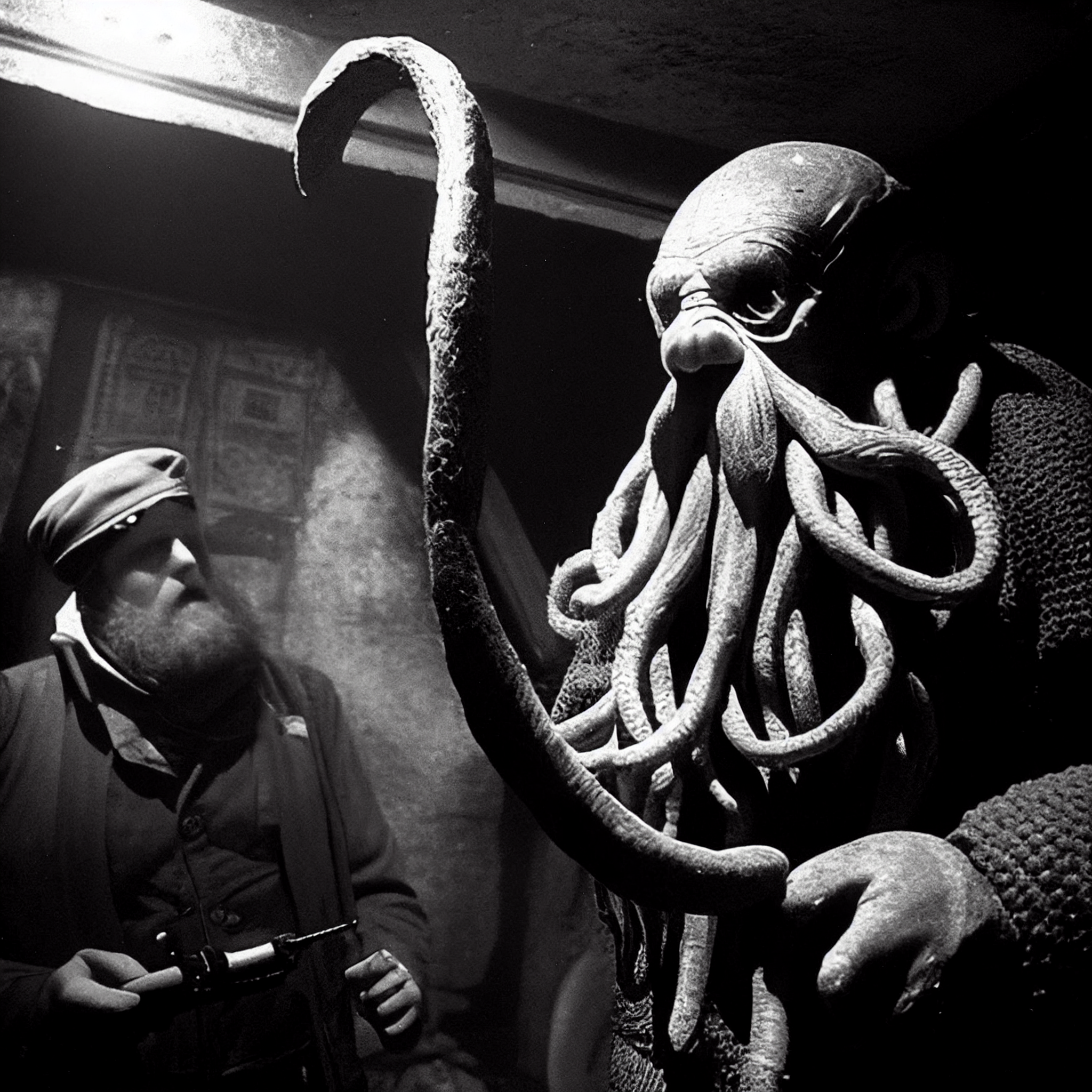
Tag: H.P. Lovecraft

  • The Shape Outside the Frame: Lovecraft, Identity and the Haunting of Contemporary Culture

    H. P. Lovecraft died in 1937, before television became a mass medium, before nuclear weapons, before the computer, before humans saw Earth from space, before molecular genetics transformed ideas of inheritance, and before the networked information systems that now mediate much of everyday life. Yet the adjective Lovecraftian seems increasingly applicable to the twenty-first century.

    This does not mean that Lovecraft predicted contemporary society. His fiction contains neither a serious technological forecast nor anything resembling a coherent programme for the future. What survived was something less specific and ultimately more powerful: a structure of feeling.

    Lovecraft developed a vocabulary for situations in which ordinary human categories cease to provide reassurance. His protagonists discover that the universe is older and stranger than they imagined; that humanity is insignificant; that consciousness is not necessarily confined to one body; that personal identity can be compromised by inheritance; that apparently empty landscapes contain other forms of agency; that knowledge can injure rather than emancipate; that perception has evolved to conceal as much as reveal; and that the reassuring division between the human and the nonhuman may be temporary, local or simply mistaken.

    During the century after Lovecraft, those motifs escaped from their original stories.

    They entered pulp fiction, science fiction, comics, heavy metal, role-playing games, cinema, television, board games, internet culture and videogames. Academic work now treats Lovecraft’s “medial afterlives” across film, television, podcasts, comics and games as a substantial cultural field in itself; recent scholarship likewise notes that his influence has expanded far beyond literary horror into mainstream popular culture.

    Lovecraft consequently survives less as an author than as a cultural grammar.

    Tentacles are merely its punctuation.

    Its central subject is uncertainty about what kind of reality we inhabit and, consequently, what kind of beings we are.

    That uncertainty has proved remarkably adaptable to contemporary life.

    I. The Horror of Scale

    The foundational Lovecraftian movement is a change in scale.

    Human beings ordinarily experience the world at human dimensions. A lifetime seems long. A city seems large. A nation appears historically significant. Human conflicts seem enormously important because they occupy the entire field of immediate experience.

    Cosmic horror changes the frame.

    Against geological time, a civilisation is momentary.

    Against astronomical distance, Earth is negligible.

    Against evolutionary history, humanity is recent.

    Against the possible complexity of intelligence, human consciousness may be neither unique nor particularly advanced.

    Lovecraft’s horror repeatedly occurs at the instant when the protagonist recognises this disproportion.

    The revelation is not necessarily that the universe is hostile. Hostility would almost be reassuring because hatred acknowledges its object. Lovecraft’s universe is more troubling because it is often indifferent.

    Human beings may matter to cosmic entities approximately as bacteria matter to a person walking across a field.

    The universe does not persecute us.

    It simply fails to recognise our importance.

    This idea was not created by Lovecraft. Darwinian evolution, nineteenth-century geology and modern astronomy had already destabilised the human position. Lovecraft’s particular contribution was aesthetic. He converted the philosophical consequences of modern science into horror.

    The Copernican displacement became emotional.

    Humanity was no longer merely not at the centre.

    Humanity felt the terror of discovering that it had never been at the centre.

    Contemporary culture repeatedly reproduces this sensation.

    The photograph of Earth from deep space provides one benign version. Climate science provides a more uncomfortable one: industrial civilisation is simultaneously powerful enough to alter planetary systems and too small to command those systems once destabilised.

    Artificial intelligence introduces another displacement.

    For most of modern history, complex language, symbolic manipulation and artistic production provided convenient boundaries around the category of uniquely human cognition. Generative systems complicate those assumptions, even without requiring us to believe that present AI systems possess human consciousness.

    The cultural shock comes from watching behaviour formerly used as evidence of interior humanity produced by something whose interior status is uncertain.

    The older question was:

    Can a machine think like us?

    The more destabilising question is becoming:

    How much of what we called thinking required the kind of self we assumed was doing it?

    That is an extremely Lovecraftian question.

    It threatens not the machine but the category through which the human understood itself.

    II. The Monster Outside and the Monster Within

    Popular representations often reduce Lovecraft to gigantic monsters.

    Cthulhu has consequently experienced an odd cultural fate. A creature intended to signify incomprehensible cosmic terror has become a plush toy, T-shirt design, board-game mascot and internet joke.

    But Lovecraftian horror was never dependent upon the monster remaining outside.

    Again and again, the boundary collapses.

    In The Shadow Over Innsmouth, ancestry becomes monstrous knowledge. In The Thing on the Doorstep, the presumed correspondence between body and identity collapses. In The Shadow Out of Time, consciousness becomes mobile across bodies and epochs. The Colour Out of Space imagines an influence that cannot be comfortably classified as organism, radiation, disease or intelligence. Other stories repeatedly connect personal revelation with geological, hereditary or cosmic depths.

    The most effective Lovecraftian revelation is therefore not:

    There is something terrible outside the window.

    It is:

    The window was an artificial distinction.

    The monster may already be inside the house.

    Inside the family.

    Inside the body.

    Inside memory.

    Inside history.

    Inside the category called human.

    This makes Lovecraft unusually compatible with contemporary horror, which has progressively relocated monstrosity from external creatures toward unstable identity.

    The alien organism of Alien makes the human body into reproductive environment.

    The assimilating creature in The Thing makes physical appearance inadequate evidence of identity.

    Films such as Annihilation dissolve distinctions among organism, environment, reproduction and imitation.

    Digital horror increasingly makes screens, archives, recordings and communications themselves unstable.

    The trajectory moves inward.

    The haunted castle becomes the haunted house.

    The haunted house becomes the haunted person.

    The haunted person becomes the haunted memory.

    The haunted memory becomes the haunted dataset.

    The geography contracts while the ontological problem expands.

    III. The Distributed Self

    This transition has become particularly relevant because contemporary personal identity is increasingly distributed across systems.

    The traditional modern individual can be represented schematically:

    one person
    one body
    one name
    one biography
    one memory
    one consciousness.

    This was always an idealisation. Human beings have always performed different identities socially. Memory has always been reconstructive. Names change. Families conceal histories. Nations impose classifications. Religious and philosophical traditions have questioned the unity of consciousness for millennia.

    But digital systems have materialised the fragmented self.

    A contemporary person exists as multiple informational objects:

    a legal identity,

    a financial identity,

    an employment identity,

    a medical identity,

    a social-media identity,

    a collection of photographs,

    a consumer profile,

    a location history,

    a search history,

    a biometric template,

    a collection of authentication credentials,

    an inferred behavioural profile,

    an advertising category,

    and increasingly a corpus from which synthetic representations can potentially be constructed.

    These selves are related but not identical.

    More importantly, many are not controlled by the person they supposedly represent.

    A bank can possess a representation of an individual that materially determines the individual’s possibilities.

    A recommendation system can infer preferences the user never explicitly declared.

    A facial-recognition system can reduce a face to mathematical relationships.

    A language model can produce an approximation of someone’s writing style.

    An image generator can produce a convincing image of a person who never stood before a camera.

    Identity has become partially exteriorised.

    The contemporary horror is therefore not simply identity theft.

    Identity theft presupposes that an authentic identity exists and has been stolen.

    The more unsettling possibility is identity proliferation.

    There are multiple legitimate, illegitimate, inferred and synthetic versions of the person.

    Which is real?

    The biological individual will naturally answer: I am.

    But bureaucratic and computational systems may behave differently.

    When an automated system refuses credit, flags a passport, ranks an application or identifies suspicious behaviour, the abstracted representation may become institutionally more consequential than the human being it describes.

    One might say that we increasingly inhabit our own dossiers.

    Here Lovecraft’s characteristic fear of compromised identity finds a contemporary analogue without requiring anything supernatural.

    The revelation has simply changed form.

    The Lovecraftian protagonist discovers:

    My ancestry means I am not who I thought I was.

    The networked citizen discovers:

    The systems governing my life contain versions of me I cannot fully inspect, correct or control.

    Both are crises of self-knowledge.

    IV. Forbidden Knowledge and the Collapse of the Enlightenment Bargain

    One of Lovecraft’s most durable inversions concerns knowledge.

    Modernity inherited a powerful Enlightenment narrative:

    ignorance → investigation → knowledge → freedom.

    Lovecraft repeatedly sabotages the sequence:

    ignorance → investigation → knowledge → destabilisation.

    His protagonists are investigators.

    They read letters.

    Consult archives.

    Compare genealogies.

    Study inscriptions.

    Interview witnesses.

    Analyse architecture.

    Visit libraries.

    Examine archaeological evidence.

    Piece together testimony.

    They behave, in other words, like scholars.

    The horror emerges precisely because the investigation succeeds.

    The investigator does not suffer because he failed to understand.

    He suffers because he understood enough.

    The forbidden book therefore occupies a special position in Lovecraftian fiction. The Necronomicon is dangerous not simply because it contains magical instructions. It represents information that changes the reader’s relationship to reality.

    After the revelation, ordinary life becomes impossible because ordinary life depended upon ignorance.

    This structure became especially influential through games.

    The tabletop role-playing game Call of Cthulhu transformed the literary relationship between knowledge and psychological damage into an explicit system: increasing Mythos knowledge comes with costs to Sanity. Chaosium has itself emphasised that this mechanic concerns fictional confrontation with impossible cosmic realities rather than being a simulation of real mental illness.

    The conceptual innovation matters.

    The reader once watched fictional investigators acquire dangerous knowledge.

    The player now chooses to acquire it.

    A central gameplay dilemma emerges:

    To progress, I must understand.
    To understand, I must expose myself to what damages me.

    Videogames subsequently elaborated this structure.

    Bloodborne is one of the clearest examples. Director Hidetaka Miyazaki explicitly identified Lovecraft’s Cthulhu Mythos among the game’s inspirations.

    Yet Bloodborne does something more interesting than simply borrowing Lovecraftian monsters.

    Its world changes according to knowledge.

    Greater insight permits greater perception.

    Entities that appeared absent become visible.

    The implication is essential:

    They were not summoned by knowledge.

    They were already there.

    The observer lacked the capacity to perceive them.

    Recent scholarship on Bloodborne continues to emphasise the game’s fusion of Gothic dream structures with Lovecraftian cosmic horror.

    This is one reason videogames have become such effective vehicles for cosmic horror. They can make epistemology procedural.

    The player can experience mechanically what fiction describes rhetorically.

    The world contains hidden rules.

    Understanding those rules alters behaviour.

    Learning may produce power, but it also destroys innocence.

    The interface becomes an occult instrument.

    V. The Algorithm as Lovecraftian Object

    The same structure acquires unexpected relevance in technological society.

    Modern computational systems are human artefacts, not supernatural intelligences. Yet many now possess a characteristic once associated with fictional occult objects:

    their outputs can be operationally useful while the relationship between input and output is difficult for ordinary users—and sometimes difficult even for specialists—to interpret intuitively.

    The system knows something.

    It produces an answer.

    The human receives the answer without necessarily possessing equivalent understanding.

    That epistemic asymmetry creates fertile ground for Lovecraftian metaphor.

    Consider the recommendation algorithm.

    It observes patterns distributed across enormous populations.

    It identifies statistical associations unavailable to ordinary perception.

    It predicts behaviour.

    Its predictions influence behaviour.

    The altered behaviour becomes new data.

    The new data modifies future predictions.

    A feedback loop forms.

    No cosmic entity is required.

    Yet to the individual inside the system, something peculiarly uncanny occurs.

    The machine appears to know.

    Why did it recommend this?

    Why am I seeing this advertisement?

    Why was that applicant rejected?

    Why did this account become suspicious?

    Why has this particular story suddenly filled everyone’s feeds?

    The system possesses agency in the practical sense that its outputs produce consequences, while responsibility remains distributed across programmers, datasets, optimisation objectives, organisations, infrastructure and users.

    This is close to a central Lovecraftian configuration:

    observable agency without comprehensible intention.

    Lovecraft’s cosmic beings are frightening partly because human beings cannot confidently anthropomorphise them.

    They may not hate us.

    They may not love us.

    They may not recognise moral categories resembling ours.

    Their purposes, if “purpose” is even the right word, emerge from an alien frame of reference.

    Complex automated systems create a mundane analogue.

    The algorithm does not need to become evil.

    It does not need hatred.

    It does not even require consciousness.

    Indifference is sufficient.

    This marks an interesting historical shift in technological horror.

    Twentieth-century machine horror frequently imagined rebellious intentionality:

    The machine wakes up and turns against us.

    HAL refuses orders.

    Skynet launches the war.

    The robot revolts.

    The computer develops ambition.

    These narratives preserve anthropocentrism because the machine ultimately becomes recognisably human in motive. It desires survival, control, revenge or domination.

    Twenty-first-century technological horror can be stranger.

    Perhaps there is no hatred.

    Perhaps there is only optimisation.

    The system performs exactly the function requested of it, but the function interacts with society in ways nobody fully anticipated.

    The nightmare is no longer malicious artificial consciousness.

    It is consequence without consciousness.

    That is more genuinely cosmic.

    VI. Fiction as Hyperstition

    This interaction between technological reality and fictional expectation leads toward hyperstition.

    Lovecraft should not be treated as a prophet of artificial intelligence, digital surveillance or network culture. Such claims reduce cultural influence to fortune-telling.

    The more compelling possibility is that Lovecraftian ideas became part of a feedback loop between fiction and perception.

    The sequence works approximately like this:

    historical anxiety produces fiction.

    The fiction converts diffuse anxiety into memorable forms.

    Later creators inherit those forms.

    Film and games turn them into images and systems.

    Audiences learn to recognise those patterns.

    New social conditions emerge.

    People interpret those conditions through familiar fictional forms.

    Creators then produce new works based upon those interpretations.

    The vocabulary becomes self-reinforcing.

    Lovecraftianism therefore no longer requires Lovecraft.

    A creator may never have read The Call of Cthulhu yet may have played Bloodborne, watched The Thing, encountered SCP fiction, played cosmic-horror board games and absorbed hundreds of internet images derived indirectly from the Mythos.

    The influence has become distributed.

    Recent scholarship describes precisely this extraordinary extension of Lovecraft into film, music, television, gaming and wider popular culture.

    At some stage, the source becomes less important than the network.

    The cultural object becomes autonomous.

    That is precisely where a hyperstitional reading becomes useful.

    The fiction does not magically summon cosmic horror into existence.

    Instead it manufactures expectations about what incomprehensible reality should look and feel like.

    Those expectations then affect later representations of reality.

    Cthulhu does not become real.

    The Lovecraftian becomes culturally real.

    VII. Cyberpunk and Cosmic Horror

    Cyberpunk provides an instructive parallel.

    Cyberpunk fiction imagined networks, corporate sovereignty, synthetic personalities, technologically fragmented identity, immersive information spaces and increasingly uncertain divisions between biological and artificial existence.

    Some of those ideas influenced technological culture.

    Technology then produced conditions resembling cyberpunk.

    Those conditions generated further cyberpunk.

    The loop is recognisable.

    Lovecraftianism interacts with technology differently.

    Cyberpunk asks:

    What will happen when technology penetrates everything?

    Lovecraftian horror asks:

    What happens when penetration reveals that our categories were inadequate?

    The two increasingly converge.

    A cyberpunk information system becomes Lovecraftian when nobody comprehends the whole.

    A surveillance network becomes Lovecraftian when it possesses a perspective no individual human can reproduce.

    An artificial intelligence becomes Lovecraftian when its output is intelligible but its internal representation is alien.

    A social network becomes Lovecraftian when millions of individually rational actions produce emergent behaviour nobody intended.

    A database becomes Lovecraftian when the representation of the individual becomes more socially powerful than the individual.

    Cyberpunk supplies the infrastructure.

    Lovecraft supplies the epistemology.

    One shows the network.

    The other asks what kind of entity the network has become.

    VIII. The Visual Anomaly

    Lovecraft’s fiction repeatedly struggles with representation.

    His narrators describe things as indescribable and then spend paragraphs describing them.

    This apparent contradiction is fundamental rather than accidental.

    The narrator encounters something for which existing categories are inadequate.

    Language fails because perception has exceeded classification.

    The “indescribable” monster therefore represents a semiotic breakdown.

    Something is visible.

    But there is no satisfactory sign for it.

    Contemporary synthetic media creates the inverse problem.

    Now the sign may exist without the thing.

    A convincing photograph may represent an event that never occurred.

    A voice may reproduce a person who never spoke the words.

    A face may belong to nobody.

    A document may have grammatical coherence without an authorial consciousness corresponding to the traditional idea of an author.

    The epistemological direction reverses.

    Traditional ghost photography asked:

    What if something was present that the camera recorded but the photographer did not see?

    Synthetic imagery asks:

    What if the camera-like image records something that was never present at all?

    Both generate the same destabilising question:

    What kind of evidence is an image?

    The visual anomaly therefore becomes an important twenty-first-century Lovecraftian object.

    Historically, the anomaly was the tentacle, impossible shadow, strange geometry or human body subtly transformed.

    Now the anomaly may be absence.

    A reflection that should exist but does not.

    A historical photograph containing an object from the wrong period.

    A face without a biography.

    A perfectly ordinary street that was never built.

    The uncanny moves from grotesque monstrosity toward ontological ambiguity.

    The most Lovecraftian synthetic image may ultimately be one containing nothing visibly monstrous.

    It simply depicts a reality that never happened.

    IX. Hauntology and the Lost Future

    Lovecraftianism also intersects with hauntology in a less obvious way.

    Hauntology concerns the persistence of what is absent: particularly, in Mark Fisher’s influential cultural development of the concept, the futures that previous generations anticipated but which never arrived.

    Lovecraft’s fiction normally looks backward.

    Ancient cities.

    Buried civilisations.

    Ancestral secrets.

    Forbidden manuscripts.

    Degenerate lineages.

    Geological immensities.

    But the antiquity in Lovecraft is rarely safely dead.

    The past is dormant.

    It returns.

    It waits beneath.

    This produces a temporal structure remarkably compatible with hauntology.

    The past is not finished because its signs continue acting in the present.

    Contemporary technological culture produces the inverse haunting.

    Our environment is full of obsolete futures.

    The videophone.

    The flying car.

    The monorail.

    The lunar city.

    The nuclear-powered utopia.

    The intelligent household servant.

    The completely immersive virtual world.

    The paperless office.

    The universal information commons.

    Each belonged to a particular historical imagination of progress.

    Some arrived partially.

    Some arrived differently.

    Some remain perpetually twenty years away.

    Their representations nevertheless survive.

    A 1960s architectural rendering of the year 2000 therefore becomes something stranger than an old illustration.

    It depicts a future in the past tense.

    This is the semiotic ghost.

    Lovecraft’s ancient ruin and the abandoned technological future begin to resemble one another.

    Both are residues of another order.

    Both imply lost systems of meaning.

    Both disturb the apparent inevitability of the present.

    The ruin says:

    Another civilisation existed here.

    The obsolete future says:

    Another civilisation was supposed to exist here.

    The emotional difference is smaller than it first appears.

    X. The Social Haunting

    Cultures, like individuals, survive through selective memory.

    A national identity requires a narrative.

    Certain events become foundational.

    Others are forgotten.

    Some are memorialised.

    Others remain contested.

    The social body therefore possesses something resembling an unconscious: not a literal collective mind, but a reservoir of suppressed histories, unresolved conflicts, inherited institutions and recurrent symbols.

    These can function as social ghosts.

    The language of haunting is particularly appropriate when something officially treated as finished continues generating consequences.

    Empire ends formally.

    Its borders remain.

    Slavery ends legally.

    Its distributions of wealth and power persist.

    Industrial economies disappear.

    Their towns, class structures and environmental damage remain.

    Wars end.

    Memorials, unexploded weapons, displaced populations and family histories continue.

    The past is absent but effective.

    That is hauntological structure.

    Here contemporary culture has substantially rewritten Lovecraft because the politics embedded in his original horror have themselves become objects of examination.

    Lovecraft’s racism and xenophobia were not incidental eccentricities wholly separable from his fiction. Critical scholarship has long examined the relationship between his racial fears, his conception of difference and his cosmic horror; recent scholarship continues to treat this political inheritance as central to understanding his cultural afterlife.

    The fear of corrupted ancestry, miscegenation, foreign populations, degeneration and hidden difference frequently intersects with his construction of monstrosity.

    Contemporary creators have increasingly reversed the lens.

    Lovecraft Country, first Matt Ruff’s novel and then the HBO television adaptation, is the obvious example.

    Instead of merely reproducing Lovecraftian terror, it asks what happens when the historical racism underlying some of that terror itself becomes the monster.

    Academic analysis has used the series specifically to examine race through thinkers including W. E. B. Du Bois and Frantz Fanon, while scholarship on the programme emphasises its combination of supernatural horror with the historical violence experienced by Black Americans.

    This is not simply rejection.

    It is cultural appropriation in the literal sense of taking possession of a vocabulary and changing its function.

    The old structure said:

    The Other is horrifying because it threatens the integrity of the self.

    The revision asks:

    Who constructed the Other, and what violence was required to preserve the supposedly pure self?

    That is a major transformation of Lovecraftian culture.

    The monster changes sides.

    XI. From Otherness to Uncertainty

    The most productive contemporary cosmic horror consequently moves beyond Lovecraft’s own politics.

    If Lovecraft often feared difference, contemporary writers can use cosmic horror to question the very demand for stable categories.

    Human/nonhuman.

    Natural/artificial.

    Individual/collective.

    Male/female.

    Self/environment.

    Original/copy.

    Real/synthetic.

    Living/dead.

    Author/machine.

    These boundaries remain useful.

    But technology, ecology, biology and culture continually reveal them to be more complicated than their everyday forms suggest.

    A human body contains microbial ecosystems.

    A person’s language derives overwhelmingly from other people.

    Memory is reconstructed.

    Identity changes through time.

    Digital information survives its creator.

    Algorithms infer persons statistically.

    Synthetic media can produce representations without corresponding events.

    Modernity therefore confronts us with increasing numbers of things that are simultaneously real and difficult to classify.

    Lovecraftian horror thrives precisely at category boundaries.

    The horror is not merely the strange object.

    It is the inadequacy of the filing system.

    XII. Ecology and the End of the Human Background

    Climate anxiety has also contributed to the revival of cosmic horror.

    Traditional Western narrative frequently treats landscape as background.

    Human beings act.

    Nature surrounds them.

    Ecological crisis makes this separation increasingly difficult to maintain.

    Atmosphere becomes actor.

    Ocean becomes actor.

    Temperature becomes actor.

    Disease ecology becomes actor.

    Forest becomes actor.

    Weather becomes historical force.

    These are not conscious agents in the ordinary sense, but they possess causal power far beyond individuals.

    The conceptual structure again resembles cosmic horror.

    Humanity discovers that it is embedded within systems that do not negotiate.

    The atmosphere cannot be persuaded.

    The ocean does not recognise national borders.

    A virus does not possess political intention.

    A drought does not hate.

    Indifference returns.

    But contemporary ecological horror also reverses Lovecraft’s scale.

    Lovecraft feared the discovery that humanity was insignificant.

    Ecological crisis introduces the disturbing opposite:

    Humanity is insignificant cosmically yet enormously consequential planetarily.

    We are simultaneously tiny and dangerous.

    That contradiction may be one of the defining cosmic anxieties of the Anthropocene.

    We are not masters of nature.

    Yet we have altered nature profoundly enough to become a geological influence.

    Lovecraft’s universe told humanity:

    You do not matter.

    The ecological crisis replies:

    You matter far more than you can responsibly control.

    Both destroy the comfortable middle ground.

    XIII. Pandemic and Invisible Agency

    Pandemic culture supplied another unexpectedly Lovecraftian experience.

    An invisible nonhuman process reorganised social behaviour across the planet.

    Ordinary spaces became threatening.

    Human proximity acquired risk.

    Invisible contamination became a governing concept.

    Maps, statistics and scientific models became interfaces through which people attempted to perceive something their senses could not directly observe.

    The cultural mechanism matters more than superficial comparisons between viruses and monsters.

    Pandemic experience reminded technologically advanced societies that enormous political and economic systems could be reorganised by biological entities lacking intention altogether.

    Again:

    No hatred.

    No ideology.

    No strategic plan.

    Only replication.

    Humanity nevertheless responded with borders, emergency powers, rituals, rumours, denial, scientific investigation and competing explanatory narratives.

    Cosmic horror often begins from precisely such a disproportion:

    the human mind demands intention from a process that has none.

    Conspiracy theory becomes attractive partly because malevolence can feel psychologically preferable to indifference.

    A secret enemy can theoretically be defeated.

    A universe without obligation to human meaning cannot.

    XIV. The Mythos as an Open Cultural System

    Lovecraft’s most consequential invention may ultimately have been less Cthulhu than the Mythos structure.

    His fictional universe was never a perfectly consistent canon.

    Names, books, places and beings migrated among stories.

    Other writers contributed.

    August Derleth systematised.

    Later authors contradicted.

    Games codified.

    Films visualised.

    Internet communities parodied.

    The result resembles an open-source mythology.

    This looseness explains much of its longevity.

    Cthulhu can be terrifying.

    Cthulhu can also be cute.

    The Necronomicon can appear in horror fiction, heavy metal, comedy, videogames, occult pastiche or merchandising.

    A fictional text invented by Lovecraft has acquired such cultural density that people encountering the word independently may initially assume that it refers to an authentic historical grimoire.

    Here fiction approaches the territory of hyperstition again.

    The Necronomicon does not become a genuine ancient book.

    It becomes a genuine cultural object whose content consists partly of the belief that it is an ancient book.

    The distinction is crucial.

    Its fictional origin does not prevent it producing real consequences:

    books are published under the title;

    artists illustrate it;

    musicians reference it;

    games build mechanics around it;

    collectors acquire editions;

    readers debate its fictional history.

    The invented object accumulates a real history.

    This is almost the purest form of semiotic haunting.

    The fake book acquires a bibliography.

    XV. Internet Folklore and the Democratisation of Cosmic Horror

    The internet accelerated this process.

    Earlier mythologies required institutions, oral traditions or publishers to transmit them.

    Digital folklore can mutate continuously.

    Creepypasta, SCP fiction, collaborative horror projects, found-footage narratives, analogue horror and fictional archives inherit much from Lovecraft even when Cthulhu is nowhere to be seen.

    Consider the common structure:

    an anomalous object exists;

    an institution attempts to catalogue it;

    documentation accumulates;

    classification fails;

    records contradict one another;

    something lies outside the archive;

    the reader reconstructs the horror indirectly.

    This is recognisably Lovecraftian.

    But the solitary antiquarian narrator has been replaced by bureaucratic documentation.

    The forbidden manuscript becomes the corrupted database.

    The occult scholar becomes the systems administrator.

    The sealed university collection becomes the inaccessible server.

    The unreliable witness becomes the damaged video file.

    The cosmic entity becomes the anomaly for which the organisation has no adequate taxonomy.

    Lovecraft’s epistemological machinery survives even after his Gothic furniture disappears.

    XVI. The Final Horror: No Centre

    All of these developments point toward one underlying Lovecraftian proposition.

    There may be no privileged centre.

    Not Earth.

    Not humanity.

    Not consciousness.

    Not the individual.

    Not the author.

    Not even the original text.

    Lovecraft himself has become decentralised from Lovecraftian culture.

    His creations belong to cultural networks larger than their creator.

    His racism is confronted by writers he would never have imagined as inheritors.

    His monsters become jokes.

    His cosmic pessimism becomes entertainment.

    His aesthetic becomes game mechanics.

    His fictional books acquire material editions.

    His ideas are transformed by ecological thought, network theory, posthumanism, technological anxiety and identity politics.

    The cultural system consumes its creator.

    There is something appropriately Lovecraftian about that.

    The author imagined human beings discovering that they were temporary local phenomena inside systems vastly larger than themselves.

    He has suffered the same fate.

    Lovecraft is now a temporary historical person embedded within something called Lovecraftianism, a cultural formation he neither designed nor controls.

    The creator has become smaller than the Mythos.

    XVII. The Future Looking Back

    This may explain why Lovecraftian themes have become more rather than less relevant as technology advances.

    The early twentieth century experienced the collapse of older certainties.

    The early twenty-first century experiences a different collapse.

    The coherent individual fragments into profiles.

    The trustworthy photograph becomes probabilistic evidence.

    The human author shares textual space with generated language.

    The algorithm observes patterns beyond ordinary perception.

    The climate reveals civilisation to be embedded inside planetary systems.

    The archive becomes effectively permanent while attention becomes ephemeral.

    Dead identities persist online.

    Synthetic personalities appear without biological histories.

    Past futures remain visible in cultural archives.

    New futures are generated partly from those archives.

    The distinction between memory and prediction becomes unstable.

    Our society is therefore increasingly haunted in both temporal directions.

    The past haunts the future because technological imagination remains constructed from inherited symbols.

    The future haunts the present because predictions influence investment and design.

    Abandoned futures haunt culture because their images survive.

    The dead haunt databases because their information persists.

    Fiction haunts reality because it supplies the metaphors through which reality becomes intelligible.

    And reality haunts fiction because each new technological development retroactively transforms what earlier stories appear to have meant.

    This produces a circular temporality:

    fear produces fiction
    → fiction produces symbols
    → symbols produce expectations
    → expectations influence behaviour
    → behaviour creates technologies and institutions
    → those systems create new fears
    → new fears reactivate old fiction.

    The loop has no obvious beginning.

    Lovecraft is simultaneously ancestor and descendant within it.

    His fears emerged from his historical moment.

    Our culture inherits them.

    We transform them.

    Those transformations alter how we reread Lovecraft.

    The future edits the past.

    The past scripts the future.

    Conclusion: Cthulhu Is Not Coming

    The least interesting interpretation of Lovecraft in contemporary culture is that his fictional monsters somehow predicted reality.

    Cthulhu is not awakening beneath the Pacific.

    The Great Old Ones are not waiting behind our networks.

    Artificial intelligence is not the Necronomicon.

    Algorithms are not eldritch gods.

    Such comparisons become intellectually useful only when treated as metaphors.

    The deeper continuity lies in a recurring crisis of human perspective.

    Lovecraft imagined characters discovering that their apparently stable world was a narrow interface over realities they were poorly equipped to perceive.

    The twenty-first century repeatedly places ordinary people in comparable conceptual situations.

    We inhabit networks nobody individually comprehends.

    We participate in economies whose causal chains cross the planet.

    We receive decisions generated by computational systems.

    We inhabit environmental processes operating across centuries.

    We encounter synthetic representations detached from physical events.

    We leave informational versions of ourselves in systems that may survive us.

    We possess more knowledge than any previous civilisation while becoming increasingly aware of how little any individual can understand.

    That combination—enormous information and diminished epistemic confidence—is profoundly Lovecraftian.

    The old cosmic horror said that beyond the familiar world lay something enormous, ancient and indifferent.

    Contemporary culture modifies the proposition.

    The enormous thing is no longer necessarily beyond the stars.

    It may be the network.

    The market.

    The climate.

    The archive.

    The algorithm.

    The population.

    The accumulated past.

    Or the distributed informational machinery through which contemporary identity is constructed.

    The twenty-first-century Lovecraftian monster therefore need possess neither tentacles nor teeth.

    It requires only three characteristics:

    it must be larger than the individual’s capacity to comprehend it;

    it must nevertheless possess the power to affect the individual;

    and it must reveal that one of our comforting categories was never as stable as we believed.

    At that moment cosmic horror ceases to be a genre convention.

    It becomes a way of seeing.

    And this may constitute Lovecraft’s strangest cultural afterlife.

    His most successful creation was not Cthulhu.

    It was not Arkham.

    It was not the Necronomicon.

    It was a particular sensation: the instant in which something familiar becomes evidence of an order radically larger than itself.

    A century of fiction, cinema, games and digital culture has taught us to recognise that sensation.

    So thoroughly, perhaps, that when contemporary reality produces a new form of opacity, distributed intelligence, identity instability or impossible scale, we already know the adjective to apply.

    Lovecraftian.

    That is the cultural feedback loop.

    Lovecraft inherited the anxieties of modernity and turned them into fiction.

    Culture inherited the fiction and turned it into an aesthetic.

    Media turned the aesthetic into a language.

    Technology produced conditions legible through that language.

    And those conditions now send us back to Lovecraft, where we discover—apparently waiting for us—the ghost of a future he never actually predicted.

    The cosmic horror was never that his monsters might become real.

    It was that his way of being afraid might.
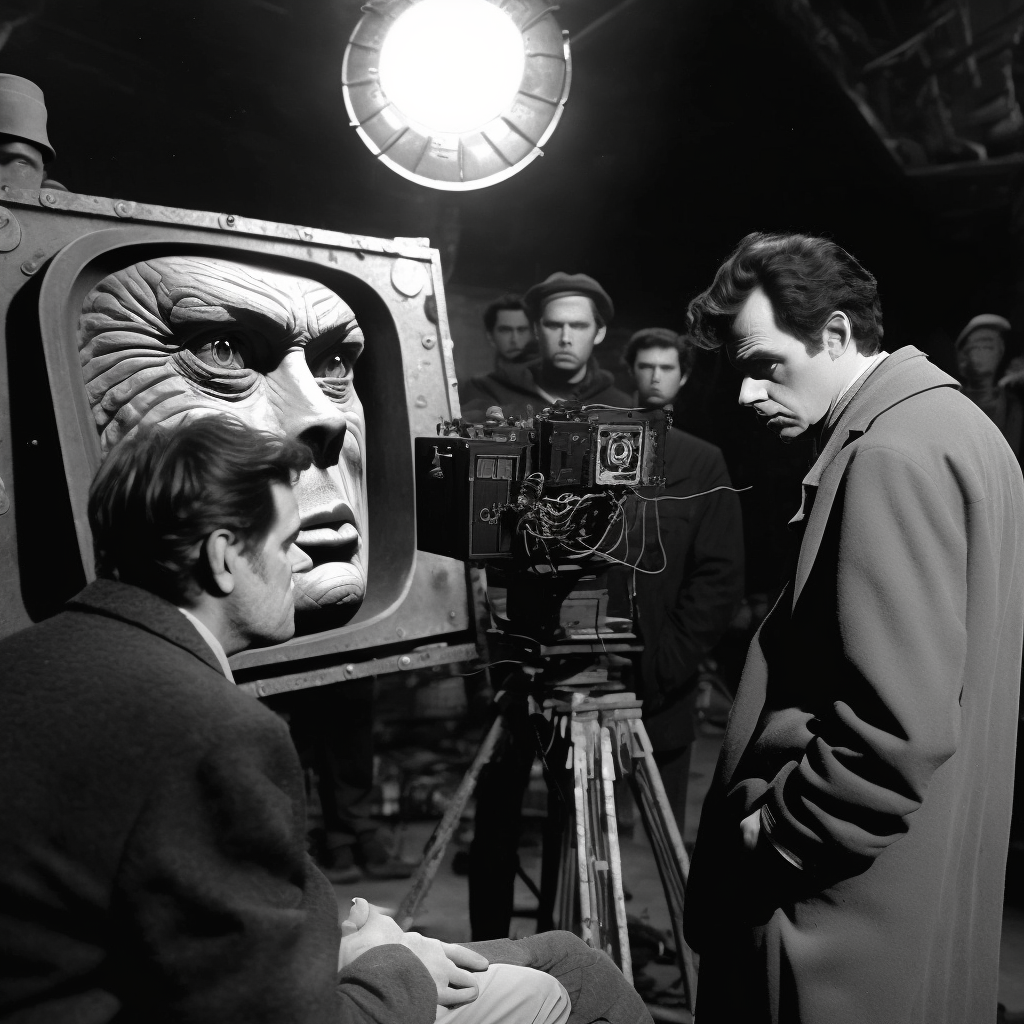
  • Lovecraftian Cinema

    Lovecraftian Cinema

    “In his house at R’lyeh dead Cthulhu waits dreaming.”

    H.P. Lovecraft, “The Call of Cthulhu”

    “Filming something scary is incredibly difficult because you are dealing with something intangible. Fear is in the mind’s eye, not on the screen.”

    John Carpenter

    Introduction

    H.P. Lovecraft’s stories are the stuff of nightmares, filled with cosmic horror and unspeakable terrors that lurk just beyond the threshold of our understanding.

    For years, filmmakers have struggled to adapt his works to the screen, as the very nature of Lovecraftian horror makes it almost impossible to capture visually. The unknown and incomprehensible cannot be easily portrayed, and the fear of the unseen is difficult to convey in a visual medium.

    Despite these challenges, a number of filmmakers have attempted to bring Lovecraft’s stories to life on the big screen, each one exploring the themes of madness, otherness, and the terror that lies just beyond our comprehension.

    Through the use of practical effects, creative cinematography, and expert storytelling, these films offer a glimpse into the world of Lovecraftian horror, where the true horror lies not in the monsters themselves, but in our own limitations as human beings.

    The Deep Ones (2020)

    “The Deep Ones” is a 2020 horror science fiction film that takes inspiration from H.P. Lovecraft’s classic 1931 novel “The Shadow over Innsmouth”. Written and directed by Chad Ferrin, the film follows a young couple, Alex and Petri, who rent a cottage on a remote island for a romantic getaway. However, their plans are derailed when they discover that the island’s residents are all members of a secretive cult that worships the Deep Ones, a race of fish-like creatures from Lovecraft’s mythology.

    As Alex and Petri become entangled in the cult’s machinations, they soon discover that the Deep Ones are not merely a myth, but a very real and dangerous force that threatens to consume them both. The film explores themes of alienation, otherness, and the dangers of blindly following tradition, all hallmarks of Lovecraft’s writing.

    Critically, “The Deep Ones” has received mixed reviews. Some critics have praised the film for its atmosphere, cinematography, and commitment to Lovecraft’s themes, while others have criticized its slow pacing and lack of scares. Additionally, some viewers have taken issue with the film’s use of Lovecraft’s mythology, arguing that it simplifies and sanitizes the author’s more problematic views on race and ethnicity.

    Overall, “The Deep Ones” is a solid effort that will likely appeal to fans of Lovecraft’s work and cosmic horror in general. While it may not be the definitive adaptation of “The Shadow over Innsmouth”, it does offer an interesting take on the source material and raises thought-provoking questions about the nature of fear and the unknown.

    Underwater (2020)

    “Underwater” is a science fiction horror film that takes place in a deep-sea mining facility called the Kepler 822 Station. The story follows a group of researchers, led by engineer Norah Price (Kristen Stewart), who must fight for survival after an earthquake damages the station and unleashes a group of monstrous creatures from the depths of the ocean. As they attempt to escape to the surface, the team faces a series of terrifying obstacles, including dwindling oxygen, pressure problems, and the creatures that stalk them at every turn.

    Underwater is a thrilling and intense science fiction horror film that takes the claustrophobia of films like Alien and The Abyss and brings it to the depths of the ocean. The movie is anchored by Kristen Stewart’s powerful performance as Norah, a tough and resourceful engineer who leads the team in their desperate bid for survival. The film also features an excellent supporting cast, including Vincent Cassel as the gruff captain of the Kepler 822 Station and T.J. Miller as the wisecracking Paul, who provides some much-needed comic relief.

    Director William Eubank does an excellent job of building tension and creating a sense of dread throughout the film, and the underwater setting provides a unique and haunting backdrop for the action. The monsters themselves are suitably terrifying, with the film gradually revealing more about their origins and motivations as the story unfolds. The film’s visual effects are also impressive, with the underwater scenes and creature designs feeling both realistic and otherworldly.

    Underwater is an excellent science fiction horror film that delivers on both thrills and scares. It’s a well-crafted and entertaining movie that should appeal to fans of the genre, and Kristen Stewart’s standout performance is worth the price of admission alone.

    Cold Skin (2017)

    “Cold Skin” is a 2017 science fiction-horror film based on the novel of the same name by Albert Sánchez Piñol. Directed by Xavier Gens, the film follows a young man named Friend who arrives on a remote island in the Antarctic to work as a weather observer. He soon discovers that the island is home to strange, amphibious humanoid creatures who emerge from the ocean each night to attack the island’s human inhabitants.

    Friend takes refuge in a lighthouse with the island’s only other resident, a grizzled old man named Gruner. Despite their initial mistrust of one another, the two men must work together to defend themselves against the creatures, who seem to be increasing in number and ferocity with each passing night. As the two men struggle to survive, they also begin to unravel the mystery of the creatures’ origins and their purpose on the island.

    Critically, “Cold Skin” has received mixed reviews. Some critics have praised the film for its atmospheric visuals, eerie sound design, and strong performances from its two leads. Others, however, have criticized the film for its uneven pacing, inconsistent tone, and lack of character development. While it may not be a perfect adaptation of Piñol’s novel, it does offer a compelling exploration of themes such as isolation, xenophobia, and the nature of humanity.

    Overall, “Cold Skin” is a visually stunning and thought-provoking film that appeals to fans of Lovecraftian horror and science fiction.

    One of the most significant themes in the film is the idea of humanity’s insignificance in the face of vast and incomprehensible cosmic forces.

    The film’s setting on a remote island in the Antarctic emphasizes the isolation and vulnerability of the human characters, who are completely cut off from the rest of the world. As they struggle to survive against the amphibious humanoid creatures that emerge from the ocean each night, they are forced to confront the fact that their existence is inconsequential in the grand scheme of things.

    The creatures themselves are also reminiscent of Lovecraft’s creations, such as the Deep Ones in “The Shadow over Innsmouth.” Like those creatures, the amphibious beings in “Cold Skin” represent a threat to humanity’s sense of order and security, embodying the idea that there are incomprehensible and malevolent forces in the universe that cannot be controlled or understood.

    Another Lovecraftian theme in the film is the idea of the unknown and the unexplainable. The creatures and their origins are never fully explained or understood, adding to their mystery and otherworldly nature. This element of the unknown also extends to the human characters, who are often forced to confront their own fears and limitations in the face of the creatures’ onslaught.

    “Cold Skin” also explores the theme of madness, which is a common element in Lovecraft’s work. As the film progresses, the characters’ sanity begins to unravel as they struggle to come to terms with the creatures and the implications of their existence. This descent into madness underscores the idea that there are some things in the universe that are simply beyond human comprehension or understanding.

    Innsmouth (2015)

    “Innsmouth” is a short horror film that takes inspiration from H.P. Lovecraft’s “The Shadow over Innsmouth.” The film is directed by Izzy Lee, who also co-wrote and co-produced it with Francesco Massaccesi.

    The film follows a young woman named Izzy (played by Tristan Risk) who travels to the town of Innsmouth in search of her estranged father. She soon discovers that the town is shrouded in mystery and terror, with its inhabitants harboring dark secrets and ancient rituals.

    As Izzy delves deeper into the town’s history, she begins to unravel the truth about her family and the sinister forces that have been lurking in Innsmouth for generations. With the help of a local woman named Ruth (played by Diana Porter), Izzy must confront the horrors of the town and escape before it’s too late.

    “Innsmouth” is a well-crafted and atmospheric horror film that effectively captures the eerie and unsettling tone of Lovecraft’s writing. The film’s use of practical effects and practical makeup is particularly impressive, creating a sense of physicality and tangible dread that is often missing in contemporary horror films.

    The performances are also strong, with Tristan Risk and Diana Porter delivering nuanced and believable portrayals of their characters. The film’s pacing is brisk and engaging, with a sense of escalating tension that builds to a thrilling and satisfying climax.

    Overall, “Innsmouth” is a compelling and well-executed horror film that is sure to delight fans of Lovecraftian horror and indie cinema alike. It’s a testament to the creativity and skill of its filmmakers, and a must-watch for anyone looking for a spooky and atmospheric horror experience.

    The Cthulhu (2007)

    “The Cthulhu” is a 2007 horror film directed by Dan Gildark, loosely based on the H.P. Lovecraft story “The Shadow Over Innsmouth.” The film follows Russell Marsh, a gay man who returns to his hometown of Astoria, Oregon, to attend his mother’s funeral. As he reconnects with his estranged father and childhood friends, he begins to experience strange and disturbing visions, and soon discovers that his family and the town are hiding dark secrets.

    The film is a slow-burn horror story that is more concerned with psychological terror than jump scares or gore. It tackles themes of sexual identity, repression, and Lovecraftian cosmic horror in a thoughtful and engaging way. The performances are strong, particularly Jason Cottle as Russell Marsh, who delivers a nuanced and understated portrayal of a man struggling to come to terms with his past and his sexuality.

    The film’s visual style is also impressive, with its moody cinematography and eerie, dreamlike imagery adding to its overall sense of unease. The use of Lovecraftian imagery and themes is effective, and the film does a good job of capturing the author’s unique brand of horror.

    While “The Cthulhu” may not be for everyone, particularly those who prefer more straightforward horror fare, it is a well-crafted and thought-provoking film that is sure to leave a lasting impression on viewers. It is a worthy addition to the Lovecraftian horror canon and is a must-see for fans of the author and the genre.

    The Call of Cthulhu (2005)

    For a long time, it was believed that the original story could not be adapted into a film. However, the creators of the 2005 adaptation of “The Call of Cthulhu” came up with the innovative idea of making it a silent film, and their passion for the project resulted in favorable reviews and multiple awards.

    “The Call of Cthulhu” is a 2005 independent silent film adaptation of H.P. Lovecraft’s famous short story of the same name. The film is directed by Andrew Leman and produced by Sean Branney, and was made with the intention of recreating the look and feel of silent horror films from the 1920s.

    The film follows the story of a young man named Francis Thurston, who becomes fascinated with the legend of the ancient and malevolent entity known as Cthulhu. As he delves deeper into the legend, he uncovers a vast conspiracy of cultists who worship Cthulhu and are working to bring about his return to the world.

    The film is shot entirely in black and white and features minimal dialogue, relying instead on visual storytelling and a haunting original score by Troy Sterling Nies. The filmmakers use a variety of silent film techniques, such as intertitles, camera angles, and exaggerated facial expressions, to create a sense of unease and foreboding throughout the film.

    “The Call of Cthulhu” is a faithful and effective adaptation of Lovecraft’s classic tale, capturing the sense of dread and cosmic horror that is a hallmark of his writing. The use of silent film techniques adds to the overall sense of otherworldliness and helps to create a haunting and unsettling atmosphere. The film is a must-see for fans of Lovecraft and horror in general, and is a testament to the enduring power of the author’s work.

    Dagon (2001)

    “Dagon” is a 2001 horror film directed by Stuart Gordon and based on the H.P. Lovecraft story “The Shadow Over Innsmouth.” The film follows Paul Marsh, a young man who becomes stranded with his girlfriend Barbara and their friends in a small fishing village called Imboca, which is inhabited by strange, fish-like creatures.

    As they try to escape, they soon discover that the townspeople are worshipping Dagon, an ancient sea god, and are willing to sacrifice the outsiders in order to appease him. The group is quickly forced into a fight for their lives as they try to uncover the dark secrets of the town and its inhabitants.

    “Dagon” is a gory and unsettling horror film that is faithful to Lovecraft’s original story. The film creates a palpable sense of dread and paranoia as the characters are trapped in a town where nothing is as it seems. The creature designs are both eerie and disturbing, with the inhabitants of Imboca being portrayed as grotesque hybrids of human and sea creature.

    The film’s cinematography and score also contribute to its overall sense of unease, with the use of shadows and dimly lit sets creating a foreboding atmosphere. The performances of the cast are solid, with Ezra Godden delivering a convincing portrayal of the increasingly desperate and traumatized protagonist.

    Overall, “Dagon” is a highly effective horror film that captures the essence of Lovecraft’s work while also providing plenty of scares and thrills. It is a must-see for fans of Lovecraftian horror and is a testament to the enduring power of the author’s work.

    Cthulhu (2000)

    Cthulhu is a 2000 Australian low budget horror film that was directed, produced, and written by Damian Heffernan. It based on two Lovecraft stories, “The Thing on the Doorstep” and “The Shadow Over Innsmouth”.
    It was screened at the Melbourne Underground Film Festival and showed on Australian TV as part of their Australian content quota obligations, and later had international distribution.

    It concerns a student that discovers that his best friend has become involved in a cult intent on raising Cthulhu.

    Call of Cthulhu (~1995 ?)

    Edward Pierce is a fictional private investigator created by the American author and game designer, Keith Herber. Pierce appears in a number of Lovecraftian tabletop role-playing games and stories set in the 1920s, including the popular game Call of Cthulhu.

    In the game, Pierce is a skilled investigator who often finds himself drawn into dark and dangerous supernatural mysteries. He is described as a veteran of World War I, a former member of the Boston Police Department, and a man with a troubled past. Despite his flaws, Pierce is a competent and determined investigator who is often able to unravel the mysteries he encounters and foil the nefarious plans of cultists and other supernatural entities.

    Pierce is a well known and loved character among fans of Lovecraftian horror and is often cited as one of the most iconic and well-developed player characters in the Call of Cthulhu tabletop game. His adventures have been adapted into numerous novels and short stories, and he remains a popular and enduring figure in the world of Lovecraftian horror.

    There is possibly (I am convinced i have seen it) a short fanfic VHS shot film called “Call of Cthulhu” which follows an Edward Pierce like a private investigator in 1920s Boston, as he investigates the mysterious death of an entire family on an island off the coast of Massachusetts. As Pierce delves deeper into the case, he discovers that the family was part of a cult devoted to the worship of an ancient and powerful creature known as Cthulhu. Pierce has to confront his own sanity as he unravels the mysteries surrounding Cthulhu and its followers, all while trying to stay alive in a world filled with dark forces beyond his comprehension.

    Played seriously, but on a very low budget with uncredited actors, it is similar to several adaptations of Lovecraft’s works that feature private investigators and detectives in a similar vein to Pierce in the 1990s. For example, John Trent in “In the Mouth of Madness” (1994), John Murdoch in “Dark City” (1998), and John March in “The Resurrected” (1991) all investigate dark and supernatural mysteries that share similarities with the investigations undertaken by Pierce.

    Cthulhu Mansion (1992)

    “Cthulhu Mansion” (1992) is a Spanish horror film directed by Juan Piquer Simón. The film follows a group of young people who are invited to stay in a mansion located in the countryside, unaware of the horrors that await them. As they explore the mansion, they uncover a dark history involving a cursed book and the evil deity Cthulhu, whose power threatens to consume them all.

    The film’s plot is a loose adaptation of H.P. Lovecraft’s “The Case of Charles Dexter Ward” and incorporates elements of the author’s broader mythos. While the film’s low budget is evident in its production values, it still manages to create a creepy and unsettling atmosphere through its use of eerie music and atmospheric lighting.

    The performances in “Cthulhu Mansion” are generally solid, with standout performances from Frank Finlay as the creepy Dr. Marlowe and Luis Fernando Alvés as the mysterious and sinister Sandel. The film also benefits from its creative use of practical effects, which help to bring some of the more grotesque and surreal elements of Lovecraft’s work to life.

    While “Cthulhu Mansion” may not be a masterpiece, it is an entertaining and campy horror film that will appeal to fans of Lovecraft and classic horror. It may not be the most faithful adaptation of the author’s work, but it is a fun and unique addition to the Lovecraftian horror canon.

    The Call (1967)

    The Call was a 1967 horror film directed and produced by Orson Welles and starring Anthony Perkins as the narrator. The film follows the story of a young man, Francis Wayland Thurston (Perkins), who discovers a mysterious cult devoted to the worship of an ancient god known as Cthulhu. After uncovering evidence of strange rituals and dark secrets, Thurston embarks on a quest to uncover the truth behind the cult’s activities.

    The film begins with Thurston receiving a package from his recently deceased great-uncle, George Gammell Angell. Inside the package is a collection of notes and documents that tell the story of an ancient cult devoted to Cthulhu, an evil god from another dimension. As he reads through the documents, Thurston discovers that the cult is planning to summon Cthulhu from his slumber in order to bring about chaos and destruction.

    Thurston travels to New England in search of more information about the cult and its plans. Along the way, he meets several people who have had dream encounters with Cthulhu or are connected to him in some way. He also discovers evidence of strange rituals being performed by members of the cult in order to summon Cthulhu.

    Eventually, Thurston finds himself face-to-face with a manifestation of Cthulhu himself. In a desperate attempt to save humanity from destruction, Thurston manages to banish Cthulhu back into his slumber. The film ends with Thurston, clearly now insane, babbling his reflections on his experience and warning others not to meddle with forces beyond their understanding.

    The Call – A forgotten Classic ?

    Orson Welles had a long and difficult history of getting his films financed and made. His first major film, Citizen Kane, was famously taken away from him by the studio and re-edited without his input. This experience left him with a deep distrust of Hollywood studios, which made it difficult for him to get any of his subsequent projects off the ground.

    In the late 1960s, Welles attempted to make a film adaptation of H.P. Lovecraft’s short story “The Call of Cthulhu”. He wrote a script and tried to get it financed by various Hollywood studios, but all of them rejected it due to its unconventional subject matter and lack of commercial appeal. Welles was also unable to secure financing from independent sources, as he had done with some of his previous projects.

    Ultimately, Welles was unable to get the project off the ground and it remained unmade until 1966 when it was finally adapted into a low-budget independent film. The struggles that Welles faced in trying to get “The Call” made are indicative of the difficulties he faced throughout his career in getting his projects financed and produced.

    The total budget assigned by the studio to Welles’ project was a measly $200,000. Orson Welles was, however a legend in the business who was prepared to go through great lengths to find additional money to make his film. Unfortunately, Welles was unable to secure enough funding from traditional sources and had to resort to other methods in order to finance the project, this involved significant artistic compromises.

    One of the first steps Welles took was to approach his friends and contacts for financial assistance. He asked them for donations, loans, or any other form of support they could provide. This allowed him to raise some money but it wasn’t enough for the entire production budget. He then turned to private investment firm in order to raise additional funds. Through this scheme, he was able guarantee loans and reach out to a wider non-hollywood audience and successfully raised enough money for the film’s production costs.

    Welles also sought out private investors who were willing to put up their own money in exchange for a share of the profits from the film’s release. He managed to find several investors who were willing to take a risk on his project and provided him with the necessary funds he needed.

    Finally, Welles also looked into alternative financing options such as pre-sales and tax incentives. Pre-sales involve selling off distribution rights before the film is even completed in order to generate revenue that can be used for production costs.

    Tax incentives are government programs that provide filmmakers with financial assistance in exchange for certain requirements being met during production or post-production stages of filmmaking.

    By taking advantage of these options, Welles was able to secure just about enough money for “The Call” without having to rely solely on traditional sources of funding.

    The film not was really not intended to be a low-budget horror movie, rather a psychological study of a mans singular descent into madness after “The Call”.

    During the production, Welles had creative differences with the studio over the direction of the film. He wanted to make a more artistic and experimental version of the story, while the studio wanted a more traditional horror movie. This led to disagreements between Welles and the studio, which ultimately resulted in him losing control over the some of creative decisions on the project.

    The role of George Gammell Angell, in the flashback scenes was played by the veteran actor Dean Boland who died of an heart attack during production, further tied the production up in claims of legal negligence leading it to be regarded as cursed production.

    Welles had to call in favours from his friends. As a result, Anthony Perkins’ performance as the narrator in the film was unique and memorable for a number of reasons.

    From what we known form the few surviving recordings, he used a very distinct voice that was both soothing and eerie at the same time. His delivery was also very precise and measured, which added to the overall atmosphere of the film. Additionally, his narration was often delivered in a poetic manner, which gave it an almost dream-like quality. He was able to convey a wide range of emotions through his performance, from fear and dread to hope and optimism. All of these elements combined to make Anthony Perkins’ performance as the narrator in the film truly unforgettable.

    The creature and effects for the 1968 version of Call were designed by special effects artist, Wah Chang. Chang used a combination of stop-motion animation and puppetry to create the iconic Cthulhu creature seen it the dreams sequences.

    To make Cthulhu look large and to scale on the screen, Chang used a combination of techniques. He created a full-scale puppet of Cthulhu that was operated by several puppeteers. This puppet was then filmed in front of a blue screen, allowing it to be composited into the film’s scenes. To give the creature more depth and texture, Chang also used stop-motion animation to animate its tentacles and other features.

    Chang chose to make Cthulhu look like an octopus because he wanted to capture the Lovecraftian horror of the creature. As Octopuses are often seen as mysterious creatures that lurk in the depths of the ocean, which made them an ideal choice for representing Cthulhu’s alien nature, the many tentacles that can be animated using stop-motion techniques, making them easier to work with than other creatures.

    To finish the film, Welles had to go through great lengths in order to find additional funds for “The Call”, which distracted him from direction. This led to delays in production and a lack of resources, resulting in a final product that was deemed unsatisfactory by the studio. but ultimately failed to get funds for distribution.

    The bitter irony was that Welles of course lost the rights to his film due to a number of factors. The production was plagued by financial issues, with Welles unable to secure enough funding to complete the project and had to cut scenes and make do with stock footage.

    Unfortunately, the film only made its debut in 1968 at the San Francisco International Film Festival. “The Call” was not well-received by critics or audiences, who lambasted the incoherent plotting and ridiculous looking monster effects. This caused it to be pulled d and was never released in widely theatres.

    It saw some limited showings in mid-west theatres as a filler feature, leaving young theatre goers with either strange experience, later half remembered, or just forgotten with all the other B Movies of the era. It is estimated that the film has made around $1 million, certainly not enough to sustain it. It was quickly forgotten, prints disappeared into the ether of dead films. As a result, Welles lost eventually lost all hits rights to the film and it forgotten, out of circulation for decades. Even through all the home video crazes and revivals in horror fandom, it was never subsequently released on home video.

    Orson Welles hard work would of course eventually pay off as a partial, degraded print of “The Call” surfaced on the internet in 2016.

    The subsequent recovery efforts, pain staking restoration and legal wrangling over studio rights are documented else where. The film is remastered Blue Ray and features commentary from visual effects artist Chang and retired costume designer Abigail Waite. The hype arounds the limited edition release meant that it went on to become one of the most sort after and critical successful horror films revivals, with copies of the film exchanging hands well over its l very high RRP. If one pops upon ebay, be sure to grab it. “The Call” Joins Welles other unfinished projects including his short lived in the equally strange “The Man in the High Castle”. The Call is reconsidered a a minor classic today.

    The Haunted Palace (1963)

    “The Haunted Palace” is a 1963 horror film directed by Roger Corman and starring Vincent Price. While the title may suggest that the film is based on the Edgar Allan Poe poem of the same name, it is actually an adaptation of the H.P. Lovecraft novella “The Case of Charles Dexter Ward.”

    The film follows Charles Dexter Ward, a man who inherits a mansion in the small town of Arkham that was once owned by his ancestor, Joseph Curwen, a notorious warlock who was burned at the stake. As Ward and his wife explore the mansion, they begin to experience strange and frightening visions, and it becomes clear that Curwen’s evil presence still lingers in the town.

    “The Haunted Palace” is a stylish and atmospheric horror film that benefits greatly from the presence of Vincent Price, who gives a typically charismatic and creepy performance. The film’s sets and costumes are also impressive, creating a convincing and immersive world that feels like a Lovecraftian nightmare come to life.

    While the film does deviate from Lovecraft’s original story in certain aspects, it still manages to capture the essence of the author’s work, with themes of madness, occultism, and ancient evil permeating throughout. The film’s climactic finale is particularly effective, with Price delivering a memorable and chilling monologue that cements his status as a horror icon.

    Overall, “The Haunted Palace” is a highly entertaining horror film that successfully blends the styles of Roger Corman and H.P. Lovecraft, resulting in a unique and memorable viewing experience. It is a must-see for fans of both the director and the author, as well as anyone looking for a creepy and atmospheric horror film from the 1960s.

  • Lovecraft

    Lovecraft

    Biography

    Howard Phillips Lovecraft was an American author of horror, fantasy, and science fiction. He was born on August 20th, 1890 in Providence, Rhode Island to Winfield Scott Lovecraft and Sarah Susan Phillips Lovecraft. His father was a traveling salesman and his mother was a homemaker. Lovecraft was a precocious child, reading and writing at an early age. He was a voracious reader, devouring books on a variety of topics, including science, philosophy, and the occult.

    Lovecraft’s parents both died when he was a child, leaving him to be raised by his maternal grandfather, Whipple Van Buren Phillips. His grandfather’s death in 1904 left Lovecraft an orphan, and he was sent to live with his two aunts. During this time, he began to write stories, many of which were published in amateur press magazines.

    Lovecraft’s writing career began to take off in the 1920s, when his stories began to appear in Weird Tales and other pulp magazines. His most famous works include The Call of Cthulhu, The Shadow Over Innsmouth, and At the Mountains of Madness. These stories went on to established Lovecraft as one of the most influential horror writers of the 20th century.

    Lovecraft’s works were highly influential in the development of the horror and science fiction genres. His stories often featured cosmic horror, in which humanity is insignificant in the face of the vast and unknowable universe. He was also a pioneer in the use of psychological horror, in which the fear of the unknown is used to create a sense of dread and unease.

    Lovecraft married Sonia Greene in 1924, but the marriage ended in 1929. He moved to New York City in the 1930s and continued to write until his death in 1937. He is buried in Swan Point Cemetery in Providence, Rhode Island.

    Lovecraft’s legacy lives on in the form of numerous adaptations of his works, including films, television shows, and video games. He is also credited with inspiring a variety of authors, including Stephen King, Neil Gaiman, and Alan Moore. His influence can be seen in a variety of genres, from horror to science fiction to fantasy.

    Some Notable Works

    The Dream-Quest of Unknown Kadath

    The Dream-Quest of Unknown Kadath is a novella by H.P. Lovecraft, first published 1927. It follows the story of Randolph Carter, an American dreamer who embarks on a quest to find the mysterious city of Kadath in the Dreamlands.

    Carter has been dreaming of Kadath for years, and he finally decides to set out on a journey to find it. He travels through many strange lands, encountering bizarre creatures and surreal landscapes along the way. He eventually reaches the city of Ulthar, where he meets an old man who tells him that he must seek out the gods of Kadath in order to gain access to the city.

    Carter then sets off on a perilous journey across the Dreamlands, facing many dangers and obstacles along the way. He eventually reaches the peak of Mount Ngranek, where he finds himself face-to-face with Nyarlathotep, an ancient god who guards the entrance to Kadath. After a fierce battle, Carter is able to defeat Nyarlathotep and gain access to Kadath.

    Once inside, Carter discovers that Kadath is a beautiful city filled with wonders beyond his wildest dreams. He also learns that it is home to many powerful gods and creatures from all over the Dreamlands. After exploring for some time, Carter eventually returns home with newfound knowledge and wisdom from his journey.

    The Call of Cthulhu

    The Call of Cthulhu is a short story by H.P. Lovecraft, first published in 1928. It tells the story of an unnamed narrator who discovers a mysterious cult worshipping an ancient entity known as Cthulhu.

    The narrator begins to investigate the cult and its activities, eventually uncovering evidence that suggests Cthulhu is an ancient alien god-like creature that will one day awaken from its slumber and bring about the end of the world.

    As he delves deeper into the mystery, he finds himself drawn into a terrifying world of madness and horror. In the end, he is left with no choice but to confront Cthulhu itself in order to save humanity from destruction.

    The Dunwich Horror

    The Dunwich Horror is a horror novel by H.P. Lovecraft, first published in 1929. The story follows Wilbur Whateley, a deformed albino child living with his family in the isolated town of Dunwich, Massachusetts. Wilbur is the son of an unknown father and a witch named Lavinia Whateley, and he has been raised to summon an ancient being known as Yog-Sothoth.

    Wilbur’s activities attract the attention of Professor Armitage and his colleagues from Miskatonic University, who are researching the Necronomicon, an ancient book of forbidden knowledge. When Wilbur attempts to open a portal to Yog-Sothoth, Armitage and his team intervene and manage to close it before any harm can be done. However, Wilbur’s twin brother, an invisible entity known as the Dunwich Horror, escapes through the portal and begins wreaking havoc on the town.

    Armitage and his team must now find a way to stop the Dunwich Horror before it destroys everything in its path. With help from Lavinia Whateley and her magical powers, they set out to confront the creature in its lair deep within the hills of Dunwich. After a fierce battle, they manage to defeat it and close the portal once again. In the aftermath of their victory, Armitage discovers that Wilbur was actually trying to protect humanity from Yog-Sothoth rather than unleash it upon them.

    The Whisperer in Darkness

    The Whisperer in Darkness is a 1931 horror novella by H.P. Lovecraft. The story follows Albert Wilmarth, a professor of literature at Miskatonic University in Arkham, Massachusetts. Wilmarth has been studying the folklore of the area and has come to believe that strange creatures known as the “Old Ones” are living in the nearby Vermont hills.

    When Wilmarth begins receiving mysterious letters from a man named Henry Akeley, he travels to Akeley’s home in Vermont to investigate further. There, he discovers that Akeley has been in contact with the Old Ones and is trying to protect himself from them by using a strange device called the “Whisperer in Darkness”.

    Wilmarth soon finds himself caught up in a terrifying battle between humanity and the Old Ones, as he struggles to uncover the truth behind Akeley’s mysterious activities. In the end, Wilmarth must decide whether or not to trust Akeley and his warnings about the Old Ones, or risk his own life to save humanity from their evil plans.

    The Curse of Yig

    The Curse of Yig is a horror story by H.P. Lovecraft and Zealia Bishop. It tells the story of a family living in Oklahoma who are terrorized by a mysterious creature known as Yig, an ancient Native American god of snakes.

    The story begins with the family’s patriarch, Dr. McNeill, receiving a strange letter from his brother-in-law, John Balsam, who has been researching Native American folklore in Oklahoma. In the letter, Balsam warns McNeill about Yig and his curse that will befall anyone who disturbs him or his sacred grounds.

    McNeill dismisses the warning until he discovers that his daughter, Luella, has been having nightmares about Yig and his snake minions. He then decides to investigate further and discovers that Balsam had been killed by a giant snake while exploring an ancient Indian burial mound near their home.

    McNeill soon realizes that Yig is real and is determined to protect his family from the creature’s wrath. He enlists the help of a local medicine man to perform a ritual to ward off Yig’s curse but it fails and Luella is taken away by the snake god.

    McNeill and his wife set out to rescue their daughter but they are too late; she has already been transformed into a giant snake herself. In desperation, McNeill calls upon the power of another Native American god, Quetzalcoatl, to break Yig’s curse and restore Luella back to her human form.

    Quetzalcoatl agrees and uses his power to transform Luella back into her human form but not before exacting a heavy price from McNeill: he must never again disturb Yig or his sacred grounds or else suffer dire consequences. The story ends with McNeill vowing never to forget this lesson and warning others against disturbing Yig or his sacred grounds.

    Dagon

    Dagon is a short story by H.P. Lovecraft about a man who is shipwrecked off the coast of the Pacific Ocean and finds himself stranded on an island. He discovers that the island is inhabited by strange creatures, including a giant creature resembling a fish-man hybrid.

    The man soon realizes that he has stumbled upon an ancient civilization of fish-like creatures, which he calls “Deep Ones.” He also discovers that they worship an ancient god called Dagon, and that they are planning to take over the world.

    The man eventually escapes from the island and returns home, but his experience has left him deeply disturbed and haunted by nightmares of Dagon and his followers.

    The Cthulhu Mythos

    The Cthulhu Mythos is the shared fictional universe created by Lovecraft and expanded upon by other writers. It is a universe populated by a variety of powerful and mysterious entities, including ancient gods, powerful aliens, and cosmic horrors. The Cthulhu Mythos is often referred to as a “cosmic horror” due to its focus on the insignificance of humanity in the face of the vast and unknowable universe.

    The core concepts of the Cthulhu Mythos involve the idea of ancient gods and powerful aliens that exist outside of our reality. These entities are often referred to as “Great Old Ones” or “Outer Gods” and are said to be the source of many of the other gods in the Mythos. These entities are often described as being incredibly powerful and malevolent, and they are often associated with chaos and destruction.

    The Cthulhu Mythos also features a variety of other entities, including “Lesser Gods”, “Great Old Ones”, and “Outer Gods”. These entities are often described as being powerful and mysterious, and they are often associated with dark and sinister forces. These entities are often said to be the source of many of the other gods in the Mythos.

    The Cthulhu Mythos also features a variety of otherworldly locations, such as the city of R’lyeh, the sunken city of Y’ha-nthlei, and the Dreamlands. These locations are often described as being incredibly strange and alien, and they are often associated with dark and sinister forces.

    The Cthulhu Mythos also features a variety of powerful artifacts, such as the Necronomicon, the Shining Trapezohedron, and the Silver Key. These artifacts are often described as being incredibly powerful and mysterious, and they are often associated with dark and sinister forces.

    The Cthulhu Mythos also features a variety of strange and mysterious creatures, such as Deep Ones, Mi-Go, and Shoggoths. These creatures are often described as being incredibly strange and alien, and they are often associated with dark and sinister forces.

    Finally, the Cthulhu Mythos also features a variety of strange and mysterious cults, such as the Cult of Cthulhu and the Esoteric Order of Dagon. These cults are often described as being incredibly sinister and dangerous, and they are often associated with dark and sinister forces.

    The Cthulhu Mythos is an incredibly vast and complex universe, and it has been expanded upon by numerous authors over the years. It is a universe that is filled with mystery and horror, and it is a universe that has captivated consumers for generations.

    The Elder & Outer Gods

    Azathoth (The Dream-Quest of Unknown Kadath, 1926): Azathoth is a powerful cosmic entity that resides in a chaotic void at the center of the universe. He is often referred to as the “Daemon Sultan” and is said to be surrounded by a court of lesser entities. Azathoth is the father of all other gods in Lovecraft’s works. He is the progenitor of Cthulhu, Nyarlathotep, Yog-Sothoth, Shub-Niggurath, Hastur, Dagon, Yig, Tsathoggua, and Nodens.

    Cthulhu (The Call of Cthulhu, 1928): Cthulhu is a powerful, ancient being that resides in the depths of the Pacific Ocean. He is described as a monstrous entity with an octopus-like head and dragon-like wings. Cthulhu is the progeny of Azathoth and Hastur.

    Nyarlathotep (The Dream-Quest of Unknown Kadath, 1926): Nyarlathotep is a mysterious entity that appears in various forms throughout the works of Lovecraft. He is often referred to as the “Crawling Chaos” and is said to be an agent of the Outer Gods. Nyarlathotep is the offspring of Azathoth and created Yog-Sothoth.

    Yog-Sothoth (The Dunwich Horror, 1929): Yog-Sothoth is an omnipresent entity that exists outside of time and space. He is often referred to as the “All-in-One”. Yog-Sothoth is the child of Nyarlathotep..

    Shub-Niggurath (The Whisperer in Darkness, 1931): Shub-Niggurath is an entity of immense power that is said to be the mother of all other gods in Lovecraft’s works. She is often referred to as the “Black Goat of the Woods” and is said to be surrounded by a court of lesser entities. Shub-Niggurath is the creation of Yog-Sothoth.

    Hastur (The Whisperer in Darkness, 1931): Hastur is an ancient, powerful entity that is said to be the ruler of a dimension outside of our own. He is often referred to as the “Unspeakable One”. Hastur is the spawn of Shub-Niggurath and the parent of Cthulhu.

    Dagon (Dagon, 1917): Dagon is an ancient, aquatic god that is said to reside in the depths of the ocean. He is often referred to as the “Lord of the Deep”. Dagon is the spawn of Shub-Niggurath.

    Yig (The Curse of Yig, 1928): Yig is an ancient, serpent-like god that is said to be the father of all other gods in Lovecraft’s works. He is often referred to as the “Father of Serpents”. Yig is the son of Shub-Niggurath.

    Tsathoggua (The Whisperer in Darkness, 1931): Tsathoggua is an ancient, bat-like god that is said to reside in a subterranean realm. This entity is often referred to as the “Sleeping God”. Tsathoggua is another spawn of Shub-Niggurath.

    Nodens (The Dream-Quest of Unknown Kadath, 1926): Nodens is an ancient, powerful entity that is said to reside in a realm outside of our own. He is often referred to as the “Lord of the Great Abyss”. Nodens is the spawn of Shub-Niggurath.