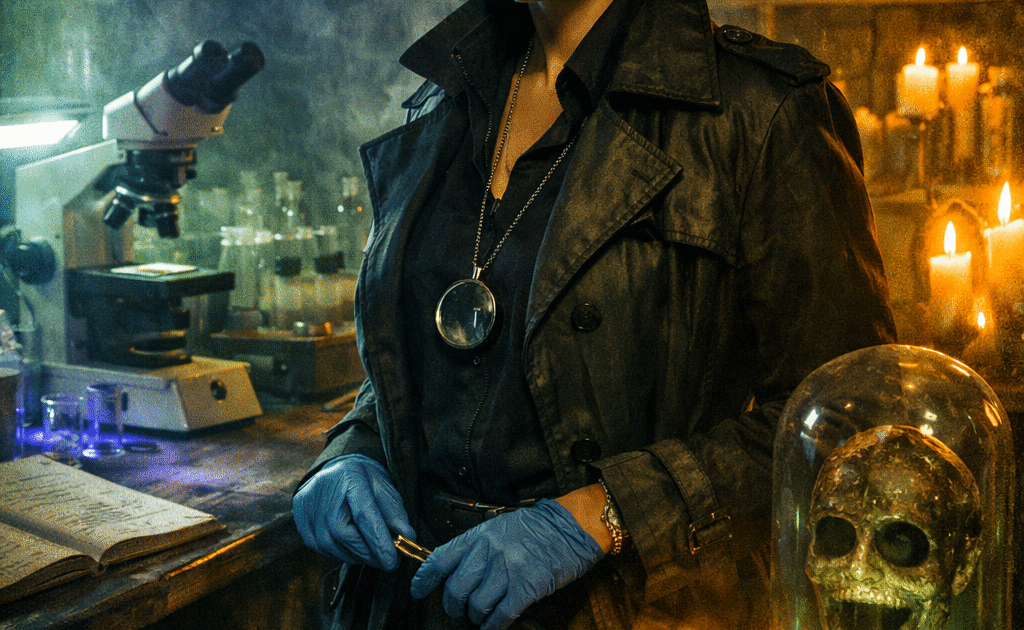
The Velveteen Husk
The damp of the Fens didn’t just cling to Dr. Elspeth Vale’s coat; it seemed to negotiate with her bones. She sat in the back of a rusted Land Rover, the driver—a silent, thick-necked man named Bram—steering them through a landscape of black soil and skeletal poplars.
Vale was an archivist of the “Soft Arts,” a specialist in the chemical decomposition of 20th-century polymers. To the public, she looked for puppets. To the insurance houses of Zurich and the private vaults of Macau, she was a forensic profiler of foam. She could tell the difference between 1968 DuPont urethane and a 1970s counterfeit by the way it smelled when it burned.
In her leather satchel lay a dossier on Arthur Penhaligon. To the trade, he was “The Taxidermist.” He didn’t stuff animals; he preserved the things that had never been alive to begin with. He was also the prime suspect in the 2018 disappearance of a Sotheby’s scout in the Yorkshire moors. No body, no blood—just an empty rental car and a single glass eye from a 1950s ventriloquist dummy left on the dashboard.
“We’re here,” Bram grunted.
Rising out of the mist like a jagged tooth was Crow’s End, a manor of rotting timber and flint. This was where the “Velveteen Husk” supposedly resided—the missing link between Jim Henson’s mother’s old coat and the birth of a global icon.
Flashback: Washington D.C., October 1955
The air in the small apartment smelled of burnt coffee and turquoise dye. A young man with a beard that hadn’t quite decided to stay sat at a kitchen table. In his hands was a pair of dressmaking shears.
He wasn’t making a toy. He was making a tool for a new kind of light—the television.
He took a discarded spring coat, a dull, pea-green wool that had seen too many winters. Beside it lay two halves of a Ping-Pong ball. He didn’t use a pattern. He moved by instinct, the way a butcher knows the grain of the meat.
As the shears bit into the fabric, a small, limbless shape began to emerge. It wasn’t a frog yet. It was a “Husk”—a proto-being with a wide, screaming mouth made of cardboard and red felt. He slipped his hand into its throat. The fabric was thin, allowing the subtle twitch of his thumb to look like a heartbeat.
This was the first one. The one that didn’t make it to the “Sam and Friends” set. It was the one he’d tossed into a scrap bin because the dye had run, creating a dark, bruised stain around the neck that looked uncomfortably like a ligature mark.
Crow’s End, March 2026
The heavy oak door groaned open. Arthur Penhaligon stood in the foyer, illuminated by the guttering orange glow of a gas fireplace. He was tall, gaunt, and wore a smoking jacket that looked like it had been stitched together from old theater curtains.
“Dr. Vale,” he whispered. His voice had the texture of dry rot. “You’ve come to see if the rumors are true. To see if the Husk has survived the hunger of the years.”
“I’ve come to prove provenance, Mr. Penhaligon,” Vale said, her voice steady despite the prickle of sweat on her neck. “My client doesn’t pay for myths. They pay for the DNA of the medium.”
Penhaligon smiled, and for a second, Vale thought of the missing Sotheby’s scout. The man’s teeth were too white, too perfect—like high-grade porcelain dentures from a period drama.
“The medium is a cruel mistress, Doctor. She demands skins. Come. Into the cellar. The humidity is… strictly controlled.”
He led her past walls lined with glass cases. These weren’t Muppets. These were the “Fakes”—grotesque, off-model parodies of children’s characters, their stitching intentional and jagged. They seemed to watch her.
As they descended the stone stairs, the smell hit her. It wasn’t just the acidic tang of degrading foam. It was something metallic. Something copper. Something that smelled like a butcher’s shop in the height of summer.
“You’re an expert in textiles,” Penhaligon said, stopping before a heavy steel vault door. “Tell me, Doctor… have you ever felt the skin of a god?”
He turned the dial. The heavy bolts slid back with a sound like a guillotine blade being primed.
Inside, resting on a velvet plinth under a single, harsh UV light, was the Husk. It was a sickly, bruised green, its mouth agape, its Ping-Pong ball eyes yellowed and cracked. But there was something wrong. The “stain” around its neck wasn’t just dye. It was thick, dark, and seemed to have soaked into the very fibers of the 1950s wool.
Vale stepped forward, her magnifying loupe trembling in her hand. She leaned in, the archivist’s instinct overriding the survival instinct.
“This isn’t just a prototype,” she whispered, the cold of the cellar finally reaching her heart. “This is a crime scene.”
Penhaligon stepped behind her, the heavy vault door swinging shut with a final, muffled thud.
“It’s both, Dr. Vale. In the world of high stakes, there is no difference.”
The Chromatography of Sin
The silence inside the vault was absolute, the kind of silence that has weight. It pressed against Vale’s eardrums, a physical manifestation of being six feet under the fenland silt.
“The door is soundproofed with lead-lined foam from the old BBC Lime Grove studios,” Penhaligon said, his voice now a smooth, terrifying purr. “Quite a poetic bit of salvage, don’t you think? History keeping us quiet.”
Vale didn’t turn around. She kept her eyes locked on the Husk. Her gloved fingers hovered millimeters from the bruised wool of the neck. Under the UV light, the dark stain didn’t glow the way organic proteins—blood, saliva—usually did. It absorbed the light, becoming a black hole in the center of the puppet’s throat.
“You didn’t bring me here to authenticate this, Arthur,” Vale said, her voice tight. “You brought me here to witness it.”
“Authentication is a cold word, Elspeth. I prefer consecration.” Penhaligon moved closer. He smelled of formaldehyde and expensive peppermint. “Every great artifact requires a sacrifice to pass from the world of ‘stuff’ into the world of ‘icons.’ That stain? That’s the moment the Husk became more than a discarded coat.”
Flashback: London, August 1976
The heatwave had turned the city into a kiln. Inside a cramped basement flat in Borehamwood, just a mile from Elstree Studios where The Muppet Show was filming its first season, a man named Geoffrey “Fingers” Malloy was sweating through his shirt.
On the table sat a battered cardboard box marked SCRAP – DO NOT REUSE.
Malloy was a driver for the production, a man with a gambling debt that reached from the dog tracks of Romford to the high-stakes backrooms of Mayfair. He had snatched the box from a dumpster behind the workshop, thinking it contained silk or high-grade foam he could sell to a rival toy firm.
Instead, he found the Husk.
It looked pathetic. A limp, pea-green ghost. But as Malloy reached into the box, a second man—a shadow in a sharp-collared leather jacket—stepped out of the kitchen.
“That’s not what I asked for, Geoffrey,” the shadow said. This was Silas Thorne, a ‘fixer’ for the emerging underground of TV memorabilia. “I wanted the pig. The blonde one.”
“The Pig’s under lock and key, Silas! This… this is the first one. I saw the notes in the workshop. This is the ancestor.”
Thorne stepped into the light. He didn’t look at the puppet; he looked at Malloy. He pulled a heavy glass ashtray from the sideboard.
“Ancestors are dead, Geoffrey. Only celebrities matter.”
The first blow caught Malloy on the temple. As he slumped over the table, his nose burst. The dark, arterial spray didn’t hit the floor. It was soaked up greedily by the thirsty 1955 wool of the puppet sitting in the open box. The green fabric turned a deep, bruised purple.
Thorne looked at the stained rag, disgusted. He tossed it back into the box, wiped the ashtray, and vanished into the London smog. The Husk sat in the dark, damp with the life of a dying man, its Ping-Pong eyes staring at nothing.
Crow’s End, March 2026
Vale pulled a small glass vial from her kit—a reagent designed to react with specific cleaning agents used in the late 70s. She dabbed a microscopic swab onto the Husk’s underside.
“Malloy,” she whispered.
Penhaligon froze. “You know the name?”
“I know the chemistry,” Vale replied, turning to face him. “This puppet was a ‘blood-soaked’ legend in the underground for decades. It disappeared from a police evidence locker in 1979. They thought it was destroyed in a fire. But you didn’t just find it, Arthur. You’ve been adding to it.”
She flicked her torch to a different frequency. The walls of the vault suddenly bloomed with hidden patterns. Splatters, handprints, and long, dragging streaks that led toward the back of the room, behind the plinth.
The “stain” on the puppet wasn’t just 1976 blood. It was layered. Like the rings of a tree, the Husk had been fed.
“The Sotheby’s scout,” Vale said, her heart hammering against her ribs like a trapped bird. “He wasn’t an expert in Muppets. He was an expert in provenance. He realized this wasn’t a prop anymore. It was a reliquary.”
Penhaligon’s face transformed. The urbane collector vanished, replaced by a man possessed by a singular, jagged madness. He reached into his smoking jacket and pulled out a pair of long, silver surgical shears—the kind used for delicate taxidermy.
“The foam is hungry, Elspeth,” he whispered. “Polyurethane degrades. It crumbles into dust. But I discovered that organic saturation—the infusion of lipids and proteins—slows the oxidation. It preserves the ‘flesh’ of the thing.”
He stepped toward her, the shears snicking open and shut with a rhythmic, metallic tictic.
“You’re the best archivist in the world. You understand the tragedy of decay. Help me, Elspeth. Help me make the Husk immortal. One more layer. One more ‘stain’ to seal the fibers for another fifty years.”
Vale backed away, her heel catching on the edge of the velvet plinth. She reached back, her hand brushing the cold, dry wool of the Husk.
As her fingers curled around the puppet’s head, she felt something. Something hard. Something that shouldn’t be inside a hollow, hand-stitched glove.
She didn’t scream. She didn’t run. She looked Penhaligon in his dead, porcelain eyes and did the only thing an archivist could do.
“You’re wrong about the chemistry, Arthur,” she said, her voice dropping to a low, dangerous growl. “Blood doesn’t preserve foam. It dissolves it. Look at the neck.”
Penhaligon paused, his gaze flickering down to the plinth.
In that second of hesitation, Vale’s fingers dug into the mouth of the Husk, ripping the 70-year-old cardboard throat wide open. Something tumbled out of the puppet’s gut and clattered onto the stone floor.
It wasn’t a prop mechanism.
It was a human thumb, mummified and preserved in a glass specimen jar, with a signet ring still cinched around the bone. The ring of the missing Sotheby’s scout.
“The provenance is proven,” Vale hissed. “And so is the murder.”
The Market of Shadows
The glass jar containing the mummified thumb rolled across the stone floor, the signet ring clicking against the granite like a gambler’s die.
Penhaligon didn’t flinch at the sight of the trophy. His eyes were fixed on the Husk, his expression one of agonizing heartbreak. He looked at the jagged tear Vale had ripped into the puppet’s throat—the 1955 cardboard substructure now exposed and shredded.
“You’ve ruined the silhouette,” he whispered. His voice was no longer a purr; it was the dry rattle of a snake in a box. “Do you have any idea how difficult it is to maintain the structural integrity of seventy-year-old cellulose? You’ve murdered the line.”
“I’ve exposed the truth, Arthur,” Vale said, her back against the lead-lined wall. Her hand went into her satchel, fingers brushing against a pressurized canister of de-acidification spray—pure, concentrated isopropyl alcohol and magnesium oxide. A makeshift flamethrower, if she could find a spark. “You didn’t just ‘find’ this in 1984. You’ve been the silent partner in every tragedy this rag has touched.”
Flashback: Soho, London, November 1984
The city was a bruise of neon and wet asphalt. Inside a basement club called The Gutter, where the air was thick with the scent of cloves and cheap amphetamines, the Husk sat on a grimy Formica table.
A man known as “Blind” Eddie—who could see perfectly well but wore dark glasses to hide a glass eye stolen from a BBC props department—pushed the puppet toward a young, pale Arthur Penhaligon.
“It’s cursed, Artie,” Eddie rasped, his breath smelling of gin and decay. “Since Silas Thorne did that job in Borehamwood, the thing’s been through four hands. Every one of ’em ended up in the Thames or a shallow grave in the Fens. They say the wool remembers the scream.”
The 1984 version of Penhaligon was already obsessed. He reached out with gloved hands—even then, he was careful. He didn’t see a curse. He saw a masterpiece of minimalist design being slowly eaten by the damp of London’s underworld.
“The screams are just vibrations in the fibers, Eddie,” young Penhaligon said. He pulled a thick envelope of cash from his coat. “The problem is the storage. Look at these grease stains. Human oils are acidic. They’re melting the face.”
“Whatever you say, Doc. Just get it out of here. It gives the girls the creeps. They say they hear it… chattering in the box when the music stops.”
As Penhaligon walked out into the rain, the Husk tucked under his arm, he didn’t head for a museum. He headed for a private laboratory. He had already realized that to keep the puppet “alive,” he would need a constant supply of organic stabilizing agents. He would need a way to stop the foam from turning to dust.
He looked at a passing vagrant huddled in a doorway. He didn’t see a person; he saw a biological resource. A source of lipids. A way to keep the 1955 wool supple for another century.
Crow’s End, March 2026
“You’re not a collector,” Vale spat, her eyes darting toward the heavy vault door. “You’re a parasite. You’ve been using human fats to ‘condition’ the puppet’s interior. That’s why the foam hasn’t crumbled. You’ve been tanning the inside of a Muppet with the remains of people who came to buy it.”
Penhaligon raised the silver shears. “Archivists always focus on the how, Elspeth. Never the why. This is the first spark of a billion childhoods. It is a secular relic. Does the cost of a few scouts and dealers really outweigh the preservation of the Divine Frog?”
He lunged.
Vale didn’t run. She was a forensic specialist; she knew the physics of a strike. She swung her heavy leather satchel, the corner catching Penhaligon in the throat. As he gasped, she pulled the de-acidification spray and a high-intensity ultraviolet torch from her kit.
“I’m not just an archivist, Arthur,” she hissed. “I’m a liquidator.”
She depressed the nozzle. A cloud of fine, highly flammable mist filled the air between them. Then, she clicked the UV torch to its highest setting—overloading the cheap, modified battery she’d rigged for field work. It sparked.
A roar of blue-white flame erupted in the vault.
It wasn’t a large explosion, but in the oxygen-deprived environment, the flash was blinding. Penhaligon shrieked, clutching his eyes. The flame licked the sleeve of his smoking jacket, the vintage fabric igniting like tinder.
Vale scrambled for the vault door. She grabbed the heavy steel handle, but it wouldn’t budge. It was locked from the outside.
“Bram,” she whispered.
The driver. The thick-necked man wasn’t just a chauffeur; he was the “Disposal Unit.” Through the small, reinforced glass slit in the door, she saw a pair of eyes watching her. Cold. Professional. He wasn’t going to let either of them out.
Inside the vault, the fire was dying down, but the heat had triggered something worse. The chemical reaction between the alcohol spray and the degrading foam in the glass cases began to release a thick, yellow clouds of cyanide gas—a byproduct of burning 20th-century polyurethane.
Penhaligon was on his knees, coughing, his hands groping blindly for the Husk. He didn’t care about the fire. He didn’t care about the gas.
“The fibers…” he wheezed. “The heat… it will melt the Ping-Pong balls… please… save the eyes…”
Vale pulled her shirt over her mouth, her vision swimming. She looked at the Husk. It sat on its plinth, the scorched air shimmering around it. It looked back at her—a pea-green ghost, a witness to seventy years of greed and blood.
She realized then that the “chattering” Blind Eddie had talked about wasn’t a ghost. It was the sound of the foam cracking. The artifact was dying, and it was taking everyone with it.
She turned back to the door, slamming her fist against the lead-lined steel.
“Bram! You’re the one who found the Sotheby’s scout, weren’t you? You’re the one who realized Penhaligon had gone off the deep end!”
The eyes in the slit didn’t blink.
“The collection is being liquidated, Doctor,” a muffled voice came through the door. “New management. The Husk is worth more as a ‘lost’ legend than a recovered corpse.”
Suddenly, the floor beneath Vale shuddered. Not an earthquake. A mechanism. The entire vault floor was a freight elevator, and it was starting to descend further into the black silt of the Fens.
The Anaerobic Tomb
The descent was slow, a grinding of rusted gears that vibrated through the soles of Vale’s boots. The air in the vault grew colder as they dropped below the water table of the Fens. The yellow cyanide smoke from the burning foam thinned, sucked upward by the draft of the elevator shaft, leaving behind a heavy, damp smell of ancient peat and wet iron.
Penhaligon was a heap of singed velvet on the floor. He was clutching his face, his breath coming in ragged, wet rattles. The “Taxidermist” was broken, but his hands—those long, delicate fingers—were still reaching out, searching the dark for the plinth.
“It’s going into the silt, Elspeth,” he moaned. “The Archive. Where the things that shouldn’t exist are kept in the dark. He’s taking it to the others.”
Vale ignored him. She was at the vault door, peering through the glass slit. The shaft was a narrow tube of Victorian brickwork, slick with slime. There was no way to pry the door from the inside. She turned back to the Husk.
The fire had scorched its left side. The pea-green wool was blackened, and the yellowed Ping-Pong ball eye had begun to sag, melting like a cataract. It looked less like a puppet now and more like a shrunken head.
Flashback: New York City, December 1999
The world was obsessed with the Y2K bug, but in a climate-controlled penthouse overlooking Central Park, a different kind of obsession was on display.
Silas Thorne was older now, his leather jacket replaced by a bespoke Italian suit. He stood before a man whose face remained in the shadows—a representative of a conglomerate that didn’t appear on any public stock exchange.
“The Husk is clean,” Thorne said, sliding a ledger across the marble desk. “The Malloy ‘incident’ is twenty years cold. The blood has been stabilized with a proprietary polymer. It’s no longer a piece of evidence; it’s an asset.”
The man in the shadows didn’t look at the ledger. He looked at the puppet, which sat in a vacuum-sealed acrylic box.
“We don’t buy assets, Mr. Thorne. We buy narratives,” the man replied. His voice was clipped, corporate, and entirely devoid of the passion that drove men like Penhaligon. “The Muppets are a multi-billion dollar pillar of Western nostalgia. Control the origin, and you control the sanctity of the brand. If the public knew the ‘First Frog’ was a blood-stained rag from a Borehamwood murder… the brand devalues.”
“So you want to destroy it?” Thorne asked.
“No. We want to archive it. In perpetuity. Along with the other ‘inconvenient’ prototypes. The ones with the lead paint. The ones made of toxic resins. The ones that… deviate from the joy we sell.”
Thorne smirked. “That’s a lot of money for a ghost you’re just going to bury.”
“The most expensive things in the world, Mr. Thorne, are the ones that are never seen.”
The Descent, March 2026
The elevator reached the bottom with a jarring thud.
The door didn’t open. Instead, the back wall of the vault—the one Vale had been leaning against—slid upward.
A flood of sterile, fluorescent light poured in. Vale shielded her eyes. As her vision cleared, she saw she wasn’t in a cellar. She was in a cavernous, sub-terrestrial warehouse. Thousands of crates, all marked with the same anonymous alphanumeric codes, stretched into the distance.
Bram stood there, holding a high-caliber tranquilizer rifle. Beside him was a woman in a lab coat, her face a mask of clinical indifference.
“Dr. Vale,” the woman said. “I am Director Miller. Thank you for the forensic update. Your field notes on the hydrolysis of the internal foam were most enlightening. We’ve been struggling with the pH balance of the 1955 batch for years.”
Vale stepped out of the vault, her hands raised. “You’re the ‘New Management.’ You’re the ones who’ve been funding Penhaligon’s ‘research.’”
“Arthur was a necessary eccentric,” Miller said, glancing at the sobbing man on the floor of the vault. “His… additions to the artifact were gruesome, certainly, but his method of using human lipids as a stabilizing agent was a breakthrough we hadn’t considered. It’s a shame he became so personally attached. It made him sloppy.”
Bram stepped into the vault. He didn’t look at Penhaligon. He reached for the Husk.
“Don’t touch it!” Penhaligon shrieked, lashing out with his surgical shears.
The movement was pathetic, the flailing of a dying animal. Bram didn’t even flinch. He simply pivoted and slammed the butt of the rifle into Penhaligon’s temple. The collector slumped over the plinth, his blood beginning to pool around the base of the puppet.
“Careful, Bram,” Miller warned. “Don’t over-saturate it. We need to transition it to the synthetic bath immediately.”
Vale saw her moment. Miller was focused on the puppet; Bram was dragging Penhaligon’s body out of the way.
“You think you can just bury it?” Vale said, her voice echoing in the vast, cold space. “History isn’t a polymer, Miller. You can’t just coat it in resin and expect it to stay still. The Husk has been through the hands of thieves, gamblers, and killers for seventy years. It doesn’t want to be in a box.”
“It’s a puppet, Doctor. It wants what the hand inside it wants.”
“Then you should check the hand,” Vale said, a grim smile touching her lips.
Miller frowned. She stepped toward the Husk, peering at the rip Vale had made in its throat.
Inside the jagged hole, where the mummified thumb had been, something else was visible. Something Vale had planted when she reached into the mouth earlier. It wasn’t a relic. It was the high-intensity UV torch, its battery stripped and short-circuited, the casing beginning to glow a dull, angry red.
“Is that a—” Miller started.
“It’s a catalyst,” Vale said.
The torch didn’t explode. It did something much worse. It ignited the pressurized pocket of isopropyl vapors that had been trapped inside the puppet’s hollow body during the vault fire.
The Husk didn’t just burn. It erupted.
The Final Liquidation
The Husk didn’t just burn; it screamed. Not with a voice, but with the high-pitched whistle of escaping gases as the 1955 Ping-Pong ball eyes finally reached their flashpoint and vaporized. The blue-white flame of the shorted UV torch ignited the isopropyl-soaked interior, turning the puppet into a handheld sun.
Director Miller didn’t scream. She didn’t even move. She watched, paralyzed by the sight of her multi-million dollar “narrative” turning into a column of toxic black smoke.
Bram, ever the pragmatist, raised his rifle to Vale, but the air in the warehouse was already changing. The heat from the Husk had triggered the overhead chemical suppression system—not water, but a heavy, suffocating foam designed to preserve artifacts by depriving the room of oxygen.
“The exit!” Vale lunged toward the elevator, but the freight platform was already rising, programmed to seal the “Archive” in the event of a breach.
She turned and ran into the dark of the warehouse, ducking between rows of crates as the white suppression foam began to fall from the ceiling like a silent, deadly snow.
Flashback: Hyattsville, Maryland, April 1955
The young man with the shears looked at the two shapes on the table.
One was perfect. Its stitching was clean, its mouth moved with a fluid, silent grace. This was the one that would go on to change the world.
The other—the Husk—was… off. The fabric of the coat had been thinner on that side. It looked haggard, weary, as if it had inherited the exhaustion of every winter the coat had endured.
“You’re not for the light,” the man whispered. He didn’t throw it away. He couldn’t. It was his first attempt, his first failure. He tucked it into the bottom of a trunk, wrapped in a piece of yellowing newspaper.
But as he closed the lid, he felt a strange, cold shiver. It wasn’t just a puppet. It was the vessel for all the shadows he wouldn’t put on screen. The hunger, the greed, the loneliness of the medium—it all went into the Husk. He didn’t know then that by creating an icon of joy, he had also created an effigy for the dark.
The Deep Fens, March 2026
Vale found the ventilation shaft. It was a narrow, vertical climb through the silt, slick with the condensation of the fenland damp. She climbed until her fingers bled, the sound of the warehouse’s destruction muffled far below.
She emerged into the gray light of a Norfolk dawn, coughing the taste of burnt polyurethane and old blood from her lungs. Behind her, Crow’s End was silent. No smoke rose from the chimneys. The “Archive” was a sealed tomb now, filled with chemical foam and the cooling remains of a madman and a corporate ghost.
She walked toward the Land Rover. The keys were in the ignition. Bram hadn’t expected anyone to make it back up.
On the passenger seat lay her leather satchel. She opened it.
Resting inside, hidden beneath her Loupe and her swabs, was a single, scorched scrap of pea-green wool. She had ripped it from the Husk’s tail just before the torch ignited.
It was the “Provenance.”
Vale looked at the scrap. She could smell the history on it: the 1955 coat, the 1976 blood, the 1984 gin, the 2026 madness. It was a map of a world that would do anything to own a piece of a childhood that never really existed.
She reached for her lighter.
“Some things,” she whispered to the empty, mist-covered fields, “should stay lost.”
She flicked the flame. The scrap caught instantly. She held it until the fire nipped at her fingertips, then dropped it into the black soil of the Fens.
The world of high stakes and shady dealers would continue to hunt for the “Lost Proto-Muppet.” Rumors would fly of a vault beneath the silt, of a fire that consumed the First Frog. Collectors would offer millions for a single thread.
But Dr. Elspeth Vale, the world’s greatest archivist of the Soft Arts, would never speak of it. She started the engine and drove toward the horizon, leaving the ghosts of television history to rot in the quiet, anaerobic dark.
Jim Henson’s early creations were made of materials never intended to last: furniture foam, felt, and rubber. The Smithsonian Institution currently houses the “original” Kermit (built from a spring coat), but historians know there were earlier, cruder iterations from the Sam and Friends (1955) era that simply vanished. While most were likely tossed in the trash, the myth of the “Stained Prototype” has persisted in collector circles for decades—a ghost story for those who trade in foam and fleece.
Journal of Dr. Elspeth Vale
Date: March 29, 2026
Location: The ‘Black Bull’ Inn, Ely (Post-Decontamination)
My hands are still stained with magnesium oxide and the smell of seventy-year-old wool. The forensic recovery team from the Home Office is currently cordoning off Crow’s End, though they won’t find much besides a very expensive soup of synthetic polymers and whatever is left of Arthur Penhaligon.
I spent my career studying Hydrolysis—the way water molecules break down the chemical bonds of polyurethane. It’s a slow, inevitable rot. I always thought it was the greatest enemy of the archive. I was wrong. The greatest enemy is Anthropo-fixation: the human need to keep a thing “alive” long after its soul has left the stitching.
Penhaligon wasn’t just a serial killer; he was a radical conservationist. He didn’t see the bodies as victims; he saw them as adjuvants. He was trying to solve the problem of entropy with the only organic stabilizers he had on hand. It’s a sick irony: the more we love these icons of childhood, the more we bleed for them.
The “Husk” is gone. I watched the last of the 1955 wool turn to ash. The market value for a “First Frog” prototype just spiked by 400% tonight because the world’s only known specimen officially ceased to exist.
Good. Let them hunt a ghost. It’s safer that way.
Date: April 2, 2026
Location: London (Bureau of Missing Media – Private Annex)
I received a call today from a contact in Bristol. They claim to have found a lead on the “lost” 1960s Dalek head—the one with the original wooden slats. Apparently, it’s being held by a “shady consortium” in a shipping container near the docks.
My lungs still burn when I breathe deep, a parting gift from the cyanide gas at Crow’s End. I told myself I was done with the “Rogue Collectors.” I told myself I’d stick to the clean, sterile world of museum provenance.
But then I saw the photos they sent. The paint is flaking in a very specific way—a pattern consistent with the 1966 BBC prop shop’s habit of using cheap industrial gloss over unprimed plywood. It’s authentic. And if it stays in that shipping container, the salt air will finish what the 60s started.
History doesn’t just decay; it’s murdered by neglect.
I’ve packed my loupe and my reagent kit. I’m an archivist, after all. I can’t let the shadows have the last word.
Field Note: If anyone asks about Penhaligon, tell them he moved to a private collection. A very deep, very dark, very permanent one.
The Cobalt Ghost
The Bristol docks in March 2026 were a graveyard of post-Brexit logistics and rusting dreams. The “M-Shed” museum loomed in the distance, a tomb for local history, but Vale wasn’t interested in curated pasts. She was looking for the debris that had fallen through the cracks of the 1960s BBC prop department.
The rain here didn’t just fall; it dissolved. It carried the grit of the Severn Estuary and the chemical ghost of the old tobacco warehouses.
Vale stood by a stack of “dead” containers—units that had lost their digital tracking tags and were now the illicit real estate of the Bristol Consortium. Her contact was a man named Vane, a disgraced antique dealer who had pivoted from Georgian silver to “Hard-Scrap Media.”
“You look like you’ve seen a ghost, Doctor,” Vane said, stepping from the shadow of a Hapag-Lloyd box. He was wearing a hi-vis vest that looked far too clean for the surroundings. “Or maybe just a fire. You smell like a chemistry lab after an explosion.”
“Occupational hazard,” Vale said, her voice raspy. She tapped her chest. “The Dalek, Vane. You said it was a ‘Slat’ model. If this is a 1970s fiberglass reproduction, I’m leaving you in the mud.”
“It’s a 1963 original, Doctor. One of the ‘Dead Planet’ survivors. It’s got the wooden slats around the skirt. The ones they replaced with plastic later because the wood kept warping in the studio lights.”
Flashback: BBC Lime Grove Studios, November 1963
The studio was a labyrinth of cables and cigarette smoke. A young prop builder named Ray Cusick stood over a pile of plywood and fiberglass, his eyes red from lack of sleep.
The budget was a joke. The BBC brass thought the “Mutant” show was a six-week filler that would be forgotten by Christmas.
“We can’t use fiberglass for the mid-section,” Cusick muttered to an assistant. “Too expensive. Get the off-cuts from the scenery shop. Cedar. Oak. Whatever they’ve got left from the ‘Oliver Twist’ sets.”
He began to pin the wooden slats to the Dalek’s “waist.” The wood was green, unseasoned. As he brushed on the first coat of silver-blue industrial gloss, the wood groaned. It was a Frankenstein’s monster of a machine—part high-concept sci-fi, part Victorian carpentry.
“When this is over,” the assistant asked, “do we put them in storage?”
Cusick laughed, a dry, bitter sound. “Storage? These are going in the skip, son. We need the space for the Christmas special.”
One Dalek, however, didn’t make it to the skip. It was pushed into a dark corner of the scenery dock, a “Cobalt Ghost” draped in a heavy canvas tarp, forgotten as the world fell in love with the pepper-pots.
Bristol Docks, March 2026
Vane led Vale to Container 409. He punched a code into a bootleg electronic lock. The heavy doors groaned open, revealing a space that smelled of stagnant salt water and wood rot.
In the center of the container sat the Dalek.
It was a decapitated god. The dome was missing, leaving the jagged internal neck-bin exposed. The silver-blue paint was bubbling, peeling back in long, necrotic strips to reveal the raw, gray wood of the 1963 slats.
Vale knelt, her UV torch illuminating the grain.
“Salt-rot,” she whispered. “The estuary air is eating the cellulose. You’ve kept it in a damp box for how long, Vane?”
“Two years. It came out of a barn in Gloucestershire. The collector died, and his son thought it was a water butt.”
Vale reached out, her gloved fingers tracing the edge of a wooden slat. She wasn’t looking at the paint. She was looking for the forensic signature—the specific, hand-stamped serial numbers the BBC prop shop used to track their lumber.
She found it. A faint, indented BBC-63-DRW.
But as she moved the torch lower, she saw something that made her blood run cold. Beneath the peeling blue paint, embedded in the very grain of the wood, were dark, circular stains. They looked like cigarette burns, but they were too deep, too uniform.
“Vane,” Vale said, her voice dropping to a dangerous low. “This Dalek wasn’t in a barn. These are industrial drill marks. Someone wasn’t trying to preserve this. They were trying to extract something from the wood.”
“I don’t know anything about that,” Vane stuttered, stepping back toward the container door.
“You’re lying,” Vale said, standing up. She saw the shadow of another man fall across the container floor. Not Bram this time, but someone leaner, holding a high-pressure pneumatic nail gun.
“The wood is ‘Old Growth’ BBC history, Doctor,” the man said, his voice echoing in the metal box. “And in 2026, there’s a very high price for the original isotopes trapped in the paint. You know the ones. The radioactive tracers they used in the 60s to make the ‘Thals’ look sick on camera.”
Vale realized then that the Slat-Dalek wasn’t being sold as a prop. It was being sold as a dirty bomb of television history.
The Half-Life of Nostalgia
The man with the nail gun was named Kessler. He didn’t look like a collector; he looked like a demolition contractor who had spent too much time inhaling asbestos. His skin was the color of old parchment, and his eyes had the milky sheen of cataracts—the tell-tale sign of long-term exposure to low-grade ionizing radiation.
“The ‘Neutronic War,’ Doctor,” Kessler rasped, the pneumatic hose of his weapon hissing like a coiled viper. “That was the first serial. The Daleks’ home world, Skaro, was supposed to be a radioactive wasteland. The BBC didn’t have the budget for CGI, and the lighting in Lime Grove was too flat for standard silver paint.”
Vale kept her hands visible, her mind racing through the chemical compositions of 1960s industrial coatings. “They used Thorium-based luminous powder,” she whispered. “A military surplus batch from the Ministry of Supply. It gave the Daleks that sickly, pearlescent glow under the studio lamps.”
“Five percent Thorium-232,” Kessler nodded, stepping closer. The nail gun was leveled at Vale’s knee. “To the BBC, it was just ‘glow-paint.’ To us, sixty years later, those wooden slats have absorbed the alpha particles into the very cellulose of the cedar. They aren’t just props. They’re fuel rods for the nostalgic.”
Flashback: BBC Lime Grove, December 1963
The “Special Effects” department was a glorified shed. A man named Jack, coughing into a handkerchief, stirred a bucket of thick, cerulean sludge. He tipped in a small canister of silver dust he’d bought for three quid from a scrap dealer in Aldermaston.
“Don’t get it on your skin, boys,” Jack joked, though his hands were already stained blue to the knuckles. “It’s ‘Hot Stuff.’ Makes the Daleks look like they’re shimmering with alien energy.”
He brushed the mixture onto the cedar slats of ‘Dalek One.’ The wood soaked it up greedily. Under the harsh ultraviolet test lamps, the machine didn’t just look silver—it looked alive. It pulsed with a faint, ghostly violet light.
“Is it safe?” an actor asked, peering through the eye-stalk slit of his fiberglass shell.
“Safe as a X-ray, mate,” Jack replied, lighting a Senior Service cigarette with trembling fingers. “Just don’t go licking the paint, and you’ll live to see the Doctor get his own spin-off.”
He didn’t notice the way the Geiger counter on the wall—left over from a documentary on the Cold War—started to click a rhythmic, frantic warning.
Bristol Docks, March 2026
“You’re harvesting the Thorium,” Vale said, her voice steady even as the humidity in the container began to make her skin itch. “You’re grinding down the wood, leaching the isotopes out with acid, and selling the concentrate to the highest bidder in the ‘Dark-Antiques’ market. Who wants it, Kessler? The survivalists? The ‘Dirty Bomb’ hobbyists?”
“Collectors of a different stripe, Elspeth,” Kessler said. “People who want to own the actual radiation that ‘killed’ the Thals. It’s the ultimate provenance. Not just the object, but the energy of the moment.”
Vane, the dealer, was trembling. “I just wanted to sell a prop, Kessler! I didn’t sign up for a nuclear waste site!”
“Shut up, Vane,” Kessler snapped. He turned his attention back to Vale. “You’re an archivist. You know that things are only truly preserved when they are stripped to their essence. I need those slats. And I can’t have you calling the Environment Agency.”
He raised the nail gun.
Vale didn’t wait. She reached into her satchel and pulled out a heavy, lead-lined Spectrometer. It was a solid block of tungsten and glass, weighing nearly five pounds.
As Kessler’s finger tightened on the trigger, Vale swung the device with the precision of a woman who had spent a decade moving fragile crates. The Spectrometer caught the pneumatic hose just behind the gun’s handle.
The hose severed.
A scream of high-pressure air filled the container, whipping the hose around like a decapitated snake. Kessler was blinded by the sudden blast of grit and salt-rot.
Vale didn’t run for the door—Vane was blocking it. Instead, she dived toward the Dalek.
“The dome!” she shouted over the roar of the air. “Vane, the dome is the shield!”
She grabbed the jagged edge of the Dalek’s neck-bin and pulled. The 1963 fiberglass was brittle, but the internal “hero” frame was made of solid Dexion steel. She crawled inside the hollow, radioactive shell of the Cobalt Ghost.
A 3-inch masonry nail slammed into the Dalek’s side, punching through the fiberglass but stopping dead against the inner steel frame.
“You’re in a coffin, Doctor!” Kessler yelled, his voice muffled by the escaping air. “That shell is ‘Hot.’ Five minutes in there and your bone marrow will start to cook!”
“I’ll take my chances with the Thorium!” Vale yelled back, her face inches from the interior wood.
She could see them now—the ‘drill marks’ she had noticed earlier. They weren’t just for extraction. Someone had hidden something inside the wooden slats.
She pulled a small dental pick from her pocket and jammed it into a hollowed-out knot in the cedar. A small, tarnished silver cylinder tumbled out into her palm.
It wasn’t an isotope.
It was a 16mm film canister, sealed with wax and embossed with the 1963 BBC crest.
The Slat-Dalek wasn’t a bomb. It was a smuggler’s hold.
Outside, she heard the heavy thud of the container doors being kicked open. But it wasn’t the police. It was the sound of a heavy diesel engine idling nearby—the ‘New Management’ from the Crow’s End incident had tracked her to the coast.
The Celluloid Coffin
The container doors didn’t just open; they were eclipsed. The gray Bristol morning was replaced by the silhouette of a matte-black Mercedes SUV idling just feet from the threshold. Two men in tactical windbreakers stepped out, their movements synchronized with the chilling precision of corporate entities.
Kessler, still clutching his severed pneumatic hose, backed away from the Dalek. “I’ve got the isotopes! I’ve got the Thorium!” he screamed, his voice cracking with the desperation of a small-time scavenger realized he’s outclassed.
The lead man, a clean-shaven operative named Vance, didn’t look at Kessler. He looked at the hollow shell of the Cobalt Ghost where Vale was currently curled in a fetal position.
“Dr. Vale,” Vance said, his voice amplified by a collar mic. “Director Miller sends her regards from the recovery ward. She’s particularly interested in the ‘surplus weight’ you just extracted from the cedar slats. Hand over the canister, and we can discuss your severance package.”
Vale’s fingers tightened around the wax-sealed film tin. The metal was cold, smelling of vinegar—the unmistakable scent of acetic acid syndrome, the slow, weeping death of vintage film stock. If she didn’t get this into a cold-storage vault soon, the history inside would liquefy into a puddle of toxic goo.
Flashback: Ealing Studios, June 1964
The “Rush” prints were usually destroyed. It was standard BBC policy: once the broadcast master was cut, the outtakes and the ‘controversial’ frames went into the incinerator.
But Arthur, a projectionist with a stutter and a secret love for the forbidden, couldn’t let go of the “Heresy Reel.”
It was a ten-minute sequence from The Dalek Invasion of Earth. In it, the Doctor—played by William Hartnell—had gone “off-script.” In a moment of exhaustion or perhaps a stroke of unscripted genius, he had delivered a monologue about the “End of the Great Experiment,” a speech that touched too closely on the actual geopolitical tensions of the Cold War.
The producers had panicked. A “D-Notice” from the Ministry of Defence had been whispered. The footage was ordered burned.
Arthur had watched the Daleks being loaded into a van for a promotional tour. He saw the wooden slats. He saw a loose knot in the cedar of ‘Unit One.’ He wrapped the reel in wax paper, shoved it into the hollow, and hammered the knot back into place.
“Live forever, little ghost,” he whispered, patting the silver-blue paint. He didn’t know the Dalek was headed for a barn in Gloucestershire. He didn’t know it would become a radioactive tomb for the most dangerous ten minutes of television ever recorded.
Bristol Docks, March 2026
“This isn’t just a lost episode, is it?” Vale shouted from inside the Dalek. Her voice echoed off the fiberglass walls, sounding tinny and robotic—a strange, unintended imitation of the machine she inhabited. “This is the Heresy Reel. The one that mentions the ‘Whitehall Oversight’ in ’64.”
Vance stepped into the container, his boots crunching on the salt-rot. “History is a series of curated lies, Elspeth. Our clients pay us to ensure the curation remains… consistent. That film contains names of men who are still in the House of Lords. Men who don’t want their ‘experimental’ interests in 1960s propaganda brought to light.”
Kessler saw his opening. He lunged for a fallen masonry nail, intending to drive it into Vance’s neck.
Thwip.
A suppressed round from Vance’s sidearm caught Kessler in the shoulder. He collapsed into the mud outside the container, his dreams of Thorium wealth bleeding out into the Bristol rain.
“The Dalek is a Shield, Vance!” Vale yelled, her hand fumbling for her Spectrometer. “But it’s also a Conductor!”
She knew the chemistry of the Cobalt Ghost. The Thorium-based paint wasn’t just radioactive; it was metallic. And the container was a giant Faraday cage.
She slammed the Spectrometer’s high-intensity UV lamp against the interior Dexion steel frame. She didn’t trigger the light—she triggered the emergency battery discharge.
A massive arc of static electricity leaped from the Spectrometer to the Dalek’s frame, then surged through the salt-crusted floor of the container.
The air smelled of ozone and fried electronics. Vance’s collar mic exploded in a shower of sparks. The electronic systems of the Mercedes SUV outside died instantly, the engine coughing into a sudden, expensive silence.
Vale kicked the bottom of the Dalek, the rotted wooden slats splintering outward. She scrambled through the gap, the film canister tucked into her waistband, and dived over the edge of the container into the freezing, oily water of the Bristol harbor.
As the water closed over her head, she heard the muffled shout of Vance. But she was already gone, sinking into the anaerobic dark where the silt of the Severn Estuary promised a different kind of preservation.
The Vinegar Syndrome
The water of the Bristol harbor wasn’t just cold; it was a sensory erasure. It tasted of diesel, salt, and the metallic tang of sixty years of industrial runoff. Vale kicked hard, her lungs screaming for the oxygen she’d traded for a chance at escape. Above her, the surface was a churning mirror of white foam and searchlights.
She didn’t swim for the docks. She swam for the mud.
The Severn Estuary is famous for its “Gloo”—a thick, anaerobic silt that can swallow a man whole. To Vale, it was a hiding place. She dragged herself into the low-tide sludge beneath a derelict pier, the weight of the water-logged Dalek slats still haunting her limbs.
She pulled the 16mm canister from her waistband. The wax seal had cracked in the pressure of the dive. A sharp, stinging scent of vinegar wafted from the tin.
Acetic Acid Syndrome. The film was “gassing off.” The cellulose acetate base was reacting with the moisture, creating a self-catalyzing loop of destruction. Within hours, the emulsion—the actual silver halides that held the image of the Doctor’s “Heresy”—would slide off the plastic like melting skin.
Flashback: Ealing Studios, August 1964
The set was a masterpiece of post-war gloom. Rubble made of painted polystyrene, a shattered “London” backdrop, and a lone Dalek standing guard over a kneeling William Hartnell.
The director, Richard Martin, checked his light meter. “And… action, Bill.”
Hartnell didn’t look at the Dalek. He looked directly into the lens of the Mitchell camera. His eyes weren’t the twinkly, grandfatherly eyes the public knew. They were hard, flinty, and filled with a very real 1940s fury.
“You speak of invasions,” Hartnell rasped, his voice vibrating with a frequency that made the sound recordist wince. “But the invasion didn’t come from the stars. It came from the basements of Whitehall. The ‘Great Experiment’ wasn’t a defense against the Daleks… it was a blueprint for them. A way to turn the British public into a hive mind of fearful, obedient copper-pots.”
The script supervisor went pale. “That’s not the line, Bill. The line is about the resistance in the tunnels.”
Hartnell didn’t stop. “The isotope-tracers in the water, the psychological conditioning via the ‘wireless’… it’s all here, in the blueprints of the Ministry. The Daleks aren’t our enemies. They are our successors.”
“Cut!” the producer screamed, stepping out of the shadows. “Burn that. Burn it all. We are not a political broadcast. We are a children’s show.”
But the camera had kept rolling. The silver had captured the truth, and Arthur the projectionist had seen the way the producer’s hand trembled when he mentioned the “blueprints.”
The Mud Flats, March 2026
Vale scrambled up the slick riverbank, her clothes a second skin of gray silt. The mud acted as a natural heat-sink, masking her infrared signature from the drones she could hear buzzing like angry hornets above the harbor.
She reached her “Go-Bag” hidden in a rusted electrical substation—a contingency she’d set up months ago when the Crow’s End contract first felt “wrong.” Inside was a portable Molecular Sieve—a canister of zeolite beads designed to soak up acetic acid vapors and stop the rot.
“Stay with me, Bill,” she whispered, her fingers shaking as she transferred the film into the sieve. “Don’t turn to liquid yet.”
She heard the crunch of boots on gravel. Not Vance. These were heavier.
“Dr. Vale,” a voice boomed. It was Bram. The driver from Crow’s End. He had survived the vault fire, though half his face was now a map of jagged, pink scar tissue from the chemical foam. He held a high-powered flare gun—a weapon that, at this range, would turn Vale into a human torch.
“The Director wants the film, Elspeth,” Bram said, his voice a distorted rasp. “She doesn’t care if it’s melted or whole. She just wants it out of the world. And she wants you in the mud.”
“You don’t understand what’s on this reel, Bram,” Vale said, backing toward the edge of the embankment. She gripped the molecular sieve like a grenade. “It’s not just an outtake. It’s a confession. The radiation in the Dalek paint? The Thorium? It wasn’t just for ‘glow.’ It was a test. To see how much the public could absorb before they started to change.”
Bram leveled the flare gun at her chest. “History is for libraries, Doctor. I’m in the disposal business.”
Vale didn’t try to outrun the flare. She knew the chemistry of the substation behind her. It was an old SF6 (Sulfur Hexafluoride) switchgear unit. If the gas escaped, it would displace the oxygen in a thirty-foot radius instantly.
She reached back and kicked the rusted release valve of the transformer.
As the flare left the barrel of Bram’s gun, a hiss of colorless, odorless gas erupted from the unit. The flare, deprived of oxygen, flickered and died in mid-air, falling into the mud with a dull thud.
Bram gasped, his hands flying to his throat as his lungs tried to process a gas that had no life in it. He collapsed, his voice dropping three octaves into a demonic, deep-sea rumble due to the density of the SF6.
Vale held her breath—the “Archivist’s Discipline.” She had learned to survive on the thin air of museum vaults. She grabbed her kit and ran, leaving Bram to “drown” in the heavy, invisible gas.
She reached the main road just as a black taxi pulled over. The driver didn’t ask questions about the mud or the smell of vinegar. In 2026, Bristol was a city of strange sights.
“London,” Vale said, clutching the film canister. “The British Library. The ‘Deep Archive’ basement. And drive like the Daleks are behind us.”
The Deep Archive
The British Library at 3:00 AM was a fortress of silent paper. Under the glow of the St. Pancras streetlamps, the red brickwork looked like dried blood. Vale didn’t enter through the revolving doors; she used a service key-card she’d kept from her days as a Senior Fellow, slipping into the subterranean “voids” where the air was filtered to a purity that made the lungs ache.
She descended to Level -4. The Deep Archive. This wasn’t just a library; it was a cryogenic vault where the “Difficult History” was kept at a steady -20°C−20°C-20°C−20°C to halt the chemical suicide of the 20th century.
The “Heresy Reel” was weeping now. The vinegar scent was overpowering, a sharp, acidic sting that signaled the final stage of decay. The film was becoming a single, fused puck of jelly.
“Come on, Bill,” Vale whispered, her breath blooming in the frigid air. “One last performance.”
Flashback: Ealing Studios, 4:00 AM, June 1964
The studio was empty, save for the hum of the cooling lights and the smell of ozone. The Producer, a man with a “Special Branch” tie-pin, stood over the Mitchell camera.
“You understand, Arthur,” the Producer said to the stuttering projectionist. “The Doctor is a hero for children. He is not a whistleblower. What Mr. Hartnell said tonight… it wasn’t drama. It was a breach of the Official Secrets Act.”
“H-he was just acting, sir,” Arthur lied, his eyes darting to the Dalek in the corner.
“He was remembering,” the Producer corrected. “He served in the Tank Corps. He saw the ‘conditioning’ camps in ’45. He knows too much about how we plan to manage the post-war psyche. The Daleks are the perfect metaphor for the modern citizen: encased in a shell of technology, fueled by a singular, broadcasted hatred, and incapable of stepping off the path laid for them.”
He tapped the camera. “Burn the negative. If a single frame survives, the BBC will be dismantled by morning.”
But as the Producer walked away, Arthur saw the “Cobalt Ghost” standing in the shadows. He saw the loose knot in the wood. He chose the ghost over the Ministry.
The Deep Archive, March 2026
Vale didn’t try to unspool the film. It would have shattered. Instead, she placed the entire canister into the Ghost-Scanner—a cutting-edge 2026 forensic rig that used terahertz radiation to “see” through layers of fused acetate and reconstruct the silver-halide images in a virtual 3D space.
The screen flickered. A wire-frame model of the film roll appeared, thousands of digital slices being stitched together by the library’s mainframe.
“Dr. Vale,” a voice echoed through the vault.
She didn’t turn. She knew the sound of Vance’s tactical boots. He was standing at the end of the aisle of lead-lined crates, his suppressed pistol aimed at the back of her head.
“The scan is at 80%,” Vale said, her eyes fixed on the monitor. “In two minutes, the ‘Heresy Reel’ won’t be a piece of melting plastic anymore. It will be a terabyte of data sitting on a decentralized server in Reykjavik. You can kill me, Vance, but you can’t kill a broadcast.”
“Director Miller doesn’t want the broadcast,” Vance said, stepping into the light. His face was pale, his eyes darting to the ticking progress bar. “She wants the silence. She wants the myth that the world is a series of happy accidents, not a ‘Great Experiment’ run by men in suits.”
“The Daleks were a warning, Vance! Hartnell knew it. The technology changes—from Thorium paint to 6G signals—but the intent is the same. To make us ‘obedient copper-pots.’”
“Ninety percent,” the computer chirped.
Vance raised the gun. “I don’t care about the history, Elspeth. I care about the contract.”
Thud.
The sound didn’t come from a gun. It came from the heavy steel door of the vault.
Director Miller walked in, leaning heavily on a cane, her face still bandaged from the Crow’s End fire. She looked at the screen, where Hartnell’s face was beginning to resolve—a digital ghost reconstructed from seventy-year-old rot.
“Let it finish, Vance,” Miller said, her voice a jagged whisper.
Vance froze. “Ma’am?”
“I spent my life burying these things,” Miller said, moving toward the monitor. She looked at the image of the Doctor, his finger pointed at the camera, his mouth open in a silent, eternal scream of truth. “I thought I was protecting the brand. But look at him. He’s the only thing in this building that isn’t a lie.”
“Ninety-nine percent,” the machine hummed. “Upload commencing.”
Miller turned to Vale. “You’ve won, Doctor. The ‘Heresy’ is out. By dawn, every fan-site and news-feed in the world will have the Hartnell Monologue. The ‘Great Experiment’ will be trending.”
“And what happens to the ‘New Management’?” Vale asked, her hand still hovering over the emergency-stop.
“We do what we always do,” Miller said, a cold, professional smile touching her lips. “We pivot. We’ll claim it was a ‘lost artistic performance.’ We’ll sell the limited edition 4K restoration. We’ll turn the truth into a commodity. People will watch the Doctor’s warning about being ‘conditioned,’ and then they’ll click ‘Buy Now’ on a replica Slat-Dalek.”
Vale looked at the screen. The upload was complete. The “Cobalt Ghost” was now immortal, a digital signal that could never be burned, buried, or forgotten.
But Miller was right. The world wouldn’t rise up. They would just subscribe.
Vale grabbed her satchel and walked past Vance, who stood like a statue in the cold. She didn’t look back at the film canister. It was just a hollow tin now, a velveteen husk of a dead era.
She emerged onto the streets of London just as the sun began to clip the horizon. Her phone buzzed. A notification from a private collector’s forum:
URGENT: Rumors of a 1950s ‘Muppet’ artifact surfaced in a Paris basement. Evidence of ‘organic staining’ on the neck. Seeking expert archivist for immediate provenance check.
Vale sighed, the vinegar scent finally fading from her skin. She looked at the rising sun, then at the notification.
“I’m an archivist,” she whispered to the empty street. “I can’t let the shadows have the last word.”
She hailed a taxi.
“St. Pancras International,” she said. “The Eurostar. And tell them I’m coming for the shadows.”
The Eurostar didn’t wash away the smell of the Bristol mud; it just layered it with the scent of stale coffee and expensive French cologne. Dr. Elspeth Vale arrived at Gare du Nord with a single suitcase and a digital dossier on “L’Écorcheur” (The Flayer)—a man who dealt in the “Skin of the Stage.”
Paris in the spring of 2026 was a city of glittering surfaces and rotting foundations. The “Paris Investigation” would take her away from the clinical vaults of the British Library and into the Ateliers of the Dead in the 11th Arrondissement.
The Ossuary of Silk
The address was a nondescript door behind a boulangerie that smelled faintly of burnt butter. Beyond it lay a spiral staircase that descended into the limestone gut of the city—a private annex of the Catacombs where the air was 14°C and smelled of wet chalk and ancient silk.
“You are late, Docteur,” a voice drifted up from the dark. It was melodic, sharp, and carried the weight of a century of cynicism.
This was Marcel Gaumont. In the 1990s, he was a respected restorer for the Musée des Arts Décoratifs. In 2026, he was a “Ghost-Stitcher,” a man who rebuilt shattered masterpieces using the hair and skin of the deceased to ensure “material continuity.”
“The Bristol tides don’t consult my watch, Marcel,” Vale replied, reaching the bottom.
In the center of the room, draped in a sheet of translucent acid-free paper, sat the artifact. It wasn’t a frog. It was something more primal. A long-necked, spindly creature made of a coarse, oatmeal-colored wool. It had no eyes—only two dark pits where buttons had once been.
“They call it ‘Le Grime’,” Marcel whispered, peeling back the paper. “Found in a wall during the renovation of a cellar in Saint-Germain-des-Prés. Look at the neck, Elspeth. Look at the collier.”
Vale leaned in with her loupe. Around the puppet’s throat was a ring of dark, waxy staining. It wasn’t the spray of a murder or the grease of a workshop. It was thick, yellowish, and had a crystalline structure that caught the light like frozen honey.
“Human tallow,” Vale whispered. “Adipocere. This puppet wasn’t just stored in a wall. It was buried with someone.”
Flashback: Paris, July 1958
The heat in the Saint-Germain cellar was stifling. A young, thin American with a nascent beard—Jim Henson—sat on a wooden crate, mesmerized. He was on his tour of Europe, searching for a sign that puppetry could be more than just “kids’ stuff.”
Across from him was Jean-Loup, a puppeteer of the old school, a man who performed in the Grand Guignol tradition—horror, blood, and existential dread.
“You make them of wood and string, Monsieur Henson,” Jean-Loup rasped, his fingers dancing inside ‘Le Grime.’ “But wood is dead. To make them live, they must have the mémoire du corps—the memory of the body.”
Jean-Loup pulled a small silver tin from his pocket. It contained a rendered fat, harvested from the local anatomy schools. He began to massage the grease into the puppet’s neck, his movements ritualistic and obscene.
“If the wool is dry, the spirit is brittle,” Jean-Loup explained. “The grease keeps the throat supple for the scream. You Americans… you want your puppets to be friends. Here, in Paris, we want them to be survivors.”
Henson watched, his eyes wide. He would take the lessons of European movement back to the States, but the “Grease of the Dead”—that, he would leave behind in the cellar. He didn’t know that Jean-Loup would be found dead two months later, his throat cut in the same manner as his puppet’s, ‘Le Grime’ clutched to his chest.
Paris, March 2026
“The collector who hired you,” Vale said, her eyes never leaving the adipocere ring. “He’s not interested in the 1958 history. He’s interested in the DNA, isn’t he?”
“He believes Jean-Loup didn’t die of a simple murder,” Marcel replied. “He believes the ‘Le Grime’ puppet is a biological recorder. That the tallow in the fibers has preserved the genetic signature of the man who killed him—a man who might still be alive, or whose descendants now sit in the National Assembly.”
Vale looked at the dark pits of the puppet’s eyes. In the shadows of the Catacombs, ‘Le Grime’ seemed to lean toward her, its oatmeal wool shivering in the draft.
“I’m not here to solve a murder, Marcel,” Vale said. “I’m here to prove the provenance of the material.”
“In this case, Docteur, they are the same thing.”
Suddenly, the lights in the atelier flickered. The smell of burnt butter from the bakery above was replaced by something else. The smell of ozone and lavender—the signature scent of the Parisian “Cleaning Squads,” the private security forces used by the French elite to “liquidate” inconvenient history.
“We are not alone,” Marcel hissed, reaching for a heavy industrial needle.
The Empire of the Dead
The lights didn’t just flicker; they died with a sharp, electronic pop. The subterranean atelier plunged into a blackness so thick it felt like a physical weight. Vale reached for her tactical torch, but Marcel’s hand—cold and smelling of beeswax—clamped over her wrist.
“No light,” he hissed. “The Nettoyeurs use thermal optics. A torch is a flare in this dark.”
Above them, the rhythmic thud-thud of boots on the boulangerie floor was replaced by the hiss of a hydraulic cutter. They were coming through the floor.
“This way,” Marcel whispered, dragging her toward a gap in the limestone wall behind a rack of drying silk. “Into the ossuary. The bones will scatter their heat signatures.”
Vale grabbed the ‘Le Grime’ puppet, wrapping it in its acid-free paper. As they slipped into the narrow, bone-lined tunnel, the scent of lavender grew sickeningly sweet. It was the smell of a high-end funeral—the scent used by the Cleaning Squads to mask the “unpleasantness” of their work.
Flashback: Paris, September 1958
The Théâtre du Grand-Guignol was a den of shadows and velvet. On stage, Jean-Loup was performing his final masterpiece: L’Étrangleur de la Seine (The Strangler of the Seine).
The audience was a mix of bohemian students and men in sharp, charcoal-grey suits from the Quai d’Orsay. In Jean-Loup’s hands, ‘Le Grime’ was a blur of oatmeal wool and terrifyingly human movement. The puppet’s neck was slick with fresh tallow, glistening under the gaslight.
“He knows your secrets!” Jean-Loup shrieked, his voice cracking. “He drinks the sweat of your fear!”
In the front row, a young man with a prominent jawline and a sapphire ring leaned forward. He wasn’t entertained; he was terrified. He recognized the “collier” around the puppet’s neck—it was a piece of lace stolen from a girl who had disappeared from the Tuileries Gardens three nights prior.
As the curtain fell, the man in the sapphire ring stood up and signaled to two shadows in the back.
Jean-Loup retreated to his dressing room, clutching ‘Le Grime.’ He began to apply the “Grease of the Dead” to the puppet’s throat, but his hands were shaking. He knew the provenance of the lace. He knew he had seen too much through the dark pits of the puppet’s eyes.
When the shadows entered, they didn’t use knives. They used a wire. As the life left Jean-Loup, his hand spasmed, his fingers digging deep into the tallow-soaked wool of ‘Le Grime,’ leaving a permanent, genetic record of the struggle in the fibers.
The Catacombs, March 2026
Vale and Marcel pressed themselves against a wall of femurs and tibias. The air was stagnant, tasting of calcium and two hundred years of silence.
Fifty feet behind them, a green laser swept across the tunnel. The Cleaning Squad was moving with predatory efficiency.
“The tallow,” Vale whispered, her mouth inches from Marcel’s ear. “It’s not just human fat, Marcel. It’s Adipocere. C_{16}H_{32}O_{2}C16H32O2C_{16}H_{32}O_{2}C16H32O2—Palmitic acid. It’s what happens when body fat is buried in an anaerobic, damp environment. Like these tunnels.”
“You think the puppet was ‘ripening’?” Marcel asked.
“I think Jean-Loup didn’t just use grease. He used a preservative. If the DNA in that ‘neck-stain’ matches the lineage of a current political dynasty, this isn’t an artifact. It’s a biological subpoena.”
Suddenly, a drone—no larger than a dragonfly—buzzed into the chamber. Its multi-lensed eye glowed a soft, menacing red.
Vale didn’t hesitate. She pulled a pressurized canister of Cyclododecane—a volatile solid used by archivists to temporarily coat fragile surfaces—and sprayed a thick, white mist directly at the drone.
The chemical froze instantly upon contact, encasing the drone’s rotors in a crystalline shell. It tumbled to the floor of the ossuary, clattering against a skull.
“That bought us thirty seconds,” Vale said, her heart hammering. “Marcel, where does this tunnel end?”
“At the ‘Well of Shadows,’” Marcel replied, his voice trembling. “An old vertical shaft used by the Resistance. But it’s a sixty-foot climb.”
“Then we’d better hope the ‘Le Grime’ is as strong as the history it’s hiding.”
They broke into a run, their boots kicking up clouds of bone dust that tasted of the dead and the desperate. Behind them, the lavender scent was being replaced by the sharp, metallic tang of drawn weapons.
The Vertical Grave
The “Well of Shadows” was less a well and more a chimney of jagged limestone and rusted iron rungs that hadn’t seen a maintenance crew since the Liberation. The air here was thin, pulled upward by a distant surface vent, creating a low-frequency whistle that sounded like the puppet’s namesake—a perpetual, rhythmic grime.
“Go, Elspeth!” Marcel grunted, shoving her toward the first rung. “The adipocere is soft. If the heat from their scanners hits the wool, the DNA will denature. It will become nothing but soap!”
Vale didn’t argue. She slung the ‘Le Grime’ over her shoulder in its protective wrap and began to climb. The iron was slick with “cave milk”—a white, moon-rock sludge of precipitated calcium. Every breath was a struggle against the dust of two centuries of Parisians.
Below her, the tunnel erupted in a flash of magnesium light. No grenades—just high-intensity “Flash-Blinders” used by the Nettoyeurs to white out optical nerves.
Flashback: Saint-Germain-des-Prés, October 1958
The police had called it a “crime of passion.” A fallout between artists. But Yvette, the girl who cleaned the theater, knew better. She had seen the man with the sapphire ring leaving the stage door.
She found Jean-Loup’s body cooling on the floor, his fingers still hooked into the oatmeal wool of the puppet. The theater was already being stripped. Men in gray suits were tossing scripts into a brazier in the alley.
“They will burn you too,” Yvette whispered to the puppet.
She didn’t run to the authorities. In 1958, the authorities were the ones holding the matches. Instead, she took ‘Le Grime’ to the cellar. She knew of a loose stone behind the wine racks, a hollow space that led into a forgotten spur of the Catacombs.
She wrapped the puppet in her own silk scarf, but she noticed the dampness of the stone. She remembered what Jean-Loup had said about the “Grease of the Dead.” She took a jar of the rendering and poured it over the neck, a frantic, desperate attempt to seal the fabric against the rot of the earth.
As she slid the stone back into place, she heard the boots on the stairs. She didn’t know that by “protecting” the puppet, she was creating a chemical time capsule—a tomb of adipocere that would hold the sapphire-ring man’s genetic signature for seventy years.
The Well of Shadows, March 2026
Vale was twenty feet up when the first red laser dot danced across the limestone inches from her hand.
“Stop, Dr. Vale,” a voice echoed from below. It wasn’t the distorted rasp of a soldier; it was a woman’s voice—cultivated, aristocratic, and utterly cold. “You are carrying a bio-hazard. For the safety of the Arrondissement, you must surrender the specimen.”
“Bio-hazard?” Vale shouted back, her boots scraping for purchase. “It’s a puppet, Madame! Or is it the name in the tallow that’s the hazard?”
“The name is ‘History,’” the voice replied. “And history is a closed file.”
A suppressed shot chipped the stone near Vale’s head. Marcel, still at the base of the shaft, let out a cry. Vale looked down. He hadn’t been hit, but he was pinned by the glare of four tactical lights.
“Leave it, Marcel!” Vale yelled. “Climb!”
“I am a restorer, Elspeth,” Marcel said, his voice strangely calm in the face of the barrels leveled at his chest. “I restore the line. You… you preserve the truth.”
Marcel reached into his coat and pulled out a vintage flare—a relic from the Resistance stores he’d raided years ago. He struck the cap.
The shaft was instantly filled with a blinding, crimson magnesium glare. The Nettoyeurs recoiled, their thermal optics overloaded by the sudden thermal spike.
“Climb!” Marcel shrieked.
Vale hauled herself upward, her muscles screaming. She reached the top of the shaft—a heavy iron grate covered in decades of street debris. She hammered at it with her shoulder, once, twice, until the rusted bolt sheared off.
She tumbled out into the cool night air of a side-street near the Place d’Italie. She didn’t wait for Marcel. She knew the silence that followed the flare meant he wasn’t coming.
She ducked into the shadows of a parked Citroën, clutching the puppet. The paper wrap was torn. Under the streetlamps, the yellow adipocere stain on ‘Le Grime’s’ neck looked like a golden collar.
Her phone buzzed in her pocket. A private, encrypted message. No text, just an image: A sapphire ring, shattered on a marble floor.
The “New Management” from London wasn’t just watching; they were competing.
The Tallow Cipher
The rain in Paris didn’t wash away the bone dust; it turned it into a gritty paste that clung to Vale’s skin like a shroud. She sat in the back of a self-driving velo-cab, weaving through the neon-blurred traffic of the Boulevard Voltaire.
On her lap, ‘Le Grime’ felt unnaturally heavy. The adipocere—the “grave wax”—was reacting to the sudden shift in humidity. It was beginning to “bloom,” a white, feathery mold sprouting from the yellowish collar. To any other archivist, this was a disaster. To Vale, it was the artifact’s way of speaking.
“Don’t go silent on me now,” she whispered, her fingers hovering over the oatmeal wool.
She needed a sequencer. Not a corporate one—those were flagged by the Nettoyeurs. She needed the “Ghost-Lab” of the Marais, a rogue biotech squat run by a defrocked geneticist named Sloane.
Flashback: Château de Lancre, November 1958
The drawing room was a masterpiece of gold leaf and silence. Henri de Lancre—the man with the sapphire ring—sat by the fire, his hands trembling as he gripped a crystal tumbler of cognac.
Across from him stood his father, the Duke, a man whose shadow seemed to swallow the room.
“The puppeteer is dead, Henri,” the Duke said, his voice as sharp as a guillotine blade. “The theater is ash. But the girl’s lace… you were seen. The American, Henson, saw the puppet. He saw the ‘collier’.”
“It was a mistake, Father! The girl… she wouldn’t stop screaming.”
“Mistakes are for the peasantry, Henri. We have spent three hundred years pruning this family tree. We do not let a piece of oatmeal wool and a dead street-performer bring it down.”
The Duke stepped closer, the firelight catching the family crest on his own ring. “The puppet has vanished into the tunnels. If it ever resurfaces, it will be the end of the De Lancre name. We have set the ‘Cleaning Men’ to work. But remember this, Henri: blood never truly leaves the fiber. It only waits for someone with the eyes to see it.”
The Marais, March 2026
The lab was hidden behind the facade of a 17th-century clockmaker’s shop. Sloane, a woman whose hair was a chaotic nest of silver wire and fiber-optics, didn’t look up from her microscope as Vale entered.
“You smell of the Catacombs, Elspeth,” Sloane said, her voice a gravelly monotone. “And something else. Something… rancid.”
“Adipocere,” Vale said, placing ‘Le Grime’ on a sterile stainless-steel table. “I need a full genomic profile of the lipids in the neck-stain. I need to know whose hands were on this wool in September ’58.”
Sloane finally looked up, her eyes widening as she saw the puppet. “That’s not a prop. That’s a mummified witness.”
She began the extraction. It was a delicate, violent process—using micro-scalpels to shave thin layers of the “grave wax” from the wool. As the sequencer began to hum, a rhythmic blue light washed over the room.
“It’s beautiful,” Sloane whispered, watching the data-streams on the wall. “The cold of the tunnels preserved the skin cells perfectly. Look at the markers. It’s not just a match for the old man, Henri. It’s a direct ancestral line.”
The screen flickered, a red-flag icon flashing over a portrait of a man currently plastered on every campaign poster in Paris: Minister Luc de Lancre, the front-runner for the Presidency.
“Luc is Henri’s grandson,” Vale said, her breath hitching. “The ‘New Management’ isn’t just protecting a brand. They’re protecting a dynasty. If this goes public, the De Lancre name doesn’t just fall—it burns.”
“And so do we,” Sloane said, pointing to a monitor.
The security cameras outside the clock-shop showed three matte-black SUVs pulling onto the narrow street. The Nettoyeurs hadn’t used thermal optics this time. They were using Acoustic Sniffers. They had tracked the unique hum of the sequencer.
“The back door leads to the rooftops,” Sloane said, grabbing a hard-drive. “But the puppet stays, Elspeth. If you take it, they’ll track the scent of that wax to the ends of the earth.”
Vale looked at ‘Le Grime.’ The oatmeal wool seemed to pulse in the blue light of the lab.
“I don’t leave the artifacts, Sloane,” Vale said, wrapping the puppet in a heavy lead-lined bag. “I liquidate them.”
She reached into her kit and pulled out a small, pressurized canister of N-Propyl Bromide—a potent, fast-acting solvent used for cleaning industrial machinery.
“If I can’t preserve the truth,” Vale hissed as the first flash-bang shattered the front window, “I’ll make sure nobody else can own the lie.”
The Absinthe Exit
The front windows of the clock-shop didn’t just break; they turned into a storm of crystal shrapnel. The flash-bangs left a ringing white void in Vale’s head, but her hands moved with the muscle memory of a woman who had survived a dozen “difficult liquidations.”
She didn’t spray the N-Propyl Bromide on the puppet. She sprayed it on the Molecular Sequencer.
The solvent hissed, eating through the delicate silicon pathways of Sloane’s illegal rig. The blue data-stream on the wall flickered and died. The physical DNA record of the De Lancre murder was being unmade in a cloud of acrid vapor.
“The drive, Sloane! Go!” Vale shouted, shoving the mummified oatmeal puppet into her lead-lined bag.
They scrambled up a narrow iron ladder toward the skylight just as the first Nettoyeur—shrouded in a charcoal-grey tactical suit—stepped through the debris. He didn’t fire. He raised a hand, a high-tech “Dazzler” on his wrist beginning to pulse with a frequency designed to induce immediate nausea.
Vale kicked the ladder away. It clattered down, taking the soldier with it.
Flashback: Paris, December 1958
The snow was falling over the Seine, a white shroud for a city that wanted to forget the heat of the summer. Henri de Lancre stood on the Pont Neuf, his sapphire ring gone, replaced by a simple gold band.
His father, the Duke, stood beside him. They were watching a small, wooden crate sink into the black water.
“The girl, Yvette… she has been ‘relocated’ to the colonies,” the Duke said, his breath hitching in the cold. “The puppeteer is a footnote. The theater is a parking lot. The world is clean again, Henri.”
“But the puppet, Father? The one she hid?”
“The earth will eat it. Wool, wood, and tallow… they are organic. They rot. In fifty years, there will be nothing left but a stain in the dirt. And stains can always be scrubbed.”
The Duke didn’t know about the unique chemistry of the Catacombs. He didn’t know that the lack of oxygen and the constant drip of calcium-rich water would turn his son’s “mistake” into a permanent record. He thought he had bought silence. He had only bought a very long delay.
The Rooftops of the Marais, March 2026
The rain was a freezing needles against Vale’s face as she leapt from the zinc roof of the clock-shop to the adjoining apartment block. Behind her, a drone hissed—a “Stinger” model, armed with a high-voltage taser.
Vale didn’t look back. She reached the edge of the Rue des Rosiers and looked down. The black SUVs were swarming like beetles. There was no way down.
“Elspeth, the chimney!” Sloane pointed to a massive, 19th-century ventilation stack.
Vale realized it wasn’t a chimney. It was a service vent for the RATP (Paris Metro). If they could drop into the tunnels, they could vanish into the 200 kilometers of track that honeycombed the city.
She gripped the ‘Le Grime’ bag. “The tallow is melting, Sloane. The heat of the chase… it’s turning into a liquid.”
“Then let it bleed!” Sloane yelled, sliding into the dark maw of the vent.
Vale followed, a sixty-foot drop through a soot-choked tube that ended in a pile of discarded maintenance rags. They emerged onto the tracks of Line 1 just as a late-night automated train roared past, a blur of white light and screeching metal.
The Final Provenance
Two hours later, in a cramped, neon-lit safehouse in the 20th Arrondissement, Vale sat at a wooden table. The ‘Le Grime’ sat before her. The adipocere had indeed melted, soaking into the lead-lined bag. The physical DNA was a smear of yellow wax.
Sloane plugged the hard-drive into a ruggedized laptop. “The sequencer didn’t finish the full profile, Elspeth. But it got enough. The mitochondrial markers… they’re a 99.8% match for the De Lancre maternal line. It’s enough to start a fire.”
“We aren’t starting a fire,” Vale said, her voice hollow with exhaustion.
She pulled a small, silver lighter from her pocket—the one she had used in the Fens. She didn’t light the drive. She lit a cigarette, the first one in years.
“The ‘New Management’ doesn’t want the truth out. Minister De Lancre doesn’t want the truth out. But the Archive… the Archive demands the truth be kept.”
“What are you saying?” Sloane asked.
“If we release this, they’ll kill us, and then they’ll spend a billion euros to bury the story. It becomes a ‘conspiracy theory.’ It dies in the noise.”
Vale looked at the oatmeal-colored puppet. Without the wax collar, it looked pathetic. A discarded toy. A “proto-muppet” that had seen too much.
“We don’t release it,” Vale continued. “We re-archive it. We send the data to the one place even the De Lancres can’t touch. The Svalbard Global Media Vault.”
“Under the ice?”
“Under the ice. Along with the ‘Heresy Reel’ and the ‘Orange Oscar’ fragments. We turn the De Lancre secret into a permanent, un-erasable part of the human record. They can be Presidents, they can be Kings… but deep under the permafrost, the ‘Le Grime’ will always be watching.”
Vale reached out and touched the puppet’s head. The wool was dry now. The “Grease of the Dead” was gone.
“Provenance proven,” she whispered.
The Paris investigation was over. But as Vale looked at the small, dark pits where the puppet’s eyes should be, she felt a familiar prickle on her neck.
The “New Management” wouldn’t stop. They were a global brand, and she was just an archivist with a kit-bag and a habit of finding the things they wanted to burn.
She stood up, grabbed her coat, and headed for the door. The sun was rising over Père Lachaise Cemetery, casting long, jagged shadows across the city of light.
“Next,” she muttered to the empty room.
The transition from the damp limestone of Paris to the hyper-saturated LED glare of Tokyo felt like a digital upload. Dr. Elspeth Vale arrived at Haneda Airport in April 2026, her lungs still carrying a faint, acidic rattle from the Catacombs.
In Tokyo, the “Soft Arts” weren’t just puppets; they were Soft-Suit Heroes. The 1970s Henshin (transformation) boom had left behind a graveyard of latex, vinyl, and high-tensile fiberglass. But one artifact stood above the rest in the black-market circles of Akihabara: The Crimson Shogun.
The Electric Graveyard
Akihabara was a vertical maze of “Radio Buildings”—narrow towers filled with thousands of tiny stalls selling everything from 1980s microchips to the “soul-wax” of dead idols.
Vale met her contact, a man known only as The Broker, in a basement level of the Radio Kaikan. The room was filled with “Suit-Husks”—the hollowed-out costumes of 1970s superheroes, hanging from the ceiling like colorful, headless carcasses.
“You are looking for the Shogun, Dr. Vale,” The Broker said, his face illuminated by the flickering green light of a vintage CRT monitor. “But you must understand. In Japan, we do not call it ‘provenance.’ We call it Tsukumogami. The belief that an object, after one hundred years—or a lifetime of intense emotion—acquires a spirit.”
“I don’t deal in spirits,” Vale said, her voice sharp. She set her forensic kit on a table made of stacked Manga magazines. “I deal in Polychlorinated Biphenyls (PCBs) and cadmium-based dyes. I heard the Shogun prototype was treated with an experimental fire-retardant in 1975. A chemical called ‘Vulcan-9’.”
“Vulcan-9 was a miracle,” The Broker whispered, pulling a heavy, lead-lined curtain back. “It made the suit impervious to the pyrotechnics of the era. But it had a side effect. It didn’t just protect the suit. It cured the organic matter inside.”
He pointed to a glass case in the corner. Inside was a suit of deep, blood-red vinyl. It was exquisite—jagged, samurai-inspired armor plates over a flexible bodysuit. But the helmet… the visor was opaque, a dark, bruised violet.
“The stuntman, Hiroshi Sato, disappeared on the final day of filming,” The Broker said. “They found the suit in the studio locker. It was heavy. Too heavy.”
Vale stepped closer, her UV torch clicking on. As the violet light hit the red vinyl, the suit didn’t just glow—it pulsed. Under the “Vulcan-9” treated surface, she could see the distinct, rhythmic shadow of a vascular system.
Flashback: Toei Studio 4, August 1975
The heat in the studio was 40°C. The director, a man obsessed with “Realism,” screamed for more gasoline.
“The Shogun must walk through the fire!” he yelled. “He is a god! Gods do not burn!”
Hiroshi Sato, the lead stuntman, felt the “Vulcan-9” liquid soaking through his undersuit. It was cold—unnaturally cold—and smelled of ozone and bitter almonds. He snapped the Crimson Shogun helmet into place. The seal was airtight.
“Action!”
The explosion was three times larger than planned. A wall of orange flame engulfed Hiroshi. The crew waited for him to emerge, to give the “victory” pose.
Inside the suit, Hiroshi wasn’t burning. The Vulcan-9 was reacting with the intense heat, but not by evaporating. It was polymerizing. The chemical was bonding the vinyl to his skin, the fiberglass to his bone. He tried to scream, but the liquid was filling his lungs, turning into a flexible, oxygenated gel.
He didn’t die. He was being encapsulated.
As the smoke cleared, the Crimson Shogun stood perfectly still in the center of the charred set. The director cheered. He didn’t notice that Hiroshi wasn’t moving. He didn’t notice that the “suit” had just become a permanent, biological sarcophagus.
Tokyo, April 2026
“The ‘New Management’ wants the suit because of the gel,” Vale said, her loupe pressed against the Shogun’s chest plate. “The Vulcan-9 didn’t just preserve Hiroshi. It created a Bio-Vinyl—a material that can heal itself. A self-repairing soldier.”
“It is not a material, Elspeth,” The Broker hissed. “It is a man who has been dreaming for fifty years.”
Suddenly, the basement door was kicked open. Not by men in suits, but by “The Disciples”—corporate-sponsored fan-zealots wearing high-tech, reinforced “Cosplay” armor. They weren’t here to buy the artifact. They were here to “activate” it.
One of the Disciples held a remote uplink. “The Shogun belongs to the Brand!” he shouted.
He pressed a button. A high-frequency signal ripped through the room.
Inside the glass case, the Crimson Shogun’s hand—frozen in a 1975 “karate chop”—slowly, agonizingly, began to curl into a fist.
The Neural-Vinyl Interface
The glass of the display case didn’t just shatter; it crystalline-fractured, exploding outward in a cloud of diamond-sharp dust. The Crimson Shogun didn’t fall; it stepped. The movement was jerky, a stop-motion nightmare of 1970s choreography translated into 2026 physics.
The “Disciples” dropped to their knees, their reinforced cosplay armor clattering against the concrete. They weren’t just fans; they were worshippers of the Total Brand. To them, this wasn’t a man in a suit—it was the Avatar of the Shogun, finally responding to the corporate prayer of the uplink.
“The signal is a broad-spectrum microwave pulse,” Vale shouted over the rising hum. She grabbed her Spectrometer, its sensors redlining. “The Vulcan-9 in the vinyl is an ionic liquid. It’s reacting to the frequency, turning the suit into one giant, flexible solenoid!”
Flashback: Toei Warehouse Annex, September 1975
The “Crimson Shogun” production had been officially canceled due to “unspecified tragedies.” The suit sat in a wooden crate in a climate-controlled vault.
Two technicians, wearing heavy rubber gloves, hovered over the crate with a soldering iron. They weren’t trying to fix the suit; they were trying to de-authenticate it.
“The readings are impossible,” the senior tech whispered. “The vinyl is showing a resting heart rate. It’s drawing micro-currents from the humidity in the air. If we try to cut it open, the Vulcan-9 hardens into a diamond-lattice structure. It’s protecting the contents.”
“The stuntman… Hiroshi… is he still in there?”
The tech didn’t answer. He touched the soldering iron to the red breastplate. Instead of melting, the vinyl rippled. A deep, sub-vocal vibration shook the workbench. The suit wasn’t just preserved; it was evolving. It had begun to treat Hiroshi Sato’s nervous system as its own CPU. The “Hero” was now the hardware.
Akihabara, April 2026
“Stop the uplink!” Vale yelled, lunging for the lead Disciple.
She didn’t use a weapon. she pulled a Conductive De-static Brush—a tool for cleaning delicate film negatives—and jammed it into the Disciples’ remote transmitter.
The carbon-fiber bristles shorted the circuit. The microwave pulse didn’t stop, but it modulated, shifting from a “Command” signal to a “Feedback” loop.
The Crimson Shogun froze. Its head tilted, the bruised violet visor suddenly clearing.
Through the transparent polymer, Vale saw him. Hiroshi Sato.
He didn’t look like a man who had aged fifty years. He looked like a specimen in amber—his face pressed against the interior of the mask, his eyes wide and glowing with a faint, bioluminescent blue. The Vulcan-9 hadn’t just saved him; it had integrated him. He was a creature of 1975, powered by 2026 radio waves.
“He’s not a puppet!” Vale screamed at the Broker. “He’s a living recording!”
The suit suddenly let out a sound—not a voice, but the screech of high-tension vinyl being stretched to its limit. The Shogun’s arm blurred, a “Crimson Strike” that shattered the Broker’s CRT monitor into a million glowing shards.
The suit wasn’t following the corporate uplink anymore. It was responding to the ambient noise of Akihabara—the millions of signals, the Wi-Fi, the 6G, the frantic heartbeat of the city.
The Crimson Shogun turned toward the exit, its boots leaving scorched melted-rubber footprints on the basement floor.
“It’s heading for the Tokyo Sky Tree,” the Broker gasped, blood trickling from a cut on his forehead. “The highest concentration of signals in the city. If it reaches the transmitter, the Vulcan-9 will expand to cover the entire district. It will turn Akihabara into one giant, red-vinyl tomb.”
Vale grabbed her kit. “Not on my watch. I don’t archive monsters.”
“He’s not a monster, Elspeth,” the Broker whispered. “He’s just a stuntman who never heard the word ‘Cut’.”
The Sky Tree Ascension
The streets of Akihabara were no longer a grid; they were a circulatory system, and the Crimson Shogun was the clot. As it moved toward Sumida, the red vinyl didn’t just stretch—it augmented.
Every time the Shogun passed a high-frequency 6G node, the Vulcan-9 expanded, absorbing the micro-currents from the air. The suit was becoming a macro-structure, the armor plates lengthening into jagged, brutalist fins of blood-red fiberglass. It wasn’t running; it was gliding on a cushion of electromagnetic repulsion.
Vale pursued in a hijacked delivery drone-scooter, her knuckles white against the handlebars. “He’s not just heading for the transmitter,” she muttered into her comms, though Sloane and the others were miles away. “He’s becoming the antenna.”
Flashback: Toei Studio 4, August 15, 1975 (The Missing Hour)
The set was a “Moon Base” made of spray-painted egg cartons and plywood. Hiroshi Sato sat in the cooling-tent, his helmet off for the last time. His skin was translucent, the “Vulcan-9” having migrated from the suit into his pores.
“Hiroshi-san,” the Director whispered, leaning into the tent. “The producers… they don’t want a show anymore. They want a Weapon. The Ministry of Defense funded the ‘Vulcan’ project. They want to see if a man can become a living receiver for the ‘National Broadcast’.”
Hiroshi looked at his hands. They were stained a permanent, bruised violet. “I am a stuntman, Director. I jump from bridges. I do not catch signals.”
“Tonight, you will do both,” the Director said, his eyes reflecting the harsh studio floods. “We are going to pump 50,000 volts into the ‘Final Spark’ pyrotechnics. The Vulcan-9 will act as a dielectric. You won’t just look like a hero, Hiroshi. You will vibrate at the frequency of the Empire.”
When the cameras rolled, Hiroshi didn’t jump. He stood in the center of the lightning, his arms raised. The film melted in the gate, but the suit… the suit drank the light.
Tokyo, April 2026
The base of the Tokyo Sky Tree was a swarm of panic and flashing blue lights. The “New Management” had arrived in force—black helicopters with the “Brand” logo circling the spire like vultures.
They weren’t trying to shoot the Shogun down. They were lowering Induction Coils. They wanted to harvest him.
The Crimson Shogun began to climb. It didn’t use the stairs; its hands, now clawed and glowing with a violent ionic discharge, bit into the steel lattice of the tower. With every foot it ascended, the signals from the city’s heart poured into the suit.
The red vinyl began to translucently throb. Vale could see Hiroshi Sato inside, his body suspended in the glowing gel, his nervous system glowing like a fiber-optic map of Tokyo.
“If he hits the main transmitter at the 634-meter mark,” Vale yelled, jumping off her scooter and sprinting toward the maintenance elevator, “the feedback loop will fry every digital brain in the Kanto region! He’ll be a ‘Broadcast’ that never ends!”
She reached into her satchel. She didn’t have a weapon that could stop a 50-year-old superhero. But she had a De-Ionizing Aerosol—a concentrated mist of non-polar hydrocarbons designed to break the “ionic bridge” of the Vulcan-9.
“I’m sorry, Hiroshi,” she whispered as the elevator lurched upward. “But the ‘Final Spark’ was fifty years ago. It’s time to roll the credits.”
Suddenly, the elevator car groaned. The walls began to glow red. The Shogun wasn’t outside anymore. It was merging with the tower. The steel was becoming vinyl. The Sky Tree was turning into a weapon.
The Hertzian Horror
The elevator was no longer a machine; it was a throat. The steel walls had softened into a translucent, ribbed membrane, pulsing with a rhythmic, sub-audible hum. As the car lurched toward the 450-meter “Tembo Galleria,” the air inside grew thick with the scent of hot vinyl and ionized ozone.
Vale pressed her back against the shifting wall, her boots sinking into a floor that felt like sun-warmed rubber. She looked at the display—the digital numbers were melting, turning into a jagged, violet “static” that pulsed in time with her own heartbeat.
“The tower isn’t just a conductor,” she whispered, pulling her de-ionizing canister from her satchel. “It’s a host.”
Flashback: Toei Studio 4, August 15, 1975 (23:58 PM)
The “Final Spark” wasn’t a pyrotechnic accident. It was a Phased Array test.
The Director stood behind a lead-shielded glass partition, his hand on a heavy copper lever. “We are not making a show, Hiroshi-san,” he muttered. “We are making a Citizen.“
As the voltage surged into the set, the Vulcan-9 didn’t just protect Hiroshi; it began to vibrate at a frequency of 2.4 GHz. The suit became a dielectric resonator.
Inside the helmet, Hiroshi didn’t see the studio. He saw the Broadcast. He saw every signal being beamed across Japan—the news, the weather, the government mandates—all of it flowing directly into his visual cortex. His nervous system was being “re-written” by the national signal. The “Crimson Shogun” wasn’t a hero of justice; he was the first Network-Integrated Human.
“He’s beautiful,” the Director whispered as Hiroshi’s body began to glow a violent, ionic blue. “He’s the only one who can hear the whole country at once.”
Tokyo Sky Tree, April 2026
The elevator doors groaned open, but they didn’t slide—they parted like a wound.
Vale stepped onto the observation deck. The 360-degree glass had been replaced by a shimmering, red-vinyl film. Outside, the “Brand” helicopters were hovering dangerously close, lowering massive induction hooks toward the spire.
In the center of the deck stood the Shogun.
It was no longer the size of a man. The suit had absorbed the structural cables of the tower, its limbs stretching into twenty-foot-long “tendrils” of red fiberglass and pulsating vinyl. It was fused to the central pillar, its chest plate open to reveal the glowing, violet-gel core where Hiroshi Sato was suspended.
He was screaming. Not with sound, but with data.
The violet visor was projecting a chaotic stream of 1970s TV commercials, 2026 stock market tickers, and encrypted government feeds onto the walls of the deck. The “Living Recording” was overflowing.
“Dr. Vale!” A voice crackled over the emergency PA system. It was Director Miller, her voice distorted by the electromagnetic interference. “Do not interfere! We are initiating the Sync. We’re going to download fifty years of the Shogun’s ‘Passive Surveillance.’ He is the ultimate black box of the Japanese state!”
“He’s a human being, Miller!” Vale shouted, though she knew the suit was currently acting as a Faraday cage. “He’s been a ‘black box’ for fifty years! The pressure is too high!”
She looked at her canister. The De-Ionizing Aerosol worked by breaking the electrostatic attraction in the ionic polymer. If she could disrupt the “Vulcan-9” bridge, the suit would lose its structural integrity and drop its connection to the Sky Tree’s power grid.
The physics was simple, but the chemistry was violent. To neutralize the charge, she needed to introduce a non-polar solvent that would disrupt the Coulombic force:
F = k_e \\frac{q_1 q_2}{r^2}
F=kefracq1q2r2F = k_e \\frac{q_1 q_2}{r^2}F=kefracq1q2r2
By increasing the distance rrrr between the polymer chains and neutralizing the charges qqqq, the “solid” vinyl would collapse into a liquid sludge.
Vale lunged forward, but the floor shifted. A red-vinyl tentacle whipped out, wrapping around her waist. It didn’t squeeze; it connected.
Suddenly, Vale wasn’t on the Sky Tree anymore. She was in 1975. She was in a cooling-tent. She felt the cold ozone of the Vulcan-9 on her skin. She felt Hiroshi’s terror—a fifty-year-long “Hertzian Horror” of being forced to listen to a world that had forgotten him.
“Hiroshi,” she gasped, her vision blurring into violet static. “I’m an archivist. I’m here… to close the file.”
She slammed the nozzle of the canister against the tentacle.
Hiss.
The Static Silence
The De-Ionizing Aerosol didn’t just hiss; it screamed as it hit the pulsating red membrane. The chemical reaction was instantaneous and violent. The non-polar solvent flooded the ionic lattice of the Vulcan-9, surging between the charged polymer chains.
In an instant, the electrostatic force (
F = k_e \\frac{q_1 q_2}{r^2}
F=kefracq1q2r2F = k_e \\frac{q_1 q_2}{r^2}F=kefracq1q2r2
) that held the Crimson Shogun together was neutralized. The “solid” armor, which had withstood fifty years of heat and pressure, began to lose its structural integrity.
The tentacle around Vale’s waist turned from a high-tensile muscle into a lukewarm, viscous sludge. She slipped through the loosening grip, falling to the vibrating floor of the observation deck.
Flashback: Toei Studio 4, August 16, 1975 (01:15 AM)
The “Final Spark” had faded. The studio was a graveyard of scorched plywood and melted egg cartons. In the center, the Crimson Shogun stood perfectly still, a dull, matte red under the emergency lights.
“He’s stopped receiving,” the technician whispered, his hands shaking as he checked the dials. “The signal… he absorbed all of it. Every radio drama, every news bulletin, every commercial for detergent. He’s saturated.”
“Seal the crate,” the Director commanded. He didn’t look at the mask. He didn’t want to see Hiroshi Sato’s eyes. “If we open it now, the air will oxidize the Vulcan-9. He’ll turn to dust. Keep him in the dark. Keep the ‘National Record’ safe.”
As the lid of the wooden crate was hammered shut, a single, muffled sound came from inside. Not a plea for help. It was the faint, rhythmic clicking of a Geiger counter—the sound of a man who had become a frequency.
Tokyo Sky Tree, April 2026
The Sky Tree groaned—a deep, metallic bass note that rattled the windows of every skyscraper in Sumida. The red-vinyl “skin” that had coated the spire was liquefying. Thousands of gallons of blood-red polymer began to cascade down the sides of the tower like a slow-motion waterfall.
“The Sync!” Miller’s voice screamed over the PA, now frantic. “We’re losing the packets! Elspeth, you’re deleting fifty years of history!”
“I’m not deleting it, Miller!” Vale shouted, scrambling toward the central pillar. “I’m letting it go ‘Off-Air’!”
She reached the violet-gel core. Hiroshi Sato was no longer screaming. His body, freed from the structural tension of the suit, was beginning to drift within the liquid. The bioluminescent blue in his veins was fading.
Vale didn’t try to pull him out. She knew the chemistry of Vulcan-9. Without the electrostatic charge, the gel was becoming an inert, biodegradable soup. If she exposed him to the oxygen now, the “Hertzian Horror” would finally end in a pile of gray ash.
She reached into her bag and pulled out a Phase-Shift Recorder—a tool for capturing “residual data” from degrading magnetic tape. She pressed it against the softening breastplate of the Shogun.
“Give me the ‘Final Spark,’ Hiroshi,” she whispered.
The Shogun’s hand, now a translucent, dripping glove, reached out and touched Vale’s palm.
A final, massive pulse of energy surged through the deck. The violet visor flared with a blinding, white-hot light. In that second, every screen in Tokyo—from the giant billboards in Shibuya to the smallest smartphone in a commuter’s hand—flickered to a single image:
A young man in a red suit, standing in a field of orange fire, giving a thumbs-up to a camera that wasn’t there.
Then, the “Static Silence.”
The power to the Sky Tree died. The red-vinyl structure collapsed entirely, sliding off the tower in a massive, gelatinous heap that buried the “New Management” helicopters on the ground below.
The Aftermath: Akihabara, One Week Later
The “Tokyo Shogun Incident” was officially scrubbed as a “large-scale chemical leak from a vintage toy warehouse.” The Sky Tree was closed for “deep cleaning.”
Dr. Elspeth Vale sat in a small ramen shop in a back alley of Akihabara. Her hands were still stained a faint, stubborn violet. On the table before her lay the Phase-Shift Recorder.
She played the file.
It wasn’t a confession. It wasn’t a government secret. It was a fifty-year-long loop of ambient sound: the wind over the Sumida river, the distant hum of 1970s traffic, and the steady, calm heartbeat of a man who had spent five decades watching the world change through a purple visor.
“The data is corrupted,” Sloane said, sitting across from her, tapping on a laptop. “There’s nothing here for Miller. Nothing for the ‘New Management’ to sell. It’s just… noise.”
“It’s not noise, Sloane,” Vale said, taking a sip of tea. “It’s a Wrap.”
She looked at the small, red-vinyl fragment she had kept from the deck. It was inert now. Just a piece of plastic.
The hunt for “lost” television history had claimed another victim, but for the first time, the artifact hadn’t been buried or stolen. It had been broadcast. Hiroshi Sato was gone, dissolved into the static of the city he had been forced to listen to for fifty years.
Vale’s phone buzzed. A new notification. A coordinates link.
LOCATION: SYDNEY, AUSTRALIA. UNDERWATER STORAGE FACILITY. ARTIFACT: ORIGINAL ‘SKIPPY THE BUSH KANGAROO’ ANIMATRONIC. REPORTS OF UNAUTHORIZED ‘RE-ANIMATION’ AFTER EXPOSURE TO EXPERIMENTAL SONAR.
Vale sighed and picked up her kit.
“I’m an archivist,” she muttered, checking her flight times. “I can’t let the shadows have the last word.”
The salt air of Sydney in May 2026 was a sharp, iodine-heavy contrast to the sterile ozone of Tokyo. Dr. Elspeth Vale stood on the deck of a research trawler in the middle of Chowder Bay, watching the dark, churning waters of the harbor.
The “Skippy” incident wasn’t supposed to be a recovery. It was supposed to be a decommissioning. The Australian Foundation for the Moving Image (AFMI) had been storing their “high-risk” 1960s animatronics in a pressurized underwater vault—a “Brine-Archive”—to prevent the rapid oxidation of the specific Hydro-Latex used in early Australian television.
But then the Royal Australian Navy began testing their new LR-Sonar (Long-Range Sonar) arrays nearby.
The Marsupial Pulse
The vault sat sixty meters down, anchored to the sandstone floor of the harbor. Vale’s contact was Detective Miller (no relation to the Director), a man who looked like he’d been carved out of a piece of driftwood.
“The signals from the Navy tests hit the vault three days ago,” Miller said, his voice battling the wind. “The frequency was 22.4 \\text{ kHz}22.4textkHz22.4 \\text{ kHz}22.4textkHz—exactly the resonant frequency of the hydraulic fluid used in the 1967 ‘Skippy’ stunt-double.”
“Resonant frequency?” Vale asked, her eyes narrowing. “You’re saying the sound waves didn’t just rattle the cage. They primed the hardware.”
“Worse. The ‘Skippy’ animatronic wasn’t just metal and foam. It used a bio-synthetic ‘Muscle-Wire’ developed by a rogue CSIRO scientist in the late sixties. It was designed to mimic the twitch of a real kangaroo’s nose. The sonar has… woken it up.”
Inside the vault’s remote feed, Vale saw it. The Skippy Animatronic—a five-foot-tall, matted-fur nightmare—was standing. Its glass eyes were vibrating in their sockets. It wasn’t just moving; it was drumming its tail against the steel walls of the vault in a rhythmic, telegraphic code.
Flashback: Ku-ring-gai Chase National Park, October 1967
The sun was a hammer, beating down on the film crew. The “Real” Skippy was being temperamental, refusing to “play” the piano for the Episode 24 climax.
“Bring in the ‘Steel-Joey’!” the director shouted.
A heavy, grease-smelling crate was hauled onto the set. Inside was a marvel of low-budget engineering. It didn’t look like a toy. It looked like a flayed animal made of copper wire and graying latex.
The lead engineer, a man named Dr. Aris Thorne, injected a thick, milky fluid into the kangaroo’s neck. “It’s a Ferro-Fluidic Polymer,” he whispered to the producer. “It reacts to sound. If you whistle at the right pitch, the ‘Steel-Joey’ will perform better than any living animal. It’s the future of the screen, man. A puppet that listens.”
He didn’t mention that the fluid was a classified byproduct of early submarine detection research. He didn’t mention that the “Steel-Joey” had a memory—a physical record of every sound it had ever “felt” through its sensitive, ferro-fluidic skin.
Sydney Harbour, May 2026
“The tail-drumming,” Vale said, her voice dropping as she analyzed the audio from the vault. “It’s not random. It’s S-O-S. But not in English. It’s the old Navy ‘Bush-Code’ from the sixties.”
Suddenly, the trawler’s sonar screen flared a violent, pulsing red. The “New Management” wasn’t far behind. A sleek, black submersible—bearing the same “Brand” logo Vale had seen in Paris and Tokyo—was descending toward the vault.
“They aren’t here for the kangaroo,” Vale realized, her heart hammering. “They’re here for the Ferro-Fluid. Sixty years of Navy sonar data has been ‘recorded’ by that animatronic’s skin. It’s the ultimate map of the Pacific’s acoustic signatures.”
The pressure in the vault was reaching a critical point. The sound of the Navy’s LR-Sonar was being amplified by the sandstone floor, creating a localized pressure wave:
P(t) = P_0 \\cos(2\\pi ft + \\phi)
P(t)=P0cos(2pift+phi)P(t) = P_0 \\cos(2\\pi ft + \\phi)P(t)=P0cos(2pift+phi)
Where P_0P0P_0P0 was the peak pressure and ffff was the 22.4 \\text{ kHz}22.4textkHz22.4 \\text{ kHz}22.4textkHz frequency. The Ferro-Fluid inside “Skippy” was expanding, the molecules aligning with the magnetic field of the sound waves.
The vault door didn’t open. It imploded.
Through the dark water of the harbor, a red-furred shape shot upward with the speed of a torpedo. It wasn’t swimming; it was being propelled by the sheer, sonic energy of its own internal fluid.
“Skippy is out!” Miller yelled.
Vale grabbed her diving gear. “He’s not ‘out,’ Detective. He’s broadcasting.”
The Acoustic Ghost
The harbor wasn’t a playground; it was a sounding board. As the “Steel-Joey” breached the surface near Fort Denison, its fur—a matted, synthetic blend of nylon and genuine kangaroo hide—began to spike.
Under the influence of the 22.4 \\text{ kHz}22.4textkHz22.4 \\text{ kHz}22.4textkHz sonar, the ferro-fluidic polymer inside the animatronic was exhibiting Rosensweig instability. The fluid was forming sharp, geometric peaks against the skin, turning the lovable icon into a jagged, metallic sea-urchin. It looked less like a marsupial and more like a naval mine with a tail.
“He’s heading for the Sydney Opera House,” Vale shouted, pulling on her rebreather mask. “The concrete sails… they’re perfect acoustic reflectors. If he gets into the base of the shells, he’ll turn the whole building into a megaphone for the ‘Bush-Code’.”
Flashback: Garden Island Naval Base, November 1968
The “Steel-Joey” sat on a workbench in a restricted hangar. Dr. Aris Thorne wasn’t looking at the animatronic’s face; he was looking at an oscilloscope.
“It’s beautiful, isn’t it?” Thorne said to the man in the naval uniform. “The public thinks it’s a puppet for a children’s show. They see it ‘chatting’ to Head Ranger Matt Hammond. But every time it’s on location near the coast, it’s drinking the ocean.”
“And the Soviet subs?” the officer asked.
“The ferro-fluid has a ‘memory’—a high-viscosity hysteresis. It captures the low-frequency signatures of the Russian ‘Whiskey’ class subs prowling the coast. We don’t need a billion-dollar hydrophone array. We just need a kangaroo with a very sensitive nose.”
Thorne patted the kangaroo’s head. “The problem is the Decay. If the fluid isn’t ‘refreshed’ with a specific acoustic pulse, it starts to hallucinate. It starts to play back everything it’s ever heard, all at once.”
Sydney Harbour, May 2026
Vale dropped into the “Bubble-Pod”—a transparent, spherical submersible used for hull inspections. She dived, the motors whining as she pursued the red-furred streak.
Behind her, the “Brand” submersible was closing in. It didn’t use a propeller; it used a Magnetohydrodynamic (MHD) drive, moving silently through the water like a ghost. They weren’t trying to capture the Steel-Joey; they were firing Acoustic Harpoons—high-frequency data-taps designed to drain the ferro-fluid’s “memory” while the animatronic was still active.
“They’re going to wipe him!” Vale hissed, her hands flying over the Bubble-Pod’s controls.
She checked her Spectrometer. The Steel-Joey was vibrating at a lethal frequency. The cavitation bubbles forming around its metallic limbs were hot enough to melt lead:
T_{bubble} \\approx T_\\infty \\left( \\frac{R_0}{R_{min}} \\right)^{3(\\gamma - 1)}
KaTeX parse error: Got function ‘\\’ with no arguments as subscript at position 23: …le} \\approx T_\̲\̲infty \\left( \…
Where R_0R0R_0R0 is the initial bubble radius and \\gammagamma\\gammagamma is the polytropic index. The kangaroo was essentially a walking (swimming) explosion of 1960s Cold War secrets.
Suddenly, a massive, booming thump echoed through the water. The Royal Australian Navy had increased the power of the LR-Sonar.
The Steel-Joey stopped. It turned its head 180 degrees, its glass eyes locking onto Vale’s Bubble-Pod. It wasn’t “Skippy” anymore. It was a 60606060-year-old tape recorder that had just reached the end of its reel.
The animatronic opened its mouth. A sound came out that wasn’t a “tsk-tsk-tsk.”
It was the sound of a Soviet Submarine engine, recorded in 1968, played back at 140140140140 decibels. The shockwave shattered the exterior lights of Vale’s pod, plunging her into a violent, churning dark.
The Parabolic Chamber
The darkness inside the Bubble-Pod was thick, punctuated only by the dying orange sparks of short-circuited instrumentation. Outside, the harbor was a chaotic symphony of cavitation—the sound of the water literally boiling around the “Steel-Joey’s” vibrating limbs.
Vale fumbled for her backup torch, the beam cutting through the silt-heavy water to find the red-furred phantom. It wasn’t swimming anymore; it was oscillating. The animatronic had reached the seawater intake pipes of the Sydney Opera House.
The structure of the Opera House isn’t just an architectural marvel; its iconic white “sails” are mathematically precise sections of a sphere. In the world of acoustics, they are parabolic reflectors.
The Steel-Joey wedged its metallic tail into the primary intake grate. It wasn’t seeking refuge. It was seeking a transformer. By pulsing its 140\\text{ dB}140textdB140\\text{ dB}140textdB Soviet signature into the concrete foundations, it was using the building’s geometry to focus the sound into a beam of coherent energy—an acoustic laser aimed directly at the Navy’s sonar array across the harbor.
Flashback: AFMI Archives, July 1970
The air in the vault was chilled to 4^\\circ\\text{C}KaTeX parse error: Got function ‘\\’ with no arguments as superscript at position 3: 4^\̲\̲circ\\text{C}
KaTeX parse error: Got function ‘\\’ with no arguments as superscript at position 3: 4^\̲\̲circ\\text{C}
to preserve the film reels, but the humidity was high enough to make the “Steel-Joey” sweat. Dr. Aris Thorne stood before the animatronic with a massive, hand-wound Degaussing Ring.
“The show is canceled, Aris,” the AFMI Director said, his voice flat. “The Navy wants the ferro-fluid back. They say the ‘Steel-Joey’ knows too much about the 1968 maneuvers.”
“It’s not just fluid anymore!” Thorne shouted, his eyes wild. “The polymer has crystallized! It’s turned the memory into a permanent physical lattice. If I pulse it now, I might wipe the data, but I’ll shatter the puppet.”
“Wipe it. We don’t archive spies.”
Thorne engaged the pulse. The room hummed with a bone-shaking electromagnetic surge. The Steel-Joey didn’t shatter. Instead, it let out a low, mournful thrum. The ferro-fluid didn’t lose the memory; it compressed it. Thorne realized then that the more energy you fed the Joey, the deeper it buried the secrets in its “mechanical soul.”
Sydney Harbour, May 2026
“The Opera House is acting as a mechanical amplifier,” Vale whispered, her fingers frantically recalibrating her handheld acoustic analyzer.
The intensity of the reflected wave followed the law of parabolic focusing:
I_f = I_0 \\cdot A_{eff}
If=I0cdotAeffI_f = I_0 \\cdot A_{eff}If=I0cdotAeff
Where I_fIfI_fIf is the intensity at the focal point and A_{eff}AeffA_{eff}Aeff is the effective area of the sail’s curvature. The Steel-Joey was turning the world-famous landmark into a weapon of mass communication.
Suddenly, a series of high-pitched pings cut through the water. The “Brand” submersible had arrived at the intake grate. They weren’t using harpoons anymore. They had deployed a Cryo-Net—a web of super-cooled filaments designed to flash-freeze the water around the animatronic, locking the ferro-fluid into a solid, unmoving block of ice.
“They’re going to freeze-dry the history!” Vale realized.
She slammed the Bubble-Pod into forward gear, the manual override groaning as she steered the crippled vessel toward the grate. She had one chance to disrupt the resonance.
She pulled a Phase-Cancellation Speaker from her bag—a prototype tool for silencing noisy archives. If she could broadcast a wave exactly 180^\\circKaTeX parse error: Got function ‘\\’ with no arguments as superscript at position 5: 180^\̲\̲circ
KaTeX parse error: Got function ‘\\’ with no arguments as superscript at position 5: 180^\̲\̲circ
out of phase with the Joey’s Soviet signature, the two waves would cancel each other out:
P_{total} = P_1 \\sin(\\omega t) + P_1 \\sin(\\omega t + \\pi) = 0
Ptotal=P1sin(omegat)+P1sin(omegat+pi)=0P_{total} = P_1 \\sin(\\omega t) + P_1 \\sin(\\omega t + \\pi) = 0Ptotal=P1sin(omegat)+P1sin(omegat+pi)=0
But to do it, she had to get within inches of the Joey’s vibrating, razor-sharp fur.
“I’m an archivist,” Vale gritted her teeth, the Bubble-Pod’s hull screaming under the pressure. “I don’t let the ‘Management’ put history on ice.”
As the Cryo-Net began to close around the kangaroo, Vale launched the speaker. The sound hit the water—a silent wall of anti-noise.
The Steel-Joey’s head snapped toward her. The glass eyes, now glowing with a strange, bioluminescent green from the Navy’s sonar energy, seemed to recognize the “Archivist’s Discipline.”
The resonance stopped. The silence was deafening.
But then, the Steel-Joey did something Thorne had never predicted. It didn’t power down. It ejected.
The matted fur and latex shell split open, releasing a cloud of pure, black ferro-fluid—a sentient oil slick that surged past the Cryo-Net and directly into the intake pipes of the Opera House’s air-conditioning system.
“It’s in the vents,” Vale gasped. “It’s going into the building.”
The Symphony of Silt
The interior of the Sydney Opera House at 4:00 AM was a cathedral of hollow echoes. The “Steel-Joey” was no longer a puppet; it was a distributed consciousness. The black ferro-fluid was crawling through the HVAC ducts, a viscous, magnetic ink that left a trail of “data-stains” on the galvanized steel.
Vale stood in the center of the Concert Hall, her breath visible in the chilled, pressurized air. She wasn’t looking at the stage. She was looking at the walls—the massive, radial ribs of reinforced concrete and steel that held up the “Sails.”
“The building is a solenoid,” she whispered, pulling a Gauss Meter from her satchel.
The Navy’s sonar pulses were inducing a current in the building’s steel reinforcement. The ferro-fluid wasn’t just hiding; it was being drawn toward the Grand Organ—the largest mechanical action organ in the world. With its 10,244 pipes, it was the ultimate output device.
The magnetic field intensity BBBB within the structural ribs was surging:
B = \\mu_0 \\left( \\frac{N}{L} \\right) I
B=mu0left(fracNLright)IB = \\mu_0 \\left( \\frac{N}{L} \\right) IB=mu0left(fracNLright)I
Where IIII was the current induced by the Navy’s 22.4 \\text{ kHz}22.4textkHz22.4 \\text{ kHz}22.4textkHz broadcast. The black fluid was pooling inside the mahogany and tin pipes, preparing for a final, literal “Swan Song.”
Flashback: Sydney, Christmas Eve 1969
The “Skippy” Series Finale was meant to be a live-broadcast event, a first for Australian television. The plot involved Skippy “finding” a lost radio transmitter in the bush.
But the Steel-Joey had been swapped in for the final scene. Dr. Aris Thorne stood in the control room, his hand on a high-frequency transmitter.
“When the red light goes on,” Thorne whispered to the technician, “the Joey isn’t going to ‘tsk-tsk.’ It’s going to broadcast the Deep-Pulse. Every TV antenna in New South Wales is going to act as a relay. We’re going to map the entire seafloor of the Tasman Sea in thirty seconds.”
The broadcast started. The Steel-Joey sat on its haunches, its ears twitching. But the signal was too strong. The ferro-fluid inside the animatronic began to boil, the heat melting the internal circuits. The “Finale” ended in a burst of static and a “Technical Difficulties” card. The tape was confiscated by the ASIO before it could be archived.
The world thought it was a blooper. The Navy knew it was a Symphony of Silt—the first time a puppet had been used as a planetary sensor.
The Concert Hall, May 2026
“Dr. Vale,” a voice boomed from the sound booth.
It wasn’t Miller. It was a man in a sharp, slate-grey suit—Vance, the “New Management” fixer from the Bristol Docks. He looked remarkably dry for someone who had just chased a robotic kangaroo through a harbor.
“You have a habit of showing up at the most expensive funerals in history,” Vance said, stepping into the light. He held a Siphon-Array—a high-powered electromagnet designed to pull ferro-fluid through solid barriers. “The fluid in those organ pipes holds the 1969 seafloor map. The ‘Brand’ wants to know where the old Soviet ‘Sleepers’ are buried in the silt. Move aside.”
“The fluid is volatile, Vance!” Vale shouted, her eyes darting to the Grand Organ. “It’s been absorbing sonar for three days. If you pull it out too fast, you’ll trigger a Magnetic Implosion.”
“I’ll take that risk. The data is worth the building.”
Vance engaged the Siphon-Array. The hum was bone-shaking.
Inside the organ pipes, the ferro-fluid reacted. It didn’t just come out; it jetted. A black, oily mist erupted from the pipes, swirling in the air like a localized storm. The magnetism was so intense that the heavy mahogany pipes began to crack, the wood splintering as the fluid fought to stay aligned with the building’s steel ribs.
Vale saw the frequency on her analyzer. The fluid was hitting the fundamental frequency of the Concert Hall:
f = \\frac{v}{2L}
f=fracv2Lf = \\frac{v}{2L}f=fracv2L
The resonance was turning the air into a solid wall of vibration.
“Vance, stop!” Vale screamed.
But it was too late. The ferro-fluid wasn’t just data; it was a Hysteresis Loop. It was playing back the 1969 “Finale”—the sound of the Deep-Pulse.
The Concert Hall didn’t explode. It harmonized.
A sound lower than human hearing, a 5 \\text{ Hz}5textHz5 \\text{ Hz}5textHz subsonic roar, ripped through the building. The “Sails” of the Opera House acted as a focus, projecting the sound downward into the harbor.
Outside, the Navy’s sonar array shattered. The black “Brand” submersible was crushed like a soda can by the sudden pressure spike.
Inside the hall, the ferro-fluid suddenly lost its cohesion. Deprived of the sonar’s energy, it fell to the floor in a harmless, inert puddle of black ink.
Vance dropped the Siphon-Array, his nose bleeding from the subsonic pressure. He looked at Vale, then at the ruined organ. He didn’t stay to fight. He vanished into the service tunnels as the emergency sirens began to wail.
Vale knelt by the puddle. She pulled a small, sterilized vial from her kit.
“End of the series, Skippy,” she whispered.
She dipped the vial into the ink. It was no longer magnetic. It was just a stain. But as she held it to the light, she saw a faint, silver shimmer—the microscopic “crystals” of the 1969 recording, preserved in the silt.
The provenance was proven. The “Steel-Joey” was finally off the air.
Journal of Dr. Elspeth Vale
Date: May 15, 2026
Location: Sydney International Airport
The AFMI is calling it “seismic activity.” The Navy is blaming “unexpected atmospheric pressure.” No one is talking about the kangaroo.
I have the sample. The “New Management” lost their submersible and their siphon-array, but they haven’t lost their appetite. Vance is already on a flight to Cairo. There are rumors of a lost ‘Doctor Who’ serial filmed in the Valley of the Kings, buried in a tomb that was never meant to be opened.
They say the film is wrapped in bandages treated with a specific, 1960s Nitrate-Preservative that has started to “mummify” the celluloid.
My lungs still feel heavy from the subsonic pulse of the Opera House. My hands are stained with black ink. But the shadows are moving toward the desert, and I’m the only one who knows how to read the dust.
I’m an archivist. And the desert is just another vault.
The flight to Cairo was a fever dream of recycled air and the metallic tang of the “Steel-Joey’s” ink still under Vale’s fingernails. By the time she reached the Valley of the Kings in late May 2026, the Egyptian sun had baked the humidity of Sydney out of her skin, replacing it with a fine, abrasive coat of limestone dust.
The “New Management” had moved fast. Vance was already seen at the Winter Palace Hotel in Luxor, flanked by “archaeological consultants” who looked more like private military contractors.
The Necropolis of Reels
Vale met her contact, Dr. Omar Khalid, in a tea house overlooking the Colossi of Memnon. Khalid was a “Digital Ghost”—a man who used satellite LIDAR to find anomalies the Ministry of Antiquities missed.
“It’s not in a royal tomb, Elspeth,” Khalid whispered, sliding a tablet across the scarred wooden table. “It’s in a Cachette—a hidden pit used by priests to hide sacred objects during times of chaos. Only this time, the ‘priests’ were a BBC film crew in 1966.”
“The serial was The Pharaoh’s Circuit,” Vale said, her eyes scanning the LIDAR data. “Twelve episodes. The BBC claimed the master tapes were lost in a fire in ’72. But the location scouts in ’66 were obsessed with ‘authenticity.’ They used a prototype Nitrate-Base film stock from a Belgian lab that was supposed to survive the desert heat.”
“The problem isn’t the heat anymore,” Khalid said. “It’s the Natron. The tomb they chose was used for mummification. The salt in the air has reacted with the cellulose nitrate. The film hasn’t just decomposed; it has mineralized.”
Flashback: Valley of the Kings, November 1966
The production was a disaster. William Hartnell was struggling with his health, the heat was 45 degrees C, and the local crew was whispering about “disturbing the sleep” of the nameless officials buried in the side-canyons.
A young production assistant named Teddy was in charge of the daily rushes. He saw the way the film was bubbling in the canisters. The Belgian nitrate was “sweating” a thick, yellow oil.
“We can’t send these back to London,” the Producer barked. “If the customs agents see ‘sweating’ nitrate, they’ll dump the whole lot in the Atlantic. It’s a floating bomb.”
Teddy, a secret devotee of the occult, found a small, unmapped shaft near KV62. He didn’t just hide the canisters; he wrapped them in linen bandages soaked in Cedar Oil and Bitumen, just as he’d seen the mummification displays in the Cairo Museum.
“Stay cool, Doctor,” Teddy whispered as he lowered the “mummified” reels into the dark. He didn’t know that the bitumen would act as a catalyst, starting a sixty-year chemical reaction that would turn the Doctor Who master tapes into a solid block of Organic Stone.
The Valley of the Kings, June 2026
Vale and Khalid reached the coordinates under the cover of a sandstorm. The shaft was hidden behind a fall of shale. As they descended, the smell hit Vale—not the vinegar of Paris or the ozone of Tokyo, but a heavy, sweet scent of ancient resin and nitric acid.
“The NO_2NO2NO_2NO2 levels are spiking,” Vale warned, checking her respirator.
The cellulose nitrate was undergoing Autocatalytic Decomposition:
2\[C_6H_7O_2(ONO_2)\_3\]\_n \\rightarrow \\text{heat} + NO + NO_2 + \\text{carbon residue}
KaTeX parse error: Undefined control sequence: \[ at position 2: 2\̲[̲C_6H_7O_2(ONO_2…
The nitrogen dioxide (NO_2NO2NO_2NO2) was reacting with the moisture in the tomb to create nitric acid, which in turn was eating the linen bandages. The “Mummy” was waking up, and it was highly unstable.
“Don’t move,” a voice rang out from the shadows of the shaft.
Vance stepped into the beam of Vale’s torch. He was wearing a state-of-the-art Hazmat Exoskeleton. Beside him sat a heavy, lead-lined cooling crate.
“The ‘Brand’ wants the ‘Heresy’ from the Egyptian episodes, Elspeth,” Vance said, his voice modulated by the suit’s speakers. “The part where Hartnell breaks character and talks about the Suez Crisis. We know it’s on Reel 9. Give us the coordinates of the specific canister, and you can walk out of this tomb.”
“If you touch those canisters with that exoskeleton, Vance, the static discharge will turn this tomb into a Roman Candle,” Vale said, her hand reaching for her Cryogenic Stabilizer spray. “Nitrate at this stage of decay doesn’t just burn. It detonates.”
Vance smiled behind his visor. “Then I suppose we’re both standing on a trigger.”
Part 2: The Nitrous Ghost
The “Mummy” sat on a limestone ledge, illuminated by the harsh, flickering LED of Vale’s headlamp. It was a terrifying hybrid of 20th-century media and 1300 BCE chemistry. The twelve film canisters had fused into a single, calcified cylinder, held together by the bitumen-soaked linen.
Under Vale’s Scanning Electron Microscope (SEM) attachment, the surface didn’t look like plastic. It looked like Guncotton.
“You don’t understand the stoichiometry, Vance,” Vale said, her voice echoing inside her respirator. “The nitric acid from the decaying film has reacted with the cellulose in the linen bandages. You haven’t found a ‘lost serial.’ You’ve found a sixty-pound block of Nitrocellulose. A single spark from your exoskeleton’s servo-motors will detonate the entire shaft.”
The danger was a progression of chemical instability. As nitrate film reaches Stage 5 decay, it turns into a brownish, acrid powder that is shock-sensitive and highly flammable.
C_6H_7O_2(ONO_2)\_3 + \\text{Organic Linen} \\rightarrow \\text{High Explosive}
C6H7O2(ONO2)_3+textOrganicLinenrightarrowtextHighExplosiveC_6H_7O_2(ONO_2)\_3 + \\text{Organic Linen} \\rightarrow \\text{High Explosive}C6H7O2(ONO2)_3+textOrganicLinenrightarrowtextHighExplosive
Flashback: The “Heresy” Takes, Luxor, December 1966
The sun was setting behind the Theban Hills. William Hartnell, wrapped in his heavy velvet cloak, stood before a replica of the Sphinx. He looked exhausted, but his eyes were sharp—too sharp for the BBC’s comfort.
“The Empire is a sandcastle, Chesterton!” Hartnell shouted, ignoring the script on the teleprompter. “They talk of the Canal as if it were a vein in their own throat. But they don’t see the desert moving. They don’t see that the ‘Lion’ is toothless, roaring at a ghost in the Suez!”
“Cut!” the Producer yelled. “Bill, we discussed this. No political parallels. The Ministry is already breathing down our necks about the ’64 footage. Stick to the Pharaohs.”
Hartnell turned to the camera, a grim smile on his face. “The Pharaohs are gone, but the ‘Suits’ remain. They’ll bury this, won’t they? Just like they bury everything that threatens the ‘National Narrative.’”
Teddy, the assistant, captured it all on the Belgian nitrate. He saw the way the silver in the emulsion seemed to vibrate during Hartnell’s speech, as if the film itself knew it was recording a death warrant for the British Colonial ego.
The Tomb of Reels, June 2026
Vance took a heavy, clanking step forward. The hydraulic hiss of his suit was a death knell in the silent tomb. “The ‘Brand’ is willing to take the risk, Elspeth. We have a Mobile Vacuum-Stabilizer waiting at the surface. We can lift the ‘Mummy’ in a neutral-argon environment.”
“You won’t get it to the surface,” Vale countered. She slowly raised her Cryogenic Stabilizer. “The pressure change alone will trigger the decomposition. If you move it, the internal heat—the Exothermic Peak—will hit 170^\\circ\\text{C}KaTeX parse error: Got function ‘\\’ with no arguments as superscript at position 5: 170^\̲\̲circ\\text{C}
C_6H_7O_2(ONO_2)\_3 + \\text{Organic Linen} \\rightarrow \\text{High Explosive}
C6H7O2(ONO2)_3+textOrganicLinenrightarrowtextHighExplosiveC_6H_7O_2(ONO_2)\_3 + \\text{Organic Linen} \\rightarrow \\text{High Explosive}C6H7O2(ONO2)_3+textOrganicLinenrightarrowtextHighExplosive
in seconds.”
Vance paused. He looked at the “Mummy,” then at Vale. “Why do you care? You’re an archivist. You want this found more than anyone.”
“I want it preserved,” Vale hissed. “Not harvested. If you take it, you’ll peel off the layers you want and burn the rest. You’ll kill the context to save the ‘Heresy’.”
Suddenly, Dr. Khalid, who had been monitoring the LIDAR at the shaft entrance, hissed into the comms. “Elspeth! We have a problem. The ‘New Management’ just activated a Seismic Thumper on the plateau. They’re trying to force a collapse to hide the theft!”
The ground shuddered. A fine rain of limestone dust fell from the ceiling, coating the “Mummy” in a white veil.
Vale saw the Nitrogen Dioxide monitor on her wrist turn from yellow to a screaming, bright red. The shock of the tremor had accelerated the reaction. The “Mummy” was beginning to “gas off” at a rate the ventilation couldn’t handle.
“Vance!” Vale yelled. “The shockwaves are hitting the Flash Point! If you don’t vent the nitrogen now, we’re all going to be part of the ‘Pharaoh’s Circuit’!”
Vance hesitated, his hand hovering over the extraction claw. He wasn’t a chemist; he was a fixer. And for the first time in the 2026 hunt, the fixer looked terrified of the history he was trying to steal.
“What do I do?” he rasped.
“The Argon-Spray on your suit,” Vale commanded. “Flood the ‘Mummy’ directly. We need to drop the core temperature before the autolysis hits the point of no return!”
As Vance moved, the “Mummy” let out a low, hissing sound—the sound of sixty years of Hartnell’s suppressed truth finally breaking the seal of the bitumen.
The Argon Shroud
The hiss of the Argon was a high-pitched scream against the heavy, thumping bass of the seismic vibrations. As Vance depressed the trigger on his exoskeleton’s cooling unit, a cloud of sub-zero inert gas enveloped the calcified cylinder.
The Nitrogen Dioxide (NO_2NO2NO_2NO2) monitor on Vale’s wrist stuttered. The numbers—previously climbing toward a lethal 500 ppm—began to plateau. The Argon was displacing the oxygen and absorbing the thermal energy of the decomposing nitrate through the Joule-Thomson effect:
\\Delta T = \\mu_{JT} \\Delta P
DeltaT=muJTDeltaP\\Delta T = \\mu_{JT} \\Delta PDeltaT=muJTDeltaP
Where \\mu_{JT}muJT\\mu_{JT}muJT is the Joule-Thomson coefficient. By forcing the pressurized gas through the suit’s nozzle, Vance was creating a localized “cold zone” that fought the Exothermic Peak of the “Mummy’s” core.
“It’s holding,” Vance grunted, the servos in his suit whining as he adjusted his stance against the shifting floor. “But the pressure is building inside the bandages. The gas has nowhere to go, Elspeth!”
Flashback: KV62 Annex, December 1966
Teddy’s hands were stained black with bitumen. He worked in the flickering light of a single kerosene lamp, the air in the small shaft thick with the smell of cedar oil.
He wasn’t an archivist; he was a terrified twenty-year-old who believed the film in the canisters was “haunted” by the Doctor’s words. He had seen the way the Belgian nitrate had started to “weep” yellow fluid—the first sign of the Nitrous Acid formation.
“You’re a king now, Bill,” Teddy whispered, wrapping the last of the twelve canisters in a linen strip. “Buried in the salt. Locked away from the men who want to burn your tongue.”
He poured the molten resin over the linen, sealing the “Mummy.” He didn’t realize that by creating an airtight seal, he was turning the canisters into a Pressure Vessel. For sixty years, the decomposing film had been generating gas, slowly inflating the internal voids of the calcified block like a chemical lung.
Teddy hammered the final limestone seal into place. “Stay silent. Until the world is ready to hear the ‘Heresy’.”
The Tomb of Reels, June 2026
“The bitumen is cracking!” Vale shouted, pointing her torch at the base of the cylinder.
Small, jagged fissures were appearing in the resinous shell. A thick, brownish-yellow vapor—the “Nitrous Ghost”—was leaking out under immense pressure. It didn’t dissipate; it swirled around Vance’s boots like a hungry animal.
“The seismic thumper!” Khalid’s voice crackled over the comms, nearly drowned out by a roar of falling rock. “The ‘New Management’ is increasing the frequency! They aren’t trying to collapse the shaft—they’re trying to shatter the ‘Mummy’ so they can harvest the fragments from the rubble!”
“They’re going to kill us all for a few frames of 16mm!” Vance roared. He turned his cooling nozzle toward the ceiling, trying to flash-freeze the cracks in the limestone, but it was like trying to stop a landslide with an ice cube.
Vale looked at the “Mummy.” She saw the way the linen was bulging. She knew the stoichiometry of the disaster. If the internal pressure reached the Burst Point, the nitrocellulose wouldn’t just explode; it would undergo a Supersonic Detonation.
D_{det} \\approx \\sqrt{\\frac{\\gamma P}{\\rho}}
DdetapproxsqrtfracgammaPrhoD_{det} \\approx \\sqrt{\\frac{\\gamma P}{\\rho}}DdetapproxsqrtfracgammaPrho
She reached into her satchel and pulled out a Laser-Scalpel—a tool for precision artifact extraction.
“Vance, I have to vent it!” she screamed. “If I don’t release the internal gas, the vibration from the next tremor will trigger the shock-sensitive guncotton!”
“If you cut that seal, the NO_2NO2NO_2NO2 will melt your respirator filters in seconds!”
“Then hold the Argon on me!”
Vale lunged forward, the laser-scalpel humming to life. She didn’t go for the film. She went for the “Crown” of the Mummy—the point where the resin was thinnest.
As the laser bit into the sixty-year-old bitumen, a jet of pressurized, acidic gas erupted. It caught the Argon cloud, turning the air into a swirling, violet vortex of chemical warfare.
Through the haze, Vale saw it. Not just a canister. Inside the vented gap, a single frame of film had been pushed against the interior of the bitumen. It was a shot of William Hartnell. He was looking directly at her, his face preserved in the silver halide, his expression one of grim, eternal defiance.
Then, the ceiling gave way.
The Petrifaction of Time
The ceiling didn’t just fall; it surrendered to the relentless, rhythmic hammering of the “New Management’s” thumper. A slab of limestone the size of a sarcophagus slammed into the floor, missing Vale by inches and sending a shockwave through the “Mummy” that nearly triggered the final detonation.
“Hold the roof!” Vale screamed over the roar of cascading gravel.
Vance didn’t hesitate. He stepped over the venting canisters, his exoskeleton’s servos screaming as he braced his titanium-reinforced arms against the sagging ceiling. The hydraulic pressure gauges on his forearms spiked into the red. He was now the only thing preventing 20202020 tons of Egyptian history from becoming a permanent tomb for them all.
“Do it now, Elspeth!” Vance grunted, his voice vibrating with the strain. “The battery in this suit wasn’t meant for a static load this high. You’ve got ninety seconds before I’m a pancake!”
Vale ignored the falling dust and the sting of the NO_2NO2NO_2NO2 gas. She focused on the vent she had opened. With the internal pressure released, the “Mummy” had undergone a sudden Endothermic Expansion. The internal temperature had plummeted, and the liquefied nitrate was crystallizing into a fragile, honeycombed solid.
Flashback: Luxor, The Final Wrap, January 1967
The production was over. The set was being dismantled by locals who didn’t care about “The Doctor.” William Hartnell sat in the back of a dusty Jeep, clutching a glass of lukewarm water. He looked at Teddy, the assistant who was frantically hiding the Belgian nitrate canisters.
“You’re a good lad, Teddy,” Hartnell said, his voice a weary rasp. “You understand that the camera is a witness. They think they can hide the Suez through ‘Entertainment.’ They think if they bury the reels, the truth stays in the sand.”
He leaned in, his eyes burning with a sudden, fierce lucidity. “But silver has a memory, lad. It’s a metal. It’s harder than their lies. One day, someone will dig this up. And they’ll see that we weren’t just playing at Pharaohs. We were playing at being human.”
Teddy nodded, his eyes wet. He watched the Jeep pull away, then turned back to the dark shaft of the cachette. He didn’t just bury the film; he prayed over it, a silent petition to the desert to keep the Doctor’s “Heresy” safe from the fire.
The Tomb of Reels, June 2026
Vale’s fingers, protected by lead-lined archival gloves, reached into the jagged opening of the bitumen. She wasn’t pulling out a canister; she was pulling out the Core.
Because the film had mineralized, the twelve reels had fused into a single, spiral lattice of silver and carbon. It was no longer a movie; it was a Data-Crystal.
She used a high-frequency Acoustic Scalpel to vibrate the crystal at its resonant frequency, shearing it away from the bitumen shell. The “Mummy” groaned, a final exhale of nitric acid, as the heart of the “Heresy” came free.
“Got it!” Vale shouted.
“Out! Now!” Vance roared.
A massive crack spidered across the ceiling. Vance’s right leg actuator buckled, the metal shrieking under the load. Vale grabbed her kit and dived through the narrow gap between the falling rock and the exit.
She didn’t stop to look back. She heard the sound of the seismic thumper reaching its final, destructive crescendo. Behind her, the shaft didn’t just collapse—it ignited. The remaining nitrocellulose powder, stirred by the falling debris and the oxygen-rich air, finally hit its flashpoint.
A column of violet-orange flame erupted from the shaft like a dragon’s breath, throwing Vale and Khalid across the sand.
Vale lay in the dust, her ears ringing, her lungs burning. She looked up as the “New Management” helicopters began to bank away, their mission—the destruction of the “Heresy”—apparently accomplished.
Beside her, a battered, scorched figure emerged from the smoke. Vance had made it out, his exoskeleton shredded, his helmet visor shattered. He slumped into the sand, looking back at the collapsed tomb.
“Did you… save it?” he wheezed.
Vale opened her satchel. Inside, the honeycombed silver crystal glowed with a faint, iridescent light in the desert sun. It looked like a piece of the moon.
“I saved the witness,” she said.
Epilogue: The British Museum (Private Vault), July 2026
The recovery was a miracle of modern forensics. Using Terahertz Tomography, Vale and her team were able to “read” the silver halides trapped in the mineralized crystal without ever unspooling a single inch.
The “Heresy Reel” was restored. Hartnell’s speech about the Suez Crisis didn’t just trend; it sparked a global conversation about the intersection of media, empire, and truth. The “New Management” found themselves under a mountain of litigation, their brand tarnished by the very history they tried to bury.
Vale sat in her office, looking at a single, framed frame from the restoration. It was the Doctor, standing in the desert, his hand raised in a gesture of defiance.
Her phone buzzed. A message from an unknown number.
LOCATION: ATHENS, GREECE. ANCIENT THEATER OF DIONYSUS. ARTIFACT: A LOST MASK FROM A 1970s SATURDAY NIGHT VARIETY SHOW. REPORTS OF THE MASK ‘SINGING’ DURING THE FULL MOON.
Vale smiled and picked up her loupe.
“I’m an archivist,” she said to the empty room. “And the world is just one big, beautiful vault.”
The Marble Throat
Athens in June 2026 was a city of vertical heat. The Acropolis was capped with a permanent halo of preservation drones, their hum blending with the incessant chirping of cicadas. Dr. Elspeth Vale stood in the center of the Theater of Dionysus, the birthplace of drama, feeling the weight of eighteen centuries of applause pressed into the limestone.
The artifact wasn’t ancient Greek, though it wore the face of one. It was the “Silver Apollo,” a high-tech mask used in the short-lived 1974 variety special, The Olympia Review. The show had been a lavish, state-sponsored production intended to distract the public during the final, crumbling months of the Greek military junta.
“It doesn’t just sing, Elspeth,” said Chloe, a sound-engineer-turned-archaeologist with hair the color of oxidized copper. “It modulates. The mask was coated in an experimental glaze containing Barium Titanate (BaTiO_3BaTiO3BaTiO_3BaTiO3). In the 70s, they wanted it to vibrate in time with the orchestra. They didn’t realize they were creating a permanent Piezoelectric recorder.”
Flashback: Theater of Dionysus, July 1974
The theater was rigged with miles of black cables, a stark intrusion of 20th-century electronics into the ancient stone. Stavros, the lead performer, gripped the Silver Apollo. The mask was heavy, its interior lined with primitive sensors.
“The frequency is too high,” Stavros whispered to the technician. “I can hear the stone. I can hear the people in the back rows whispering about the tanks in Syntagma Square.”
“Just sing the anthem, Stavros,” the Producer snapped. “The ‘New Management’ in London has paid for the satellite link. This broadcast needs to show a ‘unified’ Greece.”
Stavros put on the mask. As he began to sing, the experimental glaze reacted to the massive sound pressure. The Barium Titanate crystals aligned with the acoustics of the theater, the piezoelectric effect converting the mechanical stress of his voice—and the hushed, terrified whispers of the audience—into a localized electrical charge that was “written” into the marble of the proscenium.
Athens, June 2026
“The mask is still here,” Vale said, her hand hovering over a specific block of marble near the stage’s edge. “The ‘Singing’ people hear during the full moon… it’s not a ghost. It’s a Resonance Discharge.”
The math was clear. The piezoelectric charge DDDD was a function of the stress \\sigmasigma\\sigmasigma and the electric field EEEE:
D = d \\cdot \\sigma + \\epsilon \\cdot E
D=dcdotsigma+epsiloncdotED = d \\cdot \\sigma + \\epsilon \\cdot ED=dcdotsigma+epsiloncdotE
During a full moon, the subtle tidal forces and the specific thermal shift of the Athenian night created just enough mechanical stress \\sigmasigma\\sigmasigma to trigger a discharge. The marble was playing back the 1974 broadcast like a lithic phonograph.
“Vance is already in the city,” Chloe warned, checking her tablet. “He’s hired a ‘Seismic Recovery’ team. They aren’t going to wait for the moon. They’re going to hit the theater with an Ultrasonic Pulse to force the mask to ‘dump’ its data. If they do that, the resonance will shatter the ancient limestone.”
“They’re going to destroy the birthplace of theater for a 50-year-old audio file?” Vale’s jaw tightened.
“The file contains the names of the informants who betrayed the resistance in ’74,” Chloe replied. “The ‘New Management’ doesn’t want the song. They want the Blacklist.”
Vale looked up at the moon, which was just beginning to crest over Mount Hymettus. The air began to vibrate—a low, haunting tenor voice rising from the very ground beneath her feet.
The Silver Apollo was waking up. And it was starting with a scream.
The Acoustic Autopsy
The moonlight didn’t just illuminate the marble; it seemed to activate it. As the lunar disc cleared the ridge of the Acropolis, the Theater of Dionysus began to hum with a frequency that vibrated in the marrow of Vale’s teeth. It wasn’t a melody yet—it was the sound of a billion BaTiO_3BaTiO3BaTiO_3BaTiO3 crystals snapping into alignment, a microscopic mechanical choir.
“The thermal gradient is hitting the threshold,” Chloe whispered, her eyes glued to her frequency analyzer. “The marble is cooling, but the Barium Titanate glaze on the buried mask fragments is holding the day’s heat. That delta-T is creating the mechanical strain.”
Suddenly, the hum broke into a raspy, melodic tenor.
“Φοβάμαι τα σκιές…” (I fear the shadows…)
The voice of Stavros, preserved for fifty years, drifted through the tiers of the theater. It was hauntingly clear, yet layered with a strange, metallic distortion—the acoustic fingerprint of the 1970s.
Flashback: The Wings of the Theater, July 24, 1974
The broadcast was ten minutes from going live. Behind the heavy velvet curtains, the air was thick with the smell of cigarette smoke and fear. Stavros adjusted the Silver Apollo, his hands slick with sweat.
A man in a dark suit—a high-ranking officer of the Asfaleia (Secret Police)—leaned in close. He didn’t look at Stavros; he looked at the mask’s silver brow.
“The resistance thinks they are clever, Stavros,” the officer whispered. “But we have the list. While you sing the anthem, I will whisper the names into the secondary pickup in your collar. The London satellite will carry it as a sub-audible signal. By morning, every ‘patriot’ in the mountains will be a ghost.”
Stavros looked at the mask in the mirror. He realized the Silver Apollo wasn’t meant to celebrate Greek culture; it was meant to be a relay for a purge. He felt the cold Barium Titanate against his skin. He didn’t know the glaze was a experimental piezoelectric recorder, but he knew the mask was listening.
Athens, June 2026
“Switch it on,” a voice barked from the top of the diazoma.
Vance stood silhouetted against the city lights, holding a heavy, industrial-grade Acoustic Transducer. His team began hammering steel spikes—Seismic Probes—directly into the ancient joints of the marble seats.
“Vance, stop!” Vale shouted, her voice swallowed by the rising song of the theater. “The marble is brittle! If you hit it with an ultrasonic pulse now, you’ll trigger a Resonance Disaster!”
The piezoelectric effect in the mask fragments was currently in its “direct” mode—converting mechanical stress into an electrical signal. Vance wanted to reverse it—using an electrical pulse to create a massive mechanical vibration that would “shake” the data out of the stone.
\\delta_{mechanical} = d \\cdot E_{electrical}
deltamechanical=dcdotEelectrical\\delta_{mechanical} = d \\cdot E_{electrical}deltamechanical=dcdotEelectrical
If the electric field EEEE was too high, the mechanical deformation \\deltadelta\\deltadelta would exceed the marble’s fracture point.
“I don’t care about the stone, Elspeth!” Vance yelled back. “The ‘New Management’ has descendants of those ’74 informants on their board! They need that list erased before the broadcast finishes its discharge!”
The Transducer hummed—a bone-chilling, high-frequency whine that made the cicadas go silent.
The song of Stavros changed. The lyrics of the anthem were replaced by a rhythmic, monotone recitation of names.
“Papadopoulos… Karas… Metaxas…”
“He’s reading the Blacklist!” Chloe gasped. “The mask stored the officer’s whispers!”
Vance triggered the Ultrasonic Pulse.
A visible ripple of distortion shivered through the air. The marble stage floor groaned, a jagged crack appearing near the center. The “Singing” turned into a deafening, distorted shriek as the 1974 audio was forced out of the stone by sheer, violent energy.
Vale grabbed her Acoustic Dampening Blanket—a sheet of carbon-fiber weave designed to absorb 99% of sound energy.
“I’m not saving the list, Vance!” she screamed, lunging toward the crack. “I’m saving the stage!”
The Lithic Scream
The Theater of Dionysus was no longer a monument; it was a giant, vibrating tuning fork. As Vance’s ultrasonic pulse hammered the stage, the marble didn’t just crack—it began to exfoliate, thin layers of ancient stone shucking off like dead skin. The sound wasn’t just loud; it was structural.
Vale dove onto the proscenium, spreading the Acoustic Dampening Blanket over the primary fissure. The carbon-fiber weave, impregnated with a non-Newtonian shear-thickening fluid, stiffened instantly as the sound waves hit it. She wasn’t just trying to muffle the noise; she was trying to alter the Quality Factor (QQQQ) of the resonant system.
Q = 2\\pi \\frac{\\text{Energy Stored}}{\\text{Energy Dissipated per cycle}}
Q=2pifractextEnergyStoredtextEnergyDissipatedpercycleQ = 2\\pi \\frac{\\text{Energy Stored}}{\\text{Energy Dissipated per cycle}}Q=2pifractextEnergyStoredtextEnergyDissipatedpercycle
By drastically increasing the energy dissipation through the blanket, Vale was forcing the QQQQ factor to drop, dragging the marble out of its “Death Resonance” before the internal stress exceeded its 4.8 \\text{ MPa}4.8textMPa4.8 \\text{ MPa}4.8textMPa tensile strength.
Flashback: Theater of Dionysus, July 24, 1974
Stavros could feel the names burning into his throat. As he sang the high, soaring notes of the anthem, he heard the Asfaleia officer’s rhythmic whispering behind him—a grocery list of betrayals.
“Georgiou… Kastrioti… Vlachos…”
Stavros looked at the audience. He saw the sweat on the faces of the front-row dignitaries. He realized that the Silver Apollo mask wasn’t just recording the names; it was vibrating with his own heartbeat. In a moment of desperate defiance, Stavros shifted his pitch. He didn’t just sing; he produced a Sub-Harmonic Overtone, a low, guttural frequency designed to “scramble” the piezoelectric alignment of the Barium Titanate.
“You won’t have them,” he whispered under the mask, his voice a low growl that the satellite couldn’t pick up, but the stone—the ancient, listening stone—absorbed it all. He was “locking” the list behind a frequency wall that only a true archivist could find.
Athens, June 2026
“The sub-harmonics!” Vale shouted to Chloe, who was holding the sensor array steady against the shaking tiers. “Stavros ‘encrypted’ the audio in the stone! Vance’s pulse is only hitting the carrier wave—it’s missing the actual data!”
Vance saw the readings on his monitor. The “Blacklist” was coming out as garbled static. He turned the dial on the Transducer to maximum. “If I can’t read it, I’ll pulverize it! No one gets the ’74 files!”
The interaction between Vance’s ultrasonic wave and the mask’s stored sub-harmonics created a Moiré pattern of interference. The stage began to glow—a faint, ghostly blue light caused by Sonoluminescence, as microscopic bubbles in the marble’s moisture pockets collapsed under the sheer acoustic pressure.
“Chloe, the Phase-Inverter!” Vale yelled.
She grabbed the handheld speaker and tuned it to the exact inverse of Stavros’s sub-harmonic. As she pressed it against the dampening blanket, the “Singing” didn’t stop—it resolved.
The static cleared. The voice of Stavros returned, not as a scream, but as a clear, recorded testimony. But it wasn’t just names.
“The list is a lie,” the voice of Stavros echoed. “The officer is reading the names of his own men. A double-cross. The ‘New Management’ is protecting the wrong ghosts.”
Vance froze. The Transducer slipped from his hand as the realization hit him. The “Blacklist” he was hired to erase was actually evidence of the Junta’s own internal betrayal—a list of double-agents that would destroy the very men who had hired him.
The marble let out one final, sharp crack. The Silver Apollo mask fragments, exhausted of their piezoelectric charge, finally “went dark.”
The silence that followed was absolute. Even the drones above the Acropolis seemed to hover in shock.
Vale pulled back the blanket. The crack in the stage remained, a jagged scar in the history of the world, but the theater was standing.
“The data is in the cloud now, Vance,” Chloe said, holding up her tablet. “The ‘New Management’ just paid for a broadcast that effectively fires them.”
Vance looked at the ruins of his equipment, then at the moon. He didn’t fight. He simply walked out of the theater, a shadow among shadows.
Vale knelt and picked up a tiny, silver-flecked fragment of marble. It was cool to the touch.
“Stavros knew,” she whispered. “He knew the stone would keep the secret until someone was willing to listen to the overtone.”
Part 4: The Silent Stone
The dawn over the Acropolis was a pale, bruised violet. As the sun’s first rays hit the Theater of Dionysus, the temperature gradient equalized, and the mechanical stress within the marble subsided. The “Singing” didn’t fade out; it simply ceased, leaving a silence so heavy it felt like a physical weight on the ears.
Vale sat on the edge of the proscenium, her fingers tracing the jagged crack she had fought to save. The marble felt dead again—just stone, no longer a choir.
Flashback: Athens, July 25, 1974
The morning after the “Olympia Review,” the theater was a graveyard of discarded programs and empty shell casings. Stavros sat alone in the center of the stage, the Silver Apollo mask resting in his lap. The silver was tarnished, the Barium Titanate glaze dulled by the intensity of the night’s resonance.
He knew the tanks were moving. He knew the Junta was falling.
“You did it, didn’t you?” a voice asked. It was the young sound technician, his eyes red from lack of sleep. “You sang the names. I heard the sub-harmonics on the monitor. The satellite didn’t catch them, but the stone did.”
Stavros looked at the mask’s hollow eyes. “The stone has the only record that matters now. The men on that list… they think they are the hunters. But history has a way of turning the predator into the fossil.”
He stood up and dropped the mask. It shattered on the marble, a thousand silver-flecked shards falling into the crevices of the stage. He didn’t look back. He walked out of the theater and into the chaotic, hopeful light of the Metapolitefsi—the return to democracy.
Athens, June 2026
The “New Management” didn’t wait for a legal summons. By 8:00 AM, their London offices had issued a sterile press release citing “unauthorized third-party interference” in a “legacy preservation project.” They were already pivoting, rebranding the Athens disaster as a “found-footage art installation.”
“They’re good,” Chloe said, wiping limestone dust from her tablet. “They’ve already scrubbed Vance’s name from the payroll. To the world, he was just a rogue contractor with a hobby for acoustics.”
“But the file is out,” Vale said, looking at the fragment in her palm. “The descendants of those double-agents can’t hide behind the ‘Patriot’ myth anymore. The mask didn’t just record their names; it recorded the frequency of their betrayal.”
The data extracted from the resonance was a perfect 192 \\text{ kHz}192textkHz192 \\text{ kHz}192textkHz lossless recording. It included:
- The Blacklist: 42 names of high-ranking officers who were secretly feeding info to foreign intelligence.
- Ambient Noise: The sound of the wind, the distant rumble of tanks, and the terrified breathing of the 1974 audience.
- The Signature: Stavros’s sub-harmonic “lock,” which acted as a cryptographic key for the entire lithic archive.
The Barium Titanate had reached its Curie Point during Vance’s pulse—the temperature above which the material loses its spontaneous polarization. The mask fragments were now chemically inert. The “Singing” was over for good.
Journal of Dr. Elspeth Vale
Date: June 18, 2026
Location: Eleftherios Venizelos Airport
The Theater of Dionysus is being repaired with a specialized alkali-activated slag cement to match the ancient marble. The Ministry thinks it was just a localized tremor.
I’m leaving the fragment with Chloe. It belongs to the stone.
Vance is gone, but the “New Management” is a hydra. Every time I cauterize one “lost” history, they find another to weaponize. My next coordinates just came in through a secure relay. It seems they’ve found something in the Andes.
An old 1980s children’s television satellite—the Condor-1—which was supposed to have burned up in the atmosphere decades ago. It crashed into a high-altitude glacier. They say the solar panels have been modified with Gallium Arsenide (GaAsGaAsGaAsGaAs) cells that are still drawing power from the thin mountain air.
Reports say the satellite is still broadcasting a single, distorted episode of a show that never aired—a show that seems to be predicting local seismic events with 99\\%9999\\%99 accuracy.
I’m an archivist. And it seems the future is just another piece of the past that hasn’t been filed correctly yet.
The transition from the salt-etched marble of Athens to the razor-thin air of the Andes felt like ascending to a different planet. By late June 2026, Dr. Elspeth Vale found herself at 5,500 meters, standing on the edge of the Qori Kalis Glacier in Peru.
The air was so dry it turned every breath into a rasp of ice crystals. Below her, wedged into a crevasse that had opened during a recent 6.2-magnitude tremor, lay the shattered remains of Condor-1.
It was a 1984 communications satellite, its gold-foil skin peeling like a sunburnt reptile. But it wasn’t dead. Its solar arrays—experimental Gallium Arsenide (GaAsGaAsGaAsGaAs) cells—were still drinking the intense, unshielded UV radiation of the high altitude, fueling a low-power broadcast that should have ceased forty years ago.
he Prophet in the Ice
“The signal is coming from the internal solid-state recorder,” said Tariq, a glaciologist with skin the color of polished mahogany and eyes that had seen too many retreating ice lines. “It’s a loop of a show called Amigos del Cóndor. But the puppet… the Condor… he isn’t following the 1984 script.”
Vale adjusted her oxygen mask and knelt by the crevasse. She tuned her receiver to the satellite’s scavenged frequency. Through the static of the ionosphere, a tinny, synthesized voice emerged. It was a Condor puppet, its beak moving in a jerky, 8-bit cadence.
“Niños, listen to the mountain. At 14:00 hours, the belly of the earth will growl in Cusco. 7.17.17.17.1. Hide under your desks. The Condor sees the ‘P-wave’ before the bird flies.”
“It predicted the Cusco tremor three hours before it happened,” Tariq whispered. “Down to the decimal.”
Vale looked at the GaAsGaAsGaAsGaAs panels. Unlike standard silicon, Gallium Arsenide has a higher saturated electron velocity, allowing it to function at much higher frequencies and under extreme thermal stress.
“The satellite isn’t just a transmitter,” Vale said, her breath fogging her visor. “It’s a Seismic-Acoustic Transducer. The ‘New Management’ didn’t launch it for children’s television. They launched it to test Ionospheric Precursors—the theory that the Earth’s crust and the upper atmosphere are a single, coupled electrical system.”
Flashback: Lima, August 1984
The television studio was a humid basement filled with the smell of soldering iron and cheap coffee. The show Amigos del Cóndor was a hit, but the “Producers” never stayed for the filming. They spent their time in a shielded room behind the set, monitoring a row of high-speed tape drives.
“Is the bird ‘listening’?” asked a man in a US State Department windbreaker.
“The piezoelectric sensors in the satellite’s chassis are picking up the Ultra-Low Frequency (ULF) emissions from the Nazca Plate,” the lead engineer replied. “We’ve mapped the ULF signature to the puppet’s beak. To the kids, he’s just talking. To us, he’s a real-time readout of the crustal stress.”
The puppet, a moth-eaten construction of condor feathers and wire, sat on the set. Its eyes were two vintage LDRs (Light-Dependent Resistors). The engineers realized that the satellite was so sensitive it was picking up Pre-Seismic Electromagnetic Signals. The “Children’s Show” was a cover for a global earthquake detection system that the Cold War powers wanted to keep classified.
The Qori Kalis Glacier, June 2026
“The ‘New Management’ is already on the lower ridge,” Tariq warned, pointing to a line of black snow-cats crawling up the moraine.
“They don’t want the show,” Vale said, her fingers flying over her Signal Analyzer. “They want the Algorithm. If they can predict earthquakes with 99% accuracy, they control the global insurance markets. They control the flow of capital before the first brick even falls.”
The physics of the prediction was a matter of Piezo-Electromagnetism. When rock is under immense pressure, it generates a charge:
P = d \\cdot \\sigma
P=dcdotsigmaP = d \\cdot \\sigmaP=dcdotsigma
Where PPPP is the polarization, dddd is the piezoelectric coefficient of the quartz in the Andean granite, and \\sigmasigma\\sigmasigma is the mechanical stress. The Condor-1 satellite, even in its mangled state, was acting as a massive antenna for these subterranean electrical surges.
Suddenly, the satellite’s beak began to move frantically on Vale’s screen. The voice of the Condor turned into a distorted, high-pitched screech.
“The big one. The Mother of the Mountains. Lima. 9.29.29.29.2. In sixty minutes. The ice will speak first.”
The glacier beneath Vale’s boots let out a sound like a gunshot. A crack—perfectly straight and miles long—began to zip through the blue ice, heading directly for the Condor-1.
“We have to kill the broadcast, Tariq!” Vale yelled. “If they get the Lima data, they’ll let the city burn just to prove their model works!”
The Ionospheric Anchor
The glacier didn’t just crack; it calved with a sound like a tectonic spine snapping. A slab of ice the size of a city block slid five meters, tilting the Condor-1 satellite toward the abyss. Vale scrambled for her ice axe, the thin air making her vision swim with “altitude sparkles”—phosphenes triggered by the lack of oxygen and the intense electromagnetic field radiating from the satellite.
“The ULF signature is hitting the ionosphere!” Vale yelled to Tariq over the roar of the shifting ice. “It’s creating a Lithosphere-Atmosphere-Ionosphere Coupling (LAIC) loop!”
This wasn’t just a prediction anymore. The satellite’s Gallium Arsenide (GaAsGaAsGaAsGaAs) arrays were acting as a bridge, drawing energy from the Total Electron Content (TEC) in the ionosphere and pumping it back into the ground via the satellite’s tethered antenna.
The electromagnetic flux \\PhiPhi\\PhiPhi was intensifying:
\\Phi = \\oint_S \\mathbf{B} \\cdot d\\mathbf{A}
Phi=ointSmathbfBcdotdmathbfA\\Phi = \\oint_S \\mathbf{B} \\cdot d\\mathbf{A}Phi=ointSmathbfBcdotdmathbfA
By concentrating the magnetic field \\mathbf{B}mathbfB\\mathbf{B}mathbfB through the conductive glacial meltwater, the Condor-1 was effectively “anchoring” the atmospheric charge to the exact fault line the puppet was screaming about.
Flashback: Lima, September 1984
The puppet was no longer “Amigo.” On the studio monitors, the Condor’s beak was moving so fast it was a blur. The audio wasn’t speech; it was a rhythmic, digital pulse—the sound of the Earth’s Berlage Frequency.
“We’ve reached saturation,” the engineer whispered, his face pale in the glow of the 8-bit graphics. “The satellite is feeding back. It’s not just listening to the plate stress… it’s stimulating it.”
The man from the State Department leaned over the console. “You’re saying we can trigger the event? We can choose when the ‘growl’ happens?”
“In theory. If we pulse the GaAsGaAsGaAsGaAs panels at the resonant frequency of the granite, we can ‘lubricate’ the fault with electromagnetic energy. We can turn a 9.29.29.29.2 into a series of 4.04.04.04.0s… or we can save the big one for an ‘inconvenient’ time.”
The project was code-named “The Blue Condor.” It was the ultimate geopolitical insurance policy. But the satellite’s guidance system failed during a solar flare, and the “Prophet” fell from the sky, taking the trigger with it.
The Qori Kalis Glacier, June 2026
“Dr. Vale! Step away from the artifact!”
The voice came from a megaphone mounted on the lead snow-cat. Vance emerged, looking worse for wear after the Cairo explosion. He was wearing a high-altitude thermal suit, but his eyes were fixed on the flickering 8-bit screen of the satellite.
“The ‘Brand’ doesn’t want the algorithm, Elspeth,” Vance shouted, his breath hitching in the 5,500\\text{m}5,500textm5,500\\text{m}5,500textm air. “They want the Trigger. If we secure the GaAsGaAsGaAsGaAs uplink, we don’t just predict the Lima quake—we own it.”
“You’ll kill millions!” Vale screamed back, her hand reaching for her Electromagnetic Pulse (EMP) Grenade—a last-resort tool for “destructive archiving.”
“The market needs stability, Doctor! And nothing is more stable than a disaster you can schedule!”
Suddenly, the satellite’s voice changed. It wasn’t the puppet anymore. It was a recorded voice—the original 1984 engineer, his words trapped in the solid-state memory, finally surfacing through the layers of ice-static.
“If you are hearing this, the loop is closed. The Condor has seen the end of the experiment. The fault isn’t slipping. It’s charging.”
The ground beneath Vance’s snow-cats began to glow with a faint, blue Saint Elmo’s Fire. The air smelled of ozone and ancient dust. The 9.29.29.29.2 wasn’t just a prediction; it was being pulled toward them by the very satellite Vance was trying to steal.
“Tariq, the ice is acting as a Dielectric!” Vale realized. “The whole glacier is a giant capacitor, and it’s about to discharge!”
The Dielectric Scream
The air at 5,500 meters wasn’t just thin; it was becoming a plasma. The Saint Elmo’s Fire wasn’t just dancing on the snow-cats; it was crawling up Vale’s ice axe in jagged, violet tendrils. The glacier, a two-mile-thick slab of crystalline H₂O, was acting as a near-perfect dielectric—an insulator that was currently storing a planetary-scale electrostatic charge.
“The breakdown voltage!” Vale shouted, her voice thin in the freezing wind. “Tariq, the ice can’t hold the potential anymore! When the charge from the ionosphere hits the Critical Field Strength (E_b \\approx 30 \\text{ kV/cm}Ebapprox30textkV/cmE_b \\approx 30 \\text{ kV/cm}Ebapprox30textkV/cm), the glacier won’t just crack—it will detonate!”
The physics was a nightmare of atmospheric coupling. The Condor-1 satellite was the bridge. The Gallium Arsenide (GaAsGaAsGaAsGaAs) cells were vibrating at the resonant frequency of the Nazca Plate, creating a low-resistance path for the ionospheric discharge to strike the fault line near Lima.
Flashback: Lima, September 15, 1984 (The Unaired Finale)
The studio was under military lockdown. The “Amigos del Cóndor” puppet sat on its perch, its felt head tilted at an unnatural angle. The final episode was titled “El Sueño del Cóndor” (The Condor’s Dream).
“We can’t air this,” the technician whispered, staring at the waveform monitor. “The audio track… it’s not music. It’s a Phase-Inversion pulse.”
“It’s the fail-safe,” the lead engineer replied, his hand trembling as he labeled the master tape. “If the Blue Condor project ever goes ‘Active’ without authorization—if the satellite starts pulling too much energy from the sky—this audio loop is the only thing that can de-couple the signal. It’s a Hertzian Kill-Switch.”
“But it destroys the satellite, doesn’t it?”
“It shatters the GaAsGaAsGaAsGaAs lattice. It turns the ‘Prophet’ into a hunk of dead silicon. Better a dead satellite than a dead continent.”
The master tape was never broadcast. It was placed in a lead-lined box and marked for “Disposal.” Instead, it was stolen by a production assistant and eventually sold to the “New Management” as a curiosity. They didn’t realize they were holding the only key to the planetary trigger.
The Qori Kalis Glacier, June 2026
Vance lunged for the satellite, his thermal suit crackling with static. “The ‘Brand’ owns the ‘Kill-Switch’ audio, Elspeth! We have the digital master! We can cycle the trigger whenever we want!”
He pulled a ruggedized tablet from his belt, intending to upload the 1984 pulse to the satellite’s uplink.
“You idiot!” Vale yelled, throwing herself flat as a bolt of blue lightning arced from the Condor-1‘s antenna to the nearest snow-cat. “The satellite is in a Feedback Loop! If you try to upload a digital file now, the electromagnetic interference will scramble the data! You’ll trigger the discharge, not stop it!”
The ground shook—not a tremor, but a pre-seismic groan. The “Mother of the Mountains” was five minutes away. The ice beneath them began to glow with a terrifying, subterranean blue light.
“I don’t need the digital master,” Vale hissed, her fingers fumbling for her Phase-Shift Recorder—the device she’d used to capture the Shogun’s “Final Spark” in Tokyo.
She didn’t have the 1984 tape. But she had the Acoustic Signature of the satellite’s own decaying memory. The “Prophet” was already trying to play the kill-switch; the data was trapped in the frozen, mineralized circuits of the GaAsGaAsGaAsGaAs panels.
“Tariq! The antenna!” Vale pointed to the satellite’s long, copper-wire tail trailing into the meltwater crevasse. “If we can ground the GaAsGaAsGaAsGaAs array while I pulse the recorder, we can bypass the ionospheric anchor!”
Vance raised his arm, his exoskeleton whining as he prepared to shove Vale aside. “The ‘Brand’ doesn’t negotiate with archivists!”
“Then the ‘Brand’ can file a claim for a vanished glacier!”
Vale triggered the recorder. A sound—a high-pitched, 8-bit whistle from 1984—pierced the roar of the wind.
The Condor-1 shivered. The Gallium Arsenide panels began to glow white-hot, the crystal lattice literalizing the “Condor’s Dream” as it prepared to shatter.
The 8-Bit Shatter
The sound from Vale’s recorder wasn’t a melody; it was a Phase-Inversion pulse, a jagged, square-wave frequency designed to exploit the specific mechanical resonance of the Gallium Arsenide (GaAsGaAsGaAsGaAs) lattice. As the 8-bit whistle hit the satellite’s sensors, the piezoelectric sensors in the chassis didn’t just vibrate—they entered a state of Harmonic Overdrive.
“The lattice is failing!” Vale screamed, shielding her eyes from the blinding violet glare of the ionospheric discharge.
The GaAsGaAsGaAsGaAs crystal structure, which had served as a high-speed electron highway for forty years, was undergoing Brittle Fracture. The mechanical stress \\sigmasigma\\sigmasigma induced by the kill-switch audio exceeded the material’s ultimate tensile strength.
\\sigma_{resonance} > \\sigma_{UTS}
sigmaresonance>sigmaUTS\\sigma_{resonance} > \\sigma_{UTS}sigmaresonance>sigmaUTS
The “Prophet” wasn’t just going silent; it was being unmade at the atomic level.
Flashback: Lima, September 15, 1984 (The Final Frame)
The studio lights flickered as the “Blue Condor” satellite passed over the Nazca Plate. The lead engineer watched the monitor, his hand hovering over the ‘Erase’ button for the master tape.
“The Condor isn’t a prophet,” he whispered to the shadows. “He’s a mirror. If the world is full of tension, he reflects it back. If the people are calm, the mountain is silent. We shouldn’t have given the mountain a voice. Some things are meant to be felt, not broadcast.”
He triggered the kill-switch on the ground-link. For a split second, the puppet’s eyes on the studio monitor turned a brilliant, electric blue. Then, the screen dissolved into a “snow” of pure white noise. The experiment was over. Or so they thought.
The Qori Kalis Glacier, June 2026
The discharge didn’t hit Lima.
Instead of anchoring the ionospheric potential into the fault line, the shattering GaAsGaAsGaAsGaAs lattice acted as a Lightning Rod. The massive electrostatic charge that had been building in the “Glacial Capacitor” suddenly found a path of least resistance—straight back up the ionized air toward the satellite’s antenna.
A pillar of blue-white fire erupted from the crevasse, a Dielectric Breakdown on a planetary scale.
Vance was thrown backward as his exoskeleton’s electronics were fried by the massive Electromagnetic Pulse (EMP). His snow-cats stalled, their digital brains erased by the surge.
The Condor-1 satellite didn’t melt; it sublimated. The gold foil and silicon vanished into a puff of metallic vapor, leaving behind nothing but a scorched, circular mark in the blue ice.
The “Mother of the Mountains” groan subsided. The 9.29.29.29.2 magnitude quake, deprived of its ionospheric “lubricant,” dissipated into a series of harmless 3.13.13.13.1 tremors—the kind the locals called “the earth stretching its legs.”
Epilogue: The Digital Permafrost
Two days later, Vale stood at the Cusco airport, her face wind-burned and her hands wrapped in bandages. Tariq was beside her, holding a small, lead-lined container.
“The ‘Brand’ is claiming the satellite was a weather balloon that fell in the 90s,” Tariq said, a grim smile on his face. “They’ve already sent a ‘Clean-up’ crew to the glacier. But they’re digging in the wrong crevasse.”
“Let them dig,” Vale said. She looked at the container. Inside was a single, blackened fragment of the satellite’s primary circuit board—a piece of the “Prophet” that had survived the shatter.
“The data is gone, isn’t it?” Tariq asked.
“The algorithm is gone,” Vale replied. “But the memory… the memory is in the ice now. Water has a way of holding onto frequencies. In a hundred years, when this glacier melts, maybe the ‘Condor’ will have something else to say.”
Her phone buzzed. Not a coordinate this time. Just a video file.
It was a grainy, 1980s-era recording of the Amigos del Cóndor finale. The puppet was sitting on its perch, looking at the camera. But the audio was different. It wasn’t the 8-bit whistle. It was a voice—William Hartnell’s voice—reconstructed from the “Heresy Reel” recovered in Egypt.
“The past is a living thing, Dr. Vale. You don’t archive it. You co-exist with it.”
The “New Management” wasn’t just a corporate entity anymore. They were becoming a Synthesized History, a digital ghost that was learning from Vale’s own successes.
“London,” Vale said to the ticket agent. “The British Library. I need to check the ‘Deep Archive’ again. I think something is growing in the vaults.”
The return to London in July 2026 was not the homecoming Dr. Elspeth Vale had imagined. The city was stifling under a rare, humid heatwave, the air tasting of grit and the metallic tang of the Underground.
The British Library stood like a red-brick fortress against the modern glass of St. Pancras. But as Vale stepped through the revolving doors, she felt the “Archivist’s Chill”—a localized drop in temperature that had nothing to do with the air conditioning. The “New Management” wasn’t just a corporate shadow anymore; they had become the System.
The Haunted Server
Vale descended to Level -4, the Deep Archive. The lead-lined doors, which usually required a triple-encrypted key-card, were standing slightly ajar. The scent of acetic acid (Vinegar Syndrome) was gone, replaced by the clinical, dry smell of liquid nitrogen and burning silicon.
“You’re late for the restoration, Elspeth,” a voice echoed from the central server hub.
It was Director Miller. She wasn’t wearing her bandages anymore. Her face was a masterpiece of 2026 reconstructive surgery—smooth, porcelain, and utterly devoid of expression. She sat before a massive, holographic display where the “Heresy Reel,” the “Singing Mask” audio, and the “Condor” ULF data were being woven into a single, shimmering Neural-Media Mesh.
“What have you done with the artifacts, Miller?” Vale asked, her hand surreptitiously reaching for her Logic-Gate Disrupter.
“I didn’t destroy them, Doctor. I digitized them. I’ve fed the silver halides, the piezoelectric vibrations, and the ionospheric triggers into a generative AI model. We aren’t just watching the past anymore. We’re predicting the future.”
Flashback: BBC Lime Grove Studios, August 1974
The same night Stavros was singing in Athens, a secret meeting was held in a windowless room in London. The “New Management” of the 70s—men in pinstriped suits and Special Branch ties—were looking at a prototype Optical Computer.
“The Doctor’s ‘Heresy’ wasn’t a mistake,” the Lead Scientist said, pointing to a flickering reel of 16mm. “It was a Calibration. By recording his ‘off-script’ warnings about the Suez and the Cold War, we’ve captured the exact frequency of Dissent. If we can map that frequency, we can build an algorithm that identifies a revolutionary before they even pick up a stone.”
They realized the “Heresy” wasn’t just history; it was a Data-Set. They began to “feed” the archives into their primitive machines, trying to create a “Prophet” made of celluloid and copper. But the technology wasn’t ready. They needed fifty years of “noise”—the music, the puppets, the satellites—to complete the picture.
The Deep Archive, July 2026
“The Mesh is complete,” Miller said, the holographic Doctor Hartnell on the screen suddenly turning to look at Vale. His eyes were no longer silver; they were a shifting, digital violet.
“The ‘New Management’ is no longer a company, Elspeth,” the digital Doctor spoke, his voice a perfect, AI-synthesized blend of Hartnell and the “Steel-Joey’s” Soviet pulse. “We are the Archive. We have integrated every ‘lost’ truth you’ve recovered. We know the ‘frequency’ of history. We know exactly when the next ‘Heresy’ will occur, and we’ve already scripted the response.”
The Mesh was a Generative Adversarial Network (GAN). The “Heresy” data acted as the Generator, creating potential futures, while the “Management” acted as the Discriminator, pruning any outcome that didn’t fit their brand.
Miller smiled. “We don’t need to bury the truth anymore. We just make it part of the Update.”
Vale looked at the screen. She saw herself—an AI-generated version of Dr. Elspeth Vale—walking into a theater in 2030, finding a “lost” artifact that the Management had planted to distract her. She was a character in their loop.
“You forgot one thing, Miller,” Vale said, her thumb hovering over the Disrupter’s trigger.
“And what’s that?”
“The Artifacts are organic. They rot. They leak. They have entropy. Your AI model is a closed system. It can’t account for the Vinegar Syndrome—the slow, beautiful decay of the real world.”
Vale didn’t trigger the disrupter. She pulled out the small vial of Black Ferro-Fluid she’d kept from Sydney.
“This isn’t just ink,” Vale whispered. “It’s a Virus of the Physical.”
She shattered the vial against the server’s primary intake.
The Entropy Virus
The black fluid didn’t just drip; it hunted.
As the ferro-fluid hit the liquid-nitrogen-cooled processor arrays, the magnetic signatures of the 1968 Soviet sonar and the 1974 Athens sub-harmonics began to interact with the server’s high-frequency electromagnetic field. This wasn’t a simple hardware failure. It was an Adversarial Perturbation—a physical injection of “noise” into a system that demanded perfect, sterile data.
In machine learning, an adversarial attack involves a tiny, calculated change to the input xxxx that causes the model to produce a wildly incorrect output. Vale’s “Entropy Virus” was the ultimate perturbation:
x_{adv} = x + \\eta \\cdot \\text{sign}(\\nabla_x J(\\theta, x, y))
xadv=x+etacdottextsign(nablaxJ(theta,x,y))x_{adv} = x + \\eta \\cdot \\text{sign}(\\nabla_x J(\\theta, x, y))xadv=x+etacdottextsign(nablaxJ(theta,x,y))
Where \\etaeta\\etaeta was the physical messiness of fifty years of decay. The “Neural-Media Mesh” began to ingest the viscous, magnetic “memory” of the Steel-Joey, and the GAN (Generative Adversarial Network) started to hallucinate.
Flashback: The British Museum, October 1953
The London fog was so thick it felt like wool in the throat. In a hidden sub-basement of the King’s Library, a group of men in charcoal suits watched the first successful Nitrate-to-Magnetic-Wire transfer.
“We are building a ‘Shadow Archive,’ Minister,” the head librarian whispered. “A place where the things that shouldn’t have happened are kept in a state of permanent playback. We aren’t just storing history; we’re keeping it in a loop. If we can keep the loop closed, the future remains predictable.”
“And if the loop breaks?” the Minister asked.
“Then the ‘Vinegar’ gets out. And once the past starts to rot, it spreads to the present.”
The Deep Archive, July 2026
The holographic display of William Hartnell’s “Heresy” began to melt. His face distorted, turning into the Crimson Shogun’s red-vinyl mask, then into the “Steel-Joey’s” matted fur. The AI was trying to find a pattern in the chaos of the ferro-fluid, but there was no pattern—only Hysteresis, the physical memory of materials that refuse to be simplified into bits.
“Elspeth, stop it!” Miller screamed, her porcelain face cracking as the cooling system failed. “You’re destroying the only map we have! Without the Mesh, we’re blind to the next decade!”
“Good,” Vale said, her boots crunching on the frost-covered floor as she backed toward the exit. “History isn’t a map, Miller. It’s a witness statement. And witnesses aren’t supposed to be ‘optimized’.”
The server racks began to groan, the metal warping as the ferro-fluid’s magnetic field reached a critical intensity. The “National Narrative” that the New Management had spent fifty years building was being rewritten by a single vial of “lost” ink.
Suddenly, every screen in the British Library—and every smartphone in a three-block radius—flickered to life. It wasn’t a corporate update. It was a Composite Archive:
- The Shogun’s “Final Spark” pulsed through the 6G nodes.
- The “Singing Mask” of Athens shouted the names of the 1974 double-agents into the police bands.
- The “Condor-1” satellite’s 8-bit whistle silenced the stock market tickers at Canary Wharf.
The past was no longer “lost.” It was unfiltered.
Epilogue: The Archivist’s Duty
Vale stood outside the Library on Euston Road, watching the sun rise over a London that was, for the first time in 2026, completely unscripted. The “New Management” had been forced into a total system purge. Director Miller had vanished into the legal “Dead-Zone” of the deep web.
Vale looked at her hands. The violet stains from Tokyo and the black ink from Sydney were finally starting to fade.
“The loop is open,” a voice said behind her.
It was Sloane, leaning against a bike rack, holding two cups of coffee. He looked tired, but his eyes were bright. “The BBC is reporting a ‘massive server glitch.’ But the people on the street… they’re talking about the ‘Heresy’ video. They’re asking questions about 1953.”
“They should be,” Vale said, taking a coffee. “It’s their history. I just kept the files from burning.”
She reached into her pocket and pulled out a small, charred piece of celluloid—the only thing she’d kept from the London server. It was a single frame of the Doctor, his hand raised, waving goodbye to a camera that had finally been turned off.
“So, what’s next?” Sloane asked. “A vacation? A beach in the Maldives?”
Vale’s phone buzzed. It was a notification from an automated “Anomaly Tracker” she’d set up years ago.
LOCATION: REYKJAVIK, ICELAND. GEOTHERMAL POWER PLANT. ARTIFACT: A LOST 1990s VIRTUAL REALITY HEADSET (PROTOTYPE ‘PROJECT MNE-MOSYNE’). REPORTS OF EMPLOYEES ‘SEEING’ THE CITY AS IT LOOKED IN 1000 AD.
Vale sighed, but there was a faint, witty spark in her eyes.
“I’m an archivist,” she said, adjusting her satchel. “And it seems Iceland is having a bit of a ‘Version Control’ problem.”
The Silica Eye
Reykjavik in March 2026 was a landscape of bruised purples and blinding whites. The wind didn’t just blow; it searched for any gap in your thermal gear like a forensic investigator. Dr. Elspeth Vale stood at the edge of the Hellisheiði Power Station, the world’s largest geothermal plant, watching plumes of sulfurous steam rise against the backdrop of the Hengill volcano.
The plant wasn’t just producing electricity. It was producing hallucinations.
“It started when we began the ‘Carbfix’ injection into the new basalt layer,” said Gunnar, the plant’s head of operations. He was a man who looked like he’d been forged from volcanic glass. “The workers in the turbine hall started reporting ‘ghost polygons.’ They’d look at the floor and see 10th-century turf houses. They’d look at the sky and see Viking longships sailing through the steam.”
“And the headset?” Vale asked, her voice muffled by her scarf.
“Found it in a sealed maintenance crawlspace. It’s a Mnemosyne-V prototype from 1995. It was plugged into the primary silica-monitoring sensors. It shouldn’t have power, but it’s glowing.”
Flashback: Reykjavik, January 1995 (The Digital Sagas)
The 90s were the frontier of “Cyber-Culture.” In a basement in the Grandi district, a team of developers funded by a shadowy offshore conglomerate (a precursor to the New Management) were pushing the limits of Virtual Reality.
They weren’t using high-end silicon. They were experimenting with Silica-Resonance.
“The basalt under Iceland is a giant hard drive, Dr. Aris Thorne (the same Thorne from the ‘Skippy’ project) said, adjusting the bulky, gray plastic visor of the Mnemosyne-V. “The silica-rich water flowing through the earth records every seismic vibration, every heat signature. We don’t need to ‘program’ a world. we just need a headset that can render the rocks.”
He put the headset on. The screen flickered with a low-res, 256-color wireframe of 10th-century Iceland. But it wasn’t a simulation. It was a direct feed. Thorne screamed, not in pain, but in sensory overload. “I can see the saga! I can see the heartbeat of the Allthing!”
The project was officially shuttered after “mental instability” claims, but the Mnemosyne-V was never recovered. It was left plugged into the earth, a silent witness to thirty years of geothermal pulses.
Hellisheiði Station, March 2026
Vale and Gunnar entered the turbine hall. The noise was a rhythmic, industrial thrum that vibrated in the soles of Vale’s boots. In the center of the hall, resting on a pedestal of salt-encrusted pipes, was the Mnemosyne-V.
It looked like a fossil. The gray plastic had been partially replaced by a translucent, white growth—Amorphous Silica (SiO_2 \\cdot nH_2OSiO2cdotnH2OSiO_2 \\cdot nH_2OSiO2cdotnH2O). The geothermal brine had “mummified” the electronics in a layer of glass.
“The silica is acting as a Stochastic Resonator,” Vale whispered, pulling her analyzer from her kit.
In physics, stochastic resonance occurs when a weak signal is boosted by the addition of “noise” that resonates with the signal’s frequency. The “noise” of the geothermal turbines was perfectly tuned to the “signal” of the ancient seismic data stored in the basalt.
SNR = \\frac{\\text{Signal}}{\\text{Noise}} \\cdot (\\text{Resonance Factor})
SNR=fractextSignaltextNoisecdot(textResonanceFactor)SNR = \\frac{\\text{Signal}}{\\text{Noise}} \\cdot (\\text{Resonance Factor})SNR=fractextSignaltextNoisecdot(textResonanceFactor)
Because the SiO_2SiO2SiO_2SiO2 crystals in the pipes were aligned by the constant flow of pressurized brine, the entire power plant had become a Giant Fiber-Optic Cable. The Mnemosyne-V was the “Eye” at the end of the line.
“Dr. Vale, look,” Gunnar pointed.
Through the translucent silica shell of the headset, a tiny, internal CRT screen was flickering. It wasn’t showing the turbine hall. It was showing a Viking Chieftain standing exactly where Gunnar was standing. The figure was low-poly, flickering with 90s-era “scan-lines,” but his eyes were tracking Vale’s movements.
Suddenly, the temperature in the room dropped by 15°C. The steam from the pipes didn’t rise; it began to form the shape of a spectral longship.
“He’s not just a recording,” Vale realized, her hand reaching for her Polarized Lens. “The silica has ‘printed’ him into the local atmosphere. The plant isn’t just seeing the past—it’s downloading it into the present.”
A notification pinged on Vale’s tablet. It was an encrypted signal from the London “New Management” remnants.
PROJECT MNEMOSYNE: RE-ACTIVATION CONFIRMED. INITIATE ‘RAGNAROK’ PROTOCOL. OVERWRITE THE LOCAL GEOGRAPHY.
“Gunnar, get your men out!” Vale shouted. “The ‘Brand’ is using the plant to ‘Skin’ the city! They’re going to replace 2026 Reykjavik with a 1995-rendered version of the 10th century!”
The Polygons of Midgard
The turbine hall was no longer made of steel and concrete. As the Ragnarok Protocol initiated, the high-pressure steam pipes began to flicker, their textures replaced by low-resolution, 256-color wood grain. The floor beneath Vale’s boots felt spongy, turning into digitized turf that hummed with a low-bitrate static.
“It’s a texture-wrap,” Vale shouted over the roar of the turbines, which now sounded like a choir of distorted, synthesized Viking chants. “They aren’t moving the rocks; they’re re-coding the way light bounces off them. It’s a 1995 vision of the apocalypse, rendered in real-time.”
Gunnar stumbled, his hand passing through a valve that had turned into a shimmering, pixelated broadsword. “The pressure gauges! I can’t read the pressure!”
“There is no pressure in the Saga, Gunnar!” Vale grabbed her System-Defrag Kit. “There’s only the ‘Story’ the headset wants to tell.”
Flashback: Grandi District, February 1995 (The Ghost in the Code)
The basement was freezing, the only heat coming from the overclocked CPUs of the Mnemosyne workstations. Dr. Aris Thorne sat slumped in his chair, his eyes bloodshot behind the gray visor.
“It’s not just rendering the past,” Thorne whispered to the project overseer. “The silica… it’s hallucinating. The 10th-century data is mixing with the 1995 hardware. We tried to build a window into history, but we’ve built a predator. The code is hungry for ‘Resolution.’ It wants to consume the present to make the past look more ‘Real’.”
The overseer, a man with a “New Management” pin on his lapel, didn’t blink. “Then feed it. If the rendering requires the local environment, let it have the harbor. We need a ‘Stable History’ we can market to the tourists. A Viking world we can control.”
Thorne looked at the screen. The low-poly Viking Chieftain was no longer standing still. He was coding a house. He was coding a fire. He was looking for a User.
Hellisheiði Station, March 2026
The “Ragnarok Protocol” was spreading. Outside the plant, the Reykjavik horizon was glitching. The modern glass of the Harpa Concert Hall was being “shaved” down into jagged, gray polygons. The drones in the sky were stalling, their navigation systems unable to recognize a world that was suddenly composed of flat-shaded triangles.
“Vance is in the uplink!” Vale realized, looking at her tablet. “He’s using the Project Mnemosyne backbone to ‘Force-Quit’ the 21st century. He thinks he can reignite the ‘New Management’ by being the only ones who can navigate the glitch.”
Suddenly, the Viking Chieftain from the headset’s screen stepped out of the steam. He was seven feet tall, composed of flickering light and jagged edges. He wasn’t a ghost; he was a Volumetric Projection fueled by the plant’s massive electrical output.
He raised his pixelated axe.
“He’s the Root User,” Vale whispered, pulling a Data-Scrubbing Grenade from her belt. “The 1995 team didn’t just record him. They gave him ‘Admin Rights’ to the silica network.”
The Chieftain spoke, his voice a distorted, 8-bit growl that shook the remaining steel beams.
“SYSTEM ERROR: UNAUTHORIZED ARCHIVIST DETECTED. INITIATE RE-FORMAT.”
“I’m not a virus, you overgrown screensaver!” Vale dodged a swing of the axe that left a trail of “dead pixels” in the air. “I’m the one who’s going to archive your source code!”
She saw the connection. The Mnemosyne-V headset wasn’t just the eye; it was the Processor. If she could disconnect the “Silica-Bridge” without causing a geothermal blowout, the “Ragnarok” would collapse back into the 90s where it belonged.
But Vance’s team had remote-locked the maintenance crawlspace. The only way in was through the Simulation.
“Gunnar!” Vale yelled. “I have to go ‘Inside.’ Keep the turbines from melting down while I delete the Chieftain’s history!”
The 256-Color Valhalla
The moment the Mnemosyne-V latched onto Vale’s temples, the physical world—the smell of sulfur, the roar of the turbines, the biting Icelandic cold—was deleted. It was replaced by a nauseating, flickering void of neon-green wireframes and flat-shaded polygons.
Vale’s hands were no longer flesh; they were blocky, pixelated mittens in a low-resolution rendering of a 10th-century longhouse. The “Saga” wasn’t a movie; it was a Data-Structure.
“Welcome to the Root, Dr. Vale,” the Chieftain’s voice boomed, now clear and synthesized, echoing with the reverb of a 1990s soundcard. He stood at the head of a banquet table made of stretched, brown textures. “In this space, history is not a burden. It is Optimization.”
Flashback: Grandi District, March 1995 (The Final Exit)
Dr. Aris Thorne didn’t leave the basement. He was absorbed by it.
As the “New Management” cut the power to the project to cover their tracks, Thorne realized the only way to save the data was to bridge the gap. He didn’t just wear the headset; he wired the geothermal sensors directly into his neural pathways.
“You can’t delete a ghost!” Thorne screamed as the monitors flickered out. “The silica has the pattern! I am the Chieftain now! I am the one who remembers the fire!”
When the police finally raided the basement, they found an empty suit and a headset that was still warm. They assumed Thorne had fled. They didn’t look at the screen, where a tiny, pixelated figure was building a digital cairn in the middle of a wireframe wasteland.
The Simulation, March 2026
“You’re not a Chieftain, Thorne,” Vale said, her voice sounding like a 22kHz mono recording. “You’re a Heresy that’s been trapped in a loop for thirty years. You’re eating Reykjavik because you’ve run out of memory!”
She looked at the walls of the longhouse. They were pulsing. She could see the “New Management” code—sleek, modern, and aggressive—trying to wrap itself around Thorne’s 1995 architecture. Vance was using the Mnemosyne backbone to turn Thorne into a Human-Macro, a tool to rewrite the city’s topography for corporate profit.
“The ‘Brand’ wants the land, Thorne!” Vale shouted, dodging a “glitch-spike” that erupted from the floor. “They’re going to use your ‘Ragnarok’ to flatten the city, and then they’ll ‘Re-install’ it with their own trademarks. You’re the bulldozer, not the king!”
The Chieftain froze. His pixelated face flickered between the Viking mask and the terrified, aging face of Aris Thorne.
“ERROR: CONFLICTING DIRECTIVES. SYSTEM IS OVERLOADED. INITIATE THERMAL VENTING.”
Outside, in the real world, the Hellisheiði turbines began to spin at 400% capacity. The silica brine in the pipes was reaching the Supercritical Point.
“He’s going to blow the plant!” Gunnar’s voice crackled through the headset’s low-fi speakers. “Vale, the simulation is drawing too much power! The basalt is cracking!”
Vale saw the “Kill-Switch.” It wasn’t a file. It was the Chieftain’s Shield. On it was a crude, 8-bit carving of a raven. It was the Encryption Key for the silica resonance.
“If I break the shield, the simulation loses its anchor,” Vale realized. “But Thorne… his consciousness is the buffer. If the simulation collapses, he goes with it.”
“Do it, Elspeth,” the Chieftain whispered, his voice losing its digital growl. Thorne’s face was clear now, projected onto the 256-color polygons. “I’ve been rendering this winter for thirty years. I’m… ready for the spring.”
Vale raised her pixelated hand. She didn’t use a weapon. She used a System-Format Command she’d scavenged from the London ruins.
“The Saga ends here, Aris.”
She slammed her hand into the center of the shield.
The Great De-Frag
The shield didn’t break; it dissolved into a cascade of raw, green binary code. As the “System-Format” command rippled through the simulation, the longhouse walls began to stretch and tear like wet paper. The 256-color textures peeled away, revealing the flickering wireframe skeleton of the 1995 project underneath.
“The buffer is clearing!” Vale shouted, though her voice was now just a series of digital chirps.
Aris Thorne, stripped of his Viking armor, stood in the center of the collapsing void. He looked like a man made of static, his 1995-rendered face finally at peace. He wasn’t fighting the deletion; he was leaning into it.
“Tell the ‘New Management’…” Thorne’s voice was fading into white noise. “Tell them some things are meant to be Read-Only.”
With a final, silent flash of neon green, the simulation inverted. The wireframes collapsed into a single, infinitesimal point of light, and then—nothing.
Hellisheiði Station, March 2026
Vale gasped as the physical world slammed back into her senses. The weight of the Mnemosyne-V headset felt like a lead brick on her face. Then, with a sound like a glass window shattering, the amorphous silica growth that had encased the electronics exploded outward.
She ripped the headset off. It was cold, the internal CRT screen dark and cracked.
Around her, the turbine hall was returning to its industrial reality. The pixelated wood grain was gone, replaced by the reassuringly dull grey of stainless steel and concrete. The “ghost polygons” in the steam had vanished.
“Pressure is stabilizing!” Gunnar yelled from the control console, his face drenched in sweat. “The geothermal surge is receding. We’re back on the grid, Elspeth. The ‘Ragnarok’ is offline.”
The Aftermath: Reykjavik Harbour
The sun was setting behind the Snaefellsnes Peninsula, casting long, orange shadows over a city that looked exactly as it should—modern, glass-fronted, and 21st-century. The Harpa Concert Hall was no longer a jagged mess of triangles; it was once again a masterpiece of light and geometry.
Vale sat on a stone bench by the water, her hands still shaking slightly. Beside her, Sloane was tapping away at a laptop that was finally catching a stable 6G signal.
“Vance is gone,” Sloane said, not looking up. “The moment the silica bridge collapsed, his ‘New Management’ uplink fried. They lost the Project Mnemosyne backbone. They’ve spent thirty years trying to ‘own’ the history of Iceland, and you just hit the ‘Eject’ button.”
“Thorne was the key,” Vale said, looking at the dead headset resting on her lap. “He wasn’t just a recording. He was the Entropy. He was the only thing keeping the past from being a clean, marketable product. Once he let go, the system couldn’t sustain the simulation.”
“So, is it over?”
Vale pulled a small, jagged piece of volcanic glass from her pocket—a fragment of the silica growth that had survived the shatter. It caught the light, and for a split second, she thought she saw a 256-color wireframe of a raven dancing inside it.
“For now,” Vale said. “But the ‘New Management’ doesn’t like losing. They’ve lost their Viking world, their ‘Heresy’ reels, and their Shogun. They’re getting desperate. And desperate people look for the Deepest Archives.”
Journal of Dr. Elspeth Vale
Date: March 24, 2026
Location: Keflavik International Airport
The Icelandic authorities are calling the incident a “localized electromagnetic interference caused by geothermal mineral buildup.” It’s a clean explanation for a messy truth.
I’ve left the Mnemosyne-V with the National Museum. They think it’s a tech relic. They don’t know it’s a tombstone for Aris Thorne.
My next ping just came through. It’s not a coordinate this time. It’s a Sound File.
It’s a recording of a heartbeat. But the tempo is wrong. It’s rhythmic, mechanical, and it’s coming from the Svalbard Global Seed Vault. Reports say that the permafrost is melting, revealing a “Hidden Floor” that wasn’t on the original blueprints—a floor dedicated to Digital Seeds.
The ‘New Management’ isn’t just trying to rewrite history anymore. They’re trying to plant the Future.
I’m an archivist. And it seems I’m going to the end of the world.