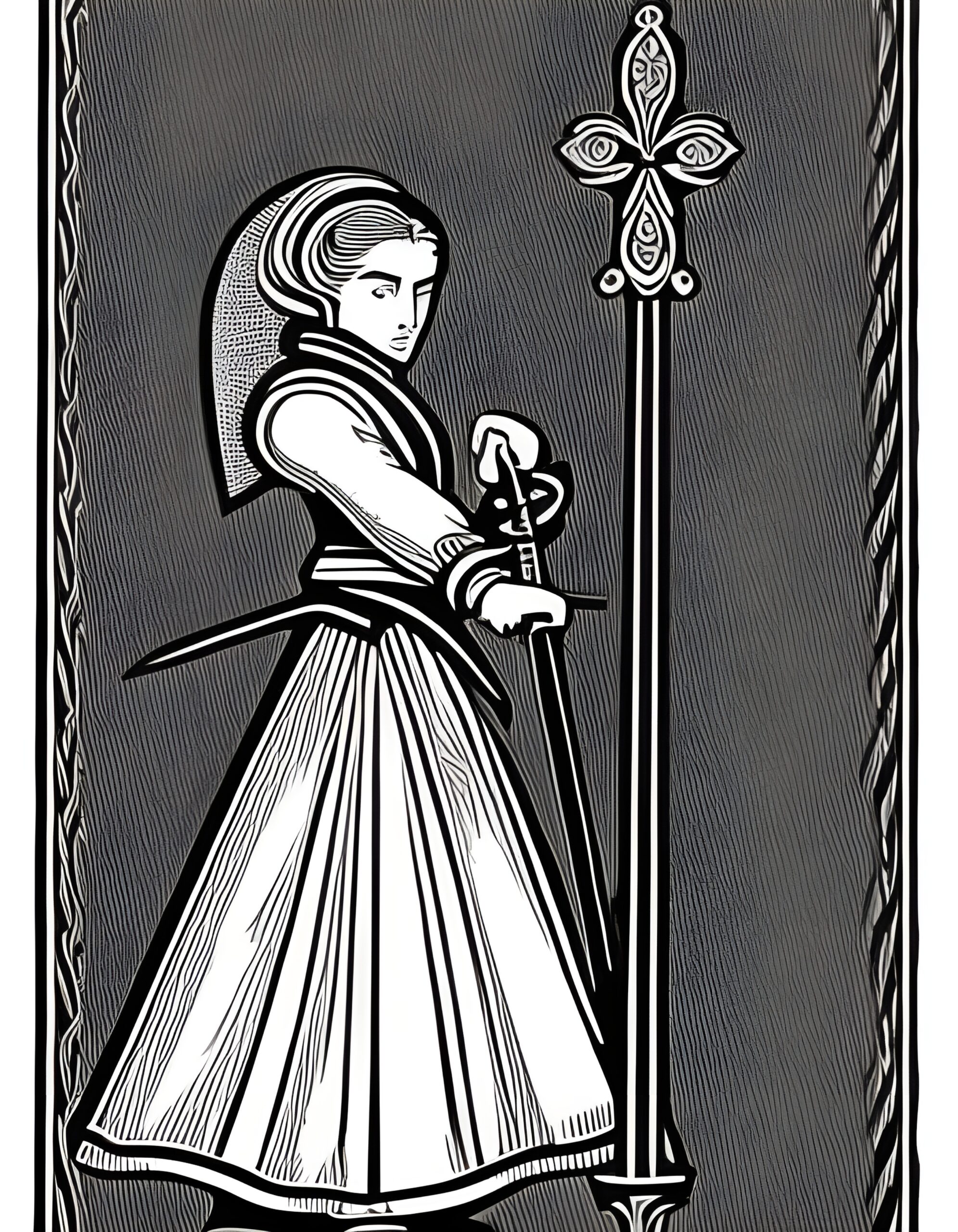
A Saxon Woman with a Sword
The practice of sword-learning – that is, the teaching of sword use and martial combat – was entirely reckoned as the part of a man in the old days, and it fixed strength and virtue in the hands of men. But the truth is that women also have the skill and the spirit to wield the iron works and they can do so as competently as a man.
The statement reflects on the historical perspective of martial prowess and the role of gender in the context of combat and warfare. Traditionally, especially in the early medieval period, the art of swordsmanship was largely considered a masculine discipline. This belief was rooted in the societal structures of the time, where the division of roles was strict, and the physical act of combat was reserved for men, who were perceived as the protectors and warriors of their communities.
The importance of this statement lies in its acknowledgment of the often-overlooked capabilities and contributions of women in martial practices. In most cultures, historical narratives have predominantly highlighted the exploits of male warriors, overshadowing the accounts of women who have also borne arms and exhibited martial skill. This statement serves as a reminder that the capacity for combat and the virtues of strength, courage, and strategic thought are not exclusively masculine traits.
In the medieval context, warfare was central to survival and territorial defense. As such, swordsmanship was not just a skill but a crucial aspect of a warrior’s identity, intertwined with their status and honor. However, throughout history, there have been notable instances where women have taken up arms — either in defense, in rebellion, or as part of their societal duty when circumstances demanded it.
On a deeper level, this statement challenges the traditional gender norms and stereotypes that have long dictated the roles and capabilities ascribed to men and women. It serves as a commentary on the fluidity of gender roles and the potential for societal change. By recognizing that women can be as adept with the sword as men, the statement is an early acknowledgment of equality in skill and potential, regardless of gender.
It also speaks to the universal human qualities of resilience and adaptability. Women’s participation in swordsmanship demonstrates that the ability to fight and defend is not inherent to one gender but can be developed and mastered by anyone with the will and determination to do so.
Finally, this reflection on sword-learning and gender is a call to re-examine and broaden the understanding of historical narratives. It urges us to consider the unsung heroines whose stories might have been forgotten or never told. It’s an invitation to search for a deeper meaning in history, recognizing that what has been recorded is not always the complete picture and that there is value in seeking out the diverse experiences of all people who shaped the past
Þin spræc hafað þæt wuldor and þa idese þe æt ymbealdlice heortan þære Engliscan tunges, ærðam þe Normannisc yfel on þis land gelumpen.
Sweordleornung – þæt is, þæt læren on sweordes brucan and wigplegan – was eallunga geman þæs weres dæl on þæm fyrndagum, ond hit þæt mægen and dryhtþihtnys on wera handum gefestnode. Ac se soð is þæt wif eac habbaþ þæt yfel and þone geist to handhabban þa irenweorc and hie mæg dydon swa gedonlice swa wer.
Hwæt, nu in þæm siðum þe we on libbaþ, se getrang to þisse leornunges is widgongol, and wifmenn ne beoþ leng utascufene fram þæm heofoncundlicum onginnum of sweordes þeawum. Forsoð, hie magon beon swa cene ond orsorh on þæm grunda and stande, ond hie habbaþ se same meteodes eac þa grunde to læran.
Þa idese þe geornlice willnað þæt sweord to læran, hi sculon se ferþ locian and þone willan þæra teonon, for hit nis nawiht butan geferþ and geedniwung, ac hit is eac se wyrd and se andgiet þe ælc wæpnedmann and ides eac sceal onfon to him sylfum.
Swiþe þa wif þe þone sweordweorc læran willað, hi sceolon onfon þone mod to standan wið þone egsan ond to þolian þa swinges and þa costunga. Þis bið se weg to mægen and þurhstregðung, ond hit bið eac þære sawle þrym, þe ða æt ænde geþeodeð to þære fyrdung of sweordes sang.
Ac min waldend, þu frignest æfter lare and þære sweordleornunge wege? Þa idese sceolon þæt ylce weg cuman swa weras; to ærstan, þurh þa æfenspræce and þeaw of þam sweord, and þonne þurh liclic þreotunge to gefrægnian þa snyttro of þære ecgplegan. Ne beoþ hit na læssa forþam þe wifmannes hand þæt sweord wegeð, ac hit mæg weorþan swa swiþ and trym swa any weres hand, swa hit is on gemyndum þæs þe ær leornode and on þæs þe þæt mægen hafað.
Your speech has the beauty and the grace at the very heart of the English tongue, before the Norman conquest brought changes to this land.
Sword learning – that is, the instruction in the use of the sword and in combat – was once considered exclusively the domain of men, and it reinforced their power and martial virtue. But the truth is that women also possess the capability and spirit to wield iron and to do so as competently as men.
Indeed, in the times we live in, access to this learning is widespread, and women are no longer excluded from the divine beginnings of sword practices. Verily, they can be as bold and untroubled in stance and foundation, and they have the same opportunity to learn the basics.
Those women who eagerly wish to learn the sword should look to the courage and will to challenge, for it is not only about strength and renewal, but also about fate and understanding that every armed person, man or woman, must embrace for themselves.
Especially the women who wish to learn swordplay, they must embrace the courage to stand against fear and to endure the blows and trials. This is the path to power and resilience, and it is also the fortification of the soul, which in the end unites with the chorus of the sword.
But my lord, you asked about instruction and the way of sword learning? These women should take the same path as men; first, through the language and customs of the sword, and then through physical exercise to master the art of swordplay. It is no less significant because a woman’s hand wields the sword, but it can become as strong and firm as any man’s hand, as it is in the memories of those who have learned before and in those who have the strength.
Se sweordleornunges mægen, dryhtþihtnys, and þurhstregþung syndon leng swiþe besungen. Ymbealdlice, hit is se ðegenlicra wera heofoncundlic onginn, ac ymbealdlice, wifmenn habbaþ se getrang and se earmgestrengo to þam andgite gecumen. Þis gewrit secaþ to lare oþ þæt sweordes handlung, stand, grundgefera, and ðærto gehyraþ; ah wifmannum is acenned, þa þe þone weg to sweordleornunge asettap
The Old English text talks about the art of sword learning, the nature of nobility, and strength. Here is a modern English translation:
“The power of sword learning, nobility, and endurance are greatly celebrated. Indeed, it is the beginning of the divine for noble men, but, indeed, women have come to the understanding and the physical strength for it. This writing seeks to instruct to the handling of the sword, the stance, the foundation companion (possibly a term for the shield or a fighting partner), and what pertains to it; but women are born, those who set the path to sword learning.”
This translation aims to convey the meaning and nuance of the original Old English while recognizing that some concepts may not have direct modern equivalents.
The text appears to be a recognition of the martial prowess not only of men but also of women, acknowledging their capabilities in terms of both understanding and physical strength in the context of swordsmanship. It may suggest a didactic intent, possibly being from a treatise on the subject.
If this seems familiar, then you may have heard of this passage as it is nearly identical to the “Ars Gladii Feminarum”, the treatise on the art of women’s swordplay that had long been lost to the annals of history until a serendipitous discovery back in the late 19th century.
The Raven Shield
Long ago, when the world was still young and the old gods walked the earth, there lived a warrior whose fame would echo through the ages, known only as the Raven Shield. She was not born of noble blood, nor granted the gifts of the gods. Instead, she was the daughter of a blacksmith, her destiny forged in the flames of her father’s hearth.
Her tale began in a small village on the edge of the great Northern forests, a place where the veil between the worlds of gods and mortals was thin. The people lived in awe and fear of the old gods, offering them tributes to earn their favor and appease their wrath.
The Raven Shield, whose true name has been lost to the mists of time, was said to have hair as dark as a raven’s wing and eyes like glinting steel. As a child, she would watch her father work, his hammer ringing against the anvil as he shaped metal into weapons of war. She learned to hold a hammer before she could wield a sword, and the strength of her arms was matched only by the sharpness of her mind.
The “Hræfnas Scholt Codex” has both factual and fictional elements, which have been explored to develop the root of Old English folklore. “Hræfnas” could be translated from Old English as “ravens,” and “scholt” is not a clear term, but could be a misspelling or variation of “sc(e)old” (shield) or a similar word. The codex might be a collection of knowledge or stories related to ravens, which were significant birds in Norse and Anglo-Saxon cultures, often associated with battle and the god Odin.
It also contain myths, legends, battle tactics, or even serve as a repository for the knowledge of a specific warrior, warrior society or guild.
Þa ceasterwaran, on anforlætnesse, clypodon heora ceneost wigan to wiðstandanne ðæt godcynn. Ac án æfter ánum, hi feollon, for ðæt nán dædelic sweord mihte þurhhrinan ðæs godes æþele flæsc.
Þa stód ðæt Hræfnscyld forð, næs mid sweorde, ac mid scylde þe hire fæder geworhte, beworht mid hræfnfeðrum and betæht mid ealdum galdorcraeftum longe forgytenum. Þæt scyld wæs næfre wæpna ecg, ac hit wæs andswaru wið þystru, fæstnung wið se deorcnes.
Heo án stód wið þone god, hire scyld up hebbende. Þa se deofol wearp forð ligetung and fyrgenstream, ðæt Hræfnscyld stód ungewemmed. Wið ælcum beate, ðæt scyld onfeng þæt mægen, his leoma stearcra werdende, ða hræfnfeðra glitende mid unworldlicre leohte.
Hit wurde sweotol þæt þeah ðæt scyld ne mihte þæt godcynn gewundian, hit mihte his cræft unnyttian. Yrre wæs se god and astah to eorðan to wiðmetan þisse deorlic wif þe hine dorste wiðsacan. Þa he beotode mid fystum þe muntas áfeollon, ðæt Hræfnscyld ne wacode. Heo bere ælcne cnyss, hire scyld onfeng ðæs godes agenes lifes mægen.
Þæt gefeoht dreag for dagas, roderas toslitene fram heora gefeoht. On ende, hit wæs ðæs dædelices wifes willa þe oferswíðde. Mid ánre wealdendre clypunge, heo þryte ðæt scyld forð áne síðe, and hit forlædde ormæte mægen þæt onfon wæs. Þæt godcynn wæs ascyred, his hiw onliðende on ðone æther, his wistful sceapen on ðæt scyld.
Þæt Hræfnscyld cwom eft to hire ceastre, an heretogan. Ac heo wiste þæt ða ealdan godas ne sceolde þæs ondsæc forgeatan. Heo fordwang on ðæt wudu, genimende ðæt galdorcræftige scyld mid hiere, swa þæt his mægen ne wurde misnoted, ne eac þæt hire leode sceolde eft onféon ðæs godcynnes yrre.
Please note that we have only loose translation, as literal translation would be quite challenging and certain phrases in the original text Old English do not have exact parallels. Furthermore, Old English poetry and prose rely heavily on alliteration and a specific meter that are not easily replicated here. This text is more in the style of a prose translation for readability rather than a faithful poetic reconstruction.
The passage might be rendered into near-modern English as follows:
The townsmen, in utter despair, summoned their most valiant warriors to confront the divine being. But one after another, they succumbed, for no earthly blade could penetrate the celestial flesh of the god.
Then forward stepped the Raven Shield, not armed with a sword, but with a shield her father had fashioned, adorned with raven feathers and endowed with ancient enchantments long forgotten. The shield was never meant as an edge of war, but as an answer to darkness, a bulwark against the shadows.
She alone stood against the deity, her shield aloft. As the fiend unleashed bolts of lightning and torrents of fire, the Raven Shield remained unscathed. With every onslaught, the shield absorbed the force, growing brighter, the raven feathers aglow with a light not of this world.
It became apparent that though the shield could not harm the divine, it could thwart his power. Wrathful, the deity descended to earth to confront this audacious woman who dared oppose him. As he raged with fists that could topple mountains, the Raven Shield wavered not. She withstood every assault, her shield absorbing the very life essence of the god.
The struggle lasted for days, the heavens rent asunder by their conflict. In the end, it was the resolve of a mortal woman that overcame. With a powerful cry, she thrust the shield forth one final time, and it released a whirlwind of stored energy. The deity was expelled, his form dissolving into the ether, his essence confined within the shield.
The Raven Shield returned to her hamlet, hailed as a champion. Yet she knew the old gods would not overlook this defiance. She retreated into the forest, taking the enchanted shield with her, so that its power would not be misused, nor her kinsmen suffer the gods’ vengeance anew.
As homework, we asked our students to provide a there own translations of the Old English passage into modern English. Each comes with a slightly different tone or style:
- She alone faced the god, her shield held high. As the devil cast forth lightning and streams of fire, the Raven Shield remained untouched. With each strike, the shield took in the energy, growing ever more radiant, the raven feathers gleaming with an otherworldly light.
- Alone she stood against the god, her shield aloft. The demon hurled lightning and rivers of flame, yet the Raven Shield was unmarred. Each blow the shield absorbed, its surface growing more intense, the raven feathers shining with a light not of this earth.
- She, by herself, confronted the deity, elevating her shield. Then the fiend flung bolts of lightning and blasts of fire, but the Raven Shield stood unblemished. Against every hit, the shield captured that power, its brightness intensifying, the raven feathers sparkling with a supernatural glow.
- She stood solitary against the god, lifting her shield. The demon unleashed lightning and fiery blasts, but the Raven Shield stood immaculate. With every impact, the shield absorbed the force, its glow becoming stronger, the raven feathers scintillating with an unearthly light.
- There she was, alone against the god, her shield upraised. The devil unleashed lightning and infernal streams, but the Raven Shield was unscathed. Every impact the shield endured, it grew more luminous, the raven feathers ablaze with an ethereal light.
The Old English term “ealdan godas” translates to “old gods” in modern English. It refers to the deities that were worshipped before the Christianization of the Anglo-Saxon people, which could include the pantheon of Norse or Anglo-Saxon paganism, such as Woden (Odin), Thunor (Thor), and Frige (Frigg), among others. These gods would have been part of the mythological traditions and religious practices prior to the widespread acceptance of Christianity in the region that is now England.
“ðæt Hræfnscyld”, the Raven Shield is likely a name or title in this context. This suggests a scene where a character known as the “Raven Shield” is entering a situation or a battle, choosing to arm herself not with an offensive weapon like a sword, but rather with a defensively purposed shield crafted by her father.
In Old English literature, specifically in the context of the Anglo-Saxons, there isn’t a standout character known universally as a divine or magical blacksmith like the Norse dwarves. Blacksmithing was viewed as a vital and respected craft, and the blacksmith (smiþ) was an essential figure in the community, but individual blacksmiths with significant stories are not prominently featured in the surviving texts. In Norse mythology, the most famous blacksmiths are the dwarves, known for their unparalleled skill in crafting. They were responsible for creating many of the gods’ greatest treasures, including Odin’s spear Gungnir and Thor’s hammer Mjölnir. The names of these dwarves varied in different sources, but some of the more prominent include Brokkr and Eitri (or Sindri), who are known for a contest with Loki to create the finest gifts for the gods.
In Old English, the phrase “unworldlicre leohte” literally translates to “unworldly light” in modern English, which suggests a light that is not from this world, or otherworldly—having a supernatural or ethereal quality. It carries connotations of the mystical or divine, something beyond normal human experience or understanding. This term would typically be used to describe phenomena associated with the divine or magical, emphasizing their extraordinary and non-earthly origins.
Þa stód ðæt Hræfnscyld forð, næs mid sweorde, ac mid scylde þe hire fæder geworhte, beworht mid hræfnfeðrum and betæht mid ealdum galdorcraeftum longe forgytenum
This passage best translates to modern English as follows:
“Then the Raven Shield stood forth, not with a sword, but with a shield that her father made, adorned with raven feathers and endowed with ancient sorcery long forgotten.”
This translation maintains the original meaning while updating the language to be understandable to a contemporary English-speaking audience. It portrays a scene where a character, known as the Raven Shield, is preparing to face an adversary not with a traditional weapon but with a unique shield that carries deep ancestral magic and significance.
The term “Raven Shield” can be deconstructed to better understand its meaning and the imagery it might evoke, especially in the context of the Old English text you’ve provided. Let’s break down the two components:
- Raven:
- In mythology and folklore, particularly Norse and Celtic, the raven is often associated with war, death, and prophecy. Ravens are considered intelligent and mysterious creatures.
- The raven is sometimes a symbol of the battlefield, owing to its presence in the aftermath of conflict, and it can also represent protection, as it was believed to watch over warriors.
- In Norse mythology, the god Odin had two ravens, Huginn (thought) and Muninn (memory), who flew all over the world and brought him information. This association with Odin ties the raven to wisdom and knowledge.
- Shield:
- A shield is traditionally a piece of defensive armor, carried by warriors to protect themselves from enemy attacks.
- Symbolically, a shield can represent protection, defense against adversity, and the concept of standing firm in the face of challenges.
- The shield is also a canvas, often bearing symbols or crests that represent the identity, lineage, or allegiance of the bearer.
Combining these two elements:
- Raven Shield suggests a protective device that carries the mystical or prophetic qualities of the raven. It’s not just a physical barrier but also a talismanic or enchanted object.
- The use of raven feathers and ancient sorcery in its creation implies that this shield may have special powers or a divine blessing, potentially offering protection that extends beyond the mere physical to the magical or supernatural.
- The Raven Shield being “forged by her father” adds a layer of personal lineage or heritage, indicating that it may have been passed down or specifically created for the individual named the Raven Shield, which can denote a special destiny or purpose.
In the context of the story or myth from which this comes, the Raven Shield likely represents the unique strength and mystical support given to the character to confront forces that are beyond ordinary human power. It serves as a symbol of her role as a protector and her connection to ancient traditions and wisdom that empower her to stand against divine or supernatural entities.
The identity of the woman associated with the “Raven Shield” in the context of the provided Old English passage is not specified beyond the story shared in the text. She appears to be a fictional or mythological warrior characterized by her unique and enchanted shield rather than a historical figure.
In the tale, she’s depicted as a valiant defender of her people, who confronts a powerful deity or supernatural being. Her shield, imbued with ancient magic and adorned with raven feathers, suggests a connection to powerful and forgotten sorcery, granting her the ability to withstand and ultimately repel the onslaught of a god. This imbues her character with a heroic stature, similar to figures in various mythologies who are chosen or destined to face gods or monsters due to their courage and special attributes.
Þæt godcynn wæs ascyred, his hiw onliðende on ðone æther, his wistful sceapen on ðæt scyld.
In waht appears to describe a supernatural event involving a god-like being and a shield. The translation into Modern English is roughly:
“The godly kind was scattered, his form dissolving into the ether, his essence shaped upon the shield.”
It depicts a deity whose physical form is dispersed into a more ethereal state, and whose very essence or being is somehow captured or imprinted upon a shield. This is carzy stuff and left many of my colleague doubting the varacity of the text. While the sentence needs to be read part of the larger narrative, in of its self it is possibly and describing a mythological or fantastical tranformation.
The motif described in the sentence “The godly kind was scattered, his form dissolving into the ether, his essence shaped upon the shield” resonates with various mythological themes from different cultures around the world. Here are some precedents and their significance:
- Ragnarök: The ultimate battle where gods fall and the world is submerged in water, only to rise again, renewed. The scattering of the gods can be akin to their fall during Ragnarök.
- Mjölnir: Thor’s hammer not only represents a weapon but also a symbol of divine power and protection. The idea of a god’s essence in a shield can parallel the way Mjölnir contains Thor’s strength.
- Aegis: A shield associated with Zeus and Athena, often depicting the head of Medusa and symbolizing divine protection. The aegis itself carries with it the power and essence of the gods.
- Cauldron of Rebirth: In some stories, warriors killed in battle are reborn from the cauldron, their essences returning to physical form. The scattering could be similar to the disintegration before rebirth.
- Ark of the Covenant: The sacred chest believed to carry the presence of God during the Israelites’ journeys. This ark, much like the shield in the sentence, was a vessel for divine essence.
- Sudarshana Chakra: The celestial weapon of Lord Vishnu, which holds a part of his essence and is considered an ultimate protector, comparable to the shielding aspect.
- Isis and the Protection of Ra: Isis created a protective circle or barrier around Ra, akin to the concept of a shield holding the essence of a deity.
- Yata no Kagami: One of the Three Sacred Treasures of Japan, this mirror represents wisdom and truth, similar to how a shield could reflect or contain the essence of a god.
The significance of these precedents lies in the universal concept of imbuing objects with divine power or essence, which then serve as protectors or carriers of that power. The notion of a deity’s form dissolving into ether could signify a transition from the physical to the spiritual or the dispersal of divine energy back into the universe. The act of shaping a god’s essence upon a shield could imply a legacy being left behind, a tangible remnant of divine influence in the mortal world. Such motifs often symbolize the cyclical nature of life and death, the continuity of power, and the protection of humanity by the divine.
The Living Flame
Without additional context or references to historical records, sagas, or literary works that mention her by name, it’s not possible to provide a specific identity of this “Raven Shield” named woman.
She may well be a part of a local legend, a piece of larger mythology, or a character in a work of historical fiction inspired by the rich tapestry of Old English literature and myth.
In heraldry, a crest is a component of a coat of arms that is typically displayed atop the helm. Crests can feature many different motifs, including animals, and the raven is a symbol that has been used in many different heraldic traditions. Identifying a specific family or individual in the English nobility with a raven crest would require a bit of research into heraldic registers, one would typically consult a heraldic authority such as the College of Arms in England, which is the official repository of the coats of arms and pedigrees of English, Welsh, Northern Irish, and Commonwealth families and their descendants.
Crests can often be similar across different families, and the usage of a raven could be found in multiple lineages. One of the known families with a raven in their crest or heraldry is the Corbet family, which is an old English noble family, the name Corbet itself meaning “little crow” or “little raven”.
Merry Old England, was in fact looking like a dead end, so we decided to look at little further from home for our Raven.
Another famous historical figure associated with ravens is King Matthias Corvinus of Hungary (1443–1490), whose name ‘Corvinus’ refers to the Latin word for raven, ‘corvus’, and his coat of arms featured a raven with a ring in its beak.
King Matthias Corvinus of Hungary, also known as Matthias I, was a Renaissance ruler whose reign from 1458 to 1490 was marked by military success, cultural flourishing, and the establishment of a large library (the Bibliotheca Corviniana).
Matthias is often surrounded by legends and stories, some of which include:
The Raven and the Ring: The most famous legend associated with Matthias is that of the raven, which is featured on his family’s coat of arms. The legend says that a raven stole a ring that Matthias’s mother had dropped. Matthias chased down the raven and retrieved the ring, an act that his family commemorated by including a raven with a ring in its beak on their coat of arms.
Justh King Matthias (Mátyás, the Just): King Matthias was reputed to be a just ruler, and there are many folk tales that describe how he would disguise himself as a commoner and mingle with his subjects to ensure that justice was being served in his kingdom. These stories are similar to the Haroun al-Rashid tales in Arabian folklore.
The Black Army: Matthias is famous for establishing the Black Army, which was a professional, standing army that was unique in Europe at the time. Many legends surround the might and discipline of this military force, which was said to be invincible for a time.
The Huntsman King: Many tales talk about Matthias being a great lover of the hunt and having exceptional knowledge of the forests and their paths. He is often depicted as a leader who could out-hunt any nobleman in his court.
This dates much later than the Hræfnas Scholt Codex. Although there is of course, and probably by no coincidence, there was reportedly a legible copy of the Ars Gladii Feminarum in the Bibliotheca Corviniana. It was one of the most significant libraries of the Renaissance world, containing thousands of volumes, including classical Greek and Latin texts, as well as contemporary humanist works. Unfortunately, much of the library was destroyed after the Ottoman Empire seized Buda, but some of the codices are still extant and are valuable sources of Renaissance art.
Antonio Bonfini’s “Rerum Hungaricarum Decades” (Decades of Hungarian Matters) is a historical work that details the history of Hungary, ,which is a comprehensive history of Hungary in ten volumes commissioned by the king. It doesn’t typically contain mythical accounts, and i regarded It is more a scholarly work rather than a collection of folktales or legends.
It was in the tumultuous year when the sultan’s host laid siege upon the fortress of Nándorfehérvár that she first appeared from the mists of Danube, a solitary figure against the backdrop of the war-torn lands. None knew whence she came, but the Black Swordmistress swiftly became the bane of the Ottoman vanguards, her blade singing a deadly lullaby through their ranks.
Johannes de Thurocz (also known as János Thuróczi), a Hungarian historian and notary of King Matthias Corvinus, authored the “Chronica Hungarorum,” the first comprehensive chronicle of the history of Hungary, completed around 1488. His work was an important source of information about the Hungarian past and included accounts of both historical events and legendary tales that had been passed down through the generations.
In temporibus quibus umbra lunae Ottomanicae supra basin Carpaticam pendebat, fabulae inter Magyaros de muliere diffundebantur, cuius virtus maximorum bellatorum superabat. Nomen illi erat Ilona, scutaria camporum Pannoniae, cuius facta tam firmiter in fati terrae textu intertexta sunt, quam flumina valles insculpunt. Nuntiabatur Ilona, in armis quae antiquos Magyarorum tribuum symbolorum gestabant, immota stetisse dum feroces Turci fines Hungariae tonitruantes transibant. Gladius eius, tam fidus quam cor ipsius, fabrefieri dicitur in occultis flammis Tűz, spiritus ignis primordialis, et in sacris aquarum Danubii refrigescere. In campis Mohács, ubi fatum umbram tristem misit, Ilona ut pharus spei contra desperationem emersit. Gladio suo, Élő Láng, ita per ordines invasorum secuit cum tanta terribili gratia ut etiam Janissarii pugna indurati retrorsum in admiratione cessissent.
History often forgets the tales of women warriors, but the people sang of her – a tempest in battle, yet a gentle guardian in times of peace. Ilona’s legend was such that the very mention of her name would cause the Turks to look over their shoulders in dread of the raven-haired Magyar who could strike as silently as the night itself:
In the times when the shadow of the Ottoman crescent loomed over the Carpathian Basin, tales spread among the Magyar folk of a woman whose valor surpassed the greatest of warriors. Her name was Ilona, the shieldmaiden of the Pannonian plains, whose deeds were woven into the fabric of the land’s fate as firmly as the rivers carve the valleys.
It was told that Ilona, cloaked in armor that bore the ancient symbols of the Magyar tribes, stood resolute as the fierce Turks thundered across the borders of Hungary. Her sword, as true as her heart, was said to be forged in the hidden flames of Tűz, the primordial spirit of fire, and cooled in the sacred waters of the Danube. Upon the fields of Mohács, where fate had cast its grim shadow, Ilona emerged as the beacon of hope against despair.
With her sword, Élő Láng (Living Flame), she carved through the ranks of the invaders with such a fearsome grace that even the battle-hardened Janissaries stepped back in awe.
After the great battle, where the blood of friend and foe mingled with the earth to seal an oath of undying resistance, Ilona vanished as mysteriously as she had appeared. Some say she retreated into the high Tatra, guarding over the land from a citadel unseen, waiting for the time when Hungary would again call for a defender of her might and spirit.
The name “Ilona” doesn’t have a good translation because it is a proper noun, specifically a given name. In Latin, proper names are typically transliterated rather than translated, meaning they are adapted into the closest phonetic equivalent in the Latin alphabet. So “Ilona” in Latin would still be “Ilona”.
If it were necessary to adapt it to a form that would fit Latin’s nominative case for proper names, it might remain unchanged or possibly rendered as “Ilonia” to fit Latin phonological patterns. In historical records, when translating names into Latin, additional descriptions or titles were sometimes added to give context or honor, rather than changing the name itself.
For example:
- Ilona, virago Pannonica – Ilona, the Pannonian warrior woman
- Ilona, scutaria Magyarorum – Ilona, shieldmaiden of the Magyars
Ilona is therfore a traditional Hungarian name believed to be a variant of Helen, which has Greek origins and means “light,” “torch,” or “bright.”
It cultural significance is that in Hungarian folklore, Ilona is associated with fairy tales and mythology, often depicted as a beautiful figure.
Digging around you’ll find later recounts on how she faced a band of janissaries alone at the Battle of the Black Water.
With nary a scratch upon her, she danced through their number, a wraith in the chaos of battle, her sword a sliver of moonlight that none could touch. And when the dawn came, the field was strewn with the vanquished, and the Raven Swordmistress was seen atop the highest rampart, her silhouette etched against the morning sun, as if she were part of the fortress itself, indomitable and unyielding.
From an editorial in 1968 from “Népszabadság,” which was the official newspaper of the Hungarian Socialist Workers’ Party:
The tale of the Raven Sword (mistress), whose exploits are etched not in the scrolls of scholars but in the hearts of those she defended. And though the annals of history may neglect to speak of her, the very mention of her name brings hope to the disheartened and courage to those who would stand against tyranny.
“Élő Láng” is Hungarian for “Living Flame.” This name suggests a powerful and possibly mythical or legendary weapon imbued with living fire or an enduring spirit, reflecting its might and potency. In the context of Hungarian history the name is fitting for a sword wielded by a hero or a mythic figure, representing the fierce spirit and resilience of the Magyar people. The idea of a weapon with such a name could be drawn from any number of sources in Hungarian mythology or from the rich tradition of storytelling in Central and Eastern Europe, where weapons are often given names that reflect their legendary status and the deeds accomplished with them.
Like the phrase “unworldlicre leohte,” which could be rendered in Modern English as “unearthly light” or “otherworldly light,” refers to a light that is not of this world, one that carries mystical or supernatural connotations, It suggests a brightness or a glow that is beyond the ordinary, often associated with the divine, the magical, or the uncanny. “Élő Láng,” translated from Hungarian as “Living Flame,” carries a similar sense of otherworldliness. It implies not just any flame, but one that is imbued with life or animation, suggesting an enduring, possibly magical or sacred fire.
Parallel to each other, both phrases convey elements of the supernatural, the mystical, and the powerful. They evoke imagery of objects or phenomena that are not just natural but are also charged with a certain mystical or ethereal quality. In the context of legends or mythological narratives, both could be used to describe artifacts, beings, or events that are suffused with a power beyond the mundane world, hinting at origins or influences that are divine, enchanted, or otherwise beyond the ken of ordinary mortals.
For example, in a folktale, “unworldlicre leohte” might describe the glow of a fairy or the aura around an enchanted object, while “Élő Láng” could be the name given to a sword that blazes with a magical fire, symbolizing its indomitable spirit and potency. Both would be at home in a story steeped in the mystical and the heroic, where the boundaries between the natural and the supernatural are blurred.
King Matthias Corvinus’s legacy is a mixture of actual historical feats and the colorful embellishments of folklore. His role in the cultural and political development of Hungary makes him a key historical figure, but the myths and stories have elevated him to a legendary status in Hungarian culture.
We find in a contempoary booklet in tourist gift shop:
The Legend of Zsófia The Shieldmaiden of the Black Army
In the days when King Matthias Corvinus ruled over Hungary with wisdom and valour, his Black Army stood as a bulwark against the threats that encircled the kingdom. Among the seasoned warriors and knights, there spread a tale, rarely spoken but deeply revered, of Zsófia, the woman mercenary whose blade sang the songs of victory.
She came from the shadows of the Carpathian Mountains, a mystery wrapped in steel, her eyes alight with a fire that matched the spirit of the Black Army. The soldiers, a superstitious lot, whispered of how the full moon had kissed her upon birth, blessing her with a warrior’s heart and a tactician’s mind.
As custom dictated that no woman should bear the weight of war, Zsófia donned the guise of a man. Yet, in the heat of battle, no helm could contain her mane of raven hair, no dirt could mask her fierce beauty. She fought not for gold nor glory but for the love of her homeland, and with each swing of her sword, she wrote her legend in the blood of the kingdom’s enemies.
Her fame came not only from her skill with the blade but from the mysterious aura that surrounded her. Rumors swirled like the mists of the Danube that she wielded charms of old, incantations that could blunt the edge of an enemy’s sword or stir a tempest upon a calm day. But her true power lay in her shield, emblazoned with the raven, a nod to the Black Army and a symbol of her enigmatic lineage.
The Turks, who had once hammered at the gates of Nándorfehérvár, grew wary of the Black Army, but they feared the ‘Raven Shieldmaiden’ above all. It was said that in the Battle of Breadfield, as the Ottomans surged like the tide against the Hungarian lines, Zsófia stood her ground, her shield an unyielding wall, her sword a harbinger of death.
The Black Army never lost a battle in which the legends claimed she fought, and when victory was secured, she vanished as suddenly as she had appeared, her name on the lips of the grateful and the vanquished alike. Some say she was a specter of war, others that she was the living embodiment of Hungary’s indomitable spirit.
Yet, for all the tales of blood and valor, it was her humanity that those who remembered her spoke of most fondly; how she would tend to the wounded, how her laughter could lift the fog of war-weariness, and how, in her presence, even the most battle-hardened warriors felt the weight of their armor lighten.
To this day, the echoes of Zsófia, the Shieldmaiden of the Black Army, linger in the ballads sung in hushed reverence in the taverns of Buda and Pest, a reminder that sometimes, the most enduring legends are those forged not just by the strength of arms, but by the courage of the heart.
Judith and Holofernes
In Judeo-Christian traditions, figures of women wielding swords are not that common, but one iconic image that often comes to mind is that of the archangel Michael, who is sometimes interpreted as having feminine qualities in various artistic representations, despite generally being considered male. Michael is often depicted holding a sword and scales, representing the fight against evil and the weighing of souls. However, if we’re looking for a specific female figure with a sword in Judeo-Christian tradition, we could look towards the apocryphal figure of Judith.
Judith is the heroine of the Book of Judith, a text that is included in the Septuagint and the Catholic and Eastern Orthodox Christian Old Testaments but is excluded from Jewish texts and assigned by Protestants to the Apocrypha. The story revolves around Judith, a daring and beautiful widow, who is upset with her Jewish countrymen for not trusting God to deliver them from their foreign conquerors.
In the narrative, Judith uses her charm to enter the tent of Holofernes, the general of the opposing Assyrian forces. She then beheads him with his own sword, which leads to the defeat of the enemy army when they find their leader dead. Judith’s story is celebrated as an example of God’s deliverance and of a strong, resourceful woman taking a leading role in the history of her people.
In art, Judith is often depicted carrying the head of Holofernes and the sword with which she decapitated him, symbolizing her bravery and the action she took against the oppressors of her people. This image has inspired many artists throughout the centuries, including Caravaggio, Botticelli, and Artemisia Gentileschi.
Where in Norse mythology, ravens are associated with the god Odin, who has two ravens named Huginn (thought) and Muninn (memory) that fly all over the world and bring him information. They are symbols of intelligence, observation, and are deeply connected to the divine. In the Judeo-Christian traditions, the raven is sometimes considered a symbol of God’s providence. Ravens fed the prophet Elijah in the wilderness (1 Kings 17:4-6), showing that God provides in miraculous ways. However, the raven can also be seen as an ill omen or a symbol of death, perhaps because they are scavengers often seen at sites of battle or execution. In Celtic mythology**, the raven is associated with war and death but also with prophecy and insight.
If we look at the themes, rather than linguistic roots, many of these names are connected through their historical and religious significance, particularly within Judeo-Christian contexts. They evoke narratives of wisdom (Sophia/Zsofia), light and beauty (Helen/Ilona), and divine oaths or praise (Isabella/Elisabeth and Judith). From a cultural standpoint, they are all names that have been carried by notable female figures in history, mythology, and religion, representing virtues like wisdom, beauty, piety, and strength. They reflect a diverse cultural tapestry, illustrating the ways in which names travel through time and geography, gathering new forms and meanings
In Romanian, the name is also spelled as “Judit” or sometimes “Iudita,” reflecting the influence of Latin, as Romanian is a Romance language. The “Iu” in “Iudita” reflects the sound of the English “J” as Romanian orthography is based on Latin, where “I” can represent a consonantal “y” sound. This name is a bit of an outlier as it does not have a clear common root with the others, assuming it’s a form of Ludmila, which has Slavic roots and means “people’s favor.”
Artists, writers, or storytellers draw these symbolic connections to create a narrative or visual piece that intertwines Judith’s tale with the multifaceted symbolism of the raven, thereby enriching the story with deeper layers of meaning. Althrough there is no direct link between Judith and the raven in the biblical texts or traditional Judeo-Christian teachings, in the realm of artistic or literary symbolism, the combination of a women with a sword and the raven represent a number of themes:
- Providence and Cunning: Judith’s reliance on divine will for her mission might be mirrored in the raven’s role as a provider of wisdom or as an agent of divine action.
- Death and Victory: Judith’s act resulted in death (Holofernes’) and victory for her people, which can be symbolized by the raven as a creature of death but also as a symbol of the triumph over enemies.
- Insight and Strategy: Ravens are keen observers, and Judith’s strategy to infiltrate and deceive Holofernes could be likened to the raven’s attributed qualities of intelligence and foresight.
El Arte del Espadón de las Damas
Defensa es tan menester como ofensa. Aprended a parar los golpes venideros desviándolos fuera del cuerpo con destreza. Seguid con una pronta respuesta, un contragolpe ejecutado luego de un parar acertado. Esta combinaçión demuestra habil manejo y control.
Isabella I of Castile, also known as Isabella the Catholic, was an avid patron of learning and the arts during her reign from 1474 to 1504. She, alongside her husband Ferdinand II of Aragon, is known for completing the Reconquista, issuing the Alhambra Decree that expelled the Jews from Spain, and sponsoring Christopher Columbus’s 1492 voyage that led to the opening of the New World. As for her support of education and the arts, Isabella founded a number of schools and universities and also established a significant royal library. This library was said to have contained a vast collection of works, ranging from religious texts to classical literature, and possibly included treatises on chivalry and martial arts as they were a part of noble education and courtly life.
Our “Ars Gladii Feminarum” has been portrayed as a manuscript that contained knowledge of combat techniques suitable for women, perhaps connected to noblewomen who were trained in self-defense or who took part in military campaigns.
within Isabella I of Castile’s library, we have references that there existed a now-lost manuscript entitled: El Arte del Espadón de las Damas, or El Arte de la Espada Feminal, familiar to use as “Ars Gladii Feminarum” (Art of the Sword for Women). This text is described to have been “a comprehensive treatise on martial arts, specifically tailored for (noble)women” of the late 15th and early 16th centuries, who might have been interested in or required to learn the art of swordsmanship for self-defense or even participation in combat.
Please note that “Espadón” can mean a large sword or a type of sword, and “Damas” is a term that was also used historically to refer to women of a certain social status. The word “Feminal” is not modern Spanish, but it is the possible medieval variation to mimic the original Latin more closely.
In this narrative, the “Ars Gladii Feminarum” was commissioned by Queen Isabella herself, who recognized the importance of martial skills for women in her realm, particularly for those who might need to defend their estates in times of war or during the frequent absences of their husbands and brothers. The work reflected the queen’s progressive attitude toward the role of women in a society dominated by male warriors.
The manuscript was be divided into several sections, each detailing different aspects of swordsmanship:
- Theoretical Foundations: Opening with a dedication to Isabella, this section would offer philosophical musings on the necessity of martial prowess and the virtue of courage in women, drawing upon classical and contemporary sources.
- Physical Preparation: Instructions on physical training and conditioning specific to women, recognizing the differences in attire and social expectations of the time.
- The Art of the Sword: Detailed descriptions and illustrations of sword techniques, stances, parries, and thrusts, with adaptations for the female physique. It would include the use of various swords, from the lighter side-swords to the heavier broadswords, possibly even touching upon the use of rapiers, which were becoming fashionable.
- Defensive Tactics: Strategies for self-defense, emphasizing agility and cunning over brute strength, alongside advice for women to protect themselves in various scenarios, including those unique to their daily lives.
- Historical Accounts: Tales of legendary swordswomen and valiant noblewomen from history and myth, serving as exemplars for the readers, perhaps even including an apocryphal account of Isabella herself training with a sword.
- Influence and Legacy: The “Ars Gladii Feminarum” was circulated among the noble families of Spain and beyond, possibly influencing the education of noble daughters. The text would have faded into obscurity after Isabella’s death, as the political climate changed and the role of women in martial affairs became less emphasized.
In the modern era, the discovery of the text, has to a degree upended the conventional understandings of women’s roles in the martial cultures of Renaissance Europe. It inspires both historical and feminist scholarship, offering a glimpse into an aspect of noble life that is rarely addressed in surviving documents from the period. Thus, while “Ars Gladii Feminarum” remains a fragment, it offers a fascinating window into “what would have been,” and reflects the timeless interest in the capabilities and achievements of women throughout history.
It seems then we, have another possible origin or interpretation of provenance the Art of the Sword for Women.