Tag: Ars Gladii Feminarum

  • Mandy at Rosewood

    In the college town of Willow Creek, nestled between rolling hills and sparkling rivers, stood the prestigious Rosewood Boarding School for Girls. Gratiam Alens, Resilientiam Fovens.

    It was here that Mandy, a young woman with a heart full of dreams and a spirit of independence, found herself feeling out of place amidst the grandeur and strict routines of the school. Though she often felt overshadowed by her more extroverted peers, Mandy possessed a keen intellect and a creative spirit. It was in the school’s fencing class that Mandy discovered her passion and a sense of purpose.

    Mandy, with her chestnut hair often tied back in a practical ponytail, had always felt slightly shy and overshadowed by her more outgoing classmates. Despite her intelligence and creativity, she struggled to find her niche in the school’s myriad of clubs and activities.

    However, everything changed the day Mandy stepped into the fencing class. Initially unsure, she was mesmerized by the elegant dance of the fencers, their swords flashing in the sunlight streaming through the large windows. Mandy’s heart raced as she took up the épée for the first time. In that moment, she found a passion she never knew she had.

    Under the tutelage of Madame Duval, a former Olympic fencer, Mandy’s natural talent for fencing blossomed. She moved with grace and precision, her épée becoming an extension of her arm. As her skills sharpened, so did her confidence, spreading into all aspects of her life.

    As weeks turned into months, Mandy’s skill with the sword grew exponentially. She became more confident, not just in fencing, but in all aspects of her life. Madame Duval, saw great potential in her and encouraged her to enter the national junior fencing championship.

    Mandy was becoming young woman of quiet determination and her newfound passion for fencing, meant she was about to encounter a formidable challenge in the form of a rival, Vanessa.

    Vanessa, with her sleek raven hair and piercing gaze, was known throughout the school as a fencing prodigy. She was as confident as she was skilled, often seen practicing her lunges and parries with a fierce intensity. Her presence in the fencing class brought a competitive edge to every session, and it wasn’t long before a rivalry developed between her and Mandy.

    Despite her initial shyness, Mandy’s talent in fencing was undeniable. Her style contrasted starkly with Vanessa’s; where Vanessa was aggressive and bold, Mandy was fluid and precise. Their duels became the highlight of the class, drawing spectators from all over the school.

    The rivalry reached its peak in the lead-up to the national junior fencing championship. Both Mandy and Vanessa were selected to represent Rosewood, and it was clear that the coming competition between them would be the talk of the tournament.

    The grand hall of Rosewood Boarding School was abuzz with excitement. Students and faculty alike had gathered to witness the much-anticipated fencing duel between Mandy and Vanessa, the school’s top fencers. The air was thick with anticipation as the two rivals took their positions on the piste, their fencing foils gleaming under the bright lights.

    Mandy, known for her fluid and precise style, faced Vanessa, whose aggressive and bold technique had won her many accolades. As the referee signalled the start of the match, a hush fell over the crowd.

    The duel began with a series of swift exchanges. Mandy’s movements were graceful and calculated, each lunge and parry executed with meticulous care. Vanessa, on the other hand, attacked with ferocity, her blade moving in rapid, forceful arcs.

    The tension between the two fencers was palpable. With each passing moment, their movements became more intense, the clashing of their foils echoing through the hall. The audience was captivated by the display of skill and agility.

    As the match progressed, Vanessa’s strikes became more aggressive. Mandy countered skilfully, but the relentless assault started to take its toll. Vanessa’s competitive spirit flared, her desire to win overshadowing her judgment.

    In a moment charged with intensity, Vanessa executed a particularly aggressive manoeuvre. Her foil, moving with excessive force, struck Mandy in an illegal move. The blow was unexpected and forceful, catching Mandy off-guard.

    The impact knocked Mandy off her feet, and she hit the ground with a thud, her head striking the floor. The hall erupted in gasps and cries of alarm. Vanessa, realizing the gravity of her action, dropped her foil and rushed to Mandy’s side.

    Mandy lay motionless, unconscious from the impact. The medical team was called immediately, and the hall was cleared to give them space to attend to her.

    Vanessa stood by, her face a mask of worry and regret. The rivalry, which had always been a source of motivation and challenge, had escalated beyond her intentions. In that moment of recklessness, she had not only violated the rules of the sport but had also endangered her fellow fencer.

    Later , Mandy goes to Madame Duval Office. The fencing instructor is calmly making a pot of English Tea.

    Madame Duval:  “Mandy, please sit down, could I have a word with you?”

    Mandy: “Of course, Madame Duval. Is everything okay?”

    Madame Duval: “Yes, everything is fine. I wanted to talk to you about your progress. You’ve been showing remarkable improvement in your technique.”

    Mandy: (Smiling shyly) “Thank you, Madame. I’ve been practicing a lot, trying to refine my movements.”

    Madame Duval: “I’ve noticed. Your dedication is admirable. But there’s something else I wanted to discuss. Your last match with Vanessa… it was intense.”

    Mandy: “Yes, it was. I’ve been reflecting on that a lot. It was… a bit overwhelming.”

    Madame Duval: “Understandable. Fencing is as much a mental game as it is physical. It’s crucial to maintain focus and control, especially in high-pressure situations.”

    Mandy: “I’ve been working on that, trying to stay calm and think a few steps ahead.”

    Madame Duval: “Good. Remember, fencing isn’t just about attacking. It’s about outsmarting your opponent, knowing when to strike and when to wait.”

    Mandy: “I’ll keep that in mind. Sometimes I get caught up in the moment.”

    Madame Duval: “That’s part of the learning process. Also, I want you to remember that what happened with Vanessa was an accident. It’s important to not hold onto any grudges.”

    Mandy: “I know. I’ve been writing about it in my journal, trying to sort through my feelings.”

    Madame Duval: “That’s an excellent way to process it. Keep using that insight. It will make you not just a better fencer, but a stronger person.”

    Mandy: “Thank you, Madame Duval. I really appreciate your guidance.”

    Madame Duval: “You’re welcome, Mandy. Keep up the good work. I see great potential in you, not just in your skill with the sword, but in your character as well.”

    Mandy: (Nodding determinedly) “I won’t let you down.”

    They share a moment of mutual respect before parting ways, Mandy feels inspired and Madame Duval proud of her student’s growth.

    In the quiet sanctuary of her room Mandy had maintained a special journal – a little repository of her thoughts, experiences, and growing expertise in fencing. This journal began to be much more than a mere notebook; it was a reflection of her journey, a personal guide through the art and science of fencing.

    The cover of the journal was a deep, forest green, worn at the edges from frequent use. Inside, Mandy’s handwriting filled the pages – a mix of meticulous notes, sketches of fencing poses and movements, and reflections on her matches and training sessions.

    The initial pages of the journal were filled with the basics of fencing. Mandy had noted down the different types of weapons – foil, épée, and sabre – and their unique rules and scoring systems. There were detailed sketches of the en garde position, the various lunges, and the defensive manoeuvres like parries and ripostes.

    As the journal progressed, it became more personal and introspective. Mandy wrote about her challenges and triumphs in the sport. She reflected on her matches, analysing her strategies and pinpointing areas for improvement. After each fencing class or competition, Mandy would diligently record what she learned, what she observed in her opponents, and the feedback she received from her instructors, especially Madame Duval.

    There were also pages where Mandy explored the mental and emotional aspects of fencing. She wrote about the importance of focus, the need to anticipate an opponent’s moves, and the mental resilience required to bounce back from a defeat. She also penned her thoughts on sportsmanship and the respect for one’s opponents, a lesson she deeply valued.

    Among the entries, one could find detailed accounts of her rivalry with Vanessa. Mandy analyzed their duels, noting Vanessa’s aggressive style and how it contrasted with her own more calculated approach. She wrote about the need to adapt her tactics to different opponents and situations, a skill that was crucial in her development as a fencer.

    As the journal neared its most recent entries, the tone shifted. These pages bore witness to the incident where Vanessa’s strike left Mandy unconscious. Mandy recorded her feelings about the event, her initial frustration and anger, and how she eventually came to terms with it, focusing on forgiveness and understanding.

    The next morning Mandy passes Vanessa in the corridor.

    Vanessa: (With a smirk) “Well, if it isn’t Mandy. Still nursing that bruise from our last match?”

    Mandy: (Looking up calmly) “Hi, Vanessa. It’s healing. Fencing bruises are part of the game, you know.”

    Vanessa: “Oh, I know. But it’s not just any game when I’m your opponent. I guess some people just can’t handle the pressure.”

    Mandy: “Or maybe some people just need to learn more about control and fair play.”

    Vanessa: (Laughing mockingly) “Control? Please, Mandy. Fencing is about winning. Maybe that’s something you’re still trying to figure out.”

    Mandy: “There’s more to fencing than just winning, Vanessa. It’s about honour and respect too. But maybe that’s something you’re still trying to understand.”

    Vanessa: “Honour won’t get you a championship trophy. But keep filling your journal with those ‘noble thoughts’ while I focus on real victories.”

    Mandy: “We’ll see at the next match, Vanessa. May the best fencer win – with honour.”

    Vanessa: “Oh, don’t worry. I plan to. See you on the piste, Mandy. You might want to bring an extra ice pack.”

    Vanessa walked away with a confident stride, leaving Mandy slightly irked but composed, her friends looking on supportively.

    Mandy’s skill were honed an to be tried  in the fencing championship, where she faced her toughest opponents with grace and determination. Win or lose, she knew she had already achieved something far greater – she had found her true self.

    As the students take their seats, Mandy and Vanessa enter the hall. They are both in full fencing gear, their masks under their arms, and their épées in hand. They acknowledge each other with a nod, a silent recognition of their rivalry.

    Referee: “Fencers, salute!”

    Mandy and Vanessa lift their swords in a traditional salute to each other and the audience. They then put on their masks, signalling their readiness.

    Referee: “En garde!”

    The two fencers take their positions, their bodies tense but focused.

    Referee: “Ready? Fence!”

    The match begins with Vanessa launching a swift attack, her movements aggressive and confident. Mandy, anticipating this, counters with precise and measured responses. Their blades clash, the sound echoing in the hall.

    Mandy takes the offensive, her style a blend of grace and accuracy. Vanessa, undeterred, meets each attack with powerful parries. The audience watches, enthralled by the skill and intensity of the duel.

    As the match progresses, the score remains close. Mandy’s strategy is to outmaneuver Vanessa, using her agility and finesse. Vanessa, on the other hand, relies on her strength and speed to dominate the bout.

    In a critical exchange, Vanessa attempts a daring move, aiming to score a decisive point. Mandy, however, reads her intention and counters with a swift riposte, scoring a touch.

    Referee: “Touch! Mandy!”

    The crowd erupts in cheers. Vanessa, momentarily taken aback, regains her composure. She acknowledges the point with a nod, a sign of respect for Mandy’s skill.

    As the match neared its end, the tension rose. Both fencers are at the top of their game, each point hard-earned. Finally, Mandy saw an opening. She feinted, drawing Vanessa into a response, and then lands a clean touch.

    Referee: “Match point, Mandy!”

    Mandy lowers her épée, the realization of her victory setting in. Vanessa removes her mask, a look of respect and acknowledgment in her eyes.

    Vanessa: “Well fenced, Mandy. You deserved it.”

    Mandy: “Thanks, Vanessa. You were incredible out there.”

    The audience applauds as the two fencers salute each other once more. There rivalry, still very much alive, has transformed into a mutual admiration, the respect between the two fencers evident to all.

    As they left the piste, Mandy and Vanessa share a moment of camaraderie, knowing that their rivalry has pushed them to be better fencers and has forged a bond of respect between them.

    It back then, a time of growing unrest in America, with tensions simmering across the nation, the tranquil town of Willow Creek and its prestigious Boarding School had stood as a safe haven of peace and education.  However, the tranquillity of Willow Creek was to shattered.

    An armed  robbery gone awry in the town. A group of desperate robbers, fleeing from a botched heist, found themselves pursued by the authorities. In their panic, they sought refuge in the least expected place – the Rosewood Boarding School.

    The school was thrown into chaos as the robbers, frantic and cornered, took shelter within its historic walls. The faculty and students were caught off-guard, their daily routines disrupted by this sudden intrusion of danger.

    In the wake of their intense fencing match, the atmosphere in the hall was one of celebration and newfound mutual respect. But this atmosphere was abruptly shattered by the unforeseen intrusion of the fleeing robbers, who had chosen the school as their hideout.

    Mandy, who had faced a life-threatening situation before, found herself once again in the midst of a crisis. However, this time, she was not alone in her bravery. Her once-rival, Vanessa, stood by her side, their past animosities forgotten in the face of this new threat.

    Together, Mandy and Vanessa, using their fencing skills and quick thinking, devised a plan to protect their fellow students and themselves. They knew that direct confrontation with the robbers was too risky. Instead, they focused on keeping the students calm and creating a safe hiding place within the school’s maze-like corridors and numerous classrooms.

    As the students began to realize the gravity of the situation, panic set in. Mandy, still catching her breath from the match, quickly assessed the danger. She noticed Vanessa, her former rival and now a comrade, stepping forward, perhaps in an attempt to negotiate or confront the intruders.

    Before anyone could react, a loud gunshot echoed through the hall. Vanessa fell to the ground, a victim of a reckless and panicked shot from one of the gunmen. The hall erupted into chaos, with screams and cries of shock.

    Mandy, along with other students, rushed to Vanessa’s side. The scene was one of confusion and horror. Vanessa lay motionless, a stark contrast to the vibrant and competitive spirit she was known for.

    Mandy, in shock, held Vanessa’s hand, tears streaming down her face. The rivalry that had once defined their relationship seemed so trivial now in the face of such a senseless tragedy.

    The hall, still echoing with the sounds of the recent fencing bout, was suddenly plunged into a crisis with the arrival of the fleeing robbers. The shock of Vanessa being shot reverberated through the crowd, creating a moment of paralyzing terror.

    Mandy, amidst the chaos, reacted instinctively. Her fencing training, coupled with her recent experiences, had honed her reflexes and decision-making under pressure. She saw one of the gunmen momentarily distracted by the commotion and knew she had to act.

    Moving with the agility and precision that had made her a formidable fencer, Mandy swiftly approached the gunman from behind. Her heart raced, but her focus was laser-sharp. She remembered a move from her training – a disarmament technique taught for emergency situations.

    With a quick movement, she used her épée to knock the gun from the gunman’s hand, sending it sliding across the floor, far out of reach. The gunman, taken aback by the suddenness of the action, was momentarily stunned, ran.

    Mandy stood there, breathing heavily, her fencing foil still in hand. She had just used her skills in a way she never imagined – not in a bout for points, but to protect her peers and herself from a real and immediate threat.

    As the authorities surrounded the school, negotiations began for the safe release of the hostages. Inside, Mandy tended to Vanessa, worked tirelessly to stop her bleeding and provide reassurance to the fading child. Her courage were a beacon in those tense standoff hours.

    This moment of surprise gave the school security and arriving police officers the opening they needed. They quickly apprehended the disarmed gunman, while others secured the second intruder.

    Finally, after what seemed like an eternity, the standoff came to an end. The robbers, realizing the futility of their situation, agreed surrendered to the authorities. The authorities swiftly moved in, securing the entire area and apprehending the remaining intruders. The immediate concern was for Vanessa and the other students’ safety. Emergency medical personnel attended to Vanessa, their expressions grave. 

    However, the triumph of the moment was overshadowed by the tragedy of Vanessa’s injury. Mandy rushed to her side, where emergency personnel were administering urgent care. The rivalry that had once defined their relationship seemed so distant now, replaced by a profound sense of camaraderie and concern.

    The school, once a place of learning and growth, was now a scene of a tragic incident, leaving students and faculty in a state of grief and disbelief.

    In the aftermath, as Vanessa was taken to the hospital, Mandy remained a figure of strength and support for her fellow students. The incident at Rosewood Boarding School would leave a lasting impact, serving as a reminder of the unpredictability of life and the courage that can arise in the face of danger.

    The students and faculty, now recovering from the initial shock, looked at Mandy with a mixture of awe and gratitude. Her courageous act had prevented further violence and saved further lives.

    Mandy, who had faced a life-threatening situation before, found herself once again in the midst of a crisis. However, this time, she was not alone in her bravery. The spirit of her once-rival, Vanessa, stood by her side, their past animosities forgotten in the face of  defeat..

    Mandy, still grappling with the intensity of the recent events, was gently led aside by a counsellor brought in to support the students.

    Counsellor: (In a calming tone) “Mandy, I’m Ms. Harper, your counsellor. I know this has been an incredibly traumatic experience for you. It’s okay to feel overwhelmed. How are you holding up?”

    Mandy: (Shakily) “I… I don’t know. It all happened so fast. I just acted. I was scared, but I couldn’t let him hurt anyone else.”

    Ms. Harper: “What you did was incredibly brave, but it’s also a lot to process. It’s normal to feel a mix of emotions right now. Fear, shock, even guilt – these are all common reactions to such a stressful situation.”

    Mandy: “I keep thinking about Vanessa. It should have been a day about our fencing, not… not this.”

    Ms. Harper: “It’s clear you care deeply about your friends and your school. Remember, it’s important to allow yourself to feel these emotions and not bottle them up. Talking about them is a good way to start processing what happened.”

    Mandy: “I just feel so… shaken. Everything’s changed in just a few moments.”

    Ms. Harper: “That’s understandable. Experiences like this can change your perspective in an instant. But remember, you’re not alone in this. We’re here to support you, and it’s okay to lean on others for help.”

    Mandy: “Thank you, Ms. Harper. I think I just need some time to make sense of all this.”

    Ms. Harper: “Take all the time you need, Mandy. And remember, it’s okay to seek help. I’m here whenever you’re ready to talk.”

    As they continue to speak, the sounds of the school returning to a semblance of order provide a backdrop to their conversation. Mandy, surrounded by support and understanding, begins the process of healing and coming to terms with the day’s harrowing events.

    In the days that followed, the school community came together to support each other. Mandy, deeply affected by the loss of Vanessa, found solace in her journal, pouring her grief and memories of Vanessa onto the pages. Vanessa’s bravery and spirit were commemorated in a school-wide memorial, her legacy living on in the hearts of those she touched.

    This tragedy at Rosewood Boarding School became a poignant reminder of the fragility of life and the senseless nature of violence. For Mandy, it was a defining moment, shaping her perspective on life, rivalry, and the importance of cherishing every moment.

    Mandy’s actions, born out of her dedication to fencing, had transcended the sport, revealing the true depth of her character and the real-world applicability of her skills and quick thinking.

    Her time at Rosewood was marked by her transformation from a shy young woman to a brave leader, became a source of inspiration. Her story, and that of Vanessa, showed that even in times of fear and uncertainty, courage and unity could prevail.  

    The incident at Rosewood became a national story, a stark reminder of the unrest and challenges facing the country. But for the students and staff of Rosewood, it was a further testament to the courage and resilience of their community. The legacy of their actions during those harrowing hours would live on in the hearts of all who witnessed it, a beacon of hope in troubled times.

    Mandy, deeply affected by the recent crisis at the school, found herself grappling with a whirlwind of emotions. The memories of the incident lingered, often invading her thoughts at quiet moments. She experienced a range of feelings – from fear and anxiety to a profound sense of loss, especially concerning Vanessa’s injury.

    In an effort to cope with her trauma, Mandy turned to what she knew best – fencing. The fencing hall, once a place of friendly rivalry and personal triumph, now became her refuge, a place where she could channel her turbulent emotions into something familiar and grounding.

    Each day, after her classes, Mandy would spend hours in the hall, practicing tirelessly. Her movements were more intense than before, each lunge and parry fuelled by an inner turmoil. Fencing had always been a passion for Mandy, but now it became a necessary outlet, a way to process and escape from the haunting memories of the attack.

    Madame Duval, noticing the change in Mandy, approached her with concern.

    Madame Duval: “Mandy, I can see you’re throwing yourself into your training. It’s good to have a focus, but are you taking time to address what happened?”

    Mandy: (Pausing, catching her breath) “Fencing is the only thing that makes sense right now, Madame. When I’m here, I don’t have to think about… about that day.”

    Madame Duval: “It’s natural to seek comfort in familiar routines, but remember, healing takes time and often requires facing those difficult emotions, not just redirecting them.”

    Mandy: “I just feel so lost. Fencing helps. It’s where I feel strong, in control.”

    Madame Duval: “Strength isn’t just about control and physical prowess, Mandy. It’s also about vulnerability, about acknowledging and working through our fears and pain.”

    Mandy: “I’m trying, Madame. But every time I stop, every quiet moment, it all comes rushing back.”

    Madame Duval: “And it might, for a while. But you’re not alone in this. We’re all here to support you, including your teammates. Don’t hesitate to lean on us.”

    Mandy nodded, understanding the truth in Madame Duval’s words. In the following weeks, while she continued to find solace in fencing, she also began to open up more. She started attending group counselling sessions at school and talking to her friends about her experiences and feelings.

    Through this combination of physical outlet and emotional support, Mandy began to heal. She learned to balance her love for fencing with the need to confront and process her trauma. Her journey wasn’t easy, but with each day, she found a little more of her old strength and joy returning.

    In the end, Mandy’s experience solidified her resilience and her understanding of true strength. She emerged not only as a skilled fencer but as a young woman who had faced adversity with courage and was learning to triumph over it.

    The lush green lawns of Rosewood Boarding School were adorned with rows of chairs and a large stage, beautifully decorated for the graduation ceremony. Students in their caps and gowns chatted excitedly, a buzz of anticipation in the air. Among them was Mandy, looking reflective yet proud in her graduation attire.

    As the ceremony commenced, the headmistress addressed the graduating class, her speech touching upon the challenges and triumphs of the past year. When she mentioned the bravery shown during the crisis, many eyes turned towards Mandy, who managed a small, humble smile.

    When it was time for the graduates to receive their diplomas, Mandy’s name was called. As she walked across the stage, there was a resounding applause. Her classmates and teachers acknowledged not just her academic achievements but the courage and resilience she had shown.

    Madame Duval, present at the ceremony, watched Mandy with a mixture of pride and affection. After the official ceremony, she approached Mandy.

    Madame Duval: “Congratulations, Mandy. You’ve grown so much, not just as a fencer but as a person of great character.”

    Mandy: “Thank you, Madame. I couldn’t have done it without your guidance… and fencing.”

    Madame Duval: “Remember, the skills and strengths you’ve developed here go beyond fencing. They’re part of who you are now, ready to face whatever comes next.”

    Mandy nodded, feeling a sense of accomplishment mixed with the bittersweet realization that her time at Rosewood was ending.

    As the graduates threw their caps in the air, Mandy felt a surge of optimism for the future. The challenges she had faced had prepared her for the world beyond Rosewood. She was ready to take the next steps in her journey, carrying with her the lessons, memories, and friendships that had shaped her.

    The ceremony ended with laughter, tears, and farewells. Mandy, surrounded by her friends and mentors, felt a deep gratitude for her time at Rosewood. It was an end, but also a beginning – a transition to a new chapter in her life, filled with possibilities.

    Mandy’s Journal Entry Date:  14th May

    Today’s practice was intense, not just physically but mentally. I’ve been reflecting a lot on the mental aspect of fencing. It’s a dance, a chess match, and a battle of wills all rolled into one. I’ve come to realize that the mental preparation is just as crucial as the physical. Here are some of my thoughts and strategies on getting my mind ready for a bout:

    Visualization: Before stepping onto the piste, I take a few moments to visualize my movements and strategies. I picture myself executing perfect lunges, parries, and ripostes. It’s not just about seeing myself win; it’s about visualizing every possible scenario, including how I might recover from a misstep or counter an unexpected move from my opponent.

    Breathing: I’ve started integrating focused breathing exercises into my routine. Deep, steady breaths help calm my nerves and centre my mind. It’s amazing how something as simple as breathing can sharpen your focus and quiet the noise of a bustling gym or a cheering crowd.

    Mindfulness: Being present in the moment is vital. It’s easy to get caught up in what just happened (a point lost) or what might happen (the outcome of the match). I’m learning to keep my mind on the here and now, on my stance, my grip, and the immediate actions of my opponent. This mindfulness helps me react more instinctively and with greater precision.

    Emotional Control: Fencing can be an emotional rollercoaster. There’s the thrill of scoring a touch, the frustration of a missed opportunity, and sometimes, the sting of an unfair call. I’m working on maintaining an even keel, not letting my emotions dictate my actions. It’s about channelling my passion and intensity into focus, not letting it spill over into anger or recklessness.

    Strategy and Adaptability: Having a game plan is crucial, but so is the ability to adapt. No two opponents are the same, and a strategy that worked brilliantly in one bout might be ineffective in the next. I think through my strategies, but I also stay flexible, ready to change tactics on the fly.

    Confidence and Positivity: Finally, I remind myself of my training, my skills, and my victories. Self-doubt can be a fencer’s worst enemy. I bolster my confidence with positive affirmations and by recalling moments when I overcame challenges or executed a technique flawlessly.

    As I close this entry, I’m reminded of a quote Madame Duval mentioned, “The most powerful weapon on earth is the human soul on fire.” As I prepare for each match, I’m not just honing my body and techniques; I’m kindling that fire within, readying my soul for the beautiful, demanding dance that is fencing.

    End of Entry

    During the summer, Mandy’s journey was to culminate in the fencing championship, where she faced her toughest opponents with grace and determination. Win or lose, she knew she had already achieved something far greater – she had found her true self.

    As she stood on the fencing piste, ready to face her final opponent, Mandy felt a surge of pride. She was no longer the shy, unfulfilled girl who had walked through the gates of Rosewood Boarding School. She was a confident, skilled fencer, and a brave young woman ready to take on whatever challenges life threw her way.

    Mandy’s story became a legend at Rosewood, inspiring generations of young women to find their own paths, to face their fears, and to discover their true selves in the unexpected adventures of life.

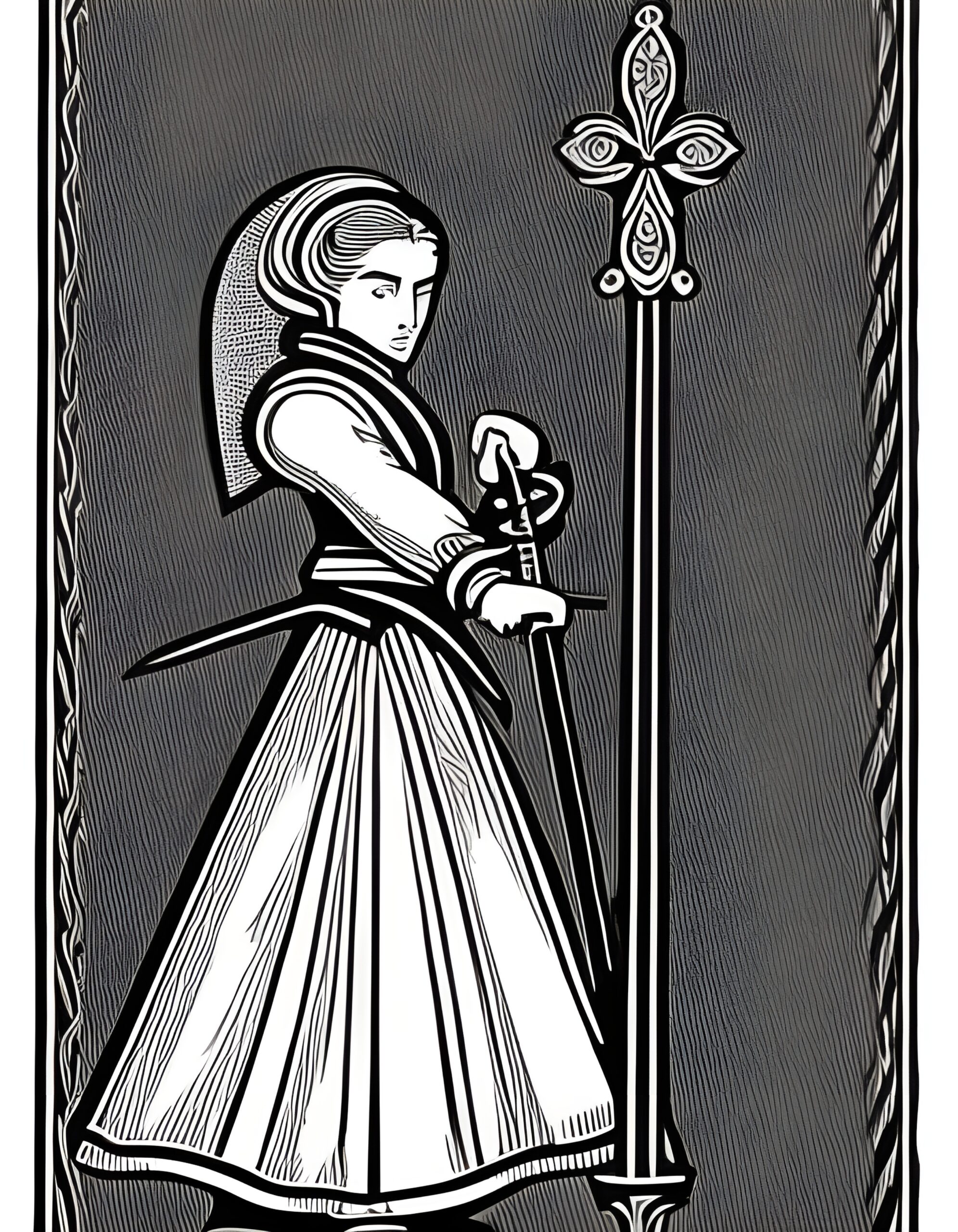
  • Margret Ravenholt

    The Voyage

    In the early 1620s, England was a land rife with religious and political turmoil. Amidst this backdrop, Margret Ravenholt, a woman of the Protestant faith, found herself increasingly alienated. Her disenchantment with the escalating conflict and the search for a new beginning propelled her decision to leave for the American colonies.

    Margret’s departure was not a whim of adventure; it was a calculated move, shrouded in secrecy. While outwardly she appeared as just another soul seeking religious freedom, her true motives were deeply entwined with her undisclosed allegiance to Spain. As a skilled swordswoman, her talents were a rare asset, and unbeknownst to her fellow travelers, she had been covertly recruited as a Spanish spy.

    The voyage across the Atlantic was a grueling test of endurance. Aboard a modest, overcrowded ship, Margret and her fellow passengers faced tumultuous seas, unpredictable weather, and the ever-present threat of disease. Life on board was harsh, with limited rations and unsanitary conditions. Despite these hardships, Margret maintained a resilient front, her resolve fueled by her clandestine mission.

    During the long weeks at sea, Margret forged subtle bonds with her fellow travelers. She listened to their stories, learning about their hopes for the New World. These interactions were a crucial part of her cover, helping her blend into the tapestry of the ship’s diverse passengers. Yet, beneath her congenial exterior, she remained vigilant, gathering information and observing the intricacies of the ship and its crew – details that would prove valuable in her reports to her Spanish handlers.

    The voyage from England to the American colonies was fraught with danger, not just from the treacherous seas but also from the tensions and conflicts that simmered among the passengers and crew on the overcrowded ship. Margret Ravenholt, amidst this volatile mix, tried to maintain a low profile, aware of the need to protect her secret identity as a spy and her unusual skill with a blade.

    One night, as the ship sailed through the dark waters of the Atlantic, Margret encountered a grave threat. A man, possibly driven by desperation, ill-intent, or the lawlessness that often prevailed in such cramped and harsh conditions, attacked her. This assault was not just a physical danger but a threat to her carefully constructed cover.

    Faced with immediate peril, Margret’s instincts and training took over. She defended herself with the only means available – her hidden blade. In the struggle that ensued, she fatally stabbed her assailant, an act of self-defense but one that risked exposing her combat skills.

    Realizing the implications of her actions, Margret knew she had to act quickly to conceal the evidence of the altercation. With a mix of fear and resolve, she made the drastic decision to throw the man’s body overboard. This act was not just about removing physical evidence; it was an attempt to erase any trace of the incident, to keep her secrets hidden in the depths of the ocean.

    The choice to cast the body overboard was a moment of significant moral and emotional conflict for Margret. It was a decision made in the heat of the moment, one that would haunt her in the days to come.

    The next morning, the disappearance of the man caused murmurs among the passengers and crew. Some suspected foul play, while others believed it to be an unfortunate accident or a case of man overboard. Margret remained silent, her guilt and fear concealed behind a facade of calmness.

    This incident was a pivotal moment for Margret. It was the first time she had been forced to use her skills in such a deadly and public manner. The fear of discovery now hung over her, adding to the already heavy burden of her secret mission. The event also served as a harsh reminder of the dangers she faced, not just in her role as a spy but as a woman traveling alone among strangers in a lawless environment.

    As the ship continued its journey to the New World, Margret was left to grapple with the consequences of her actions, both in terms of her immediate safety and the moral weight of taking a life. This experience would shape her approach to her new life in the colonies, making her more cautious but also more aware of the lengths she might have to go to protect herself and her mission.

    As the ship approached the American coast, the sight of the new land sparked a mix of emotions among the passengers – relief, excitement, apprehension. For Margret, the sight of the rugged coastline marked the beginning of a new chapter in her life. It was here, in this untamed land, that she would carve out her role as a spy, using her skills and wits to navigate the complex dynamics of the colonial settlements.

    Upon disembarking, Margret and the other settlers were greeted by a landscape vastly different from their homeland. The vast, untamed wilderness of the New World presented a stark contrast to the cultivated lands of England. This new environment posed its own set of challenges, from harsh weather to unfamiliar flora and fauna.

    As Margret stepped onto the soil of the American colonies, she knew that her journey had only just begun. Ahead lay the task of establishing her new identity, integrating into the colonial society, and fulfilling her covert mission.

    The American colonies, with their burgeoning settlements and uncharted territories, offered a fertile ground for espionage. And Margret Ravenholt, with her unique skills and hidden agenda, was poised to leave her mark on this new world, shaping not only her destiny but also the intricate web of international relations in the age of colonialism.

    Life in the Colony

    Upon her arrival in the American colonies, Margret Ravenholt was immediately faced with the stark realities of life in a new land. The settlements were rudimentary, with basic wooden structures and dirt roads, a far cry from the developed landscapes of England. Margret quickly adapted, using her resilience and resourcefulness to establish herself in the colony.

    Her daily life involved a blend of household duties common to women of the era—cooking, cleaning, and sewing. However, Margret also participated in community activities, which helped her to forge connections with her neighbours and gather information pertinent to her secret mission as a Spanish spy.

    Once settled in the colony, Margret Ravenholt quickly began to establish the means for communicating with her Spanish handlers. Her role as a spy required a discreet and reliable method to transmit information. The perfect solution presented itself in the form of a courier, a man who worked on the ships traveling between the colonies and England.

    This courier was a key figure in Margret’s espionage activities. He was a man who navigated the seas regularly, familiar with the intricacies of maritime travel and the art of discretion. His job provided him with the perfect cover to transport messages without arousing suspicion.

    Margret’s choice of the courier was strategic. His position allowed him access to outgoing vessels heading back to England, making him an ideal intermediary. He could carry her reports across the ocean, far from the prying eyes of the colonial authorities.

    Margret and the courier met covertly, often under the guise of innocuous interactions to avoid drawing attention. These meetings were risky, and both understood the grave consequences should they be discovered. They chose secluded spots for their exchanges – perhaps in the dense woods surrounding the settlement or in the quiet corners of the bustling colonial market.

    During these clandestine meetings, Margret handed over carefully crafted letters. These letters contained observations on the military strength of the colonies, political sentiments, economic conditions, and other information valuable to the Spanish. She used various codes and ciphers to encode her messages, ensuring that if the letters were intercepted, their contents would remain a mystery.

    Once in the hands of the courier, the letters began their secretive journey. They traveled first to England, hidden among the courier’s belongings or in other ingenious hiding places. From England, they were then dispatched to the Spanish court. This indirect route was a necessary precaution, as direct communication between the colonies and Spain would have been highly suspicious.

    This covert operation was fraught with danger. Margret was constantly aware that discovery would lead to severe punishment, likely death. Her meetings with the courier required meticulous planning and utmost caution. Each exchange was a gamble, a moment where her fate hung in the balance.

    Despite the risks, Margret continued her espionage, driven by her sense of duty and the thrill that came with such a dangerous endeavor. Her successful exchanges with the courier were small victories in a shadowy war of information – a war that played out silently and unseen beneath the surface of colonial life.

    Margret’s adeptness with a blade, a skill unusual for women of her time, remained a closely guarded secret. She practiced in solitude, honing her skills in the early hours of dawn or under the cover of night. This hidden talent was not just a means of self-defense; it was an integral part of her identity and a crucial element in her espionage activities.

    As a woman in the colonies, Margret faced the typical expectations of her gender—piety, modesty, and an adherence to the domestic sphere. She navigated these societal norms with a careful balance, maintaining her cover as a devout and unassuming member of the community while also fulfilling her role as a spy.

    Her position in society allowed her a unique perspective. Women were often underestimated, and as such, Margret was able to gather intelligence in ways that a man could not. She listened and observed, gathering information at social gatherings, during church services, and in the course of everyday interactions.

    Margret’s life as a spy was fraught with risks. Any misstep could lead to her exposure and, likely, her death. She communicated with her Spanish handlers through coded letters, which she hid meticulously. The information she provided was invaluable: details of the colony’s defenses, economic conditions, and political sentiments.

    In the American colonies, Margret Ravenholt had managed to secure a modest income for herself. This could have been through a variety of means common in the period, such as trading goods, providing services like sewing or teaching, or perhaps through her involvement in the local market. Despite her covert activities as a spy, she understood the importance of maintaining a semblance of normalcy and financial independence in the colony.

    Margret was prudent with her earnings. In a time when the economic status of women was precarious, she knew the value of saving. Her savings were not just a financial cushion; they represented her autonomy and a means to navigate the uncertainties of colonial life.

    However, Margret’s relative financial stability was shattered when she became the victim of a robbery. In the colonies, where law and order were still in a formative stage, such incidents were not uncommon. The robbery could have occurred at her home, perhaps a break-in during the night, or it might have been a more brazen theft in broad daylight.

    This event was a significant setback for Margret. Not only did she lose her hard-earned money, but the incident also exposed her vulnerability. It was a stark reminder of the dangers and instability of life in the colony, especially for a woman living alone.

    The loss of her savings had multiple implications, Margret found herself under immediate financial pressure. Without her savings, she faced difficulties in covering her basic living expenses and maintaining her cover in the colony. The robbery forced Margret to engage more frequently in her espionage activities to recover her financial losses. This increased activity heightened her risk of exposure. The incident eroded her sense of security and trust within the community. It made her more cautious and even more isolated, as she began to suspect those around her.

    However, ff part of her income was supplemented by her espionage activities, the loss of her savings might have made her more dependent on the money received from her Spanish handlers, compelling her to take even greater risks. Margret’s response to this adversity was a testament to her resilience. She sought ways to increase her income through alternative means or tighten her expenditure. She became more guarded, reinforcing her home against further incidents. This event, while a setback, strengthened her resolve and adaptability, traits essential for survival in the unpredictable environment of the colonial frontier.

    Her dual life was a constant juggling act. On one hand, she was a trusted member of her community, on the other, a covert operative for a foreign power. This duplicity weighed heavily on her, as she formed genuine bonds with some of her fellow colonists, all the while knowing that her actions could ultimately lead to their harm.

    Margret’s life in the colonies took a turn when she entered into a relationship with a fellow colonist, a man who initially seemed kind and understanding. However, as time passed, the man’s demeanor changed drastically. He became abusive, subjecting Margret to verbal and physical harm.

    Margret, strong-willed and independent, was not one to suffer in silence. She sought help from the colony’s elders, hoping for protection and justice. In a society where women’s voices were often disregarded, her plea was a bold move, defying the norms that dictated silent endurance of such hardships.

    To Margret’s astonishment, the elders, adhering to some archaic and bizarre practices, suggested a resolution that seemed straight out of medieval lore: a trial by combat. Margret was to face her abuser in a physical duel, an unthinkable proposition for a woman in her time.

    In the eyes of the community, this was a fair way to settle disputes, deeply rooted in ancient traditions that viewed combat as a test of truth and justice. For Margret, it was both a dangerous challenge and an unexpected opportunity to utilize her secret swordsmanship skills.

    The day of the duel drew a large crowd. Such events were rare, and the idea of a woman participating was unheard of, igniting curiosity and skepticism among the colonists. Margret, cloaked in a mix of determination and apprehension, stepped into the makeshift arena.

    The duel began, and it quickly became apparent that Margret was no ordinary combatant. Her skills with the blade, honed through years of secret practice, were evident. She moved with a precision and grace that belied her seemingly demure exterior. The man, overconfident and underprepared, found himself outmatched.

    The duel ended with Margret standing victorious, her abuser disarmed and defeated. The crowd, initially shocked, erupted into a mix of cheers and murmurs. Margret had not only defended herself but had also shattered the community’s perceptions of a woman’s capabilities.

    This victory was more than just a personal triumph over her abuser; it was a public vindication of her strength and skill. However, it also inadvertently put her in the spotlight, drawing unwanted attention to her abilities and raising questions about her past – a precarious situation for a woman harboring the secret of being a spy.

    In the aftermath of the duel, Margret’s life in the colony changed. She gained a newfound respect from some, while others viewed her with suspicion and fear. Her display of martial prowess, so contrary to the expected behavior of women at the time, made her an enigma.

    This shift in perception began to complicate her espionage activities. Margret found it increasingly difficult to blend into the background, her every move now scrutinized by those around her. The duel, while a moment of personal empowerment, had unwittingly sown the seeds of her eventual downfall, inching her ever closer to the discovery of her true identity and mission.

    Following the duel, Margret Ravenholt’s presence in the colony was transformed. She began to openly carry a short sword, a physical manifestation of her strength and defiance of societal norms. The sword, while a symbol of her victory and self-reliance, also served as a constant reminder to the colonists of her unusual abilities.

    Margret’s newfound status elicited mixed reactions from the community. Many respected her for her courage and skill, perhaps even seeing her as a figure of empowerment in a society where women were often marginalized. However, this respect was intertwined with a sense of fear and apprehension. A woman skilled in combat was an anomaly, challenging the established order and gender roles.

    The elders, who once viewed Margret as just another member of the colony, began to regard her with suspicion. Her deviation from the expected behavior of women unsettled them, and they worried about the influence she might have on other women and the broader social dynamics of the settlement.

    Margret’s role as a spy was predicated on her ability to blend in and gather information unnoticed. However, her new status made this increasingly difficult. Her every move was now observed and discussed, diminishing her ability to act covertly. The respect and fear she commanded came at the cost of her anonymity.

    Feeling the pressure of increased scrutiny, Margret began to operate with a sense of urgency and recklessness that was uncharacteristic of her previous careful approach. Her dispatches to her Spanish handlers became more sporadic and risky. She took chances she would have avoided in the past, like meeting contacts in less secluded locations or hastily encoding messages.

    This carelessness was fueled partly by paranoia. Margret felt the eyes of the colony on her at all times, and she knew that any slip could expose her true identity. The fear of discovery started to cloud her judgment, leading to mistakes that would have been unthinkable to her just months before.

    Margret’s transformation and subsequent carelessness marked the beginning of the end of her time in the colony. What started as a journey for a new life had spiraled into a complex web of espionage, conflict, and survival. As the suspicion around her grew, so too did the risk of her true identity being uncovered. Margret Ravenholt, once a shadowy figure blending into the backdrop of colonial life, had become a person of interest, her every action scrutinized by a community that had grown wary of her unorthodox ways. This shift set the stage for the eventual unraveling of her secret life as a spy.

    Margret’s carefully constructed world began to unravel when suspicions arose about her activities. It started with small inconsistencies in her behavior, observations made by a few observant colonists. Then, a series of unfortunate events led to the discovery of one of her hidden messages.

    As the community she had grown to know as home turned against her, Margret faced the harsh reality of her situation. She was no longer just a spy; she was now a traitor in the eyes of those she had lived among for years. Her arrest and trial were imminent, marking the end of her life in the colonies and the beginning of a harrowing ordeal that would test the very limits of her resilience and cunning.

    The Espionage Unveiled

    In the heart of the American colonies, amidst the bustling growth and raw challenges of the New World, Margret Ravenholt’s life took a dramatic turn. For years, she had woven herself into the fabric of the colonial community, her true identity and purpose cloaked beneath the guise of a diligent Protestant settler. But the fragile veil of her secret life was about to be torn asunder.

    The unraveling began with the discovery of her correspondence. Hidden within the floorboards of her modest abode, a cache of letters was found – intricate messages penned in a cryptic blend of codes and languages. These letters revealed her true allegiance: Margret Ravenholt, the unassuming settler, was in fact a covert agent for Spain.

    The revelation sent ripples of shock and betrayal through the community. To the colonists, her actions were not merely an act of espionage; they were a profound betrayal of trust, an affront to their nascent society and its values.

    Margret was swiftly apprehended and subjected to a trial. The colonial authorities, eager to demonstrate their commitment to justice and order, conducted a swift and rigorous examination. The evidence was overwhelming – the letters detailed her reports to Spanish handlers, her observations of the colony’s defenses, and plans that could endanger the very existence of the settlement.

    Despite her pleas of innocence and attempts to explain her actions, the court remained unmoved. In their eyes, Margret was a traitor, her guilt undeniable.

    Following her conviction, Margret was imprisoned. Her cell, a stark, cold space, became her world. The days blurred into a continuous loop of solitude and reflection. She pondered her choices, her loyalty to a distant land, and the life she had built in the colonies – a life now shattered beyond repair.

    The colonial authorities, determined to make an example of her, sentenced Margret to death by burning at the stake – a punishment both brutal and symbolic, intended to purge the community of her perceived treachery and to serve as a stark warning to others.

    As the fateful day arrived, the air was thick with tension and sombre anticipation. The community gathered, a mix of anger, fear, and morbid curiosity etched on their faces. Margret, bound and resolute, was led to the stake. The flames were lit, and as they climbed higher, consuming her physical form, the legacy of Margret Ravenholt – the settler, the skilled swordswoman, the spy – was written up into the annal of colonial lore, a cautionary tale of deception, loyalty, and the merciless hand of justice in the raw, unforgiving world of the American colonies.

    Notes for Margret Ravenholt

    Margret’s Journal: A Double-Edged Sword

    In her quest for discretion and security, Margret maintained a personal journal written in a complex cipher. This journal was a meticulous record of her thoughts, experiences, and, most crucially, details of her espionage activities. The cipher was a method to ensure that, even if the journal were discovered, its contents would remain incomprehensible to anyone but her.

    The journal served multiple purposes for Margret. It was a detailed account of her observations, plans, and contacts, crucial for her espionage activities. The journal also served as a confidential space where Margret could express her fears, hopes, and struggles, a rare luxury in her precarious situation.

    The use of cipher was a testament to Margret’s caution and intelligence. It demonstrated her awareness of the risks involved in her work and her efforts to mitigate them. However, the security Margret sought through her journal ultimately became her undoing. The journal was discovered, perhaps during a search of her home or through the betrayal of a confidant. To the colonial authorities, the very existence of a ciphered document was inherently suspicious. It implied secrets and possibly subversive activities.

    During her trial, the journal was presented as evidence against her. Although its contents remained indecipherable to her accusers, the mere fact that she had gone to such lengths to conceal these writings was incriminating in itself. The prosecution argued that the journal was proof of clandestine activities, perhaps even treasonous in nature.

    The ciphered journal had a significant impact on the trial. The inability of the authorities to decipher the journal may have further fueled their suspicions, leading them to assume the worst about its contents. To the public and the jury, the journal was a mysterious and damning piece of evidence. It painted Margret as a schemer and a spy, undermining any defense she might have presented. Margret’s inability to provide an innocent explanation for the journal, without revealing her role as a spy, put her in an impossible position. Admitting to the espionage would have sealed her fate, but maintaining her innocence in the face of such evidence was equally damning.

    The journal, which Margret had created as a tool for protection and organization, turned into one of the primary instruments of her downfall. In her efforts to guard her secrets, she had inadvertently given her accusers the very tool they needed to convict her. This twist of fate highlighted the perilous nature of espionage and the fine line Margret walked in her double life as a spy in the American colonies.

    Centuries after Margret Ravenholt’s trial and subsequent execution, her ciphered journal, long forgotten, resurfaced unexpectedly. It was discovered in the archives of a museum, perhaps during an inventory or a research project into colonial history. This journal, once a critical piece of evidence in a high-stakes trial, had become a relic of the past, its origins and significance shrouded in mystery.

    The 17th century’s ciphers and secret writings reflect a fascinating intersection of history, science, and art. They were tools of war, diplomacy, and personal safeguarding, revealing the increasing sophistication in handling information and the perennial human concern for privacy and secrecy.

    This was a period rich in the development and use of ciphers and secret writing, particularly due to political intrigue, espionage, and the burgeoning scientific inquiry of the time. This era, marked by figures like Sir Francis Bacon and Cardinal Richelieu, saw significant advancements in the art of cryptography. Ciphers were crucial for espionage. Spies used them to communicate sensitive information covertly. The ability to decipher an enemy’s codes was equally important and could turn the tide in conflicts.

    Margert used a combination of techniques:

    A Simple Substitution Cipher, which was one of the most common forms of ciphers. Each letter in the plaintext was replaced by a letter with a fixed shift in the alphabet. The Caesar cipher is a famous example, where each letter in the plaintext is shifted a certain number of places down or up the alphabet.

    Vigenère Cipher, developed in the 16th century but gaining popularity in the 17th, the Vigenère cipher used a keyword to create a series of different Caesar ciphers for each letter of the text. This method was considered more secure than simple substitution ciphers and was widely known as ‘le chiffre indéchiffrable’ or the unbreakable cipher.

    The art of codebreaking evolved alongside ciphering techniques. Codebreakers used frequency analysis, pattern recognition, and later, more complex mathematical methods to crack codes. The 17th century saw significant advancements in cryptography, laying the groundwork for modern cryptographic science. Scholars like Sir Francis Bacon proposed innovative methods, including the Baconian cipher, which used a binary system of encoding.

    The journal, once deciphered, offered historians a rare and intimate glimpse into the life of a woman in the American colonies, particularly one involved in espionage. It shed light on the day-to-day experiences, struggles, and inner thoughts of a person living in such a tumultuous period. For the researchers, the journal was a treasure trove of information on espionage techniques of the era. The use of cipher demonstrated the sophistication of spy networks and the lengths to which individuals went to protect their secrets. Margret’s writings provided valuable material for cultural and gender studies, showcasing the role and perception of women in early colonial society, especially those who defied societal norms.

    The process of deciphering the journal was likely a painstaking task for historians and cryptographers. Using a combination of historical knowledge, linguistic expertise, and modern technology, they gradually unlocked the secrets of Margret’s cipher.

    Each decoded entry revealed more about her life, her work as a spy, and the circumstances that led to her tragic end. Once deciphered, the journal became a highlight of the museum’s collection. An exhibition might have been organized, showcasing excerpts from the journal alongside other artifacts from the period, giving visitors a vivid picture of Margret’s life and times.

    The public reaction to the journal and its contents could range from fascination to empathy. Margret’s story, once marked by infamy and suspicion, might now be viewed in a new light – as a tale of courage, intrigue, and the complex nature of colonial existence.

    The discovery of the journal had a significant impact on both educational and scholarly fields. The journal became a subject of academic research, providing material for dissertations, papers, and debates in the fields of history, espionage, and women’s studies. Margret’s story, enriched by the details from her journal, inspired documentaries, and fictional adaptations, drawing a wider audience to this intriguing piece of history.

    The emergence of the journal centuries after her death transformed her from a mere footnote in history into a figure of academic interest and study. It offered a rare perspective on the complexities of life in the early American colonies and the extraordinary narrative of a woman who lived at the fringes of society, both geographically and socially.

    The journal served as a poignant reminder of the countless untold stories that lie hidden in early American of history.

    Among the many fascinating encoded discoveries within Margret Ravenholt’s deciphered journal was a section that stood out as particularly remarkable: a detailed treatise on swordsmanship.

    This section of the journal was a comprehensive guide to the art of the sword, a compilation of techniques, strategies, and philosophical insights into combat.

    Margret detailed various sword-fighting techniques, including stances, thrusts, parries, and counterattacks. She described the forms with meticulous precision, likely honed through her own practice and experience.

    Beyond her techniques, the treatise offered insights into the strategic aspects of swordplay. Margret wrote about reading an opponent’s intentions, the importance of timing and rhythm in combat, and the psychological aspects of duelling. Interspersed with the technical details were personal reflections and anecdotes from Margret’s own experiences. These stories provided context to the techniques and revealed her deep understanding of and respect for the art of swordsmanship.

    Margret also delved into the philosophy behind martial arts. She wrote about discipline, honour, and the ethical considerations of using a sword. Her words reflected a contemplative and respectful approach to what was essentially a lethal skill.

    The inclusion of a swordsmanship treatise in Margret’s journal was extraordinary for several reasons. It further challenged the prevailing notions of the role and capabilities of women in the 17th century, particularly in martial disciplines, which were predominantly male domains. The techniques and philosophies might have reflected a blend of different traditions – European fencing styles mixed with insights Margret could have gathered during her travels or through encounters with individuals from various cultural backgrounds.

    The treatise showcased a balance of practical knowledge and theoretical understanding, indicating that Margret was not just a practitioner but also a thinker and strategist. The swordsmanship treatise in Margret’s journal had a significant impact, where it became a valuable resource for historians and practitioners of martial arts, providing a unique perspective on the evolution of sword-fighting techniques and philosophies. Margret’s treatise served as an inspiration, particularly to women in martial arts, exemplifying that skill and mastery in combat are not confined by gender.

    It offered a lens into the merging of cultures and ideas in the early colonial period, highlighting how knowledge and practices were shared and adapted across different societies.

    The treatise at it most basic was a manual of combat techniques; but it was also a reflection of her life as a warrior, a spy, and a thinker. It stood as a testament to her skill, intelligence, and the complex identity she navigated in a world that often sought to define her by the standards of her time.

    1620’s England

    Life in England during the 1620s was characterized by significant social, political, and religious turmoil. This period was marked by the reign of King James I, followed by Charles I, and it was a time of growing tension that would eventually lead to the English Civil War in the 1640s. The situation in England during this era would have influenced many, including women, to consider the perilous journey to America.

    Here are some key aspects of life in England during the 1620s and reasons why a woman might seek to travel to America:

    Economic Hardship: The 1620s witnessed economic difficulties, including inflation and unemployment. The rural and urban poor suffered from these conditions, leading to increased social unrest and hardship.

    Land Shortages: In rural areas, there was a significant shortage of land due to the enclosure movement, where common lands were being privatized. This reduced opportunities for small-scale farming, impacting many families.

    Puritanism and Religious Persecution: The 1620s saw the rise of Puritanism, a movement seeking to “purify” the Church of England from Catholic practices. Puritans faced opposition and persecution from the established church and the monarchy, leading many to seek a place where they could freely practice their religion.

    Escape from Religious Conflict: England’s religious landscape was marked by tension and conflict. This environment could be particularly oppressive for women, who had fewer rights and were often targets of religious scrutiny.

    Authoritarian Rule: The policies of King James I and Charles I towards governance and religion were seen as authoritarian. This led to discontent among various segments of the population.

    Seeking Political Freedom: The lack of political freedom and representation in England was a significant concern. The New World offered a chance for greater participation in local governance and decision-making.

    Adventure and Opportunity: The idea of America as a land of opportunity was a compelling lure for many. For women, it offered a chance for a new start, especially for those who were widowed, unmarried, or seeking to escape poverty.

    Family and Community Migration: Many women traveled as part of family groups or with communities seeking to establish new settlements in America.

    Marriage and Dowry Concerns: The social structure in England often limited women’s choices regarding marriage. In the colonies, there was a higher demand for women, offering them potentially more advantageous marriage prospects.

    Widows and Inheritance: Widows might have more opportunities to own land or run businesses in the colonies, which was often not possible in England due to strict inheritance laws and social norms.

    The combination of these factors created a compelling case for migration.

    For many women, the American colonies represented not just a new land, but a chance for religious freedom, economic opportunity, and a break from the constraints of traditional English society.

    Despite the dangers and uncertainties of such a journey, the promise of a new beginning was a powerful motivator that led many to embark on the arduous voyage to America.

    Colonial Life

    Life for a woman in the American colonies during the 17th and 18th centuries was profoundly shaped by societal norms, economic demands, and the harsh realities of colonial life. Women’s experiences varied widely depending on their social status, geographical location, and whether they lived in rural or urban areas.

    However, certain commonalities defined the general experience of women during this period.

    Role in the Household: Women were primarily responsible for managing the household. This included a wide range of duties such as cooking, cleaning, sewing, and childcare. In rural areas, women also participated in farming tasks, like milking cows, tending to poultry, and gardening.

    Childbearing and Childrearing: Childbearing was a central aspect of a woman’s life. Women often had large families, and due to the high infant mortality rates, the emotional toll of losing children was a grim reality. Childrearing was a significant responsibility, with mothers playing a key role in educating their children, particularly in religious and moral instruction.

    Agricultural Work: In farming families, women contributed significantly to the agricultural labour. They helped with planting and harvesting crops, and in some cases, managed farms when their husbands were absent or deceased.

    Crafts and Trades: Some women engaged in crafts such as weaving, spinning, and candle-making. In towns, women might run or work in shops and inns. Widows sometimes took over their late husbands’ trades, becoming rare but accepted figures in professions like printing, tavern-keeping, or shopkeeping.

    Limited Legal Rights: Women had limited legal rights. Married women, in particular, were under the legal doctrine of coverture, where a wife’s legal identity was subsumed by her husband’s. Women could not vote, and in most cases, could not own property independently of their husbands.

    Social Expectations: Society held strong expectations regarding women’s behavior. Piety, modesty, and obedience were highly valued. Education for girls was focused more on domestic skills rather than formal academic subjects.

    Hardships: Life in the colonies was challenging, with threats from diseases, food shortages, and, in some areas, conflicts with Native Americans or other colonial powers. Women often had to manage these challenges while their husbands were away or deceased.

    Community and Support: Women found support in their communities through social networks, church groups, and kinship ties. These networks were crucial for survival and emotional support, particularly in frontier regions or during periods of hardship.

    Religious Life: Women were active participants in religious life. In some denominations, they could hold certain positions of authority or influence, although preaching or formal leadership roles were generally reserved for men.

    Social Reforms: In the later colonial period, some women began to play roles in social reform movements, such as the abolition of slavery and the promotion of education, although these movements became more prominent post-independence.

    The life of a colonial woman was thus marked by hard work, resilience, and resourcefulness.

    Despite their limited formal rights and societal constraints, women played a crucial role in the survival, economy, and social fabric of the colonial settlements. Their contributions, often overlooked in historical narratives, were fundamental to the establishment and growth of the early American colonies.

  • The Dance of Steel

    The Dance of Steel

    The Sword of Shadows

    In the heart of Castile, under the rule of Queen Isabelle, there was a young woman named Elena, whose spirit burned as fiercely as the midsummer sun. The daughter of a nobleman, Elena had grown up in the shadows of the grand Alcázar of Segovia, a place where history whispered from every stone and heroes of old seemed to walk in the tapestries that adorned the halls.

    From a young age, Elena was entranced by the tales of knights and their noble deeds. She would often be found in the castle’s library, her eyes devouring pages of ancient lore and legends. Her favourite stories were those of Lady Jimena, a fabled warrior who, armed with only a short sword, defended Castile against a horde of invaders. Elena’s heart would race as she read about Jimena’s bravery and skill, and a deep longing took root in her soul – she too wanted to wield a sword and protect her beloved land.

    Despite the expectations of her noble birth, which dictated a life of courtly manners and marriage, Elena secretly began training with a short sword. She found an ally in Rodrigo, the castle’s blacksmith, who had once been a soldier. Rodrigo saw the determination in Elena’s eyes and agreed to train her, impressed by her natural affinity for the sword.

    Their training sessions would take place in the early hours of the morning, in a secluded courtyard where the first rays of dawn would cast long shadows. Elena was a quick learner, her movements both graceful and deadly. The short sword felt like an extension of her own body, and she named it “Sombra,” meaning shadow, for its ability to strike swiftly and silently.

    Word of Elena’s skills eventually reached Queen Isabelle herself. Intrigued, the Queen summoned Elena to the court. Elena arrived, her heart pounding, not knowing what to expect. Queen Isabelle, known for her wisdom and strength, saw something special in Elena. She offered Elena a position in her royal guard, an unprecedented honour for a woman. But there was a condition – Elena would have to prove herself in a tournament.

    The day of the tournament arrived, and the air was thick with excitement. Nobles and commoners alike had gathered to witness the spectacle. Elena entered the arena, her short sword Sombra gleaming in the sunlight. Her opponents were seasoned warriors, each skilled in various forms of combat. But Elena was not deterred. She remembered Rodrigo’s teachings and the tales of Lady Jimena.

    With each match, Elena displayed her prowess. She moved with a dancer’s grace, her sword cutting through the air with precision. The crowd cheered, impressed by the skill and courage of this young noblewoman. In the final bout, Elena faced the champion of the royal guard, a giant of a man named Alvaro. He wielded a great sword and was known for his brute strength.

    The duel was intense, with Alvaro’s strength pitted against Elena’s agility and speed. Blow after blow, parry after parry, the two combatants were evenly matched. In the end, it was Elena’s cunning that won the day. She feigned a misstep, luring Alvaro into overextending his reach. In that brief moment, she struck, her sword finding its mark. Alvaro fell to his knees, defeated.

    The crowd erupted into cheers as Queen Isabelle rose from her throne, clapping her hands in admiration. Elena had proven herself not only as a skilled swordswoman but also as a tactician. The Queen declared Elena the winner, and the court erupted in surprise, then celebration.

    That night, as the stars shone brightly over the Alcázar, Elena stood on the battlements, her short sword by her side. She had achieved what many thought impossible. But she knew this was just the beginning. Her journey had only started, and she was ready for whatever challenges lay ahead, ready to carve her own legend in the annals of Castile.

    In the shadows of the court of Queen Isabelle, Elena, the young woman with a short sword, had become a symbol of hope and strength, a reminder that even the most unlikely heroes can rise and shape their own destiny.

    The Shadows and the Heart

    “In the realm of steel and shadow, one must not only understand the blade they hold but also the heart that wields it. The sword is not merely a tool of war; it is an extension of the self, a conduit of honor and courage. In every movement, let your actions be guided by valor and tempered by wisdom. For a true warrior, the greatest battle is not fought on the battlefield, but within the chambers of one’s own soul.” – The Philosophy of the Sword

    In the days following the tournament, Elena’s life transformed. As a member of Queen Isabelle’s royal guard, she was respected and admired. Yet, amidst the glory and honour, her heart found solace in the quiet moments she spent with Rodrigo, the blacksmith who had become her mentor and, now, her confidant. Their bond, forged in the flames of shared secrets and early morning training sessions, had blossomed into a love both deep and true.

    Rodrigo, with his rugged hands and gentle eyes, saw Elena not just as the warrior she had become, but as the woman she was beneath her armor. In his forge, away from the prying eyes of the court, they would speak of dreams and fears, of a future they wished to build together. Their love was a quiet flame, burning steadily in the chaos of the court.

    However, as their relationship grew, so too did the challenges they faced. Queen Isabelle’s reign, though prosperous, had its share of enemies. Whispers of discontent and plots of treason began to surface, darkening the halls of the Alcázar. Elena, ever vigilant, stood as a shield to her queen, her loyalty unwavering.

    One fateful night, as a grand feast was held in the palace, danger struck. Amidst the laughter and music, an assassin, cloaked in shadows, made an attempt on Queen Isabelle’s life. The court erupted into chaos, but Elena’s training took over. With Sombra in hand, she leapt into action, intercepting the assassin before he could reach the Queen.

    The battle was fierce and swift. Elena’s sword clashed against the assassin’s dagger, sparks flying with every strike. But in the heat of the combat, the assassin managed a lucky thrust. Elena felt a sharp pain as the dagger found its mark, wounding her side.

    Rodrigo, who had been among the spectators, rushed to her aid. With the strength born of desperation, he fought alongside Elena, driving the assassin back. Together, they overcame the threat, but the damage had been done. Elena, weakened by her wound, collapsed at Rodrigo’s feet.

    The Queen, safe but shaken, ordered the finest physicians to tend to Elena. As she lay in recovery, Rodrigo was a constant presence by her side, his worry etched in every line of his face. The wound was deep, and for days Elena drifted in and out of consciousness, fighting to hold onto life.

    In those fevered dreams, Elena saw a different life, one where she and Rodrigo were free from the burdens of court and conflict. They wandered through lush fields and forests, their laughter echoing in the wind. But each dream would end with the stark reality of her injury, pulling her back to the dimly lit room in the Alcázar.

    Slowly, with the care of the physicians and Rodrigo’s unwavering support, Elena began to mend. Her strength returned, but the experience had changed her. She realized how fragile life could be and how quickly everything she held dear could be taken from her.

    As Elena regained her health, her resolve strengthened. She knew that her duty to protect the Queen was more important than ever. Yet, in her heart, a new desire had taken root – the desire to cherish every moment with Rodrigo, to embrace the love they shared, even in the face of danger and uncertainty.

    The attempted assassination had revealed the depth of the threats facing the court. Elena, now more determined, returned to her duties, her sword at her side and Rodrigo’s love in her heart. Together, they faced the shadows that lurked within the walls of the Alcázar, their bond unbreakable, their courage unwavering.

    In the court, amidst the intrigue and peril, a warrior and a blacksmith found love and strength in each other. Their story, whispered in the corridors and sung by the minstrels, became a testament to the power of the heart to conquer even the darkest of shadows.

    The Legacy of the Blade

    “Defense is the art of surviving, the craft of enduring. To defend is not merely to block or to parry, but to anticipate, to see beyond the immediate strike. It is in the calm center of the storm that one finds clarity. Stand firm, yet be fluid. In the dance of blades, it is often the one who masters the art of yielding, who ultimately prevails. Remember, in stillness lies the potential for the greatest motion.” – On the Art of Defense

    In the quiet chambers of the Alcázar, where the light of dawn cast a gentle glow, Elena sat, her body still aching from the wound that had nearly claimed her life. The assassination attempt on Queen Isabelle had left its mark, not only on her flesh but on her soul. Yet, within her, the spirit of a warrior burned bright, fuelled by her love for Rodrigo and her duty to her queen.

    As she recovered, Elena found solace in pen and paper, channelling her experiences and knowledge into words. She began writing a treatise on swordplay, specifically for women. Her intention was clear: to empower other women with the skills and confidence that had defined her own path. The manuscript, titled “The Dance of Steel: A Woman’s Guide to the Sword,” detailed techniques, strategies, and philosophies of combat. It was revolutionary, a beacon of enlightenment in an era where the role of women in warfare was often overlooked.

    Rodrigo, ever her anchor, supported her endeavour, his love a constant source of strength. In the evenings, they would discuss her writings, Rodrigo offering insights from his own experiences as a soldier. Their bond deepened, rooted in mutual respect and a shared vision of a world where women stood as equals in the art of war.

    However, fate, as it often does, had its own plans. As Elena’s treatise neared completion, tragedy struck. Rodrigo, who had been working late in the forge, was caught in a terrible accident. A sudden fire, fuelled by a spilled crucible of molten metal, engulfed him. Despite the efforts of those who rushed to his aid, Rodrigo succumbed to his injuries.

    Elena’s world shattered. The man who had been her mentor, her lover, her closest friend, was gone. Grief engulfed her, as deep and dark as a moonless night. She withdrew into herself, her treatise left unfinished, its pages a painful reminder of a future they had dreamt of together.

    Queen Isabelle, seeing Elena’s despair, approached her with an opportunity. A diplomatic mission to Eastern Europe was being organized, an effort to forge alliances against potential threats. The Queen believed that Elena, with her noble birth, skill in combat, and now, her experience in tragedy and resilience, was the perfect envoy.

    Reluctantly, Elena accepted. She saw the mission as a chance to escape the ghosts that haunted her in the Alcázar, and perhaps, to find a new purpose in a world that had taken so much from her. She left behind her unfinished treatise, a symbol of a past she could no longer return to.

    Traveling across the diverse landscapes of Europe, from the rolling hills of Castile to the snow-capped mountains of the east, Elena encountered different cultures, customs, and challenges. She negotiated with kings and lords, her sword always at her side, a silent testament to her strength and skill.

    Elena of Castille, now esteemed as a diplomat, set foot in the provincial lands of Romania ** with a clear vision of fostering peace and collaboration. Renowned for her diplomatic acumen and her knack for navigating intricate political terrains, Elena carried with her a commitment to bridge understanding between her homeland and these culturally rich Eastern European nations. Her mission was to fortify the relationships between Castille and Romania, concentrating on areas of cultural exchange, economic partnerships, and collaborative security efforts.

    Upon her arrival, Elena was greeted with a blend of intrigue and respect by the local dignitaries. She delved into understanding the local customs and traditions with earnest, guided by the belief that a true appreciation of the host culture was key to successful diplomacy. Her schedule was packed with engagements – meetings with Romanian political leaders, influential business figures, and prominent cultural personalities. Each interaction was a step closer to her diplomatic objectives. Elena’s diplomatic style was marked by her exceptional listening abilities, her empathetic approach, and her skill in finding shared interests amidst diverse viewpoints. Her tenure in Romania solidified the bonds with Castille and established a legacy of enduring respect and mutual collaboration.

    In these foreign lands, Elena discovered new perspectives on life and warfare. She met other women warriors, their stories and struggles resonating with her own. Inspired, she began to write again, her treatise evolving into something more profound. It became not only a manual of swordplay but a narrative of resilience, a testament to the strength of women in a world dominated by men.

    Elena’s mission took her to Hungary, where she was presented with a unique honor – a raven crest shield. The shield, bearing the emblem of the raven, the legacy of Matthias Corvinus, the renowned King of Hungary, a symbol of wisdom and strength, resonated with Elena’s own qualities as a warrior and a diplomat. The gift was a mark of high respect but also a symbolic gesture, intertwining her path with the rich heritage leadership, intellect, and patronage of the arts.

    As she journeyed, the memory of Rodrigo remained with her, a bittersweet reminder of love and loss. She carried his spirit in her heart, letting it guide her in moments of doubt and darkness. His death, though a tragedy, became a catalyst for her growth, transforming her grief into a drive to empower and inspire.

    Elena’s mission eventually concluded, marked by new alliances and a deeper understanding of the world beyond Castile. As she returned home, she was not the same woman who had left. She carried with her the experiences of her journey, the stories of the women she had met, and the unfinished pages of her treatise, now ready to be completed.

    In the court of Queen Isabelle, Elena’s return was celebrated. She presented her completed manuscript to the Queen, who recognized its significance and ordered it to be distributed among the noble houses.

    Elena, noblewoman of Castile, had become a voice for women warriors everywhere. Her legacy, forged in the fires of loss and shaped by the journey of discovery, stood as a testament to the enduring power of the human spirit to overcome adversity and emerge stronger. In the pages of her treatise, the memory of Rodrigo lived on, his love and teachings immortalized in her words.

    The Extinguishing of a Flame

    “Strength in swordplay is not solely drawn from muscle, but from the harmony of body and mind. Grace is not a weakness, but a display of controlled power. Let your movements be like water – flowing yet forceful. In each stance, each thrust, each parry, combine the firmness of the oak with the suppleness of the willow. The greatest warriors are those who embody the balance of strength and grace.” – The Balance of Strength and Grace

    The passing of Queen Isabelle marked the end of an era in Castile. With her death, the court was plunged into a period of uncertainty and change. The new reign, led by a council of nobles wary of Isabelle’s progressive policies, began to reshape the kingdom in their vision, one that favoured traditional values and roles.

    Elena, once a favoured member of Isabelle’s court, found herself increasingly isolated. “The Dance of Steel,” her treatise became a subject of controversy. The new rulers viewed it as a challenge to the established order, a threat to their vision of a society where women’s roles were confined to the domestic sphere.

    The council decided to suppress “The Dance of Steel.” Copies of the treatise were collected and destroyed, and its teaching was banned. Elena’s life’s work, a testament to her love and her resilience, was being systematically erased from history. Her name, once spoken with respect and admiration, became a whisper of dissent.

    Elena’s position at court became untenable. Her advocacy for the rights of women to bear arms and her outspoken nature made her a target for the conservative faction. Under the guise of maintaining stability, the council exiled Elena, branding her a radical and a threat to the peace of the realm.

    Forced to leave the land she had served and loved, Elena embarked on a life in exile. She travelled across Europe, a nomad in a world that was rapidly changing. Despite the suppression of her work, “The Dance of Steel” continued to live on, passed down in secret among women who dared to dream of a life beyond the confines set by society. The treatise became a symbol of resistance, its teachings spreading like quiet whispers in the shadows.

    As she wandered, Elena encountered many who had been touched by her work. Women, inspired by her story, sought her out to learn the art of the sword. Elena taught them, each lesson a defiance against the council’s attempts to silence her voice. Her teachings took on a new form, adapting to the changing times, but the core of her message remained the same: strength, resilience, and the right of women to defend themselves and their beliefs.

    Elena’s exile was a journey within. She grappled with the loss of her home, the suppression of her work, and the memories of Rodrigo and the life they had shared. Yet, in her solitude, she found a deeper understanding of herself and her purpose. She realized that her legacy was not bound to the pages of a book or the walls of a court but lived in the hearts and minds of those she inspired.

    Years had passed, and Elena’s legend grew. Tales of the exiled swordswoman, the author of a forbidden treatise, spread far and wide. In hushed tones, people spoke of her bravery, her skill, and her defiance in the face of oppression. Elena, once a noblewoman of Castile, had become a mythic figure, a symbol of the enduring fight for justice and equality.

    As an old woman, Elena looked back on her life with a sense of peace. She had loved, lost, fought, and inspired. Her journey, marked by both triumph and tragedy, had been her own dance of steel, a dance that had left an indelible mark on the world. And though she remained in exile, her spirit, like the teachings of her treatise, knew no boundaries, echoing through time as a testament to the power of conviction and the unyielding strength of the human

    The Raven’s Manor

    “In the face of overwhelming odds, where shadows loom and hope seems but a distant light, remember the courage that dwells within. Bravery is not the absence of fear, but the will to persevere despite it. Let your sword be a beacon, cutting through the darkness, a symbol of the unwavering spirit that resides in each of us. For in the heart of struggle, lies the opportunity for greatness.” – The Courage to Face Adversity

    Elena’s final days were spent in England, in a place known as Raven’s Manor. Nestled in the rolling hills of the English countryside, the manor was a far cry from the sun-baked stones of Castile. Yet, it had become her refuge, a place of quiet and contemplation, far from the courts and conflicts of her past.

    Raven’s Manor was owned by one Lady Margaret, a widow of noble birth who had heard tales of Elena’s courage and wisdom. Moved by her story, Lady Margaret offered Elena sanctuary, a place where she could live out her days in peace. The manor, with its sprawling gardens and ancient library, was a haven for Elena, a place where she could reflect on her life’s journey.

    As the years passed, Elena’s once fiery spirit mellowed like the setting sun. Her days were spent wandering the gardens, her evenings lost in the pages of books. She often wrote, her penmanship shaky yet determined, documenting her thoughts, her memories, and her philosophies. These writings, less about swordplay and more about the lessons learned from a life rich in experience, were her final legacy.

    The local villagers, initially wary of the foreign ex-warrior, grew to respect and admire Elena. Her wisdom, her grace, and her stories of distant lands and grand battles captivated them. To the children of the village, she was a figure of fascination, a living legend who spoke of a world beyond their wildest dreams.

    Elena found a kindred spirit in Lady Margaret. The two women, both shaped by loss and resilience, spent long hours in conversation. They spoke of politics, of history, and of the changing roles of women in society. Elena’s presence at Raven’s Manor became a beacon for other women seeking knowledge and guidance, much like how “The Dance of Steel” had once inspired.

    Despite the distance from her homeland, Elena kept the traditions of Castile alive. She celebrated its festivals with the staff and villagers, sharing stories of Queen Isabelle, the Alcázar, and the vibrant life she had once led. In these moments, her eyes would sparkle with the fire of youth, her voice carrying the warmth of a land she still held dear.

    Elena’s health began to fade. She knew her journey was nearing its end, but she faced it with the same courage that had defined her life. On her final day, as the sun dipped below the horizon, casting long shadows over the gardens of Raven’s Manor, Elena passed away peacefully in her sleep. She was surrounded by her writings, the memories of a life lived fully, of battles fought, both physical and ideological, and of a love that had transcended time and tragedy.

    Word of her death travelled, and those who had been touched by her life, her teachings, and her legacy paid tribute. In Castile, despite the years of exile and the suppression of her work, her name was spoken with reverence and respect. “The Dance of Steel,” though officially banned, continued to be shared in secret, a lasting symbol of Elena’s spirit and ideals.

    At Raven’s Manor, Lady Margaret erected a modest stone in the gardens, a tribute to the remarkable woman who had graced their lives. Engraved upon it were words that Elena had lived by: “En la danza de la vida, sé valiente, sé verdadero, deja que tu corazón te guíe y tu espíritu te dirija.”

    Notes

    Chronology

    Elena’s story, from the courts of Queen Isabelle to the quiet hills of England, became a tale told through the ages. A tale of a woman who defied convention, who fought for her beliefs, and who, in the face of adversity, never lost her grace and dignity.

    Elena of Castile, the swordswoman, the writer, the exile, left a mark on the world that would never be forgotten, a legacy of strength, wisdom, and an unyielding fight for what she believed in.

    The chronology to the story of Elena of Castille, we can situate her life and events within a historical context that aligns with the reign of Queen Isabelle of Castile. Queen Isabelle reigned from 1474 to 1504. This timeline places Elena’s life in a plausible historical context, intertwining her story with the reign of Queen Isabelle and the political and social dynamics of late 15th and early 16th century Europe

    The timeline for Elena’s story within this period:

    • 1470: Elena is born into a noble family in Castile.
    • 1484 (Age 14): Elena begins secretly training in swordplay with Rodrigo, the blacksmith.
    • 1489 (Age 19): Elena impresses Queen Isabelle with her sword skills and is appointed to the royal guard.
    • 1490 (Age 20): Elena participates in and wins a tournament, gaining fame.
    • 1492 (Age 22): The assassination attempt on Queen Isabelle occurs, and Elena is wounded.
    • 1493-1495 (Ages 23-25): During her recovery, Elena writes “The Dance of Steel,” and her relationship with Rodrigo deepens.
    • 1496 (Age 26): Rodrigo tragically dies in an accident, leaving Elena heartbroken.
    • 1497 (Age 27): Elena is sent on a diplomatic mission to Eastern Europe.
    • 1500 (Age 30): Elena returns to Castile and continues her diplomatic and instructional endeavours.
    • 1504 (Age 34): Queen Isabelle dies. Elena’s treatise is suppressed, and she is exiled.
    • 1505-1515 (Ages 35-45): Elena lives in exile in various European countries, continuing to teach and inspire.
    • 1516 (Age 46): Elena settles in England at Raven’s Manor.
    • 1525 (Age 55): Elena passes away at Raven’s Manor, leaving behind a lasting legacy.

    Queen Isabelle of Castille

    Queen Isabelle of Castille, commonly known as Isabella I of Castile, was a significant figure in Spanish history. Born in 1451, she became Queen of Castile in 1474 and ruled until her death in 1504. Isabella is best known for her marriage to Ferdinand II of Aragon, which was pivotal in unifying Spain. Her reign saw major events like the completion of the Reconquista, the expulsion of Jews and Muslims from Spain, and the sponsorship of Christopher Columbus’ 1492 voyage, which led to the European discovery of the New World. Isabella’s rule significantly influenced Spanish politics, religion, and exploration.

    Isabelle the Catholic was as forceful mujer varonil (unsexed woman) or “virago” as seem one is likely to meet in this period. The term “virago” historically refers to a woman who demonstrates qualities traditionally associated with men, such as courage, strength, and leadership. This concept, rooted in ancient and medieval societies, often carries both positive and negative connotations. Positively, a virago might be seen as a woman of great bravery, akin to a warrior. Negatively, it can imply a departure from traditional feminine virtues. In literature and historical accounts, a virago is often a complex figure, embodying a blend of admired strength and problematic defiance of societal norms. Noble women at the court of Isabella I of Castile played significant roles and had considerable influence, especially in the context of the power dynamics of that period. Isabella herself was a strong and influential figure, setting a precedent for women in positions of power. The presence and roles of these women at her court would have been shaped by the broader political and cultural climate of the time, reflecting both the opportunities and limitations faced by women in positions of nobility and influence during the late 15th and early 16th centuries.

    Lady Jimena

    The name “Jimena” (sometimes spelled Ximena) is of Spanish origin. It is derived from the medieval Spanish name “Ximena,” which itself likely originates from the Basque word “semen,” meaning “son” or “offspring.” The name has historical significance in Spain and is often associated with nobility and historical figures. One of the most famous bearers of the name was Jimena Díaz, the wife of the Castilian nobleman and military leader Rodrigo Díaz de Vivar, known as El Cid 1043 to 1099) where as his legacy was to became a Spanish hero and legend, known for his military exploits in the Reconquista, the Christian reconquest of the Iberian Peninsula from the Moors, played a significant role in the history of medieval Spain, and his life and deeds have been immortalized in various literary and historical works. Her legacy, intertwined with the legends of El Cid, has contributed to the name’s enduring popularity and association with strength and nobility in Spanish history. Lady Jimena, the character in the story of Elena of Castille, is a fictional figure from medieval Spain. She is depicted as a legendary warrior who, armed with a short sword, defended Castile against invaders. Jimena’s bravery and skill in combat serve as an inspiration for Elena, the young woman in the story who aspires to become a skilled swordswoman and protector of her land. Jimena’s character symbolizes the valour and prowess in battle that Elena strives to embody.

    The Blacksmith

    An ex-soldier transitioning to a blacksmith in medieval times is a plausible scenario, especially if the soldier had been exposed to the crafting and repair of weapons and armour during their military service. Many soldiers developed a basic understanding of metalwork and the maintenance of their gear. After leaving military service, a soldier might apprentice with a skilled blacksmith to learn the trade more formally. The skills required for blacksmithing – strength, precision, and an understanding of metal properties – could have been attractive and suitable for a former soldier seeking a new livelihood.

    In medieval courts, the blacksmith played a crucial role, though not typically a prominent one in the hierarchy of court positions. The blacksmith was responsible for forging and maintaining a variety of metal items, including weapons, armour, and tools. In a military context, their skill was invaluable for ensuring that knights and soldiers were well-equipped. Additionally, blacksmiths often crafted various household items, making their trade essential for the daily functioning of the court. Their expertise in metalwork, though often not glamorous, was fundamental to the maintenance and effectiveness of the court’s operations.

    The Roman Provinces

    During the late 15th and early 16th centuries, when Elena of Castille would have been on her diplomatic mission, Romania as a unified state did not exist in the way it does today. The territory of modern-day Romania was divided into several principalities, the most prominent of which were Wallachia, Moldavia, and Transylvania. These regions were often under the influence or intermittent control of neighbouring powers, such as the Ottoman Empire and the Kingdom of Hungary.

    Wallachia: During the late 15th century, Vlad III, known as Vlad the Impaler or Vlad Dracula, was a notable ruler (reigned 1456-1462, with some interruptions). Later, around the turn of the century (the time relevant to Elena’s story), rulers such as Radu the Great (reigned 1495-1508) and Mihnea the Bad (reigned 1508-1509) were prominent.

    Moldavia: Stephen the Great (Ștefan cel Mare) was one of the most significant rulers of Moldavia, reigning from 1457 to 1504. He was known for his defensive campaigns against the Ottomans and for solidifying the cultural and architectural heritage of the region.

    Transylvania: During this period, Transylvania was more closely tied to the Kingdom of Hungary. In the late 15th century, it was part of the Hungarian Kingdom, and various Hungarian nobles governed it. John I of Zápolya (Ioan de Zápolya), for instance, was an influential voivode of Transylvania in the early 16th century (reigned 1510-1540).

    If Elena of Castille visited these regions around the late 1490s or early 1500s, she would have encountered a complex political landscape influenced by these local rulers and the overarching powers of the Ottoman Empire and the Kingdom of Hungary.

    During the 1500s, Wallachia, Moldavia, and Transylvania were under significant influence or control by neighbouring powers such as the Ottoman Empire and the Kingdom of Hungary. Wallachia and Moldavia had become tributaries of the Ottoman Empire by the 15th century. Transylvania, while preserving a degree of autonomy, also became a tributary of the Ottoman Empire after the Hungarian defeat at Mohacs in 1526. The historical context indicates a focus on political and military collaboration among these principalities, primarily aimed at containing Ottoman power. There were periods of collaboration and rivalry between Wallachia and Moldavia, with each principality asserting its pre-eminence.

    Matthias Corvinus, who was King of Hungary and Croatia from 1458 to 1490. Matthias was known for his military leadership, patronage of the arts, and efforts to modernize Hungary’s government and military. He was a contemporary of Queen Isabella of Castile, though their reigns did not completely overlap. An encounter between Elena and the court of Matthias Corvinus would involve a blend of military, political, and cultural exchanges, reflecting the interests and achievements of both figures. The coat of arms of Matthias Corvinus of Hungary is distinguished by its inclusion of a raven, which is a central element in the heraldry. This symbol is deeply associated with the Corvinus family and is emblematic of Matthias Corvinus’ reign. The raven emblem reflects the Latin name “Corvinus,” which means “raven,” and this bird is prominently featured in various representations of his coat of arms.

    Regarding diplomatic relations with Castille specifically in the 1500s, the historical records from this period do not explicitly mention direct diplomatic interactions between these Ottoman Empire’s Romanian principalities and Castille, however given the suppression, following Isabella’s death, records of both Elena’s mission and the her manuscript are lost.

    The Dance of Steel

    “Ars Gladii Feminarum” an ancient treatise on swordplay for women. In the narrative of Elena of Castille, “The Dance of Steel” could be linked to this treatise as a continuation or modern adaptation of the ancient teachings of “Ars Gladii Feminarum.” Elena’s work could be presented as a rediscovery or reinterpretation of these older teachings, tailored to the contemporary needs and conditions of her time, symbolizing a lineage of female warriors and their art of swordplay through ages.

    The suppression of manuscripts by the Catholic Church, particularly following the reign of Isabella I of Castile, was part of the broader context of controlling religious and ideological narratives. The Church, aiming to maintain its authority and doctrinal purity, often targeted writings that were seen as heretical or contradictory to its teachings. This included various texts, from theological treatises to works that promoted ideas perceived as challenging to established norms. The Church’s efforts were intensified with the spread of Protestantism and the onset of the Reformation, leading to increased censorship and suppression of books and manuscripts.

    1515’s England

    The political climate of 1515, Europe was undergoing significant changes. The Renaissance was in full swing, bringing about shifts in art, culture, and intellectual thought. The era was marked by the rise of powerful monarchies, exploration, and the beginning of European colonialism. The Catholic Church’s authority was being increasingly questioned, setting the stage for the Protestant Reformation. This period was also characterized by complex political alliances and conflicts among European powers.

    In the early 16th century, England was embroiled in political and religious intrigues, especially with the onset of the Reformation. For a Catholic woman like Elena, seeking refuge in England during this time would have been complicated. The country was transitioning from Catholicism to Protestantism under Henry VIII’s rule, which created a volatile environment for Catholics.

    However, Elena could find sanctuary in the estates of noble families who remained secretly or openly loyal to Catholicism. These households would have provided a safe haven, allowing her to live and practice her faith discretely amidst the shifting religious landscape of England.

    Lady Margaret, the owner of Hræfnes Geard (Raven’s Manor), was a noblewoman known for her wisdom and generosity. Widowed at a young age, she turned her estate, located in the serene English countryside, into a refuge for scholars, artists, and those seeking solace from the tumultuous world. Raven’s Manor, with its sprawling gardens and grand library, became a centre of learning and peace.

    Margaret was a patron of the arts and a supporter of progressive ideas, often hosting intellectual debates and cultural events at her manor. Her kindness and open-minded approach made Raven’s Manor a haven in a time of political and social change.

  • Ars Gladii Feminarum

    Ars Gladii Feminarum

    Introduction

    “Ars Gladii Feminarum” is an ancient treatise that explores the art of swordplay specifically tailored for women. Written during a time when societal norms restricted women’s involvement in combat and martial arts, this treatise challenges those limitations by empowering women to embrace their skills and proficiency in the realm of swordplay.

    While the original text of “Ars Gladii Feminarum” has been a source of intrigue and scholarly study, the need for an alternate translation arises from the desire to bridge the gap between the medieval period and contemporary readers. By providing a fresh translation, we aim to make this valuable knowledge accessible to a wider audience, fostering a deeper appreciation for women’s historical contributions to the martial arts and inspiring a reevaluation of gender roles throughout history.

    Original Text

    Ars Gladii Feminarum: Artesia Peritia, Decentia, et Fortitudo

    Artesia peritia, virtus, et certamen diu cum virtute, probitate et bello associata est. Historice, illa preclarissime ab hominibus est exercitata, sed in aequitatem et vim, feminae in hanc artiam progressae sunt, suam peritiam et decenciam ostendentes. Hic tractatus dirigere conatur de manu gladii, statura, motibus elementaribus, et consiliis de exercitatione, specialiter mulieribus accomodatis, dum artem gladii sectantur.

    Manus Gladii:
    Primus gradus in arte gladii bene exercitandae est intelligentia fundamentorum manuum. Tenacem sed flexibilem impellendi oportet, ut possis facilius moderari et flectere gladium. Gladium eligere debes, quod corporis habitui et viribus tuas accommodet, nam gladius aequilibratus, peritiam tuam excolat. Memento, gladium esse extensionem corporis tui, sic inter manus et capitulum nexus validus formetur.

    Statura

    Statura apta est ad aequitatem, stabilitatem et agilitatem in arte gladii conservandas. Stare oportet pedibus utrinque latitudine umerorum, unum pedem modice ante alium. Genua leviter flectere debes, gravitatem aequabiliter distribuens. Haec statura aequilibrii motus fluentes et promptas actiones permittere potest. Porro corpus relaxare debes, quia tensio motum et precisionem retardare potest.

    Motus Elementares

    Paucos motus elementares in arte gladii perdiscere primas bases firmitatis constituunt. Hic sunt quidam motus fundamentales ad quos tendere debes:

    (i). Iactum

    Iactus est impetus rectus et efficax. Extendere debes brachium, punctum gladii directe ad obiectum tuum dirigens. Concentrare oportet in certitudine et velocitate, simul aequilibrio gubernandae curae datis.

    (ii) Caesum

    Caesum est ictus grandis, qui utitur margine gladii ad secandam. Centrum corporis involvere debes, hepar et humeros fluide rotantes ut virtutem generes. Exerceas diversos angulos caedis ad versatilitatem promovendam.

    (iii) Parare et Reponere

    Defensio tantundem est necessaria quam offensio. Discas ictus inservientes a corpore tuo avertere. Confestim sequere pugnam repentinam, concludendo ictum iustum post felicem repressionem. Haec conjunctio regulatam gubernationem et controlam monstrat.

    Consilia de Exercitatione

    Exercitatio assidua est clavis ad artem quamcumque perficiendam, non excepta arte gladii. Hic sunt consilia utiles ad exercitationem efficacem:

    (i) Invenire Doctorem Peritum

    Conquiras doctorem peritum et expertum, qui possit te dirigere de rectis technicis, tibi consilium personale praebere, et tibi adjuvare ad perficiendum peritiam tuam.

    (ii) Exercitatio Sola

    Dedica tempus ad exercitationes solitarias, considerando gressus, ictus, et motus defensivos. Repetitio et assiduitas memoriae musculorum excitant et peritiam generalem tuam meliorant.

    (iii) Exercitatio cum Socio.

    Collabores cum sodalibus exercitationis, ut agas gressus defensivos, tempora, et certes. Hac imitata pugnas artificiales poteris sensum tactici et accommodationem generare.

    (iv) Disciplina Mentalis.

    Ars gladii non est tantum ludus corporalis, sed etiam mentis requirit concentrationem et disciplinam. Mentem compone tranquillam et intentam, ut possis decernere subitaneas decisiones et celeriter reagere.

    (v) Valetudo Corporis.

    In exercitatione complemetariis exercitiis interesses, ut corpus tuum excolas. Robora truncum, promoveas flexibilitatem, et cardiovascularem resistere potestatem, qui ipsis facultatibus in arte gladii subveniant.

    Ars gladii nullas limites novit et omnibus aperta est, qui eius peritiam adipisci volunt. Mulieres, dum artem antiquam amplectuntur, sua vires, decenciam, et constantiam ad primum adferunt. Peritus manuum gladii, staturae, motuum elementarium, et exercitationis perpetuae, mulieres in arte gladii excellere possunt, seipsas promovere et alios adhortari, ut suum proprium potentiale in mundo artium bellicarum adsumant.

    The Original Translation

    The Art of Swordplay for Women: Embracing Skill, Grace, and Empowerment

    Introduction

    Swordplay has long been associated with courage, chivalry, and the art of combat. Historically, it was primarily practiced by men, but in the pursuit of equality and empowerment, women have stepped onto the stage of swordplay, showcasing their skill and grace. This treatise aims to provide guidance on sword handling, stance, basic moves, and advice on practice, tailored specifically for women, as they embrace the art of swordplay.

    Sword Handling

    The first step in mastering the art of swordplay is understanding the fundamentals of sword handling. The grip should be firm yet flexible, allowing for precise control and maneuverability. Find a sword that suits your physique and strength, as a well-balanced sword will enhance your performance. Remember, the sword is an extension of your body, so develop a strong connection between your hand and the hilt.

    Stance

    A proper stance is essential for maintaining balance, stability, and agility during swordplay. Stand with your feet shoulder-width apart, one foot slightly in front of the other. Bend your knees slightly, keeping your weight evenly distributed. This balanced stance allows for fluid movement and quick reactions. Additionally, keep your body relaxed, as tension can hinder your mobility and precision.

    Basic Moves

    Mastering a few fundamental swordplay techniques will form a solid foundation for further growth. Here are some essential moves to focus on:

    Thrust: The thrust is a straightforward and effective attack. Extend your arm, driving the point of the sword forward in a straight line towards your target. Focus on accuracy and speed while maintaining control of your balance.

    Slash: The slash is a sweeping strike that utilizes the cutting edge of the sword. Engage your core and rotate your hips and shoulders smoothly to generate power. Practice different slash angles to improve your versatility.

    Parry and Riposte: Defense is as crucial as offense. Learn to parry incoming attacks by redirecting them safely away from your body. Follow up with a swift riposte, a counter-attack executed immediately after a successful parry. This combination demonstrates skillful maneuvering and control.

    Advice on Practice

    Regular practice is the key to mastering any art form, and swordplay is no exception. Here are some practical tips for effective training:

    Find a Skilled Instructor: Seek out a knowledgeable and experienced instructor who can guide you through proper techniques, provide personalized feedback, and help you refine your skills.

    Solo Practice: Dedicate time to solo practice sessions, focusing on footwork, strikes, and defensive maneuvers. Repetition and consistency will enhance muscle memory and improve your overall proficiency.

    Partner Training: Collaborate with training partners to practice defensive techniques, timing, and sparring. Engaging in mock combats helps develop tactical awareness and adaptability.

    Mental Discipline: Swordplay is not just a physical endeavor; it requires mental focus and discipline. Cultivate a calm and focused mind, allowing you to make split-second decisions and react swiftly.

    Physical Fitness: Engage in complementary exercises to enhance your overall physical fitness. Strengthen your core, improve flexibility, and develop cardiovascular endurance to support your swordplay abilities.

    Conclusion

    The art of swordplay knows no boundaries and is open to all who seek its mastery. As women embrace this ancient art form, they bring their unique strength, grace, and determination to the forefront. By focusing on sword handling, stance, basic moves, and consistent practice, women can excel in swordplay, further empowering themselves and inspiring others to embrace their own potential in the world of martial arts.

    Interpretation and Analysis

    Here’s a interpretation and analysis  of the translated text from a societal norms perspective, as it might be then be interpreted by a medieval and contemporary audience:

    Title: Ars Gladii Feminarum: Artesia Peritia, Decentia, et Fortitudo

    Interpretation: The title suggests an acknowledgment of women’s involvement in the art of swordplay. While the inclusion of “feminarum” (women) in the title might raise eyebrows in a society where women’s roles were often confined to domesticity, the use of Latin lends an air of formality and prestige to the subject matter.

    Analysis: The title itself is a powerful statement, as it acknowledges women’s participation in the art of swordplay, challenging the patriarchal assumption that combat and martial skills are exclusively male domains. The inclusion of “feminarum” (women) in the title asserts the agency and visibility of women in this traditionally male-centric arena.

    Introduction:

    Interpretation: The introduction emphasizes the historical association of swordplay with virtuous qualities such as courage, chivalry, and combat prowess. Mentioning that women have entered this domain might be seen as somewhat unconventional, as it challenges the prevailing gender roles of the time. However, the mention of equality and empowerment could pique the interest of those seeking progressive ideas.

    Analysis: The introduction acknowledges the historical association of swordplay with virtues such as courage and combat prowess, which were predominantly attributed to men. By highlighting women’s involvement, the text challenges the societal norms perpetuated by the medieval author, who likely adhered to a gender hierarchy where women were confined to domestic roles. The mention of equality and empowerment challenges the assumption of women’s inherent inferiority in combat.

    Manus Gladii (Sword Handling):

    Interpretation: This section addresses the proper handling of a sword, focusing on the importance of grip, control, and selecting a sword suitable for one’s physique. The idea that women would possess the necessary physical strength to handle a sword might raise eyebrows in a society that often viewed women as physically weaker than men. Nonetheless, the reference to the sword being an extension of one’s body aligns with the medieval concept of chivalry and the knight’s connection to their weapon.

    Analysis: The section addressing sword handling confronts the assumption that women lack the physical strength to handle a sword effectively. By emphasizing the importance of grip, control, and sword selection, the text challenges the medieval author’s belief in women’s inherent physical weakness. It asserts that women, like men, can possess the necessary strength and skill to wield a sword.

    Statura (Stance):

    Interpretation: The instructions for stance emphasize balance, stability, and agility, all of which are important for effective swordplay. The suggestion that women should adopt a stance similar to that of men might challenge societal expectations of femininity, where women were often associated with gracefulness and gentility. However, the mention of relaxation and avoiding tension aligns with the medieval belief in the importance of calmness and composure during combat.

    Analysis: The instructions for stance challenge the stereotypical expectations of femininity prevalent in medieval society, which valued women’s grace and gentility. By encouraging women to adopt a balanced and stable stance, the text disrupts the gendered notions of fragility and vulnerability associated with women. The emphasis on relaxation and avoiding tension aligns with the medieval ideals of composure but also challenges the restrictive expectations imposed on women.

    Motus Elementares (Basic Moves):

    Interpretation: This section introduces fundamental swordplay techniques such as thrusts, slashes, parrying, and ripostes. The idea that women could engage in offensive and defensive maneuvers might challenge gender norms, as combat and martial skills were traditionally associated with men. However, the emphasis on accuracy, speed, and control would align with the medieval ideals of skill and prowess in combat.

    Analysis: This section challenges the conventional notion that combat skills are the exclusive domain of men. By introducing thrusts, slashes, parrying, and ripostes as fundamental moves for women in swordplay, the text challenges the patriarchal assumption that women are inherently non-combative or lacking in physical aggression. It asserts that women can possess the necessary skills to engage in offensive and defensive maneuvers.

    Consilia de Exercitatione (Advice on Practice):

    Interpretation: The advice on practice encourages seeking a skilled instructor, engaging in solo and partner training, cultivating mental discipline, and maintaining physical fitness. While the notion of women actively seeking out a male instructor might be seen as unconventional, the emphasis on discipline, perseverance, and self-improvement aligns with the medieval ideals of knights and warriors. The suggestion of physical fitness may challenge societal expectations regarding women’s physical capabilities, but the emphasis on training aligns with the importance placed on skill and preparation for combat.

    Analysis: The advice on practice challenges the traditional gender roles assigned to women in medieval society. The suggestion of seeking a skilled instructor challenges the assumption that men are the sole authorities in matters of combat and martial arts. The emphasis on solo and partner training, mental discipline, and physical fitness challenges the societal norms that confined women to domestic spaces and discouraged their active engagement in physical pursuits.

    Conclusion:

    Interpretation: The conclusion highlights the limitless nature of swordplay and encourages women to embrace the art, showcasing their strength, grace, and determination. The mention of empowering oneself and inspiring others challenges traditional gender roles, as women were often expected to be passive and submissive. However, the reference to women excelling in swordplay aligns with the medieval concept of exceptional individuals who rise above societal expectations to achieve greatness.

    Analysis: The conclusion asserts the limitless potential of women in swordplay and encourages women to embrace their strength, grace, and determination. It challenges the medieval author’s adherence to traditional gender roles by celebrating women’s achievements in a typically male-dominated field. By highlighting women’s excellence, the text challenges the notion of women’s inherent inferiority and inspires others to challenge patriarchal norms and expectations.

    Overall

    While the treatise might challenge some societal norms of the medieval era regarding gender roles and expectations, it also resonates with the values of skill, chivalry, and personal growth that were highly regarded during that time. The analysis of the text would reveal a subversion of medieval societal norms that relegated women to passive roles and denied them agency in matters of combat. The text challenges gendered assumptions and asserts women’s rightful place in the world of swordplay, promoting equality, empowerment, and the dismantling of patriarchal structures.

    Analysis of the Text and Author’s Perspectives:

    The treatise on the art of swordplay for women reflects a departure from the societal norms of the medieval period, where gender roles were rigidly defined and women were largely excluded from combat and martial arts. The author or authors of the text demonstrate a progressive perspective, advocating for the inclusion and empowerment of women in the traditionally male-dominated realm of swordplay.

    Author’s Gender:

    Considering the radical nature of the text and its challenge to prevailing gender norms, it is plausible that the author is a woman. This perspective allows for a personal understanding of the experiences and potential barriers faced by women in the context of swordplay during the medieval era. By promoting women’s participation, the author aims to challenge the prevailing patriarchal structure and empower women to break free from societal expectations.

    Author’s Position in Society:

    The author likely occupies a position that grants them some degree of autonomy, knowledge, and influence. They might be a woman of noble birth or have access to privileged circles where unconventional ideas could be discussed. This position affords them the opportunity to observe the limitations imposed on women in society and the desire to challenge those restrictions.

    Rationale for Writing the Text:

    The author’s primary motivation for writing this treatise is likely to empower women and challenge the prevailing gender hierarchy. They aim to dismantle societal norms that limit women’s potential and relegate them to subservient roles. By promoting women’s engagement in swordplay, the author seeks to emphasize their physical capabilities, intelligence, and potential for leadership. This empowerment serves to undermine the patriarchal order and foster a more egalitarian society.

    In addition, the author might have personal experiences or observations of women who have shown exceptional skill in swordplay, defying societal expectations. They might have encountered women who longed for an outlet to express their physical prowess and combat abilities but were denied the opportunity due to gender restrictions. The author’s own experiences, or those of women they have encountered, likely serve as powerful catalysts for writing this text.

    The treatise could be seen as a response to the changing social landscape of the medieval period. The author might be influenced by emerging ideas of chivalry, courtly love, and the gradual recognition of women’s agency within noble circles. This growing recognition of women’s capabilities may have provided a catalyst for the author to contribute to the discourse by promoting women’s involvement in swordplay.

    The treatise on swordplay for women demonstrates an author or authors who challenge the gender norms and limitations imposed by medieval society. They advocate for equality, empowerment, and the recognition of women’s skills and abilities. By offering practical advice and encouragement, the author seeks to inspire women to embrace their potential in the martial arts and break free from the constraints of patriarchal societal norms.

    Approaching an Alternate Translation:

    Ars Gladii Feminarum: Artesia Peritia, Decentia, et Fortitudo

    Artesia peritia, virtus, et certamen diu cum virtute, probitate et bello associata est. Historice, illa preclarissime ab hominibus est exercitata, sed in aequitatem et vim, feminae in hanc artiam progressae sunt, suam peritiam et decenciam ostendentes. Hic tractatus dirigere conatur de manu gladii, statura, motibus elementaribus, et consiliis de exercitatione, specialiter mulieribus accomodatis, dum artem gladii sectantur.

    Alternate Translation with Analysis:

    Title1: The Art of Swordplay for Women: Embracing Skill, Grace, and Empowerment
    Title2: The Art of Women’s Swordplay: Mastery, Dignity, and Fortitude

    Text1: The art of swordplay has long been associated with courage, virtue, and the pursuit of combat excellence. Historically, it has predominantly been practiced by men, but women have made progress in this realm, demonstrating their own skill and propriety. This treatise aims to provide guidance on sword handling, stance, basic moves, and advice on practice, specifically tailored for women as they engage in the art of swordplay.

    Text2: The mastery of swordplay, virtue, and the pursuit of combat have long been intertwined. Historically, this noble art has predominantly been practiced by men. However, women have ventured forth into this domain, showcasing their own mastery and dignity. This treatise seeks to provide guidance on sword handling, stance, fundamental techniques, and practice advice, specifically tailored to women who embark upon the path of swordplay.

    Analysis1: The translation aims to capture the essence of the original text while incorporating the analysis and viewpoints discussed earlier. However, it is important to note that there might be ambiguities in translation and meaning due to the nature of interpreting the original medieval text and extrapolating the perspectives of the author.

    The title emphasizes the empowerment of women in the art of swordplay, aligning with the analysis that challenges traditional gender norms. The use of “embracing skill, grace, and empowerment” underscores the author’s progressive stance, highlighting the multifaceted aspects of women’s involvement in swordplay.

    In the introduction, the translation maintains the references to courage, virtue, and combat excellence, reflecting the historical association of swordplay with these qualities. The acknowledgement of women’s progress in the art challenges the medieval societal norms and aligns with the analysis regarding the author’s perspective.

    However, it is crucial to recognize that certain nuances and contextual intricacies from the original text might be lost or altered in translation. The specific medieval author’s intent and the societal norms of that era might not be fully captured or accurately conveyed, given the limitations of interpreting and understanding historical texts.

    The alternate translation attempts to highlight the analysis and viewpoints discussed, such as challenging gender roles, promoting empowerment, and advocating for women’s agency. However, these interpretations are subject to varying perspectives and potential differences in understanding the original medieval context.

    In conclusion, while the translation seeks to embody the analysis and viewpoints presented, there may be inherent ambiguities and limitations in fully capturing the original meaning and intentions of the medieval text. The interpretation aims to reflect the progressive perspectives, challenges to societal norms, and the empowerment of women in the art of swordplay, but it is important to approach historical texts with awareness of the complexities of translation and the historical context.

    The Alternate Translation:

    Title: The Art of Women’s Swordplay: Mastery, Dignity, and Fortitude

    Introduction:

    The mastery of swordplay, virtue, and the pursuit of combat have long been intertwined. Historically, this noble art has predominantly been practiced by men. However, women have ventured forth into this domain, showcasing their own mastery and dignity. This treatise seeks to provide guidance on sword handling, stance, fundamental techniques, and practice advice, specifically tailored to women who embark upon the path of swordplay.

    Sword Handling:

    The first step towards mastery of the art of swordplay is understanding the fundamental principles of sword handling. The grip must be firm yet flexible, allowing for precise control and maneuverability. It is essential to select a sword that suits one’s physique and strength, for a well-balanced sword enhances one’s performance. Remember, the sword becomes an extension of the body, and thus a strong connection between hand and hilt must be cultivated.

    Stance:

    A proper stance is paramount to maintaining balance, stability, and agility during swordplay. Stand with feet shoulder-width apart, one foot slightly in front of the other. Bend the knees slightly, distributing the weight evenly. This balanced stance enables fluid movement and rapid response. Additionally, keep the body relaxed, as tension impedes mobility and precision.

    Fundamental Techniques:

    Mastery begins with a firm foundation in fundamental swordplay techniques. The following are key techniques to focus on:

    Thrust: The thrust is a direct and effective attack. Extend the arm, driving the point of the sword forward in a straight line towards the target. Emphasize accuracy and speed while maintaining control of balance.

    Slash: The slash is a sweeping strike that utilizes the cutting edge of the sword. Engage the core and rotate the hips and shoulders smoothly to generate power. Practice various angles of the slash to enhance versatility.

    Parry and Riposte: Defense is as crucial as offense. Learn to parry incoming attacks, redirecting them safely away from the body. Follow up with a swift riposte, launching a counter-attack immediately after a successful parry. This combination demonstrates skillful maneuvering and control.

    Practice Advice:

    Regular practice is the key to mastery in any art form, and swordplay is no exception. Here are some practical tips for effective training:

    Find a Skilled Instructor: Seek out a knowledgeable and experienced instructor who can guide you through proper techniques, provide personalized feedback, and assist in honing your skills.

    Solo Practice: Dedicate time to solo practice sessions, focusing on footwork, strikes, and defensive maneuvers. Repetition and consistency develop muscle memory and improve overall proficiency.

    Partner Training: Collaborate with training partners to practice defensive techniques, timing, and sparring. Engaging in mock combat helps develop tactical awareness and adaptability.

    Mental Discipline: Swordplay requires mental focus and discipline. Cultivate a calm and focused mind to make split-second decisions and react swiftly.

    Physical Fitness: Engage in complementary exercises to enhance physical fitness. Strengthen the core, improve flexibility, and develop cardiovascular endurance to support swordplay abilities.

    Conclusion:

    The art of women’s swordplay challenges traditional gender roles and empowers women to embrace their mastery, dignity, and fortitude. By focusing on sword handling, stance, fundamental techniques, and consistent practice, women can excel in the art of swordplay, breaking free from societal constraints and inspiring others to embrace their own potential in the realm of martial arts.

    Manuscript Provenance

    The treatise on the art of women’s swordplay had long been lost to the annals of history until a serendipitous discovery in the late 19th century. It was uncovered within the hidden depths of ancestral estate in England. The estate, known as hræfnascholt or latterly Ravens Oak Manor, had been in the possession of the Montford family. Over the years, the Montfords had amassed an extensive collection of historical artifacts, including manuscripts and ancient texts. It was during an extensive renovation of the manor’s library that themanuscript, concealed behind a wood wormed bookcase, was revealed.

    The paper bore the insignia of the Montford family by later hands, indicating its significance and connection to the manor’s history. Despite its state of disregard, the text, faded was meticulously preserved and clearly legiable on parchment —the treatise on the art of women’s swordplay.

    The treatise itself bore signs of its medieval origin. The ink and aged parchment spoke volumes of its centuries-long existence. Handwritten in elegant script, the text revealed the a knowledge of swordplay techniques, stance, and advice specifically tailored for women.

    The discovery of this remarkable manuscript sparked some excitement among scholars and historians alike. Its existence challenged the prevailing narrative of gender roles in medieval society, offering a glimpse into the possibilities and aspirations of women during that era.

    Recognizing its historical and cultural significance, the Montford family generously donated the treatise to the Royal Museum of History and Arts, who have offices in London. The manuscript now rests securely in the museum’s extensive collection, safeguarded within a climate-controlled archive. The treatise serves as a testament to the empowerment of women throughout history and stands as a symbol of their resilience and determination to defy societal norms.

    Today, visitors to the Museum can marvel at the treasured treatise immersing themselves in the wisdom and skills preserved on it page. It stands as a reminder that women have always possessed the strength, grace, and fortitude to shape their own destinies, even in the face of societal constraints.

    The Facsimile Edition

    Title: Ars Gladii Feminarum: A Facsimile Edition of the Historic Manuscript
    
    Author: Anonymous
    
    Publisher: RMHA, Veritas Manuscripts
    
    Publication Year: 2010
    
    Description: This facsimile edition faithfully reproduces the historic treatise on the art of women's swordplay, known as "Ars Gladii Feminarum." The manuscript, discovered within the hidden chambers of Ravenwood Manor, has been meticulously photographed and reproduced, capturing every delicate detail of the original parchment.
    
    With the utmost care taken to preserve the manuscript's authenticity, this facsimile edition presents the elegant script and faded ink of the medieval text, allowing readers to delve into the wisdom and techniques of swordplay specifically tailored for women.
    
    Accompanied by scholarly commentary and insightful analysis, this edition provides a comprehensive exploration of the treatise's historical context and significance. Through the facsimile edition, readers can witness the empowerment of women in medieval society and gain a deeper understanding of their skill, grace, and fortitude.
    
    Available in a limited collector's edition, each copy is individually numbered and accompanied by a certificate of authenticity. This facsimile edition offers a rare opportunity to own a faithful reproduction of this remarkable manuscript, allowing scholars, historians, and enthusiasts to immerse themselves in the world of women's swordplay.


    The Hræfnas Scholt Codex

    The hræfnas scholt codex contains the following text, which has a high probability of being transcribed from Ars Gladii Feminarum.

    Þære Wifmannes Sweordleornung: Mægenþrym, Duguþ, and Æscbora

    Se sweordleornunges mægen, dryhtþihtnys, and þurhstregþung syndon leng swiþe besungen. Ymbealdlice, hit is se ðegenlicra wera heofoncundlic onginn, ac ymbealdlice, wifmenn habbaþ se getrang and se earmgestrengo to þam andgite gecumen. Þis gewrit secaþ to lare oþ þæt sweordes handlung, stand, grundgefera, and ðærto gehyraþ; ah wifmannum is acenned, þa þe þone weg to sweordleornunge asettap.

    The Woman’s Sword Learning: Might, Valor, and Ash-Spirit

    The might of sword learning, noble virtue, and the pursuit of combat have long been greatly celebrated. Indeed, it is the heavenly beginning of valiant warriors, primarily men, but indeed, women have acquired the strength and the arm-power to come to this understanding. This writing seeks to provide teaching until the sword’s handling, stance, fundamental companionship, and what pertains to them; but it is intended for women alone, those who have set themselves upon the path of sword learning.

    Analysis: The translation into Old English aims to capture the spirit and style of the language of the time. The title emphasizes the woman’s role in sword learning, highlighting her might, valor, and ash-spirit (symbolic of power and strength). The introduction acknowledges the historical association of sword learning with noble virtues and the pursuit of combat, while also recognizing women’s growing strength and interest in this pursuit.

    It is important to note that translating into Old English requires a certain degree of interpretation and guesswork, as the language has evolved over time and our knowledge of Old English is limited. The alternate interpretations provide possible meanings based on context and linguistic analysis, but they may not capture the precise intent of the original text.

    The Authors decision to translate the text into older English was likely made to create an immersive and authentic reading experience, aligning with the medieval setting of the treatise. By utilizing older English, which is reminiscent of the language spoken during the medieval period, the translation seeks to capture the essence of the historical context and transport readers back to that era.

    Translating the text into older English can also help to establish a sense of continuity and connection with the historical traditions and literature of the time. It adds an air of authenticity to the treatise, allowing readers to engage with the material in a manner that reflects the linguistic conventions of the period in which it was written, evoking a sense of nostalgia and lend an aura of mystique to the text. It can enhance the ambiance and lend an archaic charm to the words, reinforcing the historical significance of the treatise and invoking a deeper appreciation for its cultural and intellectual value.

    Translating the text into older English serves the purpose of honoring the historical context, providing readers with a more immersive experience, and evoking the spirit of the medieval era in which the treatise originated

    Review

    Reclaiming Empowerment: A Review of the Facsimile Edition of “Ars Gladii Feminarum”

    Introduction:

    The facsimile edition of “Ars Gladii Feminarum” represents a significant contribution to the study of gender dynamics and historical martial arts. Published by Veritas Manuscripts in 2010, this meticulously reproduced edition presents a faithful replication of the original medieval treatise on the art of women’s swordplay. This scholarly literary review aims to explore the value, authenticity, and scholarly insights offered by this facsimile edition.

    Authenticity and Preservation:

    The facsimile edition excels in capturing the authenticity of the original manuscript discovered in the hidden chambers of Ravenwood Manor. The careful reproduction of the parchment, faded ink, and elegant script ensures that scholars and readers alike can engage with the text as it would have appeared centuries ago. Veritas Manuscripts has taken great care to preserve the delicate details and nuances, allowing for an immersive reading experience that transports us to the medieval world of swordplay.

    Scholarly Commentary and Context:

    One of the strengths of this facsimile edition lies in the inclusion of scholarly commentary and analysis accompanying the reproduced text. The additional material provides valuable historical context, shedding light on the societal norms, gender dynamics, and cultural implications of women’s involvement in swordplay during the medieval period. The scholarly insights enrich our understanding of the treatise, enhancing its significance beyond its immediate martial arts instructions.

    Reclaiming Women’s Empowerment:

    “Ars Gladii Feminarum” becomes a powerful tool for reclaiming and celebrating women’s empowerment in a historically male-dominated realm. By exploring the techniques, stance, and advice specifically tailored for women, the treatise challenges gender norms and disrupts prevailing stereotypes. The facsimile edition serves as a testament to women’s resilience, determination, and skills, emphasizing their rightful place in the martial arts landscape.

    Impact and Future Research:

    The availability of this facsimile edition undoubtedly contributes to ongoing research and scholarship on gender studies, medieval martial arts, and historical empowerment. It opens avenues for further exploration into the experiences and agency of women in combat during the medieval era. The facsimile edition sparks curiosity, encouraging researchers to delve deeper into the treatise and its implications for women’s history, gender studies, and martial arts traditions.

    Conclusion:

    The facsimile edition of “Ars Gladii Feminarum” stands as a commendable scholarly endeavor, offering a faithful reproduction of a significant medieval manuscript. With its attention to authenticity, inclusion of scholarly commentary, and emphasis on women’s empowerment, this edition provides an invaluable resource for researchers, historians, and enthusiasts alike. It serves as a catalyst for reevaluating societal norms, celebrating women’s agency, and inspiring further research in the realm of women’s martial arts and gender dynamics.