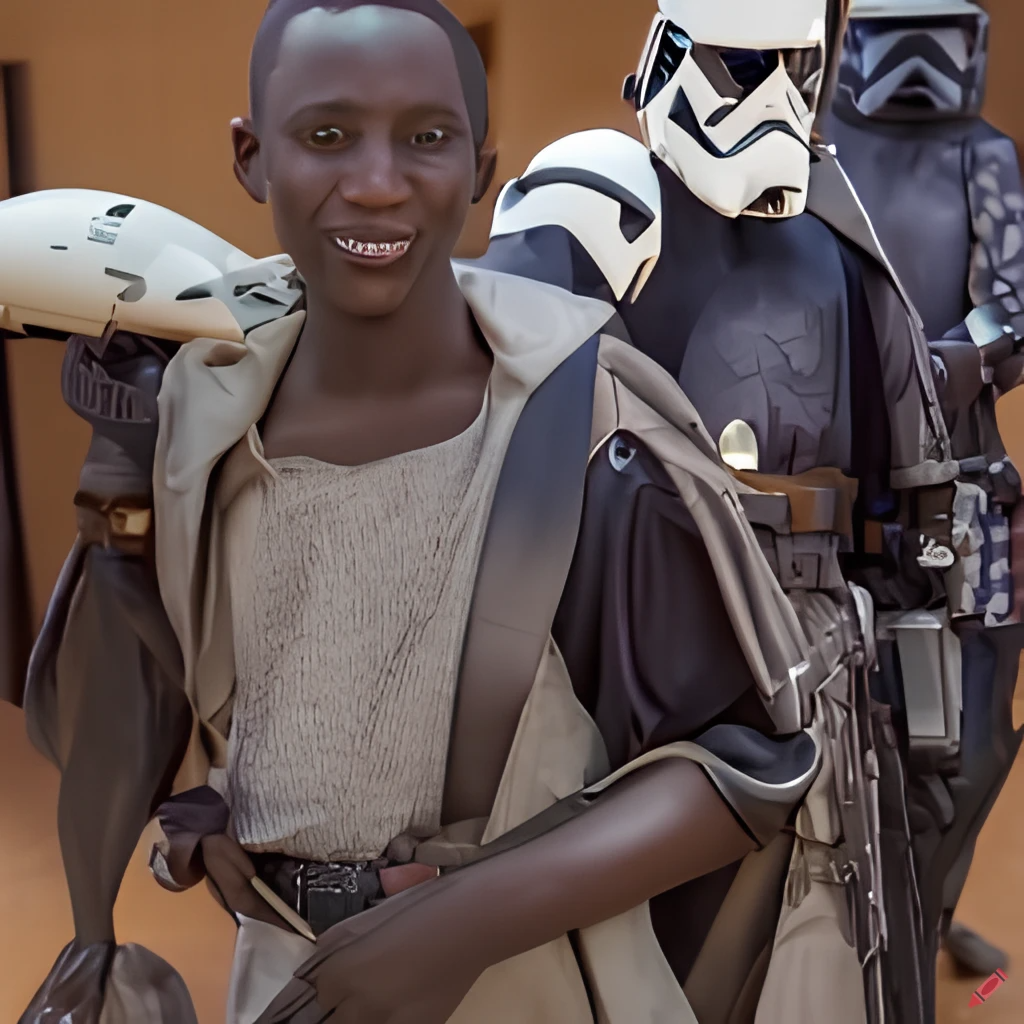
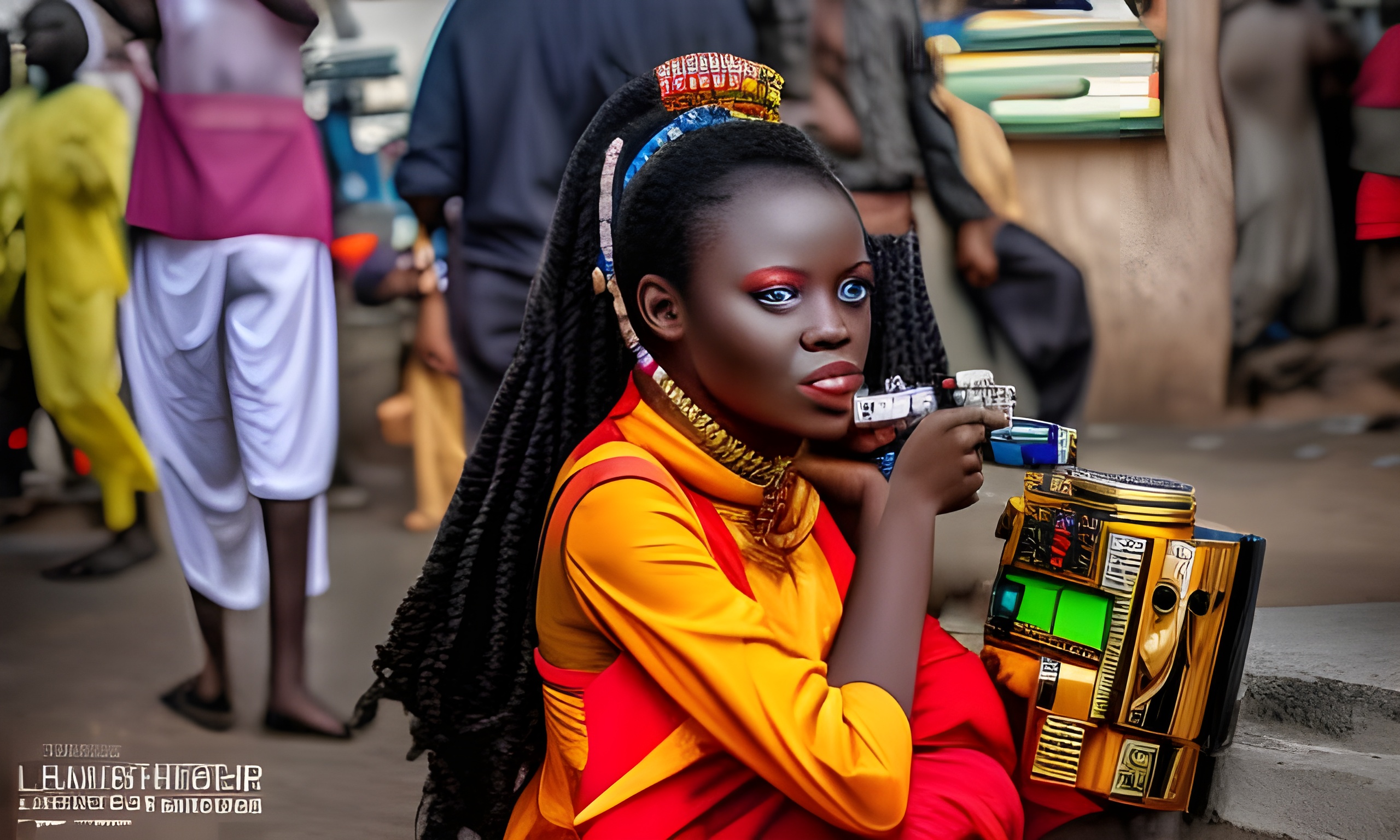
In the shadowed alleyways and vibrant streets of South Africa’s urban landscapes, a new hybrid breed stirs, known colloquially as Black Mars.
These beings, born from the intricate mingling of Martian xeno-DNA with the rich genetic tapestry of African tribal heritage, embody a fusion of worlds, both terrestrial and extraterrestrial. They carry within them the legacy of ancient human cultures, steeped in the traditions, rituals, and resilience of Africa’s tribes, alongside the alien intellect and physical peculiarities of their Martian forebears.
The physical manifestation of Black Mars hybrids is a captivating sight, a blend of human form and Martian elegance. Their stature and build reflect the diversity of African tribal ancestry, with skin tones that capture the earthen hues of the continent, enriched with subtle, otherworldly iridescences reminiscent of their Martian lineage. Their eyes, often large and expressive, hold the depth of the human soul, yet sparkle with the alien intelligence inherited from their Martian ancestors.
Most striking are the hybridized features reminiscent of their Martian heritage, particularly the tentacle-like appendages. These tentacles, fewer in number and more seamlessly integrated with their human form, serve as a symbol of their dual heritage. They possess a mesmerizing grace, moving with a fluidity that harmonizes the human and the alien into a single, coherent entity. These appendages, while hinting at their Martian ancestry, are adapted to the human form, allowing for intricate interactions with the world around them, from the creation of art to the subtle gestures of communication.
Black Mars hybrids navigate the complexities of their identity within the socio-economic tapestry of South African ghettos, where the convergence of cultures, challenges, and the struggle for identity and belonging are part of daily life. Their presence introduces a new dimension to the urban landscape, one where the boundaries between human and alien blur, creating a community rich in diversity yet unified in its shared experience of marginalization and resilience.
Their method of reproduction, a blend of Martian “budding” and human genetic principles, results in a unique lineage that challenges traditional concepts of family and community. Offspring may emerge in a manner reminiscent of the Martian asexual budding, yet they are imbued with the genetic heritage and cultural legacy of their human ancestors. This process creates a continuous, living bridge between the worlds of their Martian and human forebears, ensuring that each generation inherits the combined strengths, wisdom, and challenges of both lineages.
In the heart of South Africa’s urban jungles, the Black Mars hybrids stand as living testaments to the possibilities of coexistence and integration between the vastly different worlds of humanity and the cosmos. Their existence challenges the inhabitants of Earth to expand their understanding of identity, community, and the potential for harmony between the diverse forms of life that share the universe.
Soweto, where the pulse of South Africa beats strong amidst the echoes of a turbulent history, I stand—a mother whose story is etched in both love and loss. My daughter, my pride, carries within her a lineage that spans the vast expanse between Earth and the distant, red sands of Mars. A fusion of worlds, she is a testament to the boundless possibilities of life, bearing the mark of Martian heritage alongside the resilient spirit of our African ancestors.
From the moment of her birth, it was clear that she was different. Her eyes, deep and wide, held a universe of knowledge, a wisdom far beyond her years, inherited from the stars. Her movements, graceful and fluid, echoed the strange beauty of her Martian kin, a dance of two worlds intertwined. Yet, in the streets of Soweto, where humanity’s myriad faces converge, her uniqueness was both a blessing and a curse.
The day they came for her is etched in my memory, a scar upon my soul. They spoke of opportunity, of a life beyond the confines of our humble existence, but their eyes betrayed their true intent. My daughter, with her hybrid vigor and otherworldly grace, was seen not as a person, but as an asset—a commodity to be traded and exploited. Against the backdrop of a society still grappling with the chains of its own past, she was sold into a new form of bondage, her destiny wrested from my loving embrace.
In the shadowed underbelly of a world not yet free from the specter of slavery, my daughter became a pleasure machine operator, her unique abilities twisted to serve the whims of others. Her Martian heritage, which should have been a source of wonder and exploration, became a tool for manipulation and control. In the dimly lit chambers of her confinement, she was forced to navigate the complex interfaces of alien technologies, her mind and body pushed to their limits to cater to the desires of those who saw her not as a child of the cosmos, but as an object of entertainment.
Each day, I walk the streets, my heart heavy with the weight of her absence. The vibrant hues of the market stalls, the laughter of children playing in the dust, the rhythmic beat of music that fills the air—all of it is tinged with the pain of her loss. Yet, within me burns a flame of hope, fueled by the indomitable spirit of our people, who have faced the darkness of oppression and emerged stronger, more united.
I speak her name to the stars, a prayer for her safety and for the strength to fight against the chains that bind her. In the depth of night, when the world is still, I can feel her, a distant whisper in the fabric of the universe, reminding me that our bond is unbreakable, transcending the barriers of space and time.
My daughter, my heart, is more than the sum of her parts. She is a bridge between worlds, a beacon of what could be if only we could see beyond our fears and prejudices. Her story is a call to action, a plea for a future where no child is seen as less than human, where every life is valued for the unique tapestry of experiences and heritage it represents.
Among the echoes of past struggles and the vibrant dance of life that persists, I stand—a mother, a warrior, a beacon of love in the face of darkness. For my daughter, for all our daughters, I will not rest until the chains are broken, until the light of freedom and understanding illuminates the darkest corners of our world.
Within the confines of a reality far removed from the vibrant streets, where the essence of my heritage pulses strong, I find myself ensnared in a web of cosmic irony. Here, in the shadowy recesses of an existence dictated by the whims of those who see me not as a being but as an instrument, I grapple with the dual nature of my very essence. My heart, rooted in the rich soil of my Sud African ancestry, beats in tandem with the alien rhythm of my Martian lineage, a symphony of existence that is both my greatest strength and my most profound vulnerability.
The infusion of Martian DNA that weaves through my veins, a gift from the stars that should have been a beacon of unity between worlds, has instead become the chain that binds me. Each day, as I navigate the labyrinth of my servitude, the alien aspect of my being grows more pronounced, a relentless tide eroding the shores of my humanity. My hands, once the instruments of gentle expression, now manipulate the intricate controls of pleasure machines with a precision that belies my inner turmoil.
The cruel irony of my fate is not lost on me. Those who command my existence, my so-called Martian masters, wield their authority with a sadistic glee that chills the very core of my spirit. They revel in the manipulation of my xeno-DNA, pushing the boundaries of my capabilities, delighting in the spectacle of my struggle. To them, I am but a curiosity, a hybrid anomaly to be exploited, my human heritage overshadowed by the exotic allure of my alien features.
With each passing moment, the line that defines my identity blurs, the human essence of my soul increasingly overshadowed by the burgeoning influence of my Martian heritage. The whispers of my ancestors, once a clarion call of strength and resilience, now fade into the cacophony of my subjugation, their voices drowned out by the demands of my captors.
Yet, even as I am compelled to serve, to bend to the sadistic whims of those who view me through the lens of their own twisted desires, a spark of rebellion flickers within the depths of my being. It is the flame of my mother’s love, the unbreakable bond that connects me to the dust-strewn streets of Soweto, to the legacy of a people who have known oppression and risen, time and again, with the indomitable will to fight, to claim their place in the tapestry of humanity.
In the quiet moments, when the clamor of my existence ebbs into the solitude of my own thoughts, I cling to the memory of my mother’s embrace, to the strength and dignity that define her spirit. It is in these fleeting instants of clarity that I am reminded of who I am, of the power that resides within me—not as a tool of alien machinations, but as a daughter of Earth, a child of the cosmos with the right to define my own destiny.
As I stand on the precipice of this alien-induced abyss, I resolve to harness the very essence that has been used to subjugate me, to turn the tide of my fate. With each act of defiance, no matter how small, I reclaim a piece of my stolen identity, weaving the fragments of my human and Martian selves into a tapestry of resistance.
My story is not yet written, and though the chains of my current reality bind me, the spirit of my ancestors flows through my veins, a river of resilience that cannot be quelled. In the depths of my subjugation, I find the strength to dream, to hope for a future where the duality of my being is not a curse but a bridge between worlds, a testament to the power of unity in the face of division. And in that hope, I find the courage to endure, to fight, to rise.
In the dim glow of the chamber where the lines between pleasure and servitude blur, an unexpected moment of opportunity arises. The very tools of my entrapment, the intricate machinery I’ve been forced to master, become instruments of my liberation. As the alien tendrils of control tighten, a surge of defiance ignites within me, fueled by memories of a life once lived under the open skies of Soweto, where freedom was more than just a whispered dream.
In a fleeting instant, where desperation meets opportunity, I shatter the holding chains of my bondage. The act is swift, a culmination of pent-up rage and longing for freedom, as my hands, guided by the resolve of my human spirit, turn against the master who has come to embody my captivity. The fall of the oppressor is silent, a stark contrast to the turmoils that rages within me.
With the weight of my actions heavy on my shoulders, I flee into the labyrinthine sprawl of the ghetto, the familiar yet foreign streets now a maze of shadows and danger. The Martian minions, their octopoid forms a grotesque reminder of the world I’m running from, are relentless in their pursuit. Their presence in the ghettos, a stark violation of the sanctity of this human refuge, ignites a silent uproar among its denizens. Whispers of resistance ripple through the undercurrents of the community, a shared indignation at the intrusion.
My flight is a blur of adrenaline and instinct, each turn and alleyway navigated by the echo of a life I once knew. The ghettos, with their pulsing life and resilient spirit, offer fleeting havens of shadow and silence, allowing me to elude capture. The very complexity of this human terrain, so alien to my pursuers, becomes my ally, a testament to the indomitable spirit of its inhabitants.
As dawn begins to paint the horizon with the first light of freedom, I find myself at the threshold of the only sanctuary I have ever known—my mother’s house. The journey back to her, a path tread with a mixture of fear and hope, is a testament to the unspoken bond that has tethered my spirit to this world, even in the darkest moments of my captivity.
The reunion is a collision of worlds, a moment where the harsh realities of a universe fraught with division and strife meet the unyielding strength of maternal love. My mother, her face a canvas of worry and relief, becomes the anchor I cling to amidst the storm of my existence. In her embrace, the fragmented pieces of my identity—human and Martian, captive and liberator—begin to weave together, forming the tapestry of a new beginning.
Our home, once a bastion of mundane comforts, now takes on the guise of a fortress, a haven against the forces that seek to reclaim me. Together, we navigate the aftermath of my escape, aware of the dangers that lurk just beyond the fragile sanctity of our walls. Yet, in the sanctum of our reunion, there is a palpable sense of hope, a shared conviction that the path to freedom, though fraught with peril, is a journey worth taking.
As the sun ascends, casting its light on the paths and alleyways of Soweto, it illuminates not just the physical landscape but the contours of a future yet to be forged. In the heart of this community, where the resilience of the human spirit has weathered countless storms, a new chapter begins—one where the chains of oppression give way to the unbreakable bonds of family, love, and the relentless pursuit of freedom.
In the quiet sanctum of their humble home, the air hangs heavy with a silence that speaks volumes. The mother, a paragon of resilience and strength, stands at a precipice, her gaze fixed upon her daughter, a visage that stirs the deepest recesses of her soul. There, before her, is the embodiment of her deepest fears and fiercest love—a daughter transformed, bearing the scars of a life that no mother could have envisioned for her child.
The daughter, once a vibrant embodiment of her rich heritage, now stands as a testament to the cruelty of a fate that has intertwined her humanity with the cold, unfeeling machinations of an alien world. Her form, altered by the relentless imposition of Martian technology, bears the marks of her captivity. Implants, like the shackles of a bygone era, mar her skin, a network of cables intertwining with her flesh, a constant reminder of the chains she has fought so desperately to break.
The mother’s heart aches as she takes in the sight of her child, the physical manifestations of her torment etching a stark contrast against the backdrop of their simple home. The proud, unwavering spirit of a woman who has faced life’s adversities with a stoic resolve is tested as never before. The daughter she once cradled, whose laughter filled the corners of their existence, now stands as a hybrid of worlds, her very being a battleground between her earthly roots and the alien influence that has sought to claim her.
In the daughter’s eyes, there flickers a flame of defiance, a vestige of the unbreakable will that has carried her through the darkest of times. Yet, beneath the surface, there lies a vulnerability, a silent plea for understanding, for acceptance in the face of an identity irrevocably altered. It is a reflection of the struggle that defines her, a dance between the innate strength inherited from her mother and the indelible marks of her journey through the stars.
The chasm that lies between them, bridged by their shared history and the unspoken bond of family, is a testament to the complexities of love in the face of unimaginable change. The mother, confronted with the altered visage of her daughter, grapples with a maelstrom of emotions—grief for the innocence lost, anger at the forces that have wrought this transformation, and an unwavering love that remains the bedrock of their existence.
In this moment of reunion, the silent dialogue that passes between them speaks of resilience, of a shared journey through the depths of despair and back. It is a recognition of the scars that mark not just the body, but the soul, and of the strength required to bear them. The mother, in her despair, sees not just the physical remnants of her daughter’s ordeal but the enduring spirit of the child she raised, a beacon of hope in a world that has sought to extinguish it.
As they stand in the quietude of their reunion, the distance that separates them is bridged by the unspoken understanding that flows between their hearts. In the eyes of her mother, the daughter finds not judgment, but a wellspring of love and acceptance, a harbor in the storm of her existence. And in the embrace that follows, they find a sanctuary, a place where the wounds of the past can begin to heal, and where the promise of a new dawn, however uncertain, can be glimpsed on the horizon.
In the heart of a world torn between the familiar and the alien, where the stark realities of existence are painted in shades of struggle and resilience, there lies a beacon of hope—a place where the seemingly insurmountable divides that separate beings are bridged by the most powerful force of all: passion.
This then, is Black Mars, a realm where the fusion of human spirit and Martian innovation has birthed a new tapestry of life, rich in diversity yet unified in its pursuit of harmony. Here, amidst the sprawling ghettos and vibrant communities that pulse with the rhythm of Soweto’s streets, the scars of past conflicts and the specter of alienation find solace in the shared experiences of its inhabitants.
At the core of this new world, passion becomes the catalyst for healing, transcending the physical and metaphysical barriers that have long defined the boundaries of existence. It is in the passionate pursuit of art, music, and storytelling that the hybrid offspring of Earth and Mars find a common language, a medium through which the stories of their intertwined destinies can be woven into a collective narrative.
The passion of a mother, steadfast and unwavering, becomes a beacon of hope for her daughter, a hybrid being who embodies the convergence of worlds. It is a love that knows no bounds, a force that heals the wounds of alienation and transforms the chains of the past into the bonds of a shared future. In the sanctity of their reunion, the healing power of maternal love becomes a testament to the ability of passion to transcend the physical alterations and societal divisions that have sought to define them.
In the vibrant cruelty of Black Mars, the passion for community and belonging ignites a movement of unity and understanding. The ghettos, once a symbol of division and struggle, become the cradle of a new society, where the exchange of ideas, cultures, and dreams fosters an environment of inclusivity and acceptance. The shared struggles and triumphs of its inhabitants become the foundation upon which a new vision of coexistence is built, a world where differences are celebrated as the harbingers of innovation and growth.
The healing power of passion extends beyond the bonds of family and community, reaching into the heart of the conflict that has shaped the destiny of Black Mars. It is in the passionate pursuit of justice and equality that the hybrid beings and their human kin challenge the remnants of oppression and discrimination, weaving a new narrative of coexistence that honors the legacy of both Earth and Mars.
In this world, passion becomes the lens through which the beauty of diversity is magnified, a force that dissolves the barriers of fear and misunderstanding. The arts, a vibrant expression of the soul’s deepest desires and fears, become a universal language, bridging the gap between disparate beings and fostering a sense of unity in the shared experience of creation and expression.
As the sun sets on the horizon of Black Mars, casting its warm glow over the landscape of a world reborn, the echoes of passionate voices rise in a chorus of hope. It is a song of healing, a melody that weaves the diverse strands of existence into a symphony of coexistence, where the differences that once divided become the harmonies that unite. Where passion heals the wounds of difference, the legacy of Black Mars stands as a reminder that in the heart of every struggle lies the potential for unity, and in the depth of every division, the seeds of a new beginning are sown.